

How do you begin to capture the immense weight of fifty-five thousand lives lost within the shelves of a single library? If you've spent any time searching for RAF bomber command books, you'll know that the sheer volume of titles can feel as vast and daunting as a night operation over the Ruhr. It's a common frustration for serious researchers and hobbyists alike to sift through sensationalist accounts whilst searching for the rigorous, well-researched histories that truly honour the subject's complexity.
We've curated this specialist roundup for 2026 to help you move through this crowded field with the quiet authority of a seasoned collector. You'll discover a balanced selection of foundational texts that define the strategic air war, alongside deeply moving personal memoirs that provide a bottom-up perspective of life on the airfield. We'll guide you through new 2025 publications like Daniel Knowles' Reaping the Whirlwind, whilst also offering advice on locating rare, out-of-print squadron records for technical aircraft research. By the end of this guide, you'll have a clear roadmap for building a library that respects both the historical facts and the human experiences of the men who flew.
Key Takeaways
- Learn to distinguish between command-level strategic studies and narrative histories to ensure your collection has a firm academic foundation.
- Discover the most poignant RAF bomber command books authored by aircrew, providing a rare window into the daily lives and roles of the seven-man crew.
- Explore the practical use of squadron records and technical publications for conducting deep-dive research into family history or specific aircraft operations.
- Master the art of finding rare and out-of-print titles by understanding the role of specialist small presses and the markers of a significant first edition.
- Find out how digital downloads and back-issue magazines can provide immediate access to technical details and archival data whilst building your physical library.
Why RAF Bomber Command Literature Remains Essential
The literature surrounding the strategic air offensive covers a timeline that begins well before the first sorties of September 1939 and extends far beyond the cessation of hostilities in 1945. It's a field of study that encompasses the rapid pre-war expansion, the desperate early years of the "Phoney War", and the eventual devastating power of the Thousand-Bomber raids. For many readers, the enduring interest in RAF bomber command books stems from the deep moral complexities of the campaign. It wasn't just a matter of technical superiority; it was a struggle of endurance and ethical weight that continues to spark debate among historians today.
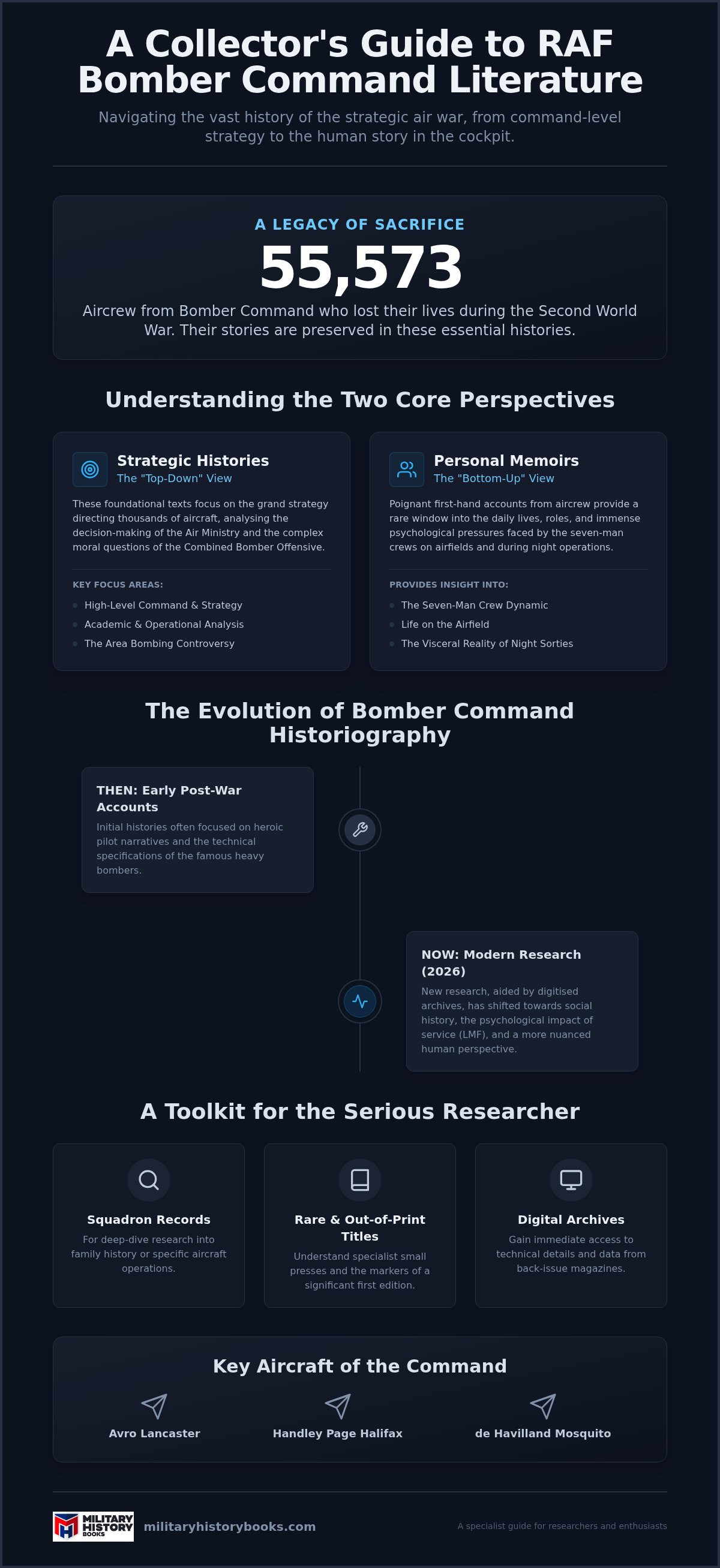
Books serve as a vital archive for the legacy of the 55,573 airmen who never returned. Unlike general aviation books that might focus on the "glamour" of fighter combat, specialist Bomber Command records offer a more sobering, detailed look at the relentless attrition of night operations. This distinction is crucial for serious researchers. Whilst a general history provides context, it's the specialist titles that offer the granular detail needed to understand specific squadron movements or technical aircraft modifications. You can explore a broader overview of the organisational structure through this RAF Bomber Command History resource.
The Evolution of Bomber Command Historiography
Early post-war accounts often focused on the technical specifications of the heavy bombers or the heroic narratives of individual pilots. Modern research has shifted towards a social history approach, examining the psychological impact of "Lack of Moral Fibre" (LMF) and the complex relationships within the seven-man crew. As we move through 2026, this field is expanding rapidly. The ongoing digitisation of national archives means that new research is constantly challenging old assumptions, moving us away from purely technical studies towards a more nuanced human history.
Key Themes to Look for in a Great History Book
When building a collection, look for works that bridge the gap between high-level strategy and the cockpit. A definitive history should analyse the decision-making of the Air Ministry and figures like Sir Arthur Harris, but it must also acknowledge the technological leaps that made their plans possible. The development of the Avro Lancaster, the Handley Page Halifax, and the versatile de Havilland Mosquito changed the course of the war. Most importantly, the best RAF bomber command books capture the visceral reality of the night-time sorties, where crews faced flak, night fighters, and the elements in a terrifying bid to reach their targets.
Definitive Strategic Histories: The "Top-Down" View
To understand the scale of the strategic air offensive, one must look beyond the individual airfield and into the corridors of Whitehall and High Wycombe. The most authoritative RAF bomber command books in this category provide a "top-down" perspective, focusing on the grand strategy that directed thousands of aircraft across the North Sea. These works often contrast narrative-driven storytelling with rigorous academic analysis of the Combined Bomber Offensive. For those seeking a wider lens on the conflict, our guide to aviation history books offers essential context on how these strategic decisions fit into the broader aerial war.
A central challenge for any historian is addressing the moral and strategic controversy of area bombing. Balanced accounts don't shy away from the destruction of German cities, yet they place these events within the desperate context of total war. This nuanced approach is essential for distinguishing between sensationalist writing and serious history. You can find a detailed summary of these campaign phases and the command's development via the Imperial War Museum on Bomber Command.
The Classics of Strategic History
Max Hastings' seminal work, Bomber Command, remains a cornerstone of the genre. It significantly shifted public perception by combining operational history with a frank assessment of the campaign's results. However, serious researchers shouldn't overlook primary sources. Sir Arthur Harris’s own despatches provide an unfiltered look at his philosophy of victory through air power. Modern accounts, such as the 2025 analysis by Daniel Knowles, Reaping the Whirlwind, benefit from decades of declassified intelligence and offer a more objective distance from the events than earlier post-war texts.
Analysing the Air Offensive Strategy
Strategic history often hinges on the fierce internal debates between competing doctrines. Many RAF bomber command books delve into the "Oil Plan" versus the "Transportation Plan", a choice that defined the final years of the war. These texts also explore the friction and cooperation between the RAF and the USAAF 8th Air Force during the debates over daylight versus night bombing. Understanding the role of the Ministry of Economic Warfare is equally vital, as they identified the specific industrial bottlenecks that the bombers were tasked to break. If you're looking to add these foundational texts to your shelves, you can browse our latest arrivals in aviation history to find both modern reprints and rare early editions.
Personal Memoirs and First-Hand Accounts: The Human Story
Whilst strategic overviews provide the framework, the heart of any collection lies in the "bottom-up" history of the seven-man crew. The most evocative RAF bomber command books are those that transport the reader into the cramped, oil-scented interior of a heavy bomber at twenty thousand feet. It's here that the narrative shifts from the politics of the Air Ministry to the visceral reality of the "tour of operations". With a survival rate that hovered around 4%, every page of these memoirs carries a profound weight. You'll find a vast array of these individual life stories in our selection of military biography books, which provide the personal context that strategic studies often miss.
Essential Aircrew Memoirs
The diversity of roles within the aircraft meant that every man had a unique perspective on the war. Pilots carried the burden of command, whilst navigators and bomb aimers worked under intense pressure in the nose of the aircraft. For a truly immersive experience, look for accounts from the "Tail-End Charlies"; these were the rear gunners who sat in isolated, freezing turrets for hours on end. Memoirs from the elite Pathfinder force offer a different angle, detailing the high-stakes task of marking targets under heavy fire. Many airmen ended their war in captivity, and Prisoner of War (POW) narratives provide essential insights into the resilience of those shot down over enemy territory.
The Ground Crew and the Home Front
A complete library must also acknowledge the thousands who never left the ground. The "Boffins", the scientists who developed vital radar and navigation aids, played a role just as critical as the aircrews. Similarly, the work of the Women's Auxiliary Air Force (WAAF) in operations rooms and signals centres was indispensable. Life on the airfields of "Bomber County" (Lincolnshire) created a unique atmosphere of tension and camaraderie that defines many of the RAF bomber command books focusing on the Home Front. For those interested in how these roles evolved during earlier crises, the RAF Museum: Bomber Command's Role during the Battle of Britain is an excellent resource for understanding the command's early operational shifts.
Technical Publications and Squadron Records for Researchers
For many enthusiasts, the interest in RAF bomber command books evolves from casual reading into a forensic investigation of the past. Technical publications and archival records are the primary tools for this work, offering a level of granularity that narrative histories often overlook. Whether you're a modeller seeking the exact camouflage pattern of a 1943 Lancaster or a researcher piecing together a family member's service history, these specialist documents provide the evidence needed to build an accurate picture. To supplement these records, many collectors turn to back issue military magazines UK, which often contain contemporary aircraft reviews and rare photographs not found in standard volumes.
Tracing a Relative in Bomber Command
Tracing the service of an individual airman requires a methodical approach. It's a journey that typically involves three distinct stages of research:
- Step 1: Start by identifying the specific squadron and aircraft type through official service records. This provides the foundation for all subsequent searches.
- Step 2: Cross-reference this information with squadron loss registers and mission logs. Works such as W.R. Chorley's Bomber Command Losses series, which is currently being reprinted with volumes covering 1937 to 1943, are indispensable for this task.
- Step 3: Locate technical data on the specific airframes involved. Operational Record Books (ORBs) will often list the individual aircraft letters and serial numbers for every sortie flown.
Specialist Technical Reference Works
For those focused on the machines themselves, technical reference works are essential. "Profile" books, such as the 550 Squadron Profile published in 2025, offer deep dives into the markings and modifications of specific units. These are particularly valuable for aviation modellers who require precise technical drawings and colour guides to ensure historical accuracy. We've seen a significant shift towards digital military history books in recent years. These formats allow researchers to zoom into high-resolution technical diagrams and schematics that might be cramped or illegible in a standard paperback.
The value of these records lies in their ability to strip away the fog of time, providing a clear, data-driven view of the strategic air war. If you're looking for specific technical manuals or out-of-print squadron histories to complete your research, you can explore our archive of rare aviation titles to find the exact records you need. Building a library of RAF bomber command books is as much about preserving these technical truths as it is about honouring the stories of the men who flew.
Sourcing Rare and Out-of-Print Bomber Command Titles
Finding the perfect addition to a collection often requires more than a simple search on a general marketplace. Many of the most significant RAF bomber command books were originally produced by small, specialist presses or even by the squadrons themselves in very limited numbers. These niche publications often contain the most granular detail on specific operations, yet their small print runs mean they are frequently out of print and difficult to track down. To understand how these specific aerial campaigns fit into the wider British experience, it's helpful to consult wartime history books UK for a broader national perspective.
When you're scouting for rare titles, pay close attention to the condition of the dust jacket and the presence of an author's signature. Signed copies, particularly those by aircrew or notable historians, significantly enhance a volume's historical value. Identifying a true first edition requires an eye for detail, such as checking the printing history on the copyright page. This is where the reliability of a specialist dealer becomes clear. Unlike general marketplaces where descriptions can be vague or prices inflated, a specialist verifies the rarity and physical condition of every volume before it reaches your shelf.
The Value of Specialist Curation
Managing a collection of over 10,000 titles requires a deep-seated understanding of the subject matter. Our archive is curated with the expert eye of an RAF veteran, ensuring that every title we stock meets a high standard of historical accuracy. We source rare titles from private collections and archives that general retailers simply cannot access. Whilst physical books remain the gold standard for many collectors, our digital downloads offer a cost-effective and immediate alternative for researchers who need access to rare technical data or out-of-print records without delay.
Building Your Own Aviation Library
If you're just beginning your journey, it's wise to prioritise foundational, strategic texts before moving into the highly specialised world of niche squadron histories. This provides the necessary context to appreciate the smaller, more detailed accounts of individual crews. Once you've acquired rare hardbacks, preservation is key. Keep them away from direct sunlight and avoid tightly packing shelves, which can damage the spines of fragile paperbacks. To find your next foundational text or a rare personal memoir, explore our specialist collection of RAF history books today.
Building Your Authoritative Aviation Archive
Assembling a collection that truly honours the legacy of those who served requires a thoughtful approach to selection. You've seen how balancing definitive strategic histories with the intimate, lived experiences of aircrew creates a more complete picture of the conflict. By incorporating technical squadron records whilst hunting for out-of-print memoirs, you move beyond surface-level narratives into the realm of serious historical research. Every volume added to your shelf serves as a vital preservation of the technical truths and human endurance that defined the strategic air offensive.
Finding the right RAF bomber command books shouldn't be a matter of chance or inflated marketplace prices. Our archive is independently owned and operated by an RAF veteran who understands the historical weight and precision required for every volume. With over 10,000 specialist titles in stock and secure international delivery for collectors worldwide, we provide the steady, reliable support you need to expand your library with confidence. Whether you're a dedicated researcher or a family historian, the right book is an essential bridge to a past that must never be forgotten.
Browse our full collection of specialist RAF history books and begin building your definitive archive today.
Frequently Asked Questions
What is the best book for a beginner interested in RAF Bomber Command?
Max Hastings' Bomber Command is widely considered the definitive starting point for those new to the subject. It provides a balanced narrative that connects high-level strategy with the visceral experiences of the aircrews. For a more recent perspective, Marcus Gibson's 2025 title, The Greatest Force, offers an excellent modern analysis of the command's role in the total defeat of Nazi Germany.
How can I find out which squadron my relative served in?
You should begin by requesting the individual's official service record from the Ministry of Defence to confirm their unit details. Once you have the squadron number, you can cross-reference this information with Operational Record Books (ORBs) or loss registers. These RAF bomber command books, such as the Bomber Command Losses series, are essential for identifying specific missions and the airframe serial numbers involved in their service.
Are there books specifically about the Dam Busters raid?
Yes, the 1943 raid on the Ruhr dams is one of the most extensively documented operations in aviation history. Paul Brickhill's The Dam Busters remains the classic narrative account, whilst James Holland's more recent research provides a detailed look at the technical challenges of the "bouncing bomb". We stock both these foundational texts and more niche studies of 617 Squadron's later precision bombing operations.
What are Pathfinders, and which books cover them best?
The Pathfinders were an elite force tasked with marking targets with precision flares to guide the main bomber stream. For a primary source, Pathfinder by Air Vice-Marshal Don Bennett, the force's founder, is indispensable. Modern works by authors like Sean Feast also provide excellent insights into the specialised navigation aids and high-pressure tactics used by these target-marking crews.
Where can I find technical manuals for the Avro Lancaster?
Technical data is best sourced from original Air Ministry Air Publications (APs) or specialised reference guides for modellers. The Avro Lancaster Manual provides a solid overview of the aircraft's systems and construction. For deeper research, we offer digital downloads of technical schematics that allow you to examine high-resolution details of the airframe, engines, and turret mechanisms.
Why are some Bomber Command books so difficult to find in print?
Many of the most accurate squadron histories were produced by small, independent publishers in limited print runs that are no longer commercially viable for large houses. These titles often contain specific data that isn't found in mainstream publications, making them highly collectible. We specialise in sourcing these rare out-of-print titles from private collections to ensure they remains available to serious researchers.
Are digital military history books as accurate as physical copies?
Digital titles are typically direct high-resolution scans of original physical documents, ensuring they maintain total historical accuracy. They are particularly useful for technical research, as they allow you to zoom into intricate diagrams or handwritten mission logs that might be difficult to read in a standard paperback. This format provides immediate access to archival data whilst preserving the integrity of the original source.
Do you stock books on the German perspective of the air war (Night Fighters)?
We do stock titles that examine the Luftwaffe's night fighter force, the Nachtjagd, to provide a complete view of the aerial conflict. Historians like Martin Middlebrook often incorporate the German perspective to illustrate the "electronic war" between British radar and German interception systems. Understanding the tactics of the opposing side is vital for anyone building a comprehensive library of RAF bomber command books.


