

The most decisive factor on the modern battlefield isn't the infantryman's rifle or the tank's armour, but the devastating, calculated power of indirect fire. If you've ever felt that generalist volumes gloss over the essential details of ordnance evolution, you aren't alone. Many enthusiasts find that standard accounts lack the depth required to truly understand how a specific battery functioned or why a particular shell was chosen. Building a collection of artillery history books requires a discerning eye, as the field ranges from dense nineteenth-century drill books to modern tactical analyses of the world's greatest bombardments.
We understand the challenge of finding technical manuals that are often as rare as the guns they describe. This guide provides a clear path through the vast literature of the 'King of Battle', ensuring you can distinguish between different eras of ordnance with confidence. You'll learn how to identify authoritative sources on specific gun types and trace the fascinating evolution of ballistics through the centuries. We also highlight the best ways to uncover rare, out-of-print memoirs that offer a first-hand look at life on the gun line, helping you curate a library that is both technically sound and historically profound.
Key Takeaways
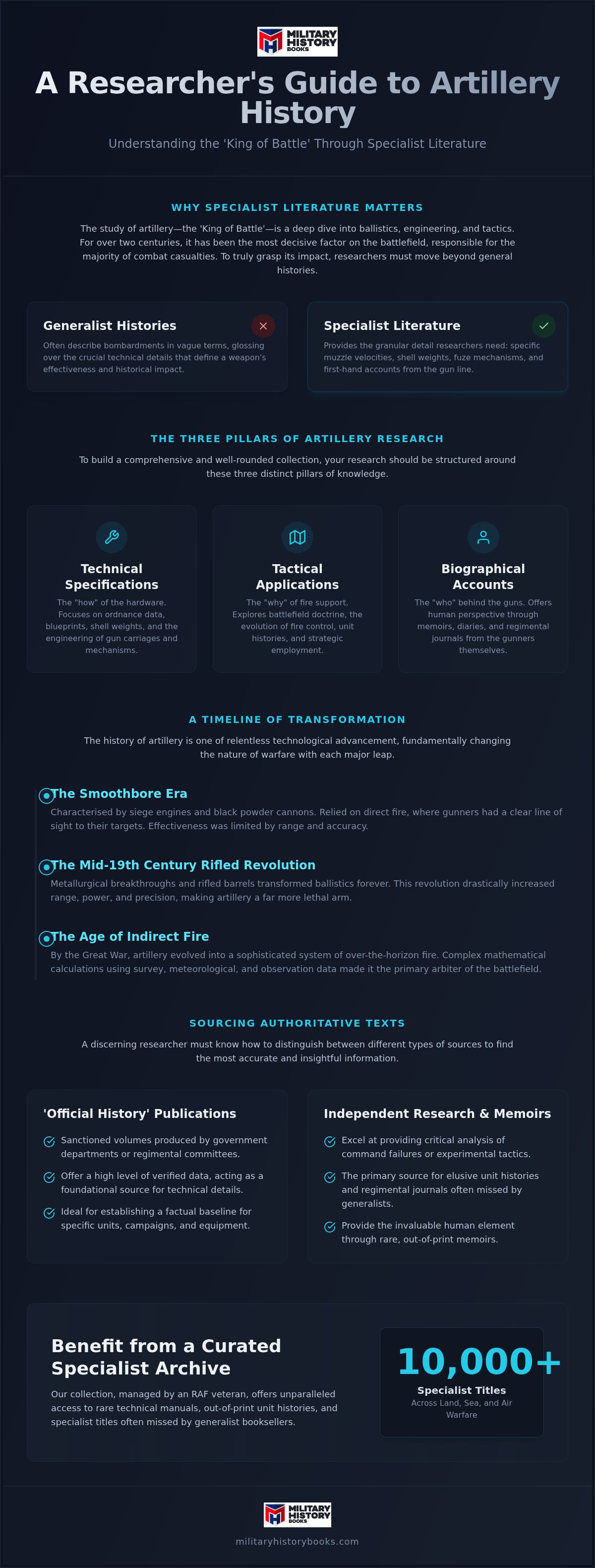
- Learn to categorise your research into technical, tactical, and biographical pillars to ensure a well-rounded understanding of the 'King of Battle'.
- Trace the evolution of fire support from the siege engines of the smoothbore era to the mid-19th century rifled revolution that transformed ballistics forever.
- Master the art of sourcing rare and out-of-print artillery history books, focusing on elusive unit histories and regimental journals often missed by generalists.
- Discover how to distinguish between 'Official History' publications and independent research to find the most authoritative data for your specific area of interest.
- Benefit from a curated archive managed by an RAF veteran, offering access to over 10,000 specialist titles across land, sea, and air warfare.
The King of Battle: Why Artillery History Books are Essential for Researchers
The study of artillery is far more than a simple catalogue of weaponry. It encompasses the rigorous science of ballistics, the evolving engineering of ordnance, and the tactical application of fire support across varied terrain. Within the pages of artillery history books, researchers find the narrative of how industrial capacity and scientific innovation merged to dominate the modern battlefield. The moniker 'King of Battle' isn't merely a decorative title; it reflects the reality that for over two centuries, artillery has been responsible for the vast majority of combat casualties. Whilst infantry may occupy territory, it's the guns that facilitate their movement by suppressing and destroying the enemy. This dominance is a recurring theme in military strategy books, where the concentration of fire is often cited as the pivot point of victory.
For technical researchers and scale modellers, these books provide the essential blueprints and specific ordnance data required for historical accuracy. Understanding the weight of a shell or the precise layout of a carriage is often the difference between a superficial understanding and true expertise. Our curated archive focuses on these details, providing a bridge between the broad strokes of history and the exacting requirements of the specialist.
The Role of Artillery in Shaping Modern Warfare
Artillery transitioned from a secondary support arm to the primary arbiter of conflict during the late 19th century. This shift was driven by the move from direct fire, where gunners could see their targets, to the complex mathematical calculations of indirect fire. By the time of the Great War, the 'Grand Battery' of the Napoleonic era had evolved into a sophisticated system of survey and meteorological data. Understanding this technical leap is vital for anyone reading army history books, as the story of any modern regiment is inextricably linked to the fire support that shielded it. The ability to reach over the horizon changed how armies dug in, how they moved, and how they survived.
Why Specialist Literature Outperforms General Histories
General history volumes often describe a bombardment in vague terms, yet specialist artillery history books offer the granular detail that serious researchers crave. They provide specific muzzle velocities, shell weights, and fuzing mechanisms that defined a weapon's effectiveness. The History of Cannons reveals how metallurgical breakthroughs allowed for lighter, more powerful barrels, a journey that generalists frequently overlook. Beyond the technical, specialist literature includes the memoirs of the gunners themselves. These accounts offer a unique perspective from behind the front lines, detailing the gruelling physical labour and mathematical precision required to keep the guns firing whilst under counter-battery pressure. Accurate diagrams and technical plates found in these specialist archives remain the gold standard for preserving our military heritage.
Navigating the Archive: Categorising Types of Artillery Literature
Building a comprehensive library requires more than just picking titles at random. To truly master the subject, one must categorise the archive into three distinct pillars: technical specifications, tactical applications, and biographical accounts. Whilst biographical memoirs offer the human element, a researcher's foundation often rests on 'Official History' publications. These sanctioned volumes, often produced by government departments or regimental committees, provide a level of verified data that independent research sometimes lacks. However, independent artillery history books often excel at providing critical analysis of command failures or experimental tactics that official accounts might gloss over. Accessing these rare insights is becoming easier through digital titles, which preserve the contents of fragile, out-of-print technical manuals for a new generation of scholars. This categorisation ensures that your collection remains balanced between the 'how' of the hardware and the 'why' of the strategy.
For a broad overview of this evolution, the classic text Artillery Through the Ages provides an excellent starting point for understanding how these categories developed over centuries. Beyond the guns themselves, successful fire support relies on the often-overlooked details of logistics and supply, a theme frequently explored in wider military history books that focus on the 'tail' rather than just the 'teeth' of an army. Without the constant flow of ammunition and the maintenance of transport lines, even the most advanced battery remains silent.
Technical Manuals and Ordnance Specifications
Serious researchers prioritise 'Range Tables' and 'Drill Books' because they define the physical limitations of the era's weaponry. Technical drawings and ballistics tables reveal the intricate physics of shell flight, barrel wear, and recoil systems. These documents were never intended for public consumption, which makes surviving out-of-print technical manuals highly sought after by collectors. They offer a level of precision that generalist histories simply cannot match. If you are searching for a specific manual to complete your research, our collection of rare and out-of-print titles often contains the exact specifications needed for authentic historical preservation.
Tactical Histories and Battle Accounts
Tactical literature examines the shift from massed Napoleonic 'Grand Battery' fire to the sophisticated science of modern counter-battery work. These books analyse how commanders suppressed enemy positions whilst protecting their own assets from return fire. This evolution is particularly evident in WW1 trench warfare books, where the development of the creeping barrage and sound-ranging techniques revolutionised the Western Front. By studying these accounts, one can see how artillery dictated the pace of the entire conflict, transforming a static stalemate into a war of movement through the sheer weight of industrialised fire.
From Black Powder to Precision: Essential Eras in Artillery History
The history of the gun is a journey from the crude, cast-iron tubes of the medieval era to the computer-controlled precision of the modern age. To understand the full scope of this development, researchers must look beyond the twentieth century. The Era of Smoothbores, defined by black powder and siege warfare, reached its tactical zenith with the Napoleonic 'Grand Battery'. During this period, the weight of metal was the primary concern, a concept detailed in many foundational artillery history books. However, the mid-19th century brought the Rifled Revolution, which introduced rifling and breech-loading mechanisms. These innovations changed ballistics forever, allowing for greater range and accuracy that rendered masonry fortifications obsolete.
For those interested in how these technical leaps influenced military doctrine, King of Battle: A Branch History provides a comprehensive look at the institutional changes that accompanied the hardware. The transition continued through the late Victorian era, setting the stage for the massive industrialised fire of the Great War and eventually the Missile Age, where conventional shells were joined by precision-guided munitions. This progression shows that whilst the tools have changed, the fundamental requirement for suppressive fire remains constant.
The Industrialisation of the Great War
The First World War remains the most prolific era for artillery literature due to the sheer scale of the conflict. It was here that the 'Creeping Barrage' was perfected, a tactic where infantry moved forward under a moving curtain of fire. Tactical books of the period meticulously document the coordination required between the gun lines and the front-line units. Key titles in this field focus on the iconic British 18-pounder and the legendary French 75, weapons that defined the standard of field artillery for decades. These volumes provide the technical drawings and firing tables that explain how batteries maintained such a high rate of accurate fire amidst the chaos of the Western Front.
Second World War and the Rise of Self-Propelled Guns
By 1939, the need for mobility forced a rethink of traditional towed artillery. The rise of self-propelled guns allowed batteries to keep pace with rapid mechanised advances, a development closely tracked in artillery history books and literature focusing on tanks and armoured vehicles. This era also highlights the vital role of the Forward Observation Officer (FOO). Combat memoirs from these officers provide a visceral look at the dangers of spotting for the guns whilst under fire. They offer a human counterpoint to the technical data, explaining how fire control shifted from static maps to dynamic, radio-directed support on the move.
The Hunt for Rarities: Sourcing Out-of-Print Artillery Titles
Finding high-quality artillery history books often feels like a tactical exercise in its own right. Many of the most definitive references were produced in limited quantities for professional military circles, meaning they never saw wide commercial distribution. Unit histories and regimental journals, particularly those concerning the Royal Artillery, are prized for their granular detail on specific battery deployments and casualty lists. These volumes were often printed specifically for veterans and families; they rarely appear in generalist bookshops. Sourcing them requires a specialist approach. Our RAF veteran-managed archive holds over 10,000 titles, providing the expert curation needed to identify these elusive works and the specific technical data they contain.
When assessing a potential acquisition, the condition of the maps and technical plates is paramount. Artillery literature frequently includes fold-out diagrams of firing arcs or gun mechanisms. If these are missing or torn, the book's value to a researcher drops significantly. We pride ourselves on accurately describing the state of our rare and out-of-print titles, ensuring you know exactly what is entering your collection before it arrives. This level of detail is why a specialist bookseller with veteran-led expertise is an invaluable ally for the serious collector.
Identifying Rare First Editions
A genuine first edition in military literature is often distinguished by its specific technical data or a limited print run from a regimental press. For artillery enthusiasts, look for works published immediately following a conflict. These often contain the most authentic, unfiltered tactical accounts. The presence of an original dust jacket can double or even triple the market value of a volume. Maps are equally critical; a complete set of 'as-issued' maps is the hallmark of a well-preserved volume and a key indicator of its historical integrity.
The Role of Digital Downloads for Rare Content
Fragile technical manuals from the nineteenth century don't always survive the rigours of time and frequent handling. Digital titles, available via download or on disc, offer a practical solution for researchers who need the data without the risk of damaging a physical artefact. This format allows you to access prohibitively expensive out-of-print titles at a fraction of the cost of a physical first edition. Building a digital reference library alongside your physical collection ensures that the most delicate ordnance specifications remain accessible for daily use whilst the physical rarities stay protected on the shelf.
Curating Your Collection with Military History Books
Building a library that reflects the true weight of military history requires more than a casual search through generalist retailers. It demands a partnership with a curator who understands the difference between a broad overview and a definitive technical manual. Our inventory of over 10,000 titles is specifically tailored to meet these exacting standards. Managed by an RAF veteran, our selection process prioritises accuracy and depth, ensuring that every volume on our shelves offers genuine value to the serious researcher. Whether you are looking for contemporary tactical analyses or artillery history books that delve into the minutiae of Victorian ordnance, our collection serves as a comprehensive archive for the dedicated enthusiast.
We recognise that our community is global. Because of this, we've refined our commitment to secure international delivery, ensuring that rare and fragile volumes reach researchers across the world in pristine condition. Our service goes beyond simple transactions; we offer a personalised approach to help you track down that elusive out-of-print title that has escaped your collection for years. This dedication to the niche reflects our deep-seated passion for the subject matter and our respect for the historical record.
A Specialist Inventory for Land Warfare Enthusiasts
Our curated approach allows us to maintain a breadth of stock that generalist high-street retailers simply cannot match. Whilst a standard bookshop might carry a handful of popular histories, we specialise in technical publications that cover the full spectrum of fire support. Our range spans from 18th-century siege craft and the dawn of black powder weaponry to the sophisticated, computer-driven systems of the modern era. By focusing on land warfare with such precision, we ensure that you can find the specific data points or biographical accounts required to complete your research project or modelling assignment.
Expert Guidance for Your Next Purchase
Choosing your next addition becomes a far simpler process when you can draw upon professional military expertise. We understand the nuances of different service branches and the specific requirements of academic researchers. If you are struggling to find a particular technical work or a rare regimental memoir, our team is ready to assist with specialist knowledge that only comes from years of immersion in the field. We take pride in being a bridge between the past and the modern enthusiast, prioritising the quality of the material and the satisfaction of our fellow historians above all else.
Explore our full range of artillery and land warfare books today and discover the definitive resources your library deserves.
Advancing Your Research into the King of Battle
Understanding the 'King of Battle' requires a library that bridges the gap between raw ballistics data and the lived experiences of the gunners. We've explored how categorising your archive into technical, tactical, and biographical pillars ensures a comprehensive view of ordnance evolution. From the heavy siege guns of the Napoleonic era to the mechanised batteries of the twentieth century, the right artillery history books provide the clarity needed to interpret complex battlefield manoeuvres. Identifying rare unit histories and technical manuals remains essential for any researcher seeking the granular details of historical fire support.
Finding these elusive titles shouldn't be a struggle. Our RAF veteran-managed shop offers over 10,000 specialist titles, including the rare technical manuals and regimental journals that generalists often overlook. With secure global delivery, we ensure these vital records reach collectors and researchers wherever they are stationed. Whether you are a dedicated scale modeller or a professional historian, the depth of our archive is designed to support your passion for preservation and technical accuracy.
Browse our specialist collection of artillery and land warfare books
We look forward to helping you find the next cornerstone for your collection.
Frequently Asked Questions
What are considered the most authoritative artillery history books?
Authoritative works include official regimental histories and technical volumes by established experts like Ian Hogg, Chris Bellamy, or John Norris. These artillery history books are prized for their reliance on primary source data and verified ordnance specifications. For researchers focusing on the British perspective, the 'History of the Royal Regiment of Artillery' series remains the gold standard for accuracy and tactical depth.
Where can I find technical manuals for vintage artillery pieces?
Technical manuals are best sourced through specialist booksellers who focus on rare and out-of-print land warfare literature. We maintain an inventory of over 10,000 titles, which often includes original drill books and range tables that generalist shops don't carry. These documents provide the precise mechanical details and ballistics data essential for serious historical preservation or restoration projects.
Why is Ian Hogg considered a key author for artillery literature?
Ian Hogg's status as a Master Gunner in the British Army gave him a unique, practical understanding of ordnance that is evident in his writing. His work is essential because it bridges the gap between complex engineering and tactical usage on the battlefield. Hogg's prolific output covers everything from small arms to heavy siege guns, making his books a primary reference for technical data.
Are there artillery books specifically for scale modellers?
Yes, many artillery history books are specifically curated with scale modellers in mind, featuring detailed technical drawings and camouflage plates. We also stock modelling magazines that focus on the construction and weathering of specific artillery pieces. These publications provide the close-up photography and structural diagrams required for creating an authentic scale representation of historical ordnance.
How do I find out-of-print Royal Artillery regimental histories?
Finding out-of-print Royal Artillery regimental histories usually requires searching the secondary market or specialist veteran-managed archives. These volumes were often produced in limited runs for unit members, making them rare finds today. Our expertise in sourcing out-of-print military literature allows us to help researchers track down these elusive records of battery deployments and individual service history.
What is the difference between a 'gun' and a 'howitzer' in historical literature?
In historical literature, a 'gun' typically refers to a long-barrelled weapon designed for a flat trajectory and high muzzle velocity. Conversely, a 'howitzer' has a shorter barrel and is designed to fire shells at a higher arc to reach targets behind cover. Understanding this distinction is crucial when interpreting tactical accounts of siege warfare or indirect fire support in the twentieth century.
Can I buy digital versions of rare artillery books?
You can purchase digital versions of many rare titles, which are available as downloads or on disc. This format is particularly useful for accessing fragile technical manuals or prohibitively expensive out-of-print books. Digital titles allow you to zoom in on complex ordnance diagrams without risking damage to a physical first edition, making them a practical choice for daily research.
Do you offer international shipping for heavy military history volumes?
We provide secure international delivery for all our volumes, regardless of their weight or destination. We understand that heavy artillery references and large-format technical books require robust packaging to survive global transit. Every order is handled with care to ensure your research material arrives in the same condition it left our archive, supporting collectors and researchers across the globe.


