

A digital archive can never truly replace the tactile precision of a physical technical drawing found in a vintage periodical. You’ve likely experienced the frustration of zooming into a scanned schematic only to find a blur of pixels where a clear rivet line should be. It's a common struggle for dedicated enthusiasts who know that naval history magazines are the lifeblood of accurate maritime research and scale modelling. High-street retailers rarely stock these specialist titles anymore, leaving collectors to scour the corners of the internet for reliable information.
We understand that building a comprehensive library requires more than just a cursory search; it demands access to rare, out-of-print editions that preserve history in high fidelity. Finding these gems isn't always easy. This guide will help you discover the most reputable naval journals available today and provide a roadmap for sourcing elusive back issues that digital databases often overlook. We'll examine the unique value of different publication formats and reveal how to find a curated archive of maritime literature to support your next research or modelling project.
Key Takeaways
- Discover how specialised periodicals provide unique contemporary perspectives and technical depth that general maritime books often lack.
- Identify the gold-standard publications like Warship and Naval History (USNI) to build a robust and reliable research library.
- Evaluate the benefits of physical back issues versus digital downloads to determine which format best suits your research or modelling workflow.
- Learn how to integrate naval history magazines with your existing book collection to ensure absolute accuracy in technical projects.
- Gain practical advice on sourcing rare and out-of-print titles through specialist retailers rather than relying on inconsistent general auction sites.
Why Naval History Magazines Are Essential for Serious Research
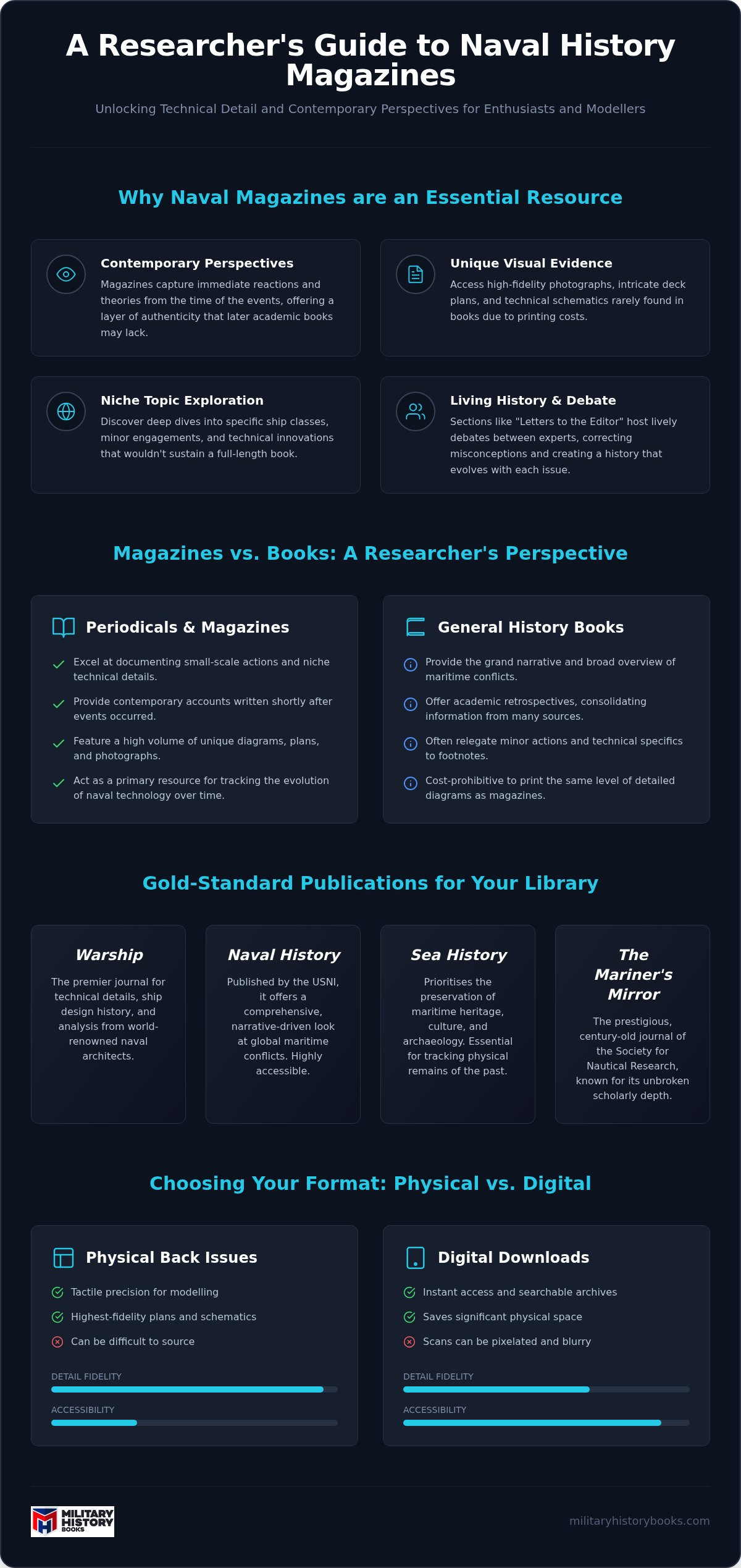
Whilst books often provide the grand narrative of maritime conflict, naval history magazines serve a distinct and vital role in the preservation of technical and personal detail. These periodicals frequently offer contemporary perspectives written shortly after historical events occurred, capturing the immediate reactions and theories of the time. This proximity to the source material provides a layer of authenticity that later academic retrospectives might accidentally polish away. For the serious researcher, these journals bridge the gap between dense academic papers and broad general interest books, offering a level of specificity that is hard to find elsewhere.
These publications are particularly valuable for their visual evidence. High-quality photographs, intricate deck plans, and technical schematics are often unique to periodicals. The cost of printing such detailed diagrams in a standard book can be prohibitive, but magazines dedicate the necessary space to these vital resources. Beyond the steel and steam, they preserve the human element of naval warfare through published letters, diaries, and memoirs. These accounts provide a window into the daily lives of those who served, capturing the vernacular and social nuances of a specific era that a purely technical manual would miss.
The Advantage of Periodical Literature
The frequency of publication allows editors to explore niche topics that would never sustain a full-length book. You might find a twelve-page deep dive into a specific class of Victorian gunboat or a detailed analysis of a forgotten minor engagement in the Baltic. Expert columns and peer-reviewed articles within these pages ensure a high standard of historical accuracy. They act as a primary resource for tracking the evolution of naval technology and strategy as it happened. By reading a series of naval history magazines published over a decade, you can witness the transition from sail to steam or ironclads to dreadnoughts through the eyes of the engineers and officers who lived through those changes.
Magazines vs. Books: A Researcher’s Perspective
Magazines excel at documenting small-scale naval actions and skirmishes that are often relegated to a single footnote in larger volumes. One of the most useful features for a historian is the "Letters to the Editor" section. These columns often host lively debates between experts, correcting historical misconceptions or providing additional context to previous articles. These interactions create a living history that evolves with each issue. Additionally, collectors often use bibliographies in back issues to identify out of print military books that were considered essential reading at the time of publication. This cross-referencing creates a more complete picture of the maritime past, ensuring your research is built on a foundation of diverse and verified sources.
Essential Naval History Publications for Your Library
Building a definitive maritime library requires a discerning eye for quality. Whilst numerous periodicals cover the waves, a select group of naval history magazines has earned a reputation for peerless accuracy and depth. These titles form the backbone of serious research, providing the technical and narrative context that general histories often lack.
For those interested in the intricacies of ship construction, Warship remains the gold standard. It focuses heavily on technical details and ship design history, often featuring articles from world-renowned naval architects and historians. In contrast, Naval History, published by the USNI, offers a comprehensive look at global maritime conflict with a slightly more accessible, narrative-driven approach. Sea History takes a different tack, prioritising the preservation of maritime heritage and archaeology, making it indispensable for those tracking the physical remains of the past. Finally, The Mariner’s Mirror stands as the prestigious journal of the Society for Nautical Research, offering scholarly depth that has remained unbroken for over a century.
Technical and Modelling Focused Titles
For the scale modeller, certain publications are more than just reading material; they are vital tools. These journals provide essential scale drawings, detailed deck plans, and accurate camouflage schemes that are rarely found in digital archives. You'll find that modelling magazines military enthusiasts often collect work in tandem with naval research titles to ensure every rivet and bulkhead is correctly placed. Whether your interest lies in the complex rigging of the Age of Sail or the sleek, radar-absorbent angles of the Cold War, identifying titles that specialise in these specific eras is key to achieving historical authenticity in your projects.
Narrative and Biographical Journals
History is fundamentally about people, and several journals excel at bringing the lives of sailors and famous admirals to the fore. These publications often serve as a starting point for deeper investigation, frequently referencing military biography books that provide a more exhaustive look at a specific figure's career. Journals that cover the Royal Navy’s national heritage are particularly important for UK collectors, as they often feature memoirs and letters that have never been published elsewhere. If you are searching for a specific issue to complete your set or need a particular technical reference, you can browse our extensive range of maritime back issues to find exactly what your archive is missing.
Choosing the Right Format: Physical Back Issues vs. Digital Downloads
Deciding between physical copies and digital versions of naval history magazines depends on your specific goals. For many enthusiasts, the choice isn't mutually exclusive. A physical issue provides a tactile connection to the past that a screen cannot replicate. It allows you to flip through pages and view large-scale technical drawings without the frustration of digital artifacts or low-resolution scans. However, digital formats offer undeniable efficiency for those conducting broad thematic research where speed is a priority.
The Collector’s Choice: Physical Back Issues
Collectors often prioritise physical copies because they preserve the highest level of visual detail. Technical diagrams and camouflage schemes, which are essential for modellers, are far clearer in print than in many compressed digital formats. Digital compression can sometimes obscure fine lines or subtle colour gradients that are vital for historical accuracy. There's also the element of investment. Rare, first-run naval magazines can appreciate in value, especially if they're kept in excellent condition. When sourcing back issue military magazines UK collectors should look for specialist retailers who understand the importance of grading and condition.
Preservation is vital for maintaining this value. We recommend storing your collection in acid-free sleeves and keeping them in a cool, dry environment away from direct sunlight. This prevents the yellowing of pages and the cracking of spines; it ensures the information remains legible for decades to come. A well-kept physical archive is a legacy that can be passed down through generations of maritime historians.
The Researcher’s Choice: Digital Archives
Digital archives excel where physical copies struggle: speed and portability. Using keyword searches allows you to find mentions of a specific destroyer or a minor engagement across thirty years of publications in seconds. This level of cross-referencing is nearly impossible with a physical stack unless you've spent years indexing them yourself. Digital formats also make rare information accessible to a global audience, bypassing the delays and costs of international shipping for heavy paper volumes.
For those with limited shelving, the space-saving benefits of digital military history books and magazines on disc are significant. You can carry an entire library of maritime history on a single tablet, making it easy to reference technical data whilst at your modelling bench or visiting a museum. Many researchers find that a hybrid approach works best; they use digital copies for rapid indexing and physical issues for deep, focused study of technical plans.
Practical Applications: Using Magazines for Research and Modelling
Periodicals offer a granular level of detail that even the most exhaustive encyclopedias might miss. By cross-referencing specific articles with broader naval history books, you can construct a multidimensional view of a vessel or engagement. This method is particularly effective for identifying authentic paint colours and markings. Naval history magazines often publish contemporary descriptions or colourised plates that clarify the ambiguous shades seen in grainy black-and-white photography, ensuring your research is grounded in documented fact rather than guesswork.
Accuracy in Scale Modelling
For the modeller, these journals are indispensable for tracking the minute changes in ship configurations over time. A destroyer in 1940 looked vastly different by 1943 after various radar fits and anti-aircraft upgrades. Back issues often feature photo essays and technical drawings that highlight specific deck layouts and armament details often omitted from general volumes. Many specialized naval history magazines include "walk-around" photo features. These provide close-up views of winches, vent structures, and cable reels, which are vital for those aiming for museum-quality precision in their builds.
Using these periodicals allows you to verify camouflage patterns used during specific naval campaigns. You can often find first-hand accounts from crew members describing how paint was applied or weathered in theatre. This level of tactical detail transforms a generic model into a historically accurate representation of a specific ship at a specific moment in time.
Tracing Naval Ancestry and Ship Histories
Beyond technical specifications, magazines serve as a bridge to personal history. Many journals publish unit histories and theatre-of-war reports that allow researchers to track a relative's service at sea with surprising precision. You might find a specific vessel mentioned in a report on the Battle of the Atlantic or a minor skirmish in the Mediterranean. Whilst the wartime history books UK researchers rely on provide the essential strategic context, the periodicals fill in the tactical gaps and human experiences.
If you are looking to verify a specific configuration or track a ship's movements for your next project, you can browse our collection of maritime periodicals to find the exact reference you need. Our archive is curated to support both the technical modeller and the dedicated naval historian in their search for rare information.
How to Source Rare and Out-of-Print Naval Magazines
Finding complete runs of discontinued naval history magazines often feels like a maritime search-and-rescue operation. Many titles, particularly those published in the mid-twentieth century, had limited print runs and were frequently discarded once read. This makes sourcing high-quality back issues a specialised task. Whilst general auction sites might offer an occasional bargain, they rarely provide the detailed condition reports required by serious researchers. A specialist retailer understands the historical weight of these items and ensures that technical inserts, which are often missing from general listings, remain intact.
When you're evaluating vintage periodicals, look for specific signs of wear. "Foxing", which refers to those small brown spots caused by oxidation or fungal growth, is common in older paper but shouldn't obscure technical text. Check the spine for brittleness and verify that any fold-out deck plans haven't been torn or removed by previous owners. Purchasing from an expert curator with a military background provides an extra layer of security. They don't just see a magazine; they see a primary historical record that needs to be preserved and handled with professional care.
Building Your Specialist Collection
Start your search by identifying "key issues" that contain seminal research on famous battles or specific ship classes. These are the cornerstones of any library. To maintain their value, you should organise your archive in a temperature-controlled environment using acid-free sleeves. This prevents the deterioration of the delicate paper over time. For those looking to expand their horizons, finding military history gift books UK collectors prize can provide the perfect companion to your magazine archive, offering a broader narrative to sit alongside your technical periodicals.
The Military History Books Advantage
Our inventory includes over 10,000 specialist titles, ranging from rare out-of-print journals to modern technical manuals. This vast collection is managed by an RAF veteran who understands the specific needs of the military history community. Whether you're a modeller looking for a specific camouflage scheme or a researcher tracking a destroyer's movements, we offer expert advice on sourcing the exact back issues you require. Every order is handled with the respect it deserves, with secure, professional delivery from our UK base to ensure your fragile historical publications arrive in the same condition they left our archive.
Expanding Your Maritime Archive
Building a comprehensive library is a journey of discovery that goes far beyond standard historical accounts. By integrating naval history magazines into your collection, you gain access to the technical drawings and contemporary perspectives that bring maritime history to life. These periodicals offer a level of detail that digital databases often overlook, providing the high-fidelity schematics and personal memoirs essential for both accurate modelling and academic research.
Finding the right issue shouldn't be a struggle. As a veteran-owned and operated specialist, we take pride in curating a vast archive that respects the historical weight of its subject matter. With over 10,000 titles in stock and a focus on rare and out-of-print military literature, we're dedicated to helping you find the specific references your project requires. Whether you're searching for a seminal technical journal or a hard-to-find back issue, our expertise ensures you receive a quality primary source.
Browse our extensive collection of naval history magazines and back issues to find the missing pieces of your research project. We're here to support your passion for preservation and help you uncover the stories that shaped the waves.
Frequently Asked Questions
What are the best naval history magazines for technical ship details?
Warship is widely considered the premier publication for technical ship details. It focuses on design history and architectural schematics that aren't found in general books. Other reputable naval history magazines include the Mariner's Mirror for scholarly depth and the USNI's Naval History for global conflict analysis. These publications often include intricate deck plans and armament layouts, which are essential for anyone conducting deep technical research or detailed maritime reconstructions.
Where can I find back issues of out-of-print naval journals?
Specialist online retailers are the most reliable source for out-of-print naval journals. Military History Books maintains an inventory of over 10,000 titles, including rare back issues and discontinued periodicals. Unlike general auction sites, we verify the condition of every issue to ensure technical inserts and fold-out plans are present. This expert curation by a military veteran provides peace of mind for collectors looking to complete their specialist maritime archives.
Are digital naval magazines better than physical copies for research?
The choice between formats depends on whether you value speed or visual fidelity. Digital downloads offer instant access and searchable text, which is ideal for locating specific ships or battles across decades of issues. However, physical naval history magazines are superior for technical study. They provide high-resolution diagrams and camouflage schemes that digital compression often obscures, making them the preferred choice for serious modellers and technical historians.
How do I identify a rare or valuable naval history magazine?
Rarity is often determined by the print run and the presence of unique technical content. First-run issues containing seminal research on famous engagements or specific ship classes tend to hold higher value. You should also check for the presence of original inserts or fold-out deck plans. Condition is a vital factor; collectors look for minimal foxing and intact spines to ensure the publication remains a durable part of their long-term archive.
Can naval magazines help with Royal Navy family history research?
Periodicals are excellent resources for tracing a relative's naval service. Many journals publish theatre-of-war reports and unit histories that track specific vessels with great precision. You can often find mentions of individual ships in reports on convoys or minor skirmishes that general history books omit. These accounts, combined with published memoirs and letters, provide a vivid window into the daily life and service conditions of Royal Navy personnel.
What is the best way to store and preserve a collection of military magazines?
Proper preservation requires a controlled environment to prevent the deterioration of delicate paper. We recommend using acid-free sleeves for individual issues and storing them upright in a cool, dry location. Avoid exposure to direct sunlight, as UV rays cause rapid yellowing and make the paper brittle. This methodical approach to storage ensures that your collection remains legible and retains its historical and financial value for future generations.
Do you stock magazines specifically for naval scale modellers?
We stock a dedicated range of publications specifically curated for the maritime modeller. Our collection includes technical journals and specialised modelling magazines that provide the scale drawings and camouflage patterns needed for authentic builds. These titles often feature "walk-around" photo essays of modern warships or detailed rigging guides for Age of Sail vessels. This technical depth allows enthusiasts to ensure their models are historically accurate in every detail.
How often were major naval history journals like Warship published?
Publication frequency varies significantly between titles. For example, Warship was originally established as a quarterly journal before transitioning to its current annual format. Other periodicals might be published monthly or bi-monthly depending on their editorial focus. Understanding these cycles is helpful for collectors who are trying to track down every issue in a specific series. Our archive includes a wide variety of these formats to support comprehensive research projects.


