

Did you know that the number of online auctions for rare and collectible books has grown by an average of 11.53% every year over the last decade? For the serious collector, this surge in interest makes finding truly reliable aviation history books amongst a sea of generic, mass-market titles more challenging than ever. You likely recognise the frustration of seeking out precise technical data only to find another surface-level summary that lacks the depth your research requires. Whether you're hunting for a signed first edition of a classic narrative or a 1944 handbook of airplane maintenance, the quest for authenticity is what defines a great collection.
In this guide, you'll discover how to build a world-class aviation library by identifying rare titles, evaluating technical manuals, and selecting the most authoritative pilot narratives. We'll provide a curated list of essential titles and share expert tips on how to spot a valuable rare edition. You will also learn where to find specialist technical publications and which modern reprints are actually worth your investment, ensuring your archive remains both historically significant and technically accurate.
Key Takeaways
- Learn how to balance technical design data with personal pilot narratives to create a truly comprehensive collection of aviation history books.
- Understand the unique historical value of Royal Air Force first-hand accounts and how these memoirs offer insights that generic histories often overlook.
- Discover the essential criteria for evaluating rare first editions versus modern reprints to ensure your library maintains its long-term investment potential.
- Master the process of organising your archive by specific era or aircraft type whilst learning the advantages of sourcing from specialist, veteran-led retailers.
- Identify where to locate hard-to-find technical manuals and out-of-print titles that provide the granular detail required for serious historical research.
What Defines a Great Aviation History Book?
Great aviation history books do more than just record dates and aircraft types; they weave together the technical evolution of flight with the visceral human experiences of those who took to the skies. Understanding the broader History of Aviation requires a book that places a specific airframe within its proper social and military context. Without this background, a technical manual is merely a list of parts, and a pilot's memoir is just a collection of anecdotes. A truly superior volume bridges this gap, explaining why a design choice was made and how that choice influenced the outcome of a conflict or a pioneering record attempt.
Many enthusiasts start their journey with "coffee-table" books. Whilst these are often visually stunning, they frequently lack the rigorous analysis found in scholarly military history. For the serious researcher or modeller, a book's value lies in its status as a primary source. High-quality titles provide granular details, such as cockpit layouts, camouflage schemes, and engine performance charts, which are essential for historical accuracy. They don't just tell you what happened; they provide the evidence that proves it.
The Three Pillars of Aviation Literature
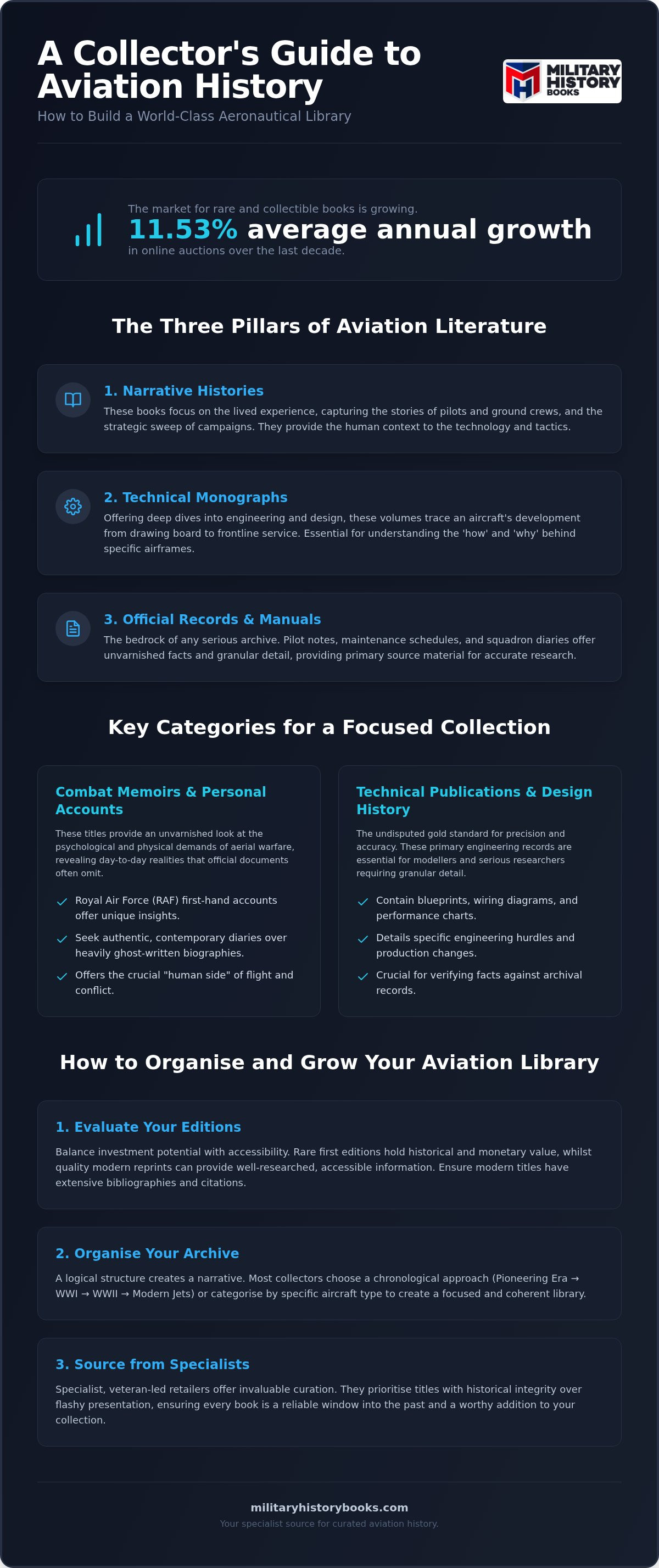
- Narrative histories: These focus on the lived experience, capturing the stories of pilots, ground crews, and the strategic sweep of campaigns.
- Technical monographs: These offer deep dives into engineering, tracing the development of an aircraft from the drawing board to the front line.
- Official records and manuals: These are the bedrock of any archive, consisting of pilot notes, maintenance schedules, and squadron diaries that offer unvarnished facts.
Why Specialist Knowledge Matters for Collectors
Identifying high-calibre aviation history books requires a discerning eye. Mass-market titles often recycle well-known stories without adding new research or verifying facts against archival records. This is where specialist curation becomes invaluable. Managed by an RAF veteran, our collection emphasises titles that prioritise historical integrity over flashy presentation. You'll find that the best books always include extensive bibliographies and citations. These are the hallmarks of a work built on thorough research rather than conjecture. A specialist retailer understands the weight of these stories and ensures that every title in your library serves as a reliable window into the past.
Navigating the Categories: From RAF Memoirs to Technical Manuals
To build a focused collection, you must first decide how to organise your library. Most collectors choose a chronological approach, starting with the pioneering days of flight before moving into the specialised combat roles of the Great War and the rapid technological leaps of the Second World War. This progression mirrors the FAA's Brief History of Aviation, which charts how regulatory frameworks and safety standards evolved alongside airframe complexity. By grouping your aviation history books by era, you create a logical narrative that shows how one generation's innovations became the next generation's baseline.
Combat Memoirs and the Human Side of Flight
There's a profound difference between reading a strategic overview and a first-hand account from the cockpit. Royal Air Force (RAF) memoirs, particularly those from the Battle of Britain, remain highly sought after because they provide an unvarnished look at the psychological and physical demands of aerial warfare. Whilst official histories focus on squadron numbers and mission objectives, personal diaries reveal the day-to-day realities that documents often omit. It's vital to look for authentic voices; some later biographies were heavily ghost-written to fit a specific public image, whereas contemporary accounts often hold more historical weight.
Technical Publications and Aircraft Design History
If you require absolute precision, technical publications are the undisputed gold standard. These works allow you to understand the specific engineering hurdles designers faced, such as cooling issues in early radial engines or the transition to monocoque construction. A technical publication serves as a primary engineering record, detailing the exact specifications of an aircraft at a specific point in its production life. For modellers, these are essential; they provide the blueprints, wiring diagrams, and scale drawings that ensure a replica is accurate down to the last rivet.
The Value of Back Issue Magazines for Researchers
Sometimes, the most valuable information isn't found in a hardback volume. Back issue magazines often contain niche articles on obscure prototypes or specific squadron markings that never made it into full-length books. These publications allow you to track how historical theories have changed as new wreckage is discovered or archives are declassified. They're a living record of enthusiast research that evolves over decades. If you're looking for these harder-to-find references, you can browse our collection of specialist journals to find the missing pieces of your research. Whether you're interested in the technical minutiae of a single engine or the strategic sweep of a campaign, these aviation history books and magazines provide the depth needed for a world-class library.
Rare vs. Modern Aviation Titles: Finding the Best Value
Choosing between a leather-bound first edition and a crisp modern reprint is a dilemma every collector faces. Whilst rare aviation history books carry the weight of history, modern editions often provide superior clarity and updated research. Balancing your budget requires a strategic approach. You might invest in a few "trophy" volumes whilst relying on modern publications for daily reference. This hybrid method ensures your library remains both an investment and a functional research tool.
The rise of digital titles has changed the landscape for enthusiasts who need quick access to technical data. With over 10,000 titles in stock, we've observed that many researchers prefer digital downloads for their searchability. However, the tactile experience of turning a physical page remains central to the hobby. The key is knowing when the physical object adds historical value and when the information itself is the primary goal.
The Allure of Out-of-Print and Rare Editions
Identifying "holy grail" titles is a skill developed over time. Books like a signed first edition of North to the Orient by Anne Morrow Lindbergh or a first edition of Around the World in Eight Days signed by Wiley Post and Harold Gatty are more than just literature; they're artefacts. Certain out-of-print books remain the definitive word on a subject because they were written by the pioneers themselves. Owning a veteran-signed copy provides a tangible link to the past that a digital file cannot replicate. These volumes often appreciate in value, especially if they're kept in excellent condition.
Modern Research and Digital Accessibility
Modern historians often have access to declassified archives that were unavailable to earlier writers. This means that a modern military history books library often benefits from including both original accounts and contemporary analysis. Contemporary authors can debunk myths that were once accepted as fact in older publications. High-quality research often appears in the National Air and Space Museum magazine, where new discoveries about aircraft performance and historical events are regularly published.
Digital formats are particularly useful for technical manuals and back issue magazines where you might need to zoom in on a specific blueprint or wiring diagram. They don't replace the rare first edition, but they complement it. By using digital versions for intensive study, you preserve the physical integrity of your rare aviation history books, ensuring they remain in "collector grade" condition for years to come.
How to Organise and Grow Your Aviation Library
Building a cohesive collection of aviation history books involves more than simply filling shelves. A focused archive usually starts with a specific interest, such as the development of jet propulsion, the history of a particular squadron, or the technical evolution of the Fleet Air Arm. By narrowing your scope, you can acquire the most authoritative works on a subject rather than a scattered assortment of general histories. Specialist retailers offer a distinct advantage over general marketplaces because they understand these nuances, providing curated selections that meet the rigorous standards of serious researchers.
Once your collection begins to expand, cataloguing becomes essential. Recording the edition, condition, and source of each volume helps you track your investment and identify gaps in your research. It's also the best way to ensure that your library remains a functional tool for future study. If you're ready to expand your archive with expert guidance, you can explore our specialist aviation collection to find your next essential title.
Identifying Authentic First Editions
Spotting a true first edition requires an understanding of publishing history. During the Second World War, many British publishers used "war economy" paper, which was thinner and more prone to yellowing due to its high acid content. Whilst this paper was a necessity of the time, it makes the condition of surviving copies even more critical. You should also verify any signatures or provenance; a genuine pilot's signature can significantly enhance a book's historical value, but it must be authenticated against known examples or supported by documentation.
Preserving and Storing Your Collection
Rare and fragile military publications require specific storage conditions to prevent deterioration. Dust jackets should be protected with archival-grade clear sleeves, as these prevent scuffing and UV damage whilst allowing the artwork to remain visible. For large collections of back issue magazines, acid-free storage boxes are the best way to prevent the pages from becoming brittle over time. If you own digital titles on disc or via download, ensure you maintain multiple backups on different devices to guarantee long-term access as technology evolves. Methodical preservation ensures that these stories and technical records remain intact for the next generation of enthusiasts.
Sourcing Your Next Read: The Advantage of Specialist Retailers
Finding a specific technical manual or a rare memoir requires more than just a search engine; it demands a retailer who understands the context of the material. Whilst generalist shops focus on the latest bestsellers, specialist retailers provide a sanctuary for researchers and enthusiasts seeking deep historical accuracy. The primary advantage of choosing a dedicated provider for aviation history books is the breadth of inventory available. With over 10,000 titles in stock, we offer access to out-of-print works and niche technical documents that simply aren't found on the high street.
Personal service is another hallmark of the specialist experience. When you're tracking down an elusive title that has been out of print for decades, having a knowledgeable curator to assist you is invaluable. We don't just process orders; we help collectors navigate the complexities of military literature, offering advice on which editions provide the best technical data or the most authentic narratives. This level of support helps sustain the wider military history community by ensuring that rare knowledge is preserved and shared with the next generation of historians.
Why Veteran-Led Curation Makes a Difference
Curation is an art that relies on professional expertise. As a business managed by an RAF veteran, we bring a unique perspective to the selection of our stock. This background allows us to filter out sensationalist or poorly researched works, ensuring that only the most reliable accounts reach our shelves. Building trust with our readers is paramount; we share your passion for the subject and understand the weight of the stories we preserve. This specialist knowledge means we can offer guidance that goes beyond a standard transaction, helping you identify which volume will best serve your specific area of research.
Beyond the High Street: Accessing Specialist Titles
Collectors often find that generalist marketplaces miss the nuances of military literature. If you're searching for rare wartime history books UK, a specialist shop is often the only place where these titles are properly catalogued and understood. Our inventory spans multiple disciplines, making us a valuable resource for those conducting cross-over research. For instance, studying the development of carrier-borne aircraft often requires consulting naval history books alongside aviation records to get the full picture of maritime operations.
Geography shouldn't be a barrier to building a world-class library. We offer global secure delivery to ensure that collectors around the world can access our archive with confidence. Whether you're looking for a digital download for immediate reference or a physical back-issue magazine to complete a set, our personal service ensures your requests are handled with care. By supporting specialist shops, you aren't just buying aviation history books; you're helping to sustain a community dedicated to the preservation of human experience and technical achievement in flight.
Elevating Your Personal Aviation Archive
Building a world-class library is a rewarding pursuit that requires both a deep passion for flight and a discerning eye for historical integrity. You've seen how the most significant aviation history books are those that successfully bridge the gap between complex engineering specifications and the lived experiences of the pilots themselves. By focusing your archive on authentic primary sources and technical manuals, you create a collection that serves as both a valuable investment and a vital record of human achievement.
Finding those elusive, out-of-print volumes doesn't need to be a struggle. As a veteran-led business managed by an RAF veteran, we take pride in curating a selection that meets the highest standards of accuracy and depth. We specialise in rare and out-of-print titles that you won't find in general bookshops, and our secure international delivery ensures your new acquisitions arrive safely, no matter where you're based. Your next landmark discovery is waiting amongst our shelves. We invite you to browse our collection of over 10,000 aviation history titles and take the next step in growing your personal archive.
Frequently Asked Questions
What are the most essential aviation history books for a beginner?
Beginners should start with authoritative general histories that provide a broad strategic overview of flight development. Authors such as Max Hastings or James Holland offer accessible narratives that place aerial combat within its wider historical context. It's also worth picking up classic memoirs like Paul Richey's Fighter Pilot to understand the human side of the cockpit before moving into more technical aviation history books.
How can I tell if an aviation book is a rare first edition?
Check the copyright page for the "First Published" date and ensure it matches the known original release year without any mention of subsequent printings. In British publishing during the 1940s, many first editions were produced on thin "war economy" paper, which is a distinct physical marker for collectors. You should also look for a lack of "edition" numbers, as these usually indicate later impressions or reprints.
Are digital aviation books as good for research as physical copies?
Digital titles are excellent for quick reference and granular data searches whilst physical copies remain the best choice for long-term investment. Downloads allow you to search for specific technical terms or zoom into high-resolution blueprints on a screen. However, a physical book provides a tactile connection to history and doesn't suffer from the digital obsolescence that can affect files over decades.
Where can I find technical manuals for vintage aircraft?
Technical manuals are typically found at specialist military retailers who curate primary engineering records. These documents were originally intended for pilots and ground crews, providing the most accurate data on airframe maintenance and engine performance. We maintain a significant collection of these specialist publications, which are essential for any researcher requiring absolute technical precision.
Why should I buy from a specialist aviation bookshop instead of a general retailer?
Specialist shops provide veteran-led curation and a much deeper inventory, often exceeding 10,000 titles in a single niche. Unlike general retailers, we understand the nuances of military publishing and can help you identify rare or out-of-print works that are historically accurate. This expertise ensures you avoid sensationalist accounts and find the most reliable aviation history books for your specific research needs.
How do I preserve the condition of my rare military history books?
Store your books upright in a cool, dry environment away from direct sunlight to prevent the spines from fading. Protect original dust jackets with archival-grade clear sleeves, as these prevent scuffing and preserve the artwork's value. For fragile wartime editions, handle the pages with clean, dry hands and avoid over-extending the bindings, which can become brittle as the paper ages.
Can I find back issue aviation magazines for specific aircraft research?
Yes, back issue magazines are a vital resource for finding niche articles and photographs that never appeared in full-length books. These journals often contain detailed research on obscure prototypes, specific squadron markings, and evolving historical theories. They are particularly useful for modellers and historians who need to track the development of a single airframe across different eras of service.
What is the best way to start an RAF history book collection?
Focus on a specific era or aircraft type, such as the Battle of Britain or the development of the Spitfire, to give your collection a clear direction. Start with well-regarded first-hand memoirs to build a narrative foundation, then supplement these with technical monographs and squadron histories. This methodical approach ensures your archive remains cohesive and grows in both research value and historical significance.


