

A single misplaced rank or an impossible ship manoeuvre can instantly shatter the immersion for a dedicated maritime enthusiast. Finding the best naval fiction books requires more than just a search for a gripping plot; it demands a commitment to historical authenticity that respects the complexities of life under sail or steam. You've likely felt the frustration of reading a beautifully bound novel only to find the technical details of the rigging or the chain of command are fundamentally flawed.
We understand that for the serious collector, a book is a bridge to the past that must be built on a foundation of accuracy. This guide will help you identify the most rigorous maritime prose available in 2026, from the latest releases like Richard Nigel Stembridge’s The Trafalgar Bastard to elusive, out-of-print classics. We'll explore how to curate a specialist library that captures the true human experience at sea whilst ensuring every technical detail rings true. By the end of this guide, you'll know exactly which titles deserve a permanent place on your shelves and how to source the rarest editions to complete your collection.
Key Takeaways
- Understand why technical accuracy and historical realism are the hallmarks of a quality naval novel, ensuring every ship specification and rank is authentically portrayed.
- Explore a curated selection of the best naval fiction books for 2026, spanning the legendary Age of Sail to the high-stakes submarine warfare of the 20th century.
- Learn practical methods for organising a specialist maritime library, helping you categorise your collection by conflict, service branch, or chronological era.
- Discover the advantages of using a specialist bookseller to source rare and out-of-print titles that are often unavailable through general high-street retailers.
What Makes the Best Naval Fiction Books Worth Reading?
Naval fiction is a distinct subgenre that goes beyond mere adventure. It centres on maritime conflict and the intricate social hierarchies of life aboard a vessel. Whether it's the creak of a wooden hull in the Age of Sail or the claustrophobic tension of a modern submarine, the best naval fiction books offer a level of immersion that technical manuals simply cannot match. They provide the "silent service" with a voice, translating cold facts into the lived reality of a storm-tossed deck. For those who study naval history, these novels aren't just entertainment; they're an exploration of the technical and psychological limits of human endurance.
The Balance of Historical Fact and Narrative
Many readers begin their journey with non-fiction, but they often find that technical accounts lack the sensory depth of the period. Authors like Patrick O’Brian famously utilised actual historical logs and Admiralty records to inform their prose, ensuring that every tactical decision mirrored real-world possibilities. There's a clear distinction between a simple nautical thriller and a meticulously researched historical novel. High-quality naval fiction serves as a vital vehicle for historical empathy, allowing readers to inhabit the psychological landscape of those who served. These stories act as an essential component of any broader military history books collection by humanising the strategic maps and order-of-battle charts found in academic texts.
Why Specialist Readers Reject "Hollywood" Naval Prose
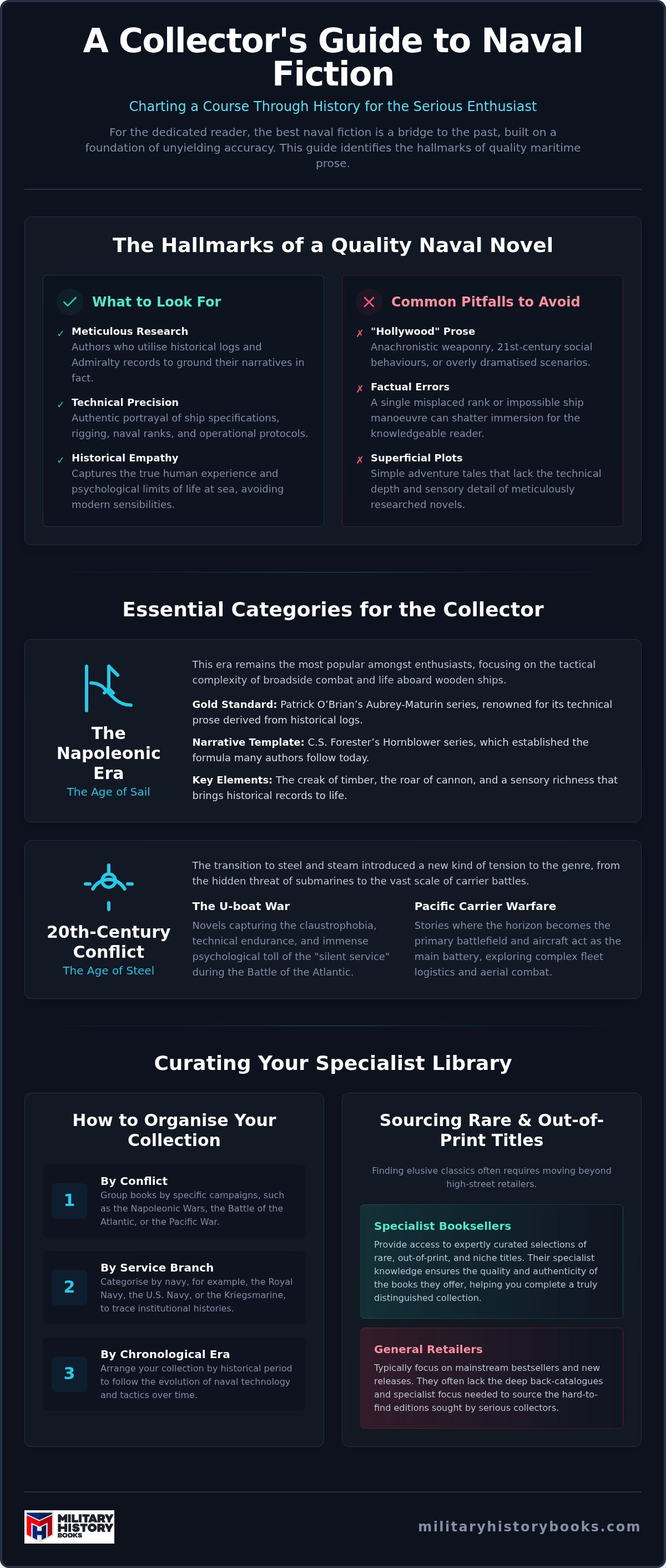
Serious enthusiasts have little patience for "Hollywood" interpretations. We've all seen the common pitfalls: 21st-century social behaviours transposed onto 18th-century sailors, or anachronistic weaponry that wouldn't exist for another fifty years. Accuracy in terminology, from the complex names of rigging to the precise protocols of sonar and naval rank, is non-negotiable. For a reader who knows their way around a quarterdeck, a single error in a ship’s specifications can ruin the entire experience. This is why we prioritise technical realism whilst curating our collection. Our background as specialists means we filter through thousands of titles to ensure that what reaches your shelf respects the technical constraints of the era it depicts. Finding the best naval fiction books involves a rigorous vetting of the author's maritime knowledge to ensure the prose holds up under expert scrutiny amongst a community of dedicated researchers.
Essential Categories of Naval Fiction: A 2026 Roundup
Naval fiction is a vast field that rewards readers who appreciate the evolution of maritime technology. To find the best naval fiction books, one must first decide which era of seafaring speaks to them most clearly. Categorising by period allows collectors to see how different authors handle the transition from the creak of timber to the hum of nuclear reactors. Whether you're drawn to the tactical complexity of broadside combat or the hidden movements of the "silent service", there is a specific category of prose that captures that reality.
The Napoleonic Era: Aubrey, Maturin, and Hornblower
The Age of Sail remains the most popular category amongst enthusiasts. Patrick O’Brian’s Aubrey-Maturin series is widely regarded as the gold standard for technical maritime prose; it doesn't just describe a ship, it inhabits it. O'Brian's use of historical logs ensures that every sail change and naval engagement is grounded in fact. Similarly, C.S. Forester’s Hornblower series established the narrative template that many modern authors still follow. These works offer a sensory richness that complements the factual records found in wartime history books UK, providing the emotional context that archives often omit.
20Th-Century Maritime Conflict: The U-boat War
The shift to modern steel brought a new kind of tension to the genre. Novels focusing on the U-boat war capture the claustrophobia of the Battle of the Atlantic with chilling realism. Unlike the grand fleet actions of previous centuries, these stories focus on technical endurance and the psychological toll of underwater warfare. Pacific carrier warfare adds another layer of complexity, where the horizon becomes the primary battlefield and aircraft become the main battery. These stories are invaluable for readers who want to understand the tactical shifts documented in official naval history publications. If you are looking for specific titles from this era, you can browse our naval history books to find both modern releases and classic accounts.
Beyond the World Wars, the Cold War introduced a era of high-tech submarine thrillers. These books focus on the technical complexity of sonar, acoustic signatures, and nuclear propulsion. Recent 2026 releases like Cal Clement's Rebel Ship or Richard Nigel Stembridge's The Trafalgar Bastard show that the genre is still thriving. Some authors even blend historical conflict with investigative plots, creating naval mysteries that challenge the reader’s intellect whilst maintaining a high standard of nautical accuracy. Finding the best naval fiction books in these niche categories often requires looking beyond the bestseller lists to find authors who truly understand the technical reality of the service.
Why Technical Accuracy is the Priority for Serious Collectors
Serious readers of the best naval fiction books often value technical precision as much as the narrative arc itself. Whilst the plot might be a product of the author's imagination, the vessel, the weather, and the social hierarchy must remain tethered to historical reality. We approach our curation through a "Veteran Lens", drawing on our RAF background to identify works that respect the realities of service life. We understand that a writer who fails to grasp the terminology of a ship’s rigging or the mechanics of a sonar sweep is likely to overlook other crucial historical details too.
Spotting Research-Backed Maritime Authors
Identifying high-quality prose often begins with looking at the author's research process. The most respected writers in this field spend years scouring archives and back issue military magazines UK to ensure their descriptions of deck life or engine room operations are flawless. Look for bibliographies or archival acknowledgements in the back of the book; these are clear indicators that the author has done the heavy lifting. Correct nautical terminology isn't just window dressing; it's a hallmark of quality that signals a deep respect for the subject matter. For a specialist reader, a technical error acts like a jarring note in a symphony, instantly breaking the immersion and casting doubt on the entire work.
The Problem with Maritime Anachronisms
Errors in ship classification or radar technology can completely ruin the experience for an informed collector. If a destroyer is equipped with radar tech that wasn't available until 1944 in a story set in 1941, the tactical tension of the engagement evaporates. High-quality fiction helps preserve the technical history of naval manoeuvres by illustrating how they were executed in real-time scenarios. We often encourage our readers to cross-reference their favourite prose with military biography books to see how real-life commanders handled similar tactical dilemmas. This comparative reading ensures your library remains an authoritative resource rather than just a collection of stories. When an author gets the technical constraints of the era right, the best naval fiction books become more than just entertainment; they become a vivid window into a lost world of seafaring expertise.
How to Organise and Build a Specialist Naval Fiction Library
Building a specialist collection is a deliberate act of preservation that goes far beyond simply filling shelves. For many enthusiasts, the best naval fiction books serve as the narrative heart of a much larger military archive. A well-organised library allows you to trace the evolution of maritime strategy and the changing nature of life at sea across different centuries. Whether you're a serious researcher or a casual reader, the way you curate and store your titles will determine the long-term value and utility of your collection.
Physical vs Digital Naval Literature
The choice between physical and digital formats often depends on how you intend to use the material. Vintage hardbacks and older paperbacks possess a tactile appeal that digital downloads cannot replicate; there's a unique satisfaction in feeling the weight of a first edition or smelling the aged paper of a mid-century classic. To prevent yellowing and spine damage, keep your physical books away from direct sunlight and store them upright in a cool, dry environment. Whilst digital titles are exceptionally convenient for research whilst travelling or for quick keyword searches, they lack the permanence and collectibility of a physical volume. Many serious collectors maintain a "working" digital library for reference whilst reserving their shelf space for high-quality printed editions.
Curating a Thematic Naval Collection
Rather than collecting every maritime title available, you might find more value in centring your library on a specific niche. This could be a particular conflict, such as the Royal Navy’s operations in the Mediterranean, or a specific service branch like the submarine corps. A thematic approach allows you to gain a deeper understanding of a specific area of history. You can enhance this by blending fiction with memoirs and technical manuals, creating a 360-degree view of the subject. Completing an author’s full maritime bibliography is another rewarding way to build a collection, as it allows you to see how their technical understanding and prose style developed over time. If you’re ready to expand your archive with expert-vetted titles, you can browse our collection of naval books to find your next essential addition.
Investing in collectible editions is the final step for a truly specialist library. First editions, particularly those signed by the author, often appreciate in value and become the centrepieces of a collection. These volumes represent a tangible connection to the history of the genre itself. By combining these rare finds with meticulously researched modern works, you ensure your library remains both a professional resource and a personal sanctuary for maritime history. The best naval fiction books aren't just stories; they're an investment in the preservation of seafaring heritage.
Sourcing Rare and Out-of-Print Naval Fiction
Many of the best naval fiction books ever written are no longer in active print. Whilst modern bestsellers are easy to find, the niche masterpieces of the mid-20th century often vanish from high-street shelves, leaving collectors to search through various second-hand markets. General retailers like Waterstones typically focus on current releases, which means they rarely stock the obscure or technical titles that serious maritime enthusiasts crave. Finding these books requires a different approach, one that relies on specialist knowledge and a deep understanding of the genre's history.
At Military History Books, we manage a massive inventory of over 10,000 titles, including a significant selection of rare naval literature. Our approach isn't just about stocking books; it's about curating a collection that respects the technical and historical weight of the subject matter. We understand the frustration of searching for a specific out-of-print title only to find it unavailable on major digital platforms. By maintaining a vast archive of physical copies, we act as a bridge between the past and the modern enthusiast, ensuring that these important stories aren't lost to time.
The Hunt for Forgotten Maritime Masterpieces
Identifying forgotten classics of the 20th-century naval genre is a task that demands expertise. Many exceptional works from the post-war era never made the transition to digital formats, meaning they exist only in their original printings. Finding these titles amongst thousands of generic listings is difficult without a professional framework. We use our specialist knowledge to filter for quality, focusing on authors who provided an authentic look at the "silent service" or the complexities of fleet manoeuvres. This level of curation helps collectors find specific titles that are often overlooked by generalist sellers who don't understand the nuances of ship specifications or naval rank.
Why a Specialist Curator Matters for Collectors
Buying from a specialist offers a level of reliability that general marketplaces cannot match. As a business managed by an RAF veteran, we bring a sense of professional authority to every title we stock. We don't just sell books; we provide a personalised service that helps you find the exact volume for your research or collection. We understand the historical significance of these works and the importance of their preservation. Whether you are looking for a technical manual or a rare first edition of a classic novel, we are here to assist with your specific requests. If you're ready to find that elusive title to complete your library, browse our curated collection of naval fiction today and discover the depth of our maritime archive.
Charting Your Course for a Definitive Maritime Collection
Navigating the vast waters of maritime literature requires a keen eye for technical realism and historical integrity. By prioritising research-backed prose and thematic organisation, you can transform a simple shelf into a professional archive that captures the true essence of naval service. We've explored how identifying the best naval fiction books involves looking past the bestsellers to find authors who truly respect the technical constraints of their era.
Whether you're tracking down a Napoleonic classic or a rare Cold War thriller, the right curator makes all the difference. Our collection is managed by an RAF veteran and stocks over 10,000 specialist titles, ensuring every book meets the high standards of a dedicated researcher. We provide secure international delivery for collectors who value the preservation of seafaring heritage. Explore our extensive range of Naval Fiction and History Books today and find the next cornerstone for your specialist library. We look forward to helping you source those hard-to-find volumes that keep history alive.
Frequently Asked Questions
What are the best naval fiction books for beginners to the genre?
Entry-level readers often find C.S. Forester's Hornblower series to be the most accessible starting point. These novels provide a clear introduction to the Age of Sail without overwhelming the reader with overly dense terminology too early. For those interested in 20th-century conflict, Nicholas Monsarrat's The Cruel Sea offers a stark and compelling look at the Battle of the Atlantic with a narrative style that remains engaging for newcomers.
Is naval fiction historically accurate enough for researchers?
High-quality maritime prose is often meticulously researched using primary sources like Admiralty logs and official ship records. Whilst the characters are invented, authors like Patrick O'Brian are celebrated for their technical precision regarding ship handling and period-accurate social structures. Researchers find the best naval fiction books useful for understanding the lived experience of sailors beyond the dry facts found in academic journals.
Where can I find out-of-print naval fiction books in the UK?
Specialist retailers are the most reliable source for hard-to-find titles that general high-street bookshops no longer stock. We maintain an inventory of over 10,000 titles, focusing specifically on rare and out-of-print military literature. This allows collectors in the UK and abroad to source elusive editions that are often missing from major digital marketplaces or general retailers.
Who are the most respected authors in the naval fiction genre?
C.S. Forester, Patrick O'Brian, and Alexander Kent are widely considered the pillars of the genre. Modern authors continue to build on this legacy; for example, Richard Nigel Stembridge’s July 2026 release, The Trafalgar Bastard, demonstrates the ongoing commitment to historical detail. These writers are respected because they balance narrative tension with a deep, technical understanding of maritime technology and command structures.
How does naval fiction differ from standard historical fiction?
The primary difference lies in the intense focus on the technical reality of the vessel and the psychological isolation of life at sea. Naval fiction treats the ship itself as a central character, demanding a level of mechanical and nautical detail that standard historical novels rarely require. It's a genre where a single technical error in rigging or sonar protocol can undermine the entire story's credibility for an expert reader.
Can naval fiction be used as a supplement for historical research?
Fiction serves as an excellent companion to non-fiction by providing the sensory and psychological context of a conflict. It helps researchers visualise the claustrophobia of a submarine or the chaotic reality of a broadside engagement in a way that technical manuals cannot. Using the best naval fiction books alongside memoirs and official reports creates a more comprehensive understanding of the human element in maritime history.
What is the best way to collect first edition naval novels?
Working with a specialist curator is the most effective way to identify and acquire genuine first editions. Collectors should focus on the condition of the dust jacket and the presence of author signatures, as these factors significantly impact the long-term value of the volume. We often assist collectors in tracking down specific editions to complete their personal maritime archives, ensuring the provenance and quality of each find.
Do you offer digital versions of rare naval fiction titles?
We provide a selection of digital titles available by download and on disc to ensure these stories remain accessible to modern readers. This is particularly helpful for researchers who need to search for specific terms or for those who prefer to read whilst travelling. Whilst we value the tactile nature of physical books, digital formats ensure that out-of-print knowledge and rare narratives are preserved for future generations.


