

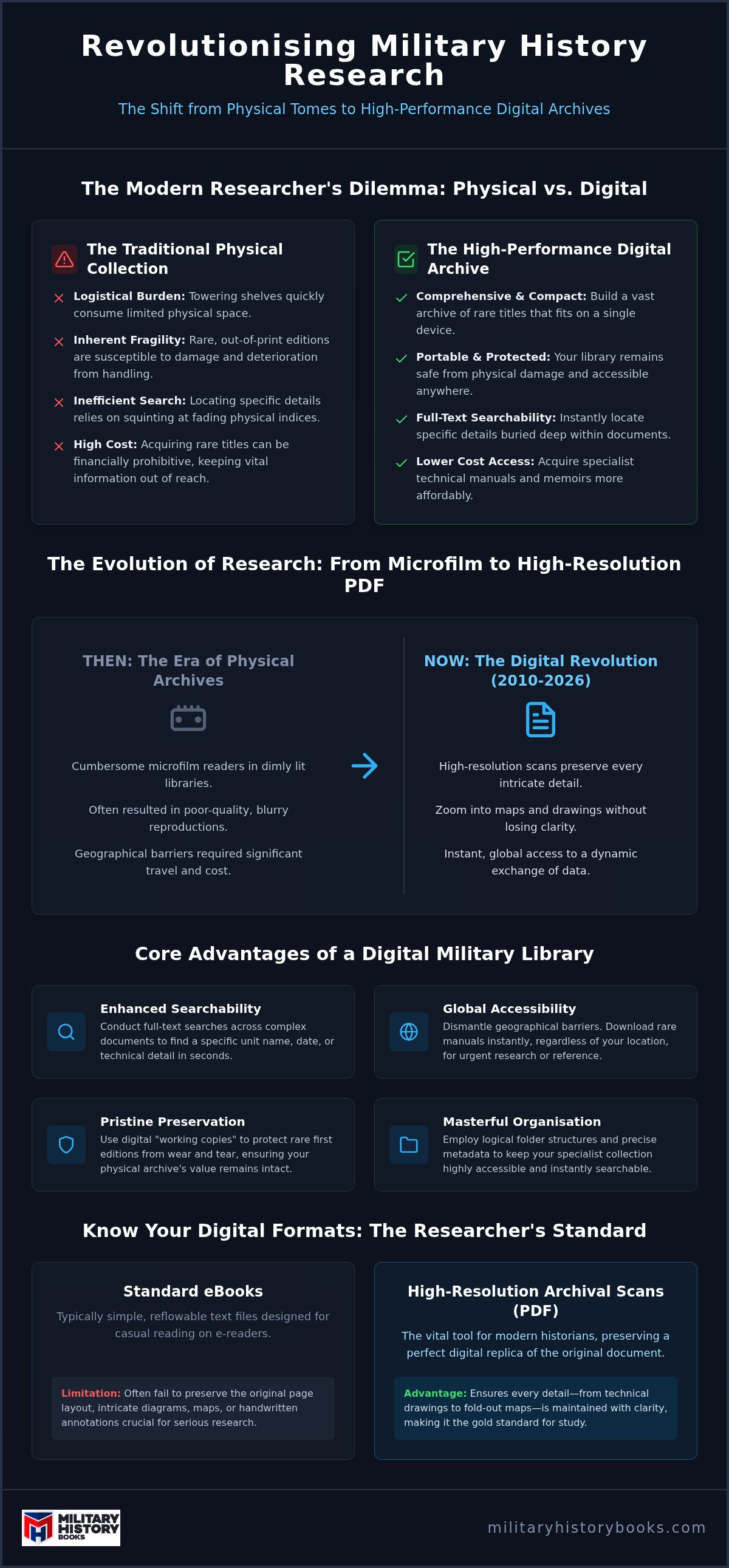
A traditional collection of military history books often feels like a living museum, yet for the dedicated researcher, those towering shelves can quickly become a logistical burden. You likely appreciate the historical weight of a rare memoir, but you also understand the frustration of limited physical space and the inherent fragility of out-of-print editions. It's often difficult to find a specific technical detail when you're squinting at a fading index, and the high cost of acquiring rare titles can keep vital information out of reach.
We believe that digital military history books are revolutionising research by acting as a high-performance tool rather than a mere replacement for paper. You'll discover how to build a comprehensive, searchable archive of rare and specialist titles that fits entirely on a single device. This article explores how to access technical manuals and memoirs at a lower cost, ensuring your library remains portable and protected. We'll examine the shift towards digital-first archives and provide a roadmap for creating a modern collection that respects the past whilst embracing the convenience of the present.
Key Takeaways
- Understand how the transition from physical archives to digital downloads provides immediate access to rare memoirs and technical manuals without the risk of damage or deterioration.
- Learn to utilise full-text searchability within digital military history books to quickly locate specific technical details that are often buried in traditional physical indices.
- Identify the crucial differences between standard eBooks and high-resolution archival scans to ensure your digital library meets the high standards required for serious research.
- Master the art of organising a digital archive using logical folder structures and precise metadata to keep your specialist collection accessible and searchable.
- Discover how to navigate the digital marketplace to find rare, out-of-print titles from specialist sources that understand the historical weight of their inventory.
The Evolution of Digital Military History Books in Modern Research
The study of Military history has always relied on the meticulous preservation of primary sources, yet the way we interact with these documents has fundamentally changed over the last decade. Digital military history books are no longer simple, text-only files designed for casual reading; they've evolved into high-resolution archival tools that preserve the intricate details of technical manuals, maps, and rare memoirs. These digital editions serve as a vital bridge between the past and the modern researcher, offering a level of clarity and accessibility that physical copies often cannot match. Specialist retailers, frequently led by experts with deep-seated passion for the niche, play a crucial role in this transition. They don't just sell files; they act as curators for rare and out-of-print titles that might otherwise be lost to time or remain locked behind the doors of distant physical archives.
Technical publications and manuals have found a significant second life online. These documents were originally produced for functional use in the field or factory, meaning they weren't always printed on durable paper. By digitising these works, specialist archives ensure that the specific engineering details of a Spitfire engine or the tactical diagrams of a Cold War tank remain available for study. This preservation effort is particularly important for out-of-print aviation and land warfare literature, where the original physical copies are often too fragile for regular handling.
From Microfilm to PDF: A Brief History
Historically, researchers spent hours hunched over microfilm readers in dimly lit libraries to catch a glimpse of a specific battalion diary or aircraft schematic. This process was cumbersome and often resulted in poor-quality reproductions. The advent of high-resolution scanning changed everything, allowing for the creation of PDFs that maintain the integrity of technical drawings and large-scale maps. You can now zoom into a 1940s naval chart without losing the sharpness of the original ink. Between 2010 and 2026, the digital shift in military history research transformed the discipline from a pursuit tethered to physical archives into a dynamic, global exchange of searchable data. This evolution ensures that even the most obscure military history books are preserved in a format that won't degrade with age.
The Accessibility Revolution for Global Historians
Geographical barriers once made it nearly impossible for a researcher in Australia or North America to study rare UK military records without significant travel costs. The digital revolution has dismantled these walls. Instant delivery via download means that a historian can access a rare memoir or a technical manual in seconds, regardless of their location. This speed is indispensable for urgent research or for modellers who need an immediate reference for a specific camouflage pattern or internal engine layout. Whether provided as a direct download or on a disc for archival purposes, these digital titles allow enthusiasts to build a comprehensive library that would have been physically and financially impossible just twenty years ago.
Why Collectors and Researchers are Embracing Digital Libraries
Building a significant collection of military history books often leads to a common dilemma: the physical constraints of the home library. For many enthusiasts, the sheer volume of land warfare books and aviation journals can quickly outpace available shelving. Digital libraries offer an elegant solution by allowing thousands of volumes to reside on a single hard drive or cloud server. This isn't just about saving space; it's about the strategic preservation of your physical collection. By using digital "working copies" for day-to-day research, you can protect rare first editions from the natural wear and tear that comes with frequent handling. This approach ensures that the historical weight of your physical archive remains intact whilst you benefit from the utility of modern formats.
Enhanced Searchability and Data Cross-Referencing
The most profound advantage of digital media is the ability to conduct full-text searches across complex military campaigns. Instead of manually scanning hundreds of pages for a specific unit name, date, or geographical location, you can find the information instantly. This level of efficiency is transformative for order of battle (ORBAT) research, where cross-referencing multiple sources is essential to building an accurate picture of a conflict. As highlighted in the West Point Library research guide, the integration of digital tools allows for a more rigorous academic approach to historical data. You can easily annotate PDFs, organise research notes by theme, and jump between different military history books to verify technical details without losing your place.
Preserving Fragile and Rare Military Memoirs
Many of the most valuable insights into past conflicts come from personal memoirs, yet these out-of-print titles are often incredibly fragile. The paper quality of mid-20th-century publications was rarely designed for longevity, making digital scans a necessity for long-term study. Accessing these rare works digitally provides a cost-effective alternative to purchasing expensive, brittle originals on the second-hand market. This focus on preservation is a key part of maintaining Wartime History Books UK as a viable field for future generations of collectors. If you're looking to expand your own archive with rare technical manuals or out-of-print memoirs, you might explore our latest digital titles available for download. By embracing these formats, you aren't just reading history; you're ensuring its survival in an age where physical space is at a premium and technical precision is paramount.
Understanding Formats: Downloads, Discs, and Technical Manuals
Choosing the correct format is a vital step when curating a collection of military history books, as the needs of a researcher differ significantly from those of a casual reader. Whilst standard eBooks often use reflowable text that adjusts to screen size, they frequently fail to preserve the complex layouts, tables, and detailed illustrations found in specialist historical literature. High-resolution PDF scans are the preferred standard for serious study because they maintain the exact visual integrity of the original document. This ensures that every footnote, margin note, and technical diagram remains in its intended context, which is essential for accurate historical cross-referencing. By prioritising DRM-free content, you also ensure that your digital archive remains accessible across various devices, from desktop PCs to portable tablets, without the risk of being locked out by changing software platforms in the future.
Technical Military Publications and Manuals
For those focused on the mechanics of warfare, technical manuals for iconic aircraft like the Hawker Hurricane or the Supermarine Spitfire represent a goldmine of information. These publications weren't intended for the general public, so they contain intricate engineering details that are often omitted from narrative histories. The primary advantage of a high-resolution digital format is the ability to zoom into high-detail engineering blueprints without losing clarity. A high-fidelity technical aviation manual typically requires a resolution of at least 300 DPI and a file size ranging from 50MB to 200MB to ensure that every minute detail of an engineering blueprint remains legible when magnified. This precision allows modellers and restorers to examine the specific placement of rivets or the internal routing of hydraulic lines with absolute confidence.
Digital Media Delivery: Downloads vs. Discs
The method of delivery often depends on the urgency of your research and your personal archival preferences. Instant downloads provide immediate access to military history books, allowing you to begin your study seconds after purchase. This is particularly useful for historians working on tight deadlines or modellers who need a quick reference for a specific project. However, many collectors still value digital titles provided on disc. Physical discs serve as a robust, offline backup that isn't dependent on internet connectivity or cloud storage stability. We manage secure digital delivery for global clients, ensuring that whether you choose a download or a physical disc, the material arrives safely and remains a permanent part of your specialist archive. This flexibility allows you to balance the need for modern speed with the traditional desire for a tangible, well-organised collection.
Organising and Preserving Your Digital Military Archive
Establishing a logical folder structure is the first step in transforming a collection of files into a functional research tool. For a substantial library of military history books, we recommend a hierarchy based primarily on the branch of service, followed by the specific conflict or era. This methodical approach allows you to quickly locate a technical manual for a Hawker Hurricane within your aviation folder without having to sift through unrelated land warfare memoirs. Metadata plays an equally vital role; ensuring that every file is named consistently with the publication year, title, and author makes your entire archive searchable through standard operating system tools. Integrating cloud storage further enhances this by providing multi-device access, allowing you to move from your desktop PC to a tablet whilst conducting research in the field or at a museum archive.
Categorisation by Campaign and Branch
Organising your library by era is often the most intuitive method for historians. We suggest broad categories such as Ancient, Napoleonic, the World Wars, and Modern conflicts. Within these, it's helpful to separate technical manuals from biographical accounts to maintain a clear distinction between hard data and personal narrative. Personal stories provide the human context that technical drawings lack, and you can explore more about Military history globally and across the ages to see how biography fits into the wider historical record. This separation ensures that when you need a specific engineering fact, you aren't distracted by a lengthy wartime diary. A well-organised structure reflects the precision of the subject matter itself, turning a simple list of downloads into a curated reference centre.
Long-term Digital Preservation Strategies
Digital files are durable, but they aren't immortal. As software and hardware evolve, ensuring your digital library remains readable is a primary concern for the serious collector. The "3-2-1" backup rule is the gold standard for preserving irreplaceable research data: maintain three copies of your library, on two different types of media, with one copy stored off-site. This might involve keeping your primary archive on a modern solid-state drive, a secondary copy on a physical disc, and a third in a secure cloud service. If you've previously purchased digital titles on older disc formats, migrating that data to modern SSDs is a wise precaution to avoid the eventual degradation of the physical media. This proactive maintenance ensures that your investment in history remains protected for decades to come.
If you're ready to expand your curated archive with rare and specialist titles, you can browse our full collection of digital military history books today.
Navigating the Digital Marketplace for Specialist Titles
Finding high-quality military history books in digital format requires a discerning eye, especially when you move beyond mainstream titles into the realm of technical manuals and rare memoirs. General digital retailers often rely on automated processes, which can result in poor-quality optical character recognition (OCR) scans that miss technical nuances or distort vital data. In contrast, specialist bookshops prioritise the integrity of the material, ensuring that diagrams are legible and text is accurately rendered. One significant advantage of these curated digital editions is that they allow you to preserve your rare first editions. By using a high-quality digital scan for your daily research, you eliminate the need to handle a fragile physical book, ensuring the original remains in pristine condition whilst the information remains at your fingertips.
Why Specialist Knowledge Matters in Digital Curation
A specialist archive is managed with a level of care that generic platforms simply cannot replicate. Our collection is curated by an RAF veteran who brings deep-seated subject-matter expertise to the selection process, ensuring that every title meets the high standards required by serious historians. This expert oversight helps you avoid the frustration of poor-quality scans found on generic platforms, where technical drawings are often compressed beyond recognition. This commitment to quality is evident across our entire inventory, including our extensive range of Naval history publications, where the accuracy of ship schematics and fleet movements is essential for credible research. When you choose a specialist shop, you're not just buying a file; you're gaining access to a curated archive that respects the historical weight of the subject matter.
Finding Rare and Out-of-Print Digital Gems
Tracking down digital versions of rare land warfare titles or obscure military fiction can be a challenge if you don't know where to look. Specialist retailers often focus on digitising out-of-print literature that larger publishers overlook, providing a second life to valuable historical narratives. This includes access to back-issue modelling and military magazines, which are indispensable for researchers looking for specific unit histories or camouflage patterns that aren't found in broader historical surveys. These magazines often contain contemporary accounts and technical details that are missing from modern reprints. By building your library through a dedicated archive, you ensure that even the most specialist titles are preserved in a searchable, portable format that supports your passion for history.
Ready to build a more comprehensive and accessible archive? Explore our curated collection of over 10,000 digital and physical titles, including rare aviation, land, and naval warfare resources designed for the modern researcher.
Securing the Future of Your Military Archive
Embracing digital media isn't about replacing the traditional bookshelf; it's about adding a high-performance layer to your research capabilities. By integrating searchable downloads and archival discs, you can protect fragile original editions whilst ensuring technical details are always accessible. We've discussed the importance of logical organisation and high-fidelity formats in building a library that remains functional as technology evolves. This transition allows you to maintain the historical weight of your collection without the logistical burden of physical storage.
Finding the right military history books requires a source that understands the technical and emotional weight of the subject matter. Our archive is expertly curated by an RAF veteran and contains over 10,000 specialist titles, ranging from rare technical manuals to personal memoirs. With secure international delivery available for all physical and digital media, we ensure your collection grows with quality and precision. We take pride in being a trusted guide for enthusiasts and researchers alike, providing the tools necessary to keep history alive.
Take the next step in refining your research tools and browse our extensive library of digital military history books today. Your commitment to preserving these stories ensures that history remains a living, accessible resource for years to come.
Frequently Asked Questions
What is the best format for digital military history books?
High-resolution PDF is widely considered the superior format for serious research and archival purposes. Unlike standard eBooks with reflowable text, PDFs preserve the exact pagination and complex layout of the original military history books, which is essential for accurate citation and technical study. This format ensures that tables, footnotes, and margin notes remain in their intended context for a seamless reading experience.
Can I read digital military books on my Kindle or tablet?
Yes, you can access your digital library on most modern devices, including Kindles, iPads, and Android tablets. Whilst some eReaders are best suited for text-heavy fiction, high-resolution tablets are ideal for viewing the complex technical drawings and maps found in specialist warfare literature. Most devices allow you to side-load these files easily, providing portability for research whilst you are on the move or visiting archives.
Are digital military history books cheaper than physical copies?
Digital editions are typically more cost-effective because they eliminate the high expenses associated with printing, physical storage, and international shipping. This format allows you to acquire rare technical manuals or out-of-print memoirs at a significantly lower price than a fragile physical first edition. It's an excellent way to expand your archive without the financial strain often associated with collecting rare antiquarian volumes.
How do I access out-of-print military books in digital format?
Specialist digital archives focus on preserving out-of-print land, naval, and aviation warfare titles by creating high-quality digital scans of the original works. These rare publications are often unavailable through mainstream retailers or general libraries, making specialist bookshops the primary resource for historians seeking obscure historical data. These digital versions provide a second life to important texts that would otherwise be lost to time.
Do digital military books include all the original maps and illustrations?
Authentic digital editions are designed to be faithful reproductions, capturing every map, diagram, and illustration found in the original volume. High-resolution scanning ensures that even large-scale tactical maps or intricate engineering blueprints remain legible and zoomable for detailed analysis. You won't lose the visual context that is so vital to understanding the tactical and technical aspects of historical conflicts.
What happens if I lose my downloaded military history files?
We always recommend following the 3-2-1 backup strategy mentioned earlier in this guide to prevent the permanent loss of your military history books. However, if a file is misplaced, most specialist retailers provide secure account areas or support services where you can access your previous purchases for re-download. Keeping your digital library on a physical disc as a secondary backup is also a wise archival precaution.
Why should I buy from a specialist military bookshop instead of Amazon?
Specialist shops offer expert curation and a deep understanding of the subject matter that generic platforms simply cannot replicate. An archive managed by a veteran ensures that technical scans are of the highest quality and that the collection includes rare, specialist titles that don't appear on mass-market sites. You're also supporting a community that values the preservation of history over simple high-volume commercial sales.
Are digital titles available for international customers?
Digital delivery completely removes the geographical barriers and high shipping costs traditionally associated with international historical research. Historians across the globe can instantly access our inventory of over 10,000 titles via download or disc, regardless of their location. This global accessibility ensures that vital military records and memoirs are available to researchers in every corner of the world without delay.


