

A digital scan can never truly replicate the experience of unfolding a pristine technical schematic or reading a first-hand account in its original context. Most researchers find that generic online marketplaces are a lottery, often resulting in damaged copies or missing pages that stall a meticulous project. If you are searching for authentic naval history magazine back issues, you know that mainstream digital archives frequently overlook the specific British naval perspectives and technical depth required for serious study.
We understand these frustrations because we've spent years curating a collection of over 10,000 specialist titles for enthusiasts who value accuracy. This guide promises to reveal the sourcing secrets of an expert bookseller, helping you distinguish between casual hobbyist magazines and those that offer genuine research value. You'll learn how to build a curated reference library using both high-quality physical copies and space-saving digital formats. From identifying rare technical data to avoiding the risks of unverified sellers, we'll provide the roadmap you need to enhance your naval archive with confidence.
Key Takeaways
- Understand why naval history magazine back issues provide more granular technical data and primary narratives than general history books.
- Learn how to categorise publications to build a comprehensive library, with a particular focus on essential British naval archives.
- Compare the benefits of physical collections against digital downloads to decide which format best suits your research needs and shelf space.
- Discover the key indicators of a well-preserved periodical, such as spine integrity and paper acidity, to ensure you receive high-quality reference material.
- Gain insight into why sourcing from a specialist veteran-run bookseller ensures professional packaging and access to rare, out-of-print titles.
The Research Value of Naval History Magazine Back Issues
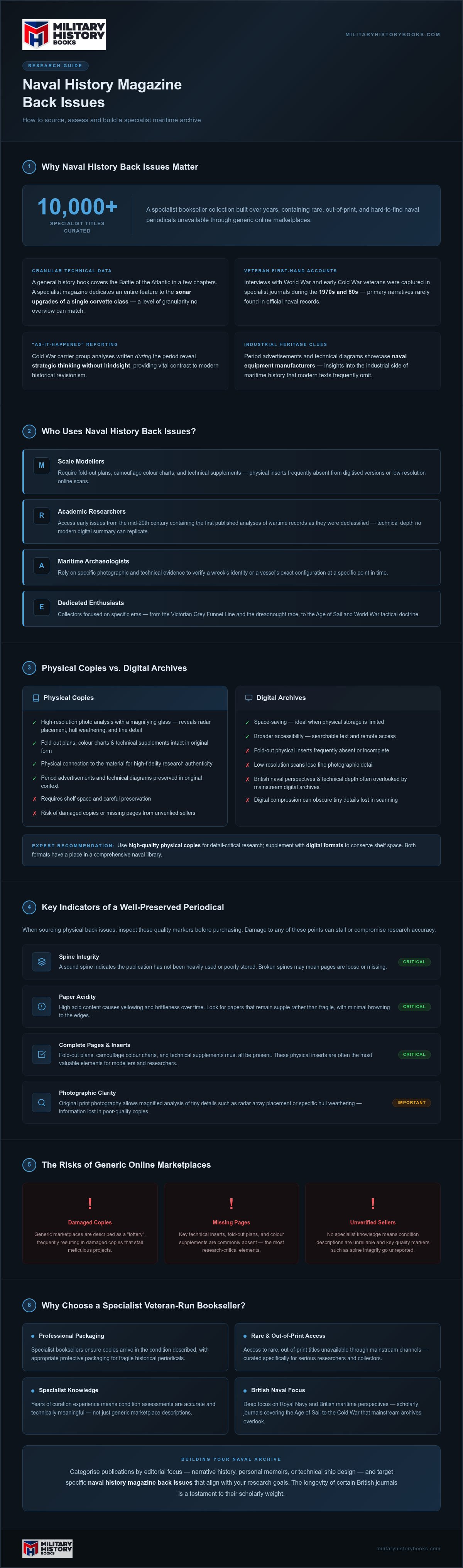
Naval history magazine back issues are more than just old paper; they are periodic snapshots of maritime scholarship and technical data. Whilst a general history book might cover the entirety of the Battle of the Atlantic in a few chapters, a specialist magazine often dedicates an entire feature to the specific sonar upgrades of a single corvette class. This level of granularity makes these publications indispensable for those who require more than a surface-level summary of events. They serve as a bridge between academic research and the dedicated enthusiast community, preserving details that larger volumes often overlook.
These archives are particularly valuable because they contain contemporary accounts and veteran interviews captured decades ago. Many of the individuals who served during the World Wars or the early Cold War shared their stories with specialist journals in the 1970s and 80s. These first-hand narratives provide a human element to the technical data, offering insights into daily life at sea that are rarely found in official naval records. For those involved in maritime archaeology or ship modelling, these magazines offer the specific evidence needed to verify a wreck's identity or a vessel's exact configuration at a specific point in time.
Primary Sources vs. Secondary Narratives
Magazines capture the evolving understanding of naval tactics whilst they were still active doctrine. Reading an analysis of carrier group movements written during the height of the Cold War reveals the strategic thinking of the era without the benefit of hindsight. This "as-it-happened" reporting provides a vital contrast to modern historical revisionism. Period advertisements and technical diagrams also offer a unique form of authenticity. These adverts often showcase the manufacturers of naval equipment, providing clues about the industrial side of maritime history that modern texts frequently omit. Whilst many publications exist, the Naval History magazine remains a foundational reference for those exploring global maritime events from a scholarly perspective.
The Utility for Scale Modellers and Researchers
For the dedicated modeller, these publications are a primary resource for accuracy. Many naval history magazine back issues included fold-out plans, camouflage colour charts, and technical supplements. These physical inserts are frequently missing from digitised versions or low-resolution scans found online. Researchers often prefer physical copies because they allow for high-resolution analysis of photographs. Using a magnifying glass on an original print can reveal tiny details, such as the placement of a specific radar array or the subtle weathering on a hull, which are often lost in digital compression. This physical connection to the material ensures that your reference library remains a reliable tool for high-fidelity research.
Essential Titles for a Comprehensive Naval Library
Building a curated reference library is an exercise in discernment. Whilst general history books offer a broad overview, the true depth of maritime research is often found in the archives of specialist journals. Categorising these publications by their editorial focus is the first step for any serious collector. Some titles prioritise narrative history and personal memoirs, whilst others serve as technical repositories for ship design and naval architecture. Understanding this distinction helps you target specific naval history magazine back issues that align with your research goals.
The longevity of certain British journals is a testament to their scholarly weight. Early issues from the mid-20th century remain highly sought after because they often contain the first published analyses of wartime records as they were declassified. These technical military publications represent a vital subset of the market, offering a level of detail that modern digital summaries simply cannot match. If you are searching for a specific volume to complete a set, our collection of over 10,000 titles is a reliable place to browse for rare editions.
Specialist Royal Navy and Maritime Journals
British naval publications have a long-standing legacy of academic excellence, providing a deep-seated perspective on the Royal Navy's global influence. These journals often focus on specific eras, from the strategic complexities of the Age of Sail to the technological shifts of the World Wars. For those researching the Victorian 'Grey Funnel Line' or the dreadnought race, these periodicals are essential. They function best when paired with authoritative naval history books, which provide the broader context for the granular details found in the magazines.
Modelling and Technical Naval Periodicals
There is a significant crossover between historical research and the world of scale modelling. Many researchers rely on specific modelling magazines military enthusiasts use for their technical accuracy. These titles are prized for providing high-resolution ship plans, precise camouflage patterns, and armament layout changes that occurred during mid-commission refits. Identifying rare ship variants often requires cross-referencing multiple naval history magazine back issues to track how a vessel's silhouette evolved over its service life. These technical journals provide the visual evidence needed to ensure a model or a historical paper is as accurate as possible.
Physical Back Issues vs. Digital Archives: A Comparison
Deciding how to store a collection involves balancing accessibility with preservation. Whilst digital archives offer convenience, many naval history magazine back issues are best appreciated in their original physical form. A primary concern is longevity. You can pull a 1950s journal from a shelf and read it instantly, yet a 1990s floppy disc or an obsolete file format often requires specialist hardware to recover. Print is a proven long-term storage medium that doesn't rely on evolving software or hardware compatibility.
The Case for Physical Print
For those studying maritime art or complex photography, the tactile quality of paper is unmatched. Original print runs capture the subtle nuances of colour and shading that low-resolution scans often flatten. Researchers also find that spreading multiple physical pages across a desk makes cross-referencing easier than toggling between digital tabs on a screen. Beyond utility, there's the inherent value of ownership. Well-preserved periodicals, much like rare military history books, can appreciate in value whilst serving as a permanent anchor for your reference library.
The Advantages of Digital Titles on Disc and Download
Digital formats excel when speed and searchability are the priority. If you need to find every mention of a specific destroyer or a particular engagement date, optical character recognition (OCR) allows you to scan thousands of pages in seconds. This is particularly useful for urgent research projects where immediate access is required. We provide digital titles via download and on disc, ensuring that even those with limited shelf space can maintain a vast archive. We organise these digital collections logically, mirroring the experience of a physical library without the physical footprint. Many collectors now adopt a hybrid approach, using digital files for quick data retrieval whilst keeping physical copies of their most significant references for deep, uninterrupted study.
How to Source and Preserve Rare Naval Periodicals
Sourcing naval history magazine back issues is a task that requires more than a simple search on a generic marketplace. Whilst these platforms host thousands of listings, they frequently lack the technical oversight needed for serious historical research. A non-specialist seller might describe a copy as "excellent" based solely on a clean cover, yet they may fail to notice that a vital technical insert or a loose-leaf map is missing. For a researcher or modeller, these supplements are often the most valuable part of the publication. Finding a reputable source means looking for sellers who understand the historical weight of the material and can verify the completeness of every volume before it reaches your shelf.
Identifying Completeness and Condition
When evaluating a potential addition to your library, focus on the physical indicators of its history. Check the spine for signs of "spine lean" or cracking, which often results from decades of improper vertical storage. Page acidity is another concern; newsprint paper from the mid-20th century is prone to becoming brittle and yellowed if it wasn't kept in a climate-controlled environment. Specialist sellers, particularly those with a background in wartime history books UK researchers trust, will have already vetted their stock for these issues. They can also distinguish between an original first-run printing and a later, lower-quality reprint, ensuring your archive remains an authentic primary resource.
Professional Preservation Techniques
Professional storage is the only way to prevent the gradual decay of your naval history magazine back issues. Foxing, the rust-coloured spots caused by fungal spores reacting with moisture, is a persistent threat in the UK. To combat this, you should follow a few archival standards:
- Use individual acid-free polypropylene sleeves to shield paper from atmospheric pollutants and handling oils.
- Store your magazines horizontally in archival-grade boxes to support the weight of the page block and prevent staples from tearing.
- Maintain a cool, dry environment with stable humidity to prevent the paper fibres from swelling or warping.
Avoiding attics or damp basements where moisture can seep into the paper is essential for long-term preservation. If you have a complete annual run, professional binding can provide an extra layer of protection and make the volumes easier to consult on a shelf. This methodical approach ensures that your collection remains readable for future generations of maritime enthusiasts. If you're ready to add high-quality, professionally handled titles to your collection, view our latest arrivals of naval periodicals.
Why Choose a Specialist for Your Naval History Collection?
Sourcing historical material shouldn't be a gamble. When you choose a specialist, you're tapping into a curated archive rather than a random pile of stock. Our business is managed by an RAF veteran who understands the precision required for military research. With over 10,000 titles in stock, we provide a level of expertise that generic marketplaces simply cannot match. Every item in our collection is treated as a piece of history, ensuring that the naval history magazine back issues you receive are complete, well-preserved, and ready for your reference library. We take pride in being a reliable alternative to unverified sellers, offering a steady and informative presence that respects the intelligence of our readers.
Expert Curation by Military History Enthusiasts
A veteran's eye for detail ensures that our inventory meets a higher standard. We don't just list titles; we understand the contents and their historical significance. This knowledge allows us to offer a personalised service for those searching for specific, hard-to-find issues that might not be visible in our current online catalogue. Whether you're looking for technical data on a Victorian ironclad or the best naval fiction books to round out your collection, our breadth of knowledge spans across maritime, aviation, and land warfare history. This expertise ensures that every technical supplement, fold-out plan, and map is accounted for before an issue is listed for sale.
Secure Global Access to Naval Heritage
We recognise that collectors and researchers are located all over the world. Our commitment to secure international delivery means your items are protected by professional packaging designed to prevent transit damage. We use sturdy, oversized materials to ensure that corners remain crisp and spines stay intact during their journey across the United Kingdom or overseas. It's our goal to act as a reliable bridge between the past and the modern enthusiast, preserving maritime stories for the next generation. We encourage you to stay informed about our latest acquisitions by signing up for updates as we regularly add new naval history magazine back issues to our naval archives.
Browse our full range of naval history magazine back issues at Military History Books
Advancing Your Maritime Research
Building a comprehensive archive requires moving beyond general summaries to the specific, granular detail found in naval history magazine back issues. These periodicals serve as essential repositories for technical data, first-hand accounts, and ship schematics that larger history volumes often overlook. Whether you're a scale modeller seeking precise camouflage patterns or a researcher verifying primary narratives, the right collection provides a level of depth that mainstream digital archives simply don't offer. By adopting a hybrid approach of physical print for study and digital formats for searchability, you can ensure your library is both functional and enduring.
As a veteran-owned and operated specialist, we manage a collection of over 10,000 military history titles, ensuring every item is expertly packaged for secure national and international delivery. Don't settle for incomplete copies or damaged arrivals from unverified sellers. Explore our extensive archive of naval history magazine back issues to find the rare and out-of-print titles that will complete your collection. We're here to help you preserve these vital maritime stories and technical legacies for years to come.
Frequently Asked Questions
Are naval history magazine back issues a good investment for collectors?
Naval history magazine back issues often appreciate in value when they are well-preserved and contain rare technical supplements that are missing from modern reprints. Collectors prize early volumes from the mid-20th century because they capture first-hand accounts that are no longer available. Whilst the market fluctuates, complete runs of specialist journals in excellent condition remain highly sought after by academic researchers and maritime museums across the United Kingdom.
What are the most sought-after titles in naval history periodicals?
The most desirable titles are typically those that offer granular detail on ship design and naval warfare. Long-standing British journals are particularly popular amongst Royal Navy enthusiasts for their scholarly depth. Additionally, technical modelling periodicals that include original camouflage charts and deck plans are in high demand. These publications provide the visual evidence required for high-fidelity research, making them a cornerstone for any comprehensive maritime library or professional archive.
How can I tell if a back issue is missing its technical supplements?
You should always check the original table of contents or editorial page, which usually lists any loose-leaf maps, fold-out plans, or technical inserts. Non-specialist sellers often overlook these extras, leading to incomplete copies. At Military History Books, we manually inspect every issue to ensure that all supplementary materials are present. This expert vetting process protects your research from the frustration of finding a vital schematic is missing after your purchase.
Do you offer digital versions of out-of-print naval magazines?
We provide a wide range of digital titles available for immediate download or on disc to suit your research needs. This format is an excellent alternative for those with limited shelf space who still require access to rare, out-of-print material. Our digital collection is organised logically for ease of use, allowing you to search for specific ship names or historical dates without manually browsing through thousands of physical pages.
How do you ensure magazines are not damaged during international shipping?
We use professional packaging techniques specifically designed to prevent transit damage during national and international delivery. Every item is shielded by protective materials and placed in sturdy, oversized mailers to ensure that corners remain crisp and spines stay intact during their journey. As a veteran-run business, we understand the importance of preserving these historical records, so we never compromise on the quality of our shipping materials to protect your investment.
Can I request a specific issue of a naval magazine that isn’t listed online?
You are welcome to contact us with specific requests for hard-to-find issues that may not be currently visible in our online catalogue. With over 10,000 titles in stock, we often have unlisted material or can use our network to source rare volumes for you. This personalised service is a key benefit of choosing a specialist bookseller who understands the specific needs of the maritime research and modelling communities.
What is the difference between a standard magazine and a technical military publication?
A standard magazine usually focuses on narrative history and general interest articles for a broad audience. In contrast, a technical military publication provides blueprints, armament layouts, and specific performance data intended for researchers and scale modellers. These technical titles are often treated as primary sources because they contain the exact measurements and camouflage patterns used by shipyards and naval architects during a vessel's commission or refit.
Why should I buy from a specialist rather than a general marketplace like eBay?
Buying from a specialist ensures that you receive a vetted, complete copy rather than a gamble from an unverified seller. General marketplaces often host listings with inaccurate condition reports or missing technical inserts. As an RAF veteran-owned business, we provide a higher standard of inventory where we manually verify naval history magazine back issues for completeness. Our subject-matter expertise offers a reliable alternative for serious collectors who value accuracy and preservation.


