

What if the most enduring legacy of the Crusades wasn't found in theology, but in the brutal, brilliant laboratory of the Levantine battlefield? While many focus on faith, the reality of crusading warfare was a sophisticated exchange of military science that forced Western and Eastern traditions to collide, adapt, and innovate. It's a subject that demands more than just a surface-level summary of kings and clerics.
It's often frustrating to navigate the oversimplified narratives or the conflicting troop numbers found in common historical accounts, especially whilst searching for rare, out-of-print specialist titles that offer genuine depth. You likely recognise that the true story lies in the technical details of armour, the logistics of desert marches, and the grit of the siege line. This article promises an in-depth exploration of the tactical innovations and siegecraft that defined centuries of conflict in the Holy Land. We'll examine how Western knights adjusted to Eastern mobility, the complex engineering of period siege engines, and the essential military literature that belongs in any serious researcher's library.
Key Takeaways
- Discover how the Levant served as a tactical laboratory where Western heavy cavalry and Eastern mobile archery merged into a unique form of crusading warfare.
- Learn to identify the strategic evolution of fortifications, moving from basic wooden mottes to the sophisticated concentric stone designs seen at Krak des Chevaliers.
- Understand the tactical discipline of the "marching square" and how infantry screens were essential for protecting cavalry whilst operating in the Levant.
- Identify essential historians and specialist literature to move beyond oversimplified narratives toward a more technical, "New Military History" perspective.
- Gain practical advice on sourcing rare out-of-print titles and using digital formats to build a comprehensive archive of technical military data.
Defining Crusading Warfare: More Than Just Holy War
To understand crusading warfare, one must look beyond the simplified chronicles of religious zeal and examine the technical evolution of a unique military science. It wasn't merely a series of disparate battles; it was a sustained, tactical interaction between Western feudal structures and Eastern mobile traditions. Whilst the First Crusade began as an irregular armed pilgrimage, the subsequent establishment of the Latin East required a shift toward institutionalised, professional warfare. This transition turned the Levant into a sophisticated theatre for military innovation where survival depended on rapid adaptation.
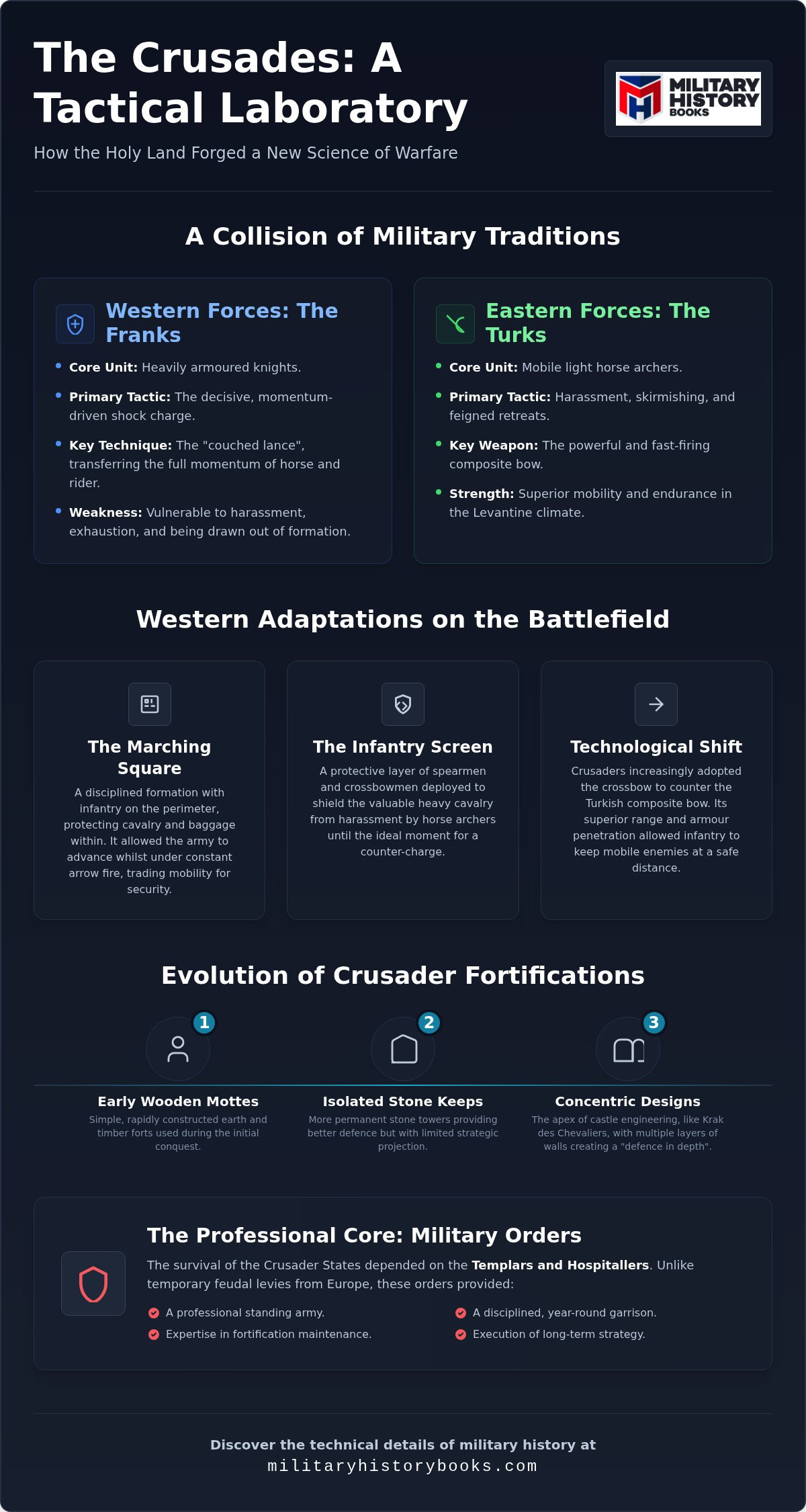
The backbone of this permanent military presence was found in the military orders, specifically the Templars and the Hospitallers. Unlike the temporary feudal levies of Europe, these orders functioned as professional standing armies. They provided the Latin East with a disciplined, year-round garrison capable of maintaining complex fortifications and executing long-term strategic goals. Their presence allowed for a level of tactical consistency that was otherwise impossible in a region where manpower was always at a premium.
The Geographical Constraints of Outremer
The narrow coastal strip of Outremer dictated a specific strategic behaviour. With the sea at their back and a thin line of settlements to defend, the Crusaders couldn't afford a war of attrition. The harsh Levantine climate also forced significant changes in logistics and equipment; Western knights had to manage the weight of their mail armour against the constant threat of heat exhaustion and dehydration. To compensate for their limited numbers, they adopted a "defence in depth" strategy, relying on a network of intervisible fortifications to control the landscape with minimal troops.
The Collision of Military Traditions
Combat in the Holy Land was defined by the contrast between Frankish heavy cavalry and Turkish light horse archery. The Westerners relied on shock tactics, whilst their opponents favoured fluid harassment and the feigned retreat. This environment also saw the integration of indigenous Christian forces, such as Armenian heavy cavalry and Maronite archers, who provided essential local knowledge and specialised skills. The Frankish charge functioned as a decisive but high-risk tactical tool that could shatter an opposing line in a single momentum-driven strike or leave the heavy cavalry dangerously exposed if the enemy refused to break.
For researchers looking to delve into these technical nuances, sourcing rare and out-of-print titles is often necessary to find the detailed analyses that general histories omit. Our collection of land warfare books includes specialist publications that explore these specific tactical evolutions in great detail.
The Tactical Laboratory: Infantry, Cavalry, and Combined Arms
The Levant functioned as a rigorous tactical laboratory where the survival of a force often depended on the seamless integration of infantry and cavalry. In the context of crusading warfare, the traditional European reliance on the knightly class had to be tempered by the reality of Eastern harassment tactics. This led to the development of the infantry screen, a protective layer of spearmen and archers designed to shield the heavy cavalry from the constant sting of horse archers until the moment of a decisive counter-strike.
Maintaining cohesion whilst on the move was perhaps the greatest challenge for Western commanders. The "marching square" became the standard response; a disciplined formation where infantry formed the outer perimeter, enclosing the baggage train and the cavalry. This allowed the army to advance under constant arrow fire without breaking ranks. It was a gruelling test of endurance, especially as Western armour was gradually lightened or covered with surcoats to mitigate the oppressive heat. To counter the rapid fire of the Turkish composite bow, Crusaders increasingly relied on the crossbow. Its superior range and penetration allowed infantry to keep horse archers at a distance, preventing the enemy from closing for a more lethal strike.
If you're interested in the technical specifications of medieval weaponry or the logistics of these formations, our land warfare books provide extensive detail on the development of these military systems.
The Role of the Heavy Cavalry Charge
The "couched lance" technique was the defining feature of the Latin knight. By tucking the lance firmly under the arm, the rider's momentum and the horse's weight were concentrated into a single point of impact. Timing was everything. A premature charge could lead to the knights being isolated and swarmed, whilst a well-timed strike could shatter even the most resolute line. Despite its psychological terror, the charge often failed against disciplined Muslim formations that refused to break, proving that shock tactics alone couldn't win a campaign in the East.
Infantry Formations and Resilience
Infantry units were far from being mere support; they were the anchor of the battlefield. Composed of spearmen and archers, these units utilised "shield wall" tactics that proved decisive at the Siege of Jerusalem and the Battle of Ascalon. By locking shields, they created a portable fortification that absorbed projectiles and repelled light cavalry. This defensive core was often supplemented by Turcopoles, indigenous light cavalry who served as scouts and skirmishers. These scouts provided the essential mobility and local knowledge that defined the hybrid nature of crusading warfare in the field.
Siegecraft and Fortification: The Strategic Role of Crusader Castles
The landscape of crusading warfare was defined by stone. Early Western arrivals brought the wooden motte-and-bailey designs familiar in Europe, but these proved inadequate against the Levantine climate and sophisticated Eastern siege techniques. This necessity led to a rapid evolution toward concentric stone fortifications. Castles like Krak des Chevaliers and Belvoir weren't merely passive shelters; they were offensive tools used to secure agricultural resources and establish a reliable tax base from the surrounding countryside. By controlling the high ground and vital water sources, a small garrison could dominate a vast territory and intercept enemy supply lines.
Western engineers heavily adapted Byzantine fortification techniques, incorporating double curtain walls and bent entrances to create lethal kill zones. This architectural sophistication was a direct response to the chronic lack of available manpower in the Latin East. A well-designed castle acted as a force multiplier, allowing a handful of knights and sergeants to hold out against significantly larger forces until relief could be organised.
Siege Engines and Technical Warfare
Technical superiority often decided the fate of a fortified city. The mangonel, a torsion-powered engine, provided traditional bombardment, but the introduction of the counterweight trebuchet changed the scale of destruction. These massive machines could hurl projectiles with enough force to shatter thick masonry from a safer distance. When walls held, engineers turned to mining and sapping; this involved digging tunnels beneath curtain walls and burning the support timbers to cause a structural collapse. Transporting siege towers across arid, uneven terrain remained a logistical nightmare, often requiring the local construction of these wooden giants using timber imported from Europe or Lebanon.
The Logistics of the Siege
Commanders faced a binary choice: the direct assault or the "starve them out" strategy. A direct assault was high-risk and costly in men, whilst a protracted siege required immense supplies for the besiegers. Successful operations, such as the siege of Acre, demonstrated that a land investment was rarely sufficient without a naval blockade. Preventing the arrival of reinforcements and supplies by sea was vital for victory. For a deeper look at the maritime dimension of these conflicts, our naval history books offer comprehensive technical data on period galley warfare and transport logistics.
Researching the Crusades: Key Historians and Specialist Literature
Researching crusading warfare requires a deliberate shift away from the purely narrative focus of 19th-century chronicles toward the "New Military History" approach. This modern methodology, championed by historians like Christopher Tyerman, prioritises technical data, logistics, and social structures over simple heroic tales. To build a robust understanding, one must engage with primary sources like the Gesta Francorum, which offers a gritty, anonymous eyewitness account of the First Crusade. This should be balanced with the more analytical works of William of Tyre. These foundational texts provide the raw data that modern technical publications interpret to explain the "hardware" of the era, from the specific metallurgical properties of armour to the calculated density of arrow fire during a siege.
The Legacy of R.C. Smail
Raymond Charles Smail's seminal work remains the essential cornerstone of this subject. His analysis of the "field army" fundamentally changed medieval historiography by shifting the focus from isolated, dramatic battles to the sustained strategic behaviour of armies in the Levant. Smail demonstrated that Crusader forces weren't merely a collection of individualistic knights; they were integrated, disciplined units that relied on infantry screens for survival. His insights into the tactical necessity of combined arms remain vital for both academic historians and wargamers who require accurate models for historical simulation. It's a text that hasn't lost its relevance despite decades of subsequent research.
Modern Perspectives and Specialist Journals
Modern scholars like Jonathan Riley-Smith have expanded our knowledge by focusing on the institutional power and professional nature of the military orders. Gaining a granular understanding of the Templars and Hospitallers often requires looking into niche tactical studies and period-specific research. Such details are frequently found in back issue military magazines UK, which serve as a vital resource for collectors and researchers alike. These publications often feature archaeological reports that clarify the technical evolution of castle architecture or the effectiveness of the crossbow. To find these specialist texts and build a comprehensive personal archive, you can browse our collection of rare and out-of-print titles. This depth of material allows for a nuanced perspective that avoids the pitfalls of oversimplified or conflicting historical accounts.
Building Your Collection: Sourcing Rare and Specialist Crusading Books
Building a personal library is more than a hobby; it's a vital component of serious research into crusading warfare. Whilst modern reprints are accessible, identifying valuable first editions of crusading memoirs often reveals nuanced technical details that later editors might have omitted or simplified. Tracking down these out of print military books requires a methodical approach, as many of the most significant works were published in limited quantities by academic presses or specialist societies. A specialist bookseller acts as a curator in this process, helping you navigate the complex market of historical media to find the specific technical data you need for your archive.
Physical vs. Digital: The Researcher’s Dilemma
Researchers often face a dilemma between the tactile value of a rare hardback and the utility of digital formats. There is a robust collector's market for 19th-century crusading histories, where the physical condition and provenance of the volume add to its historical weight. However, for those conducting deep technical analysis, digital titles available by download or on disc offer indispensable benefits. These formats provide searchable technical data, allowing you to quickly cross-reference troop numbers or siege engine specifications across multiple volumes. Having an extensive archive on disc ensures that your primary sources remain accessible even when specialist physical copies are tucked away for preservation.
The Specialist Bookseller Advantage
Engaging with a shop managed by an RAF veteran provides a distinct advantage for military researchers. We understand that the technical details of crusading warfare, from the logistics of supply lines to the engineering of fortifications, are just as important as the overarching narrative. This expertise ensures that our collection is curated with the serious enthusiast in mind. To ensure these high-value rare titles reach you safely, we prioritise secure national delivery for all our collectors. For those looking to place these conflicts within a broader chronological framework, we invite you to browse our wartime history books UK collection. This wider context is often essential for understanding how the military science developed in the Levant influenced later European combat and fortification design.
Advancing Your Research into Levantine Conflict
The study of crusading warfare reveals a sophisticated landscape of military science where Western and Eastern traditions were forced into a constant state of adaptation. From the disciplined cohesion of the marching square to the architectural brilliance of concentric stone fortifications, the Levant served as a pivotal laboratory for tactical innovation. Gaining a true understanding of these complexities requires moving beyond surface-level narratives and engaging with the technical publications and rare primary sources that define the field.
Whether you're a serious researcher seeking out-of-print technical manuals or a dedicated collector of land warfare history, we're here to assist. Our inventory features over 10,000 military history titles, including rare and out-of-print editions curated with the specialist expertise of an RAF veteran. We prioritise secure national and international delivery for all our collectors, ensuring your archive grows with the highest quality material.
Explore our extensive collection of Land Warfare and Crusading History Books and discover the depth of military science preserved within our archive. We look forward to helping you find the next essential volume for your collection.
Frequently Asked Questions
What is the best book to start learning about crusading warfare?
R.C. Smail’s "Crusading Warfare (1097–1193)" is widely regarded as the essential starting point for any serious student of the period. Whilst general histories focus on religious motivations, Smail provides the technical foundation for understanding crusading warfare as a military science. His work details the transition from feudal levies to the professional field armies of the Latin East. For those building a research library, seeking out the second edition with Christopher Marshall’s updated introduction is highly recommended.
How did crusader armour differ from standard European armour of the time?
Crusader armour was essentially the same mail-based protection used in Europe, but it was adapted to survive the oppressive Levantine climate. Knights began wearing fabric surcoats over their mail to reflect the sun and prevent the metal from heating to dangerous temperatures. Under-layers were also modified to manage sweat and dehydration better. These practical adjustments were vital for maintaining combat effectiveness during the long, exposed marches that defined conflict in the Holy Land.
Were the Knights Templar the only professional soldiers in the Crusades?
The Knights Templar were certainly prominent, but they were not the only professional force. The Knights Hospitaller operated with similar discipline and permanent standing, whilst the secular knights of the Latin East also functioned as a professional military class. Additionally, the armies relied on Turcopoles, who were indigenous light cavalry, and various mercenary sergeants. Together, these groups provided the consistent, year-round military presence required to garrison the extensive network of Crusader fortifications and maintain strategic control.
Can I find rare first editions of crusading history books online?
Finding rare first editions is possible through specialist retailers who curate specific military archives. At Military History Books, we manage a stock of over 10,000 titles, including rare and out-of-print editions that are often difficult to source through general marketplaces. We provide secure national delivery for all collectors, ensuring that high-value historical memoirs and technical publications reach researchers in excellent condition. Our expertise as a veteran-managed shop helps us identify the most valuable editions for your collection.
What role did naval power play in crusading warfare strategy?
Naval power was the silent partner of the land campaign, providing the essential logistics and blockade capabilities needed for victory. Most major cities in the Levant were coastal, meaning they could only be taken if their sea-lanes were severed. Successful sieges, such as those at Acre and Tyre, relied heavily on Italian maritime republics to prevent the arrival of enemy supplies and reinforcements. Without this naval superiority, the Crusader states could not have maintained their thin coastal presence.
How did the introduction of the trebuchet change siege tactics in the Levant?
The counterweight trebuchet revolutionised siegecraft by providing the power necessary to breach sophisticated stone fortifications. Unlike earlier torsion-powered engines, the trebuchet used a massive swinging weight to hurl projectiles with immense force and improved accuracy. This allowed besiegers to batter curtain walls from a safer distance, forcing defenders to innovate with thicker masonry and more complex gatehouses. It turned sieges from simple blockades into highly technical engineering competitions between attackers and defenders on the battlefield.
Are there specialist magazines that cover medieval military modelling?
Specialist modelling magazines frequently feature medieval subjects, providing detailed guides on heraldry, armour textures, and siege engine construction. We offer a wide range of these publications, alongside back issue military magazines that serve as a rich resource for historical accuracy. These titles are particularly useful for those looking to recreate the specific tactical formations of crusading warfare in miniature, offering technical data and visual references that general history books might often overlook or simplify.
Why is R.C. Smail considered the most important historian for this topic?
R.C. Smail is considered pivotal because he was the first to analyse the Crusades through the lens of professional military science. Before his work, many accounts focused on religious fervour or the heroic actions of individuals. Smail shifted the academic focus toward the tactical reality of the "field army" and the essential role of the infantry screen. His methodology laid the groundwork for the "New Military History," which prioritises logistics, combined arms, and strategic behaviour over narrative storytelling.


