

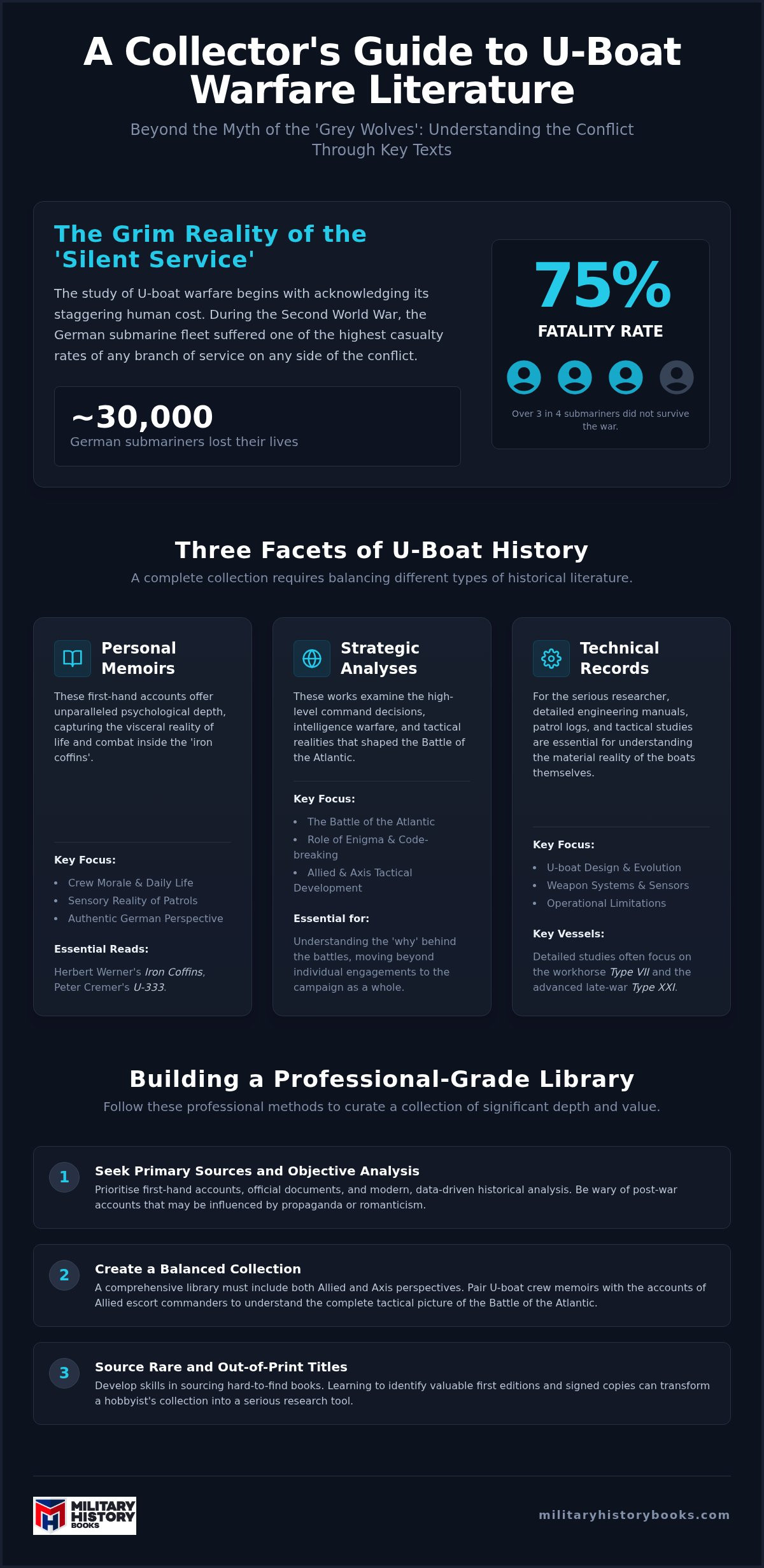
Approximately 30,000 German submariners were killed during World War II, a staggering figure that represents over 75% of the total number deployed. For the dedicated naval historian, these statistics are only the start of a much deeper story that requires the right reference material and a curated selection of U-boat warfare books. You likely recognise the frustration of sifting through generic accounts that gloss over the complex tactical realities of the Battle of the Atlantic or fail to capture the authentic German perspective.
This specialist guide identifies the most authoritative titles currently available, ranging from gripping first-hand memoirs to rare technical manuals essential for serious research. Whether you are looking for out-of-print gems or the latest scholarship, we provide the expertise needed to curate a library of significant depth. We will examine must-read primary sources, discuss strategies for sourcing rare maritime literature, and explain how to build a balanced collection of Allied and Axis perspectives that honours the historical weight of the subject matter.
Key Takeaways
- Identify the essential differences between strategic analyses, technical records, and personal memoirs to ensure your collection covers every facet of the naval conflict.
- Explore the psychological depth and historical authenticity of first-hand accounts written by the commanders who served within the German submarine fleet.
- Uncover the technical evolution of Type VII and Type XXI vessels by integrating detailed tactical studies and engineering manuals into your research.
- Learn the professional methods for sourcing rare and out-of-print U-boat warfare books, including how to identify valuable first editions and signed copies.
- Build a balanced maritime library that serves as both a dedicated hobby and a professional-grade research tool for studying the Battle of the Atlantic.
Understanding the Landscape of U-boat Warfare Books
The study of U-boat warfare books requires an appreciation for a diverse range of literary styles, from cold, data-driven technical records to the emotionally charged memoirs of those who served. These works don't just recount naval engagements; they document a fundamental shift in how wars were fought at sea. Early literature from the Kaiserliche Marine during the First World War often focused on the novelty of underwater craft, whereas the vast library of Kriegsmarine accounts from the Second World War reflects a more industrialised and brutal form of conflict.
Modern readers will find that the historical narrative has changed significantly over the decades. Immediate post-war accounts were sometimes coloured by the lingering effects of wartime propaganda, often portraying the submarine crews in a purely heroic or villainous light. Today, serious researchers look for objective historical analysis that separates myth from reality. To understand the broader History of U-boat Development, it's essential to look at how these vessels evolved from experimental prototypes into the formidable weapons that nearly severed Britain's lifeline.
The Battle of the Atlantic: A Literary Focus
The struggle for the Atlantic convoys remains the primary focus for naval historians because it was the longest and most strategically vital campaign of the Second World War. The "Silent Service" is a term often used in maritime literature to describe the clandestine, isolated nature of submarine life, where crews operated in a world of secrecy and extreme pressure. Modern U-boat warfare books now place a heavy emphasis on the role of Enigma and code-breaking, revealing how the hidden war of intelligence was just as decisive as the torpedoes fired in the mid-Atlantic gap.
German vs Allied Perspectives in Naval History
Building a comprehensive collection means looking beyond a single perspective. Whilst the accounts from U-boat crews provide a visceral look at life inside the "iron coffins", the memoirs of Allied escort commanders offer the necessary counterpoint to understand how the threat was eventually neutralised. Modern historians have worked hard to re-evaluate the "Grey Wolves" myth, moving away from romanticised portrayals toward a grounded understanding of the tactical failures and successes on both sides. For those researching the wider context of maritime conflict, our guide to naval history books provides a broader perspective on fleet engagements and strategic naval theory.
First-Hand Accounts: Life Aboard the 'Grey Wolves'
Primary source memoirs provide a psychological depth that official documents simply cannot match. Whilst a patrol report might record a successful torpedo hit or a depth-charge attack, it rarely captures the suffocating atmosphere of the "iron coffins". Authentic U-boat warfare books written by those who served offer a visceral look at the sensory reality: the stench of diesel, the constant damp, and the chilling silence of "silent running" when Allied destroyers were overhead.
Personal journals often fill the gaps left by sanitised military records. These accounts reveal the shifting morale of the crews as the war progressed. In the early years, the "Happy Time" is often described with a sense of professional pride and confidence. By 1943, the tone in these narratives shifts toward exhaustion and a grim acceptance of the staggering casualty rates. Finding these narratives is essential for any collector wanting to move beyond dry statistics. If you are looking for specific titles to round out your collection, you can browse our extensive naval history section for rare and out-of-print memoirs.
Essential Memoirs for the Serious Collector
Works by commanders like Herbert Werner (Iron Coffins) and Peter Cremer (U-333) are cornerstone texts for any specialist library. Werner’s account is particularly famous for its raw, controversial depiction of the war’s final years, providing a perspective that was often suppressed in official histories. These memoirs are indispensable for understanding naval tactics as they were applied in the heat of battle, rather than on a strategist's map. Sometimes, the line between reality and dramatisation blurs, which is why many enthusiasts also explore the best naval fiction books to see how these real-life experiences have influenced maritime prose.
The Human Element: Crew Journals and Letters
High-level strategic histories often overlook the common sailor. Books like Hans Goebeler’s Steel Boat, Iron Hearts focus on the daily life of the enlisted men amongst the U-boat fleet. These works detail everything from the struggle with skin conditions in the humid atmosphere to the intense bonds formed during weeks of isolation. Photographic histories are also vital here. They illustrate the incredibly cramped conditions that words alone sometimes fail to convey. These narratives provide a granular, human-centric view that serves as a necessary balance to the broader accounts of fleet movements and grand strategy.
Technical Analysis and Tactical Developments in Submarine Warfare
Serious collectors often find that narrative memoirs only tell half the story. To truly grasp the Battle of the Atlantic, one must study the mechanical evolution and tactical doctrine found in technical U-boat warfare books. These works move beyond the emotional experience of the crew to examine the cold realities of naval engineering and the rigid protocols of underwater combat. The transition from the Type VII, the reliable workhorse of the early war, to the revolutionary Type XXI "electro-boat" represents a massive leap in military technology that influenced submarine design for decades after 1945.
Understanding these developments requires an analysis of both German innovation and the Allied response. Books detailing the "Wolf Pack" formations explain how Admiral Dönitz sought to overwhelm convoy escorts through coordinated surface attacks. However, no study is complete without examining Allied anti-submarine warfare (ASW) developments. The introduction of centimetric radar, the Leigh Light, and advanced "Hedgehog" mortars fundamentally changed the tactical landscape, forcing the U-boat arm to adapt or face certain destruction.
Submarine Design and Engineering Records
For scale modellers, technical illustrators, and engineering enthusiasts, specialist naval literature provides the granular detail missing from general histories. These volumes often feature fold-out blueprints and intricate cutaway diagrams of internal machinery, from the MAN diesel engines to the complex electric motors used for submerged propulsion. These records are essential for understanding how crews managed limited oxygen and battery life under combat conditions. Interestingly, studying artillery history books can provide surprising technical insights into the development of U-boat deck guns and the ballistic challenges of engaging merchant vessels in heavy seas.
Tactical Manuals and Combat Reports
The U-boat Commander’s Handbook (U-Boot-Kommandanten-Handbuch) remains one of the most influential primary sources for historical research. It outlines the official doctrine for submerged attacks, night surfacing, and defensive manoeuvres. To see these tactics in action, researchers often turn to patrol logs, known as Kriegstagebuch (KTB). These logs offer a minute-by-minute account of tactical movements during a mission. A high-quality scholarly reference will cross-reference these German logs with Allied Admiralty records to provide a verified account of engagements. This level of technical accuracy is what differentiates a serious research tool from a standard "coffee table" book that might rely on broader, less precise summaries.
Sourcing Rare and Out-of-Print U-boat Titles
Many of the definitive U-boat warfare books were produced in limited print runs or published by specialist academic houses that no longer exist. These out-of-print titles frequently contain high-resolution tactical maps, veteran interviews, and technical appendices that modern mass-market editions often omit to save on production costs. Finding these requires moving beyond general marketplaces and engaging with specialist booksellers who understand the nuance of maritime literature. A professional curator can vet the condition of a rare volume, ensuring that internal plates and fold-out diagrams remain intact.
Collectors should also consider the value of contemporary reporting. Using resources like back issue military magazines UK allows researchers to access wartime analyses and photographic evidence that hasn't been filtered through decades of post-war revisionism. These periodicals often capture the evolving public and military perception of the submarine threat as it happened. If you are ready to expand your archive with verified specialist material, you can explore our collection of rare naval history books today.
The Hunt for Out-of-Print Naval Literature
Successful sourcing depends on an eye for bibliographical detail. When you find a potential addition to your library, verify the edition number and the publisher, as certain early printings are prized for their superior paper quality and clarity of photographs. Signed copies from naval veterans add significant historical and monetary value, but they require careful verification of provenance. For those just starting their search, our out of print military books guide offers a deeper look at the strategies used by professional collectors to track down obscure naval titles.
Preserving Your Naval History Collection
A specialist library is an investment that requires active preservation. Rare physical books are susceptible to damage from fluctuating humidity and direct sunlight, which can cause paper to become brittle or ink to fade. Serious researchers often adopt a dual approach, using digital copies for daily reference whilst keeping the physical first editions in a climate-controlled environment. The condition of the dust jacket and the integrity of the binding are the most critical factors in determining a book’s long-term value. Keeping these items in protective sleeves or acid-free boxes ensures that these stories of the submarine service remain preserved for future generations of historians.
Building Your Specialist Naval History Library
Curating a functional archive is a rewarding process that transforms a simple collection into a powerful research tool. A balanced selection of U-boat warfare books should ideally contain a mixture of high-level strategic overviews and granular technical manuals. Whilst strategy books provide the "why" behind fleet movements, technical records explain the "how" of submarine operations, from ballast tank mechanics to torpedo fire control. Effective research depends on how you choose to organise your military history books. Many collectors find that categorising titles by submarine type or specific year of the Atlantic campaign allows for a more logical progression when cross-referencing multiple sources.
Building this library requires patience and a keen eye for quality. We invite you to explore the curated collection at Military History Books, where our expertise as a specialist retailer helps you find the specific titles needed to complete your archive. Whether you are a dedicated researcher or a casual enthusiast, our inventory of over 10,000 titles offers the depth required for a serious study of naval conflict.
Digital vs Physical: The Modern Researcher’s Dilemma
The choice between digital and physical formats often depends on your specific research goals. Digital titles are exceptionally useful for word-searching through thousands of pages of text; this makes them an ideal tool for quickly locating specific patrol dates or technical specifications. They also offer portability for those who need to carry their library to archives or museums. However, the tactile value of a first-edition physical book is significant for preservationists. Holding a volume that has survived since the post-war era provides a tangible connection to the past. Many serious collectors now use digital downloads to supplement their physical collection, allowing them to protect their rare volumes whilst keeping the information accessible for daily use.
Gifting for the Naval Historian
Selecting a meaningful gift for a specialist collector can be challenging amongst the vast number of titles available. If the recipient already possesses the standard memoirs, consider looking for technical design records or rare out-of-print titles that offer a more niche perspective. For enthusiasts whose interests span multiple branches of service, aviation history gifts UK can provide an excellent alternative, particularly regarding the maritime patrol aircraft that played a decisive role in the Atlantic. Our secure international delivery ensures that these specialist items reach global naval collectors in pristine condition, regardless of their location.
Advancing Your Naval History Research
Building a comprehensive archive of the submarine service requires a deliberate balance between the visceral experiences of the crew and the objective precision of design manuals. By integrating rare first-hand accounts with detailed technical records, you gain a multi-dimensional understanding of the Battle of the Atlantic that single sources cannot provide. Preserving these physical volumes whilst utilising digital tools ensures your research remains both thorough and protected for years to come.
Finding the right U-boat warfare books is easier when you have a trusted guide to help you explore the vast landscape of maritime literature. Military History Books is managed by an RAF veteran with deep subject knowledge, offering an inventory of over 10,000 specialist titles in stock. Whether you're searching for a rare first edition or a technical patrol log, we provide secure global delivery to ensure your collection reaches you in pristine condition. Browse our extensive collection of Naval and U-boat warfare books to discover the next essential addition to your specialist library. We look forward to helping you preserve these vital human stories and technical achievements.
Frequently Asked Questions
What are the best U-boat warfare books for beginners?
Beginners should start with accessible narratives that provide a broad overview of the conflict. Das Boot by Lothar-Günther Buchheim is a classic entry point for its atmosphere, whilst general histories like The U-Boat War by David Miller offer a clear chronological framework. These titles help new readers understand the basic terminology and strategic context before they move on to more granular technical manuals or specific commander memoirs. It's an excellent way to build a foundation.
Where can I find rare first-edition U-boat memoirs?
Rare first-edition memoirs are best sourced through specialist military booksellers who can verify the provenance and condition of the volume. We maintain an inventory of over 10,000 titles, including many out-of-print naval histories that are difficult to find elsewhere. Collectors should look for retailers who understand the specific bibliographical details of wartime publications. You'll want to ensure you're acquiring a genuine first printing rather than a later, less valuable book club edition.
Are there any books that focus specifically on U-boat technology?
Yes, several authoritative volumes focus exclusively on design, engineering, and tactical equipment. The U-Boat by Eberhard Rössler is widely considered the definitive technical reference, covering every class of boat from early designs to the advanced Type XXI. These technical U-boat warfare books are essential for researchers and modellers who require precise details on diesel engines, torpedo types, and the evolution of radar-detection equipment throughout the war. They're vital for any serious technical library.
How accurate is the book Das Boot compared to real history?
Das Boot is highly regarded for its visceral accuracy regarding the atmosphere and psychological strain of submarine life. The author, Lothar-Günther Buchheim, served as a war correspondent on U-96, and his descriptions of the "iron coffin" conditions are based on his direct observations. Whilst it's a work of fiction, its portrayal of the technical procedures and the claustrophobic reality of a combat patrol is considered historically authentic by many veterans who served in the Kriegsmarine.
Can I buy digital versions of out-of-print naval history books?
You can access many rare and out-of-print naval titles through our digital catalogue. We offer a variety of digital titles available for immediate download or on disc, which provides an excellent way to access hard-to-find information without the cost of a rare physical volume. This format is particularly useful for researchers who need to search for specific terms or carry their entire library on a portable device. It's a modern solution for historical research.
What is the most comprehensive book on the Battle of the Atlantic?
Clay Blair’s two-volume series, Hitler's U-Boat War, is often cited as the most comprehensive study of the campaign. It provides an exhaustive account of every patrol and engagement, utilising both German and Allied records to build a complete picture of the conflict. This scholarly work is indispensable for anyone seeking a deep understanding of the strategic decisions and tactical shifts that defined the struggle for the Atlantic convoys. It's a cornerstone of modern naval history.
Do you offer international shipping for heavy naval history volumes?
We provide secure international delivery for our entire collection, including large-format technical volumes and multi-book sets. As a specialist retailer managed by an RAF veteran, we understand the importance of careful packaging to ensure that rare items arrive in pristine condition. Our global shipping service allows collectors from around the world to access our unique inventory of U-boat warfare books with confidence. You'll find that we don't compromise on the safety of your historical investment.
How can I tell if a military history book is a rare first edition?
Identifying a true first edition requires checking the publication details on the copyright page, often looking for a specific sequence of numbers or the absence of later printing dates. The presence of the original dust jacket and the name of the primary publisher are also key indicators of value. Serious collectors often consult specialist bibliographies to confirm that the binding and internal plates match the known characteristics of the first printing. It's a meticulous but rewarding process.


