

Why does the Iron Duke continue to command such a formidable presence on our bookshelves long after the smoke has cleared from the fields of Waterloo? You've likely found that while there's no shortage of material, the real challenge lies in sifting through generic accounts to find the expert-level tactical analysis your collection deserves. It's frustrating to spend hours searching for a specific campaign memoir only to end up with another surface-level biography that lacks the technical depth of true military scholarship.
We understand that building a definitive library requires more than just a few modern paperbacks. This guide will help you discover the most authoritative Duke of Wellington books, ranging from rare first editions to the latest academic breakthroughs. You'll learn how to identify valuable out-of-print titles and understand the vital differences between life-spanning biographies and campaign-specific studies. We've curated this selection to ensure your personal archive reflects the authentic, technical voices of the Napoleonic era rather than outdated Victorian hagiography. By the end of this article, you'll have a clear roadmap for acquiring the literature that truly honours Wellesley's complex legacy.
Key Takeaways
- Learn how to distinguish between rigorous modern scholarship and outdated hagiography by prioritising primary source usage and tactical clarity in your research.
- Discover the essential Duke of Wellington books for a definitive library, comparing Elizabeth Longford’s narrative prose with Rory Muir’s academic depth.
- Gain a more sophisticated understanding of the Peninsular War and Waterloo by integrating specialist artillery history books and detailed campaign studies into your reading list.
- Master the technical aspects of sourcing rare editions, including how to verify original fold-out maps and identify significant out-of-print memoirs.
- Understand the benefit of building a collection through a specialist veteran-owned curator who prioritises the preservation of authentic military history over mass-market appeal.
What Makes a Definitive Duke of Wellington Book?
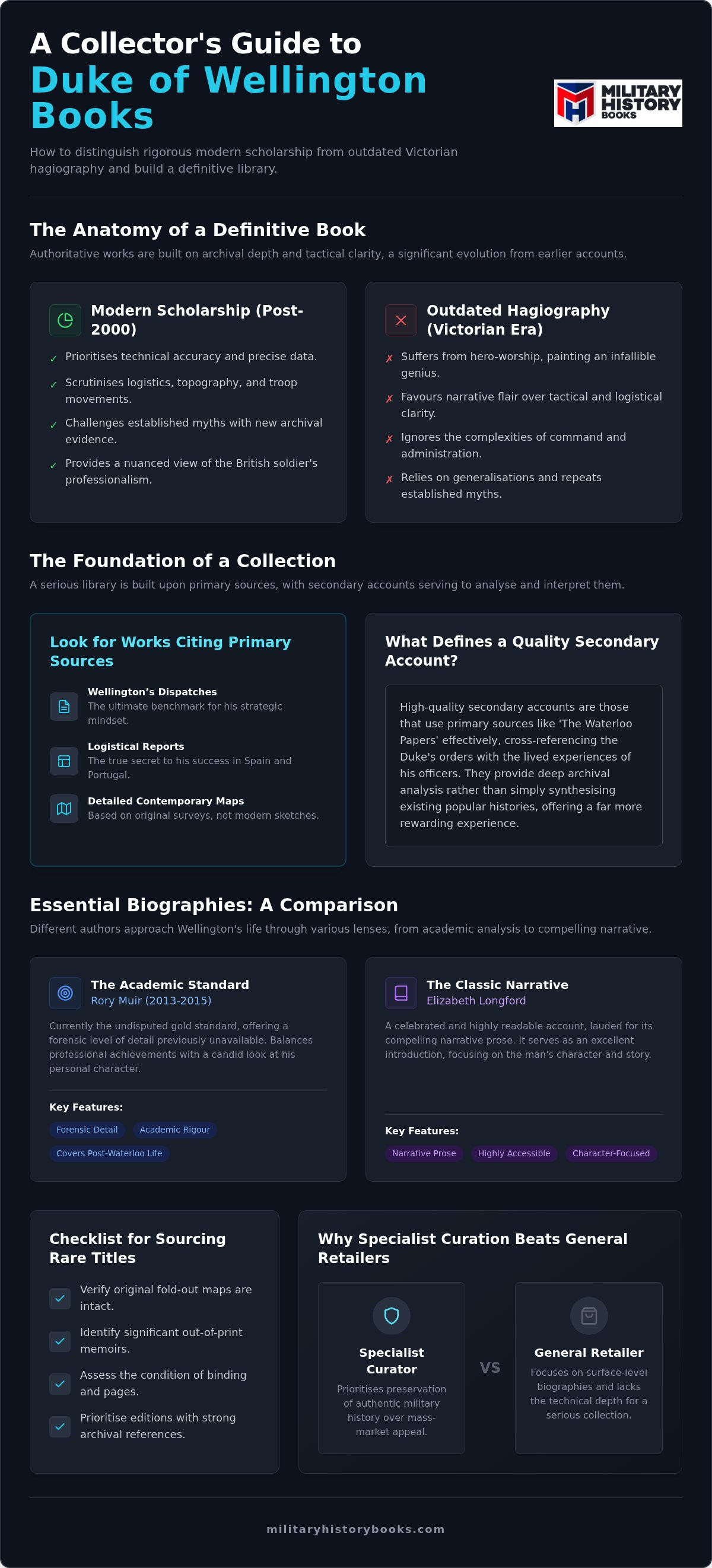
Identifying a truly authoritative work amongst the vast sea of Duke of Wellington books requires a discerning eye for archival depth. A definitive biography doesn't just recount dates; it provides tactical clarity and relies heavily on primary source evidence. For the serious collector, it's essential to distinguish between titles that focus on Wellington the politician and those that examine Wellington the commander. A specialist military history book is one that prioritises technical accuracy over narrative flair.
Since the year 2000, contemporary scholarship has undergone a revolution. Historians have moved away from repeating established myths, instead scrutinising the logistics, topography, and troop movements that defined the Iron Duke's success. This shift has replaced generalisations with precise data, making modern works indispensable for those seeking a realistic portrayal of 19th-century warfare. These newer accounts often challenge the "Scum of the Earth" narrative, providing a more nuanced view of the British soldier's professionalism.
The Evolution of Wellingtonian Literature
Wellingtonian literature has matured significantly since the Victorian era. Early accounts often suffered from hero-worship, painting a picture of an infallible genius whilst ignoring the complexities of his command. Today, modern objective analysis has taken centre stage, fuelled by a deeper exploration of the Peninsular War archives. These records have allowed writers to reconstruct battles with unprecedented accuracy. The rise of digital titles has also ensured that even the most obscure Duke of Wellington books, once hidden in private collections, are now accessible to researchers and hobbyists alike.
Primary Sources vs Secondary Accounts
The foundation of any serious Wellington library rests upon primary sources. Wellington’s own dispatches remain the ultimate benchmark for understanding his strategic mindset and administrative burden. High-quality secondary accounts are those that utilise 'The Waterloo Papers' effectively, cross-referencing the Duke's orders with the lived experiences of his officers. We find that land warfare books with deep archival roots provide a far more rewarding experience than those that simply synthesise existing popular histories. Look for authors who engage with:
- Original correspondence and orders of the day to understand decision-making in real-time.
- Detailed maps based on contemporary surveys rather than generic modern sketches.
- Logistical reports regarding supply lines, which were the true secret to Wellington's success in Spain and Portugal.
This commitment to primary evidence separates a standard biography from a work of lasting historical value. By focusing on these technical details, you ensure your collection serves as a reliable reference for years to come.
Essential Biographies: Understanding the Man Behind the Image
Selecting the right Duke of Wellington books requires an understanding of the different lenses through which historians view his life. Some authors focus almost exclusively on the tactical genius of the Peninsular War, whilst others delve into the complexities of his later political career. To appreciate the full scope of his influence, it helps to view these works within the wider context of military biography books, which track the evolution of leadership styles across the centuries. Whether you seek a technical breakdown of his command or a nuanced portrait of his personal character, the following titles represent the pinnacle of Wellingtonian scholarship.
The Modern Academic Standard
For the serious researcher, Rory Muir’s definitive two-volume biography is currently the undisputed gold standard. Published between 2013 and 2015, these volumes offer a level of forensic detail that was previously unavailable. Muir balances Wellington’s professional achievements with a candid look at his personal character, avoiding the hagiography common in earlier works. He provides an extensive analysis of the Duke’s post-Waterloo years, which are often overlooked. His time as Prime Minister and his role in the House of Lords are integrated into a cohesive study of a man dedicated to public service. This academic rigour makes his work essential for anyone building a serious collection.
Classic Narratives and Literary Merit
Whilst modern scholarship offers precision, the enduring legacy of Elizabeth Longford’s prose remains unmatched for its narrative power. Her two-volume set, 'Years of the Sword' and 'Pillar of State', helped define the 'Iron Duke' image for the 20th century. Longford had a unique ability to humanise her subject, drawing on family archives to present a vivid, accessible portrait. These books are perfect for those new to Napoleonic history who want to understand the man before diving into technical campaign studies.
Collectors often seek out-of-print biographical essays from this era, as they frequently offer unique perspectives or character sketches that modern, more clinical accounts might omit. If you are looking to expand your library with these foundational texts, you can browse our curated selection of out-of-print land warfare titles to find well-preserved editions that capture these classic perspectives. Ultimately, a balanced library should include both the narrative flair of the mid-20th century and the archival depth of contemporary works. This combination allows you to see both the legendary figure and the practical, often embattled commander who shaped the map of Europe.
Tactical Analyses: Campaign Studies of the Peninsular War and Waterloo
Beyond the personal life of the commander lies the technical reality of his victories. For many collectors, the most rewarding Duke of Wellington books are those that dissect the mechanics of his campaigns with surgical precision. These works move past the "great man" theory to explore the logistics, topography, and unit-level decisions that determined the fate of Europe. Understanding the friction of war requires a library that values technical depth over popular generalisations.
The Peninsular War: Wellington’s Tactical Masterclass
The conflict in Spain and Portugal from 1808 to 1814 was where Wellington truly mastered the art of defensive-offensive warfare. Specialist literature on this period often focuses on the Lines of Torres Vedras, a feat of engineering and strategic patience that saved Lisbon from Masséna’s advance. To understand how thin red lines consistently broke the French columns, readers should consult detailed land warfare books that analyse infantry formations and skirmishing tactics. These technical accounts are particularly valued by wargamers and modellers who require exact data on troop placements, supply routes, and uniform details for historical accuracy.
Wellington's success wasn't just about the infantry; it was about the synergy between different branches of service. Incorporating artillery history books into your study is vital for understanding the "King of Battle." These texts explain how the Royal Horse Artillery provided the mobile firepower necessary to disrupt Napoleon’s massed batteries. This technical detail is often glossed over in broader narratives but remains crucial for anyone wanting to grasp the full tactical picture of the 19th-century battlefield.
Waterloo: The Final Confrontation
Waterloo remains the most documented battle in history, yet new perspectives continue to emerge through rigorous archival research. A comprehensive library needs to balance minute-by-minute tactical accounts with strategic overviews that include British, Allied, and Prussian perspectives. Modern Duke of Wellington books now give proper weight to the role of Blücher’s forces and the multi-national composition of the Anglo-Allied army, correcting the Anglo-centric bias of earlier centuries.
Specific studies on the defence of Hougoumont and La Haye Sainte are essential for understanding the grit required to hold the line under intense pressure. These technical publications use contemporary maps and archaeological findings to clarify terrain and troop movements. By studying these micro-histories, you gain a clearer picture of how a few thousand men held the key to an entire campaign. This level of detail transforms a casual interest into a deep, expert-level understanding of the final confrontation that ended the Napoleonic Wars.
A Checklist for Sourcing Rare and Out-of-Print Wellingtonian Titles
Sourcing rare Duke of Wellington books is a pursuit that combines historical research with the keen eye of a curator. Moving beyond modern reprints into the world of antiquarian and out-of-print titles requires a methodical approach to ensure the historical integrity and value of your library. When you're evaluating a potential addition to your collection, use this technical checklist to verify its quality:
- Verify original maps: Many 19th-century tactical studies included intricate fold-out diagrams. Ensure these haven't been removed or torn, as their absence significantly devalues the work and hinders your understanding of the battlefield.
- Confirm the edition: Whilst a first edition is the collector's prize, a second or third edition published during Wellington’s lifetime might contain vital revisions or additional dispatches that offer a more complete picture.
- Check for regimental details: Look for technical manuals or regimental histories that mention Wellington’s specific commands. These often provide granular data that general biographies omit.
- Assess physical preservation: Examine the binding for spine strength and check the pages for "foxing" or acidic damage. A well-preserved volume is a bridge to the past that deserves careful handling.
To navigate these complexities, it's helpful to consult a specialist guide on out of print military books, which provides deeper insight into the nuances of sourcing rare titles in the current market.
Identifying First Editions and Collector Value
Identifying true collector value requires knowledge of 19th-century military publishing houses, such as T. Egerton or John Murray. These publishers were the primary conduits for Wellington’s official dispatches and early campaign memoirs. Author-signed copies are exceptionally rare in Napoleonic literature, so it's vital to distinguish between an authentic signature and a printed facsimile. Rare land warfare titles maintain their value amongst UK collectors because they were often printed in limited runs for a professional military audience. This scarcity, combined with a growing interest in technical Napoleonic history, makes these volumes stable and rewarding investments for your personal archive.
Where to Find Specialist Out-of-Print Titles
General marketplaces often lack the technical expertise required to accurately describe a rare military text. They don't always understand the significance of a specific plate or the nuance of a particular binding. This is where buying from a veteran-owned specialist shop provides a distinct advantage. With a background in the RAF and a passion for preserving military stories, a specialist curator can verify the technical accuracy of a title before it reaches your shelf. If you're looking for a specific volume that isn't currently listed, you can often request a search service to track down elusive memoirs or out-of-print campaign studies. We invite you to explore our current inventory of rare land warfare titles to find the next cornerstone of your Wellingtonian collection.
Why Specialist Curation Beats General Retailers
Algorithms can suggest titles based on popularity, but they cannot evaluate the historical rigour or tactical depth of a specific volume. When you’re searching for Duke of Wellington books, the guidance of a human curator who understands the nuances of land warfare is invaluable. Military History Books isn't just a retailer; it’s a dedicated archive managed by an RAF veteran with over 10,000 titles in stock. This specialist knowledge ensures that every book in our collection, from rare out-of-print memoirs to modern tactical studies, meets a high standard of accuracy. We don't just move inventory; we preserve the technical details of the past.
Supporting an independent UK business means you’re contributing to the preservation of wartime history books UK collectors rely on for their research. We focus on the 'hidden gems' that general retailers often overlook, such as regimental records or technical artillery manuals that provide the granular detail serious enthusiasts crave. These are the texts that turn a general interest into true expertise.
The Personal Touch in Military History
A veteran’s perspective adds a layer of understanding that goes beyond academic study. It’s about recognising the logistical burdens and command pressures that Wellington faced, which helps in selecting titles that offer a realistic portrayal of military life. Our mission is rooted in preservation and education, ensuring that the stories of those who served aren't lost to time. We provide a personalised service for global collectors and local UK researchers alike, often assisting individuals in finding that one elusive title needed to complete a specific area of study. You won't find that level of dedication in a mass-market warehouse.
Building a Cohesive Napoleonic Library
Building a definitive library is a journey from owning a collection of books to maintaining an organised historical archive. A cohesive setup often combines physical, rare editions with digital titles available on disc or via download. This hybrid approach allows you to preserve valuable out-of-print material whilst using digital copies for everyday cross-referencing and tactical mapping. We’re here to help you bridge the gap between the past and modern scholarship. We invite you to explore our curated Duke of Wellington collection today and find the authoritative works your library deserves.
Building Your Definitive Wellingtonian Archive
Curating a library that truly honours the legacy of the Iron Duke requires a balance between modern academic rigour and the technical voices of the past. You've seen how identifying primary sources and tactical clarity can transform a collection of biographies into a formidable historical archive. By prioritising works that offer deep archival roots and expert campaign analysis, you ensure your research remains grounded in the technical realities of 19th-century warfare. Whether you're seeking a first edition of a Peninsular memoir or the latest two-volume scholarly study, the right selection of Duke of Wellington books will provide clarity for years to come.
At Military History Books, we're dedicated to helping you find those essential volumes that general retailers often overlook. Managed by an RAF veteran with expert knowledge, our shop offers over 10,000 specialist military titles, ranging from rare out-of-print gems to the latest technical publications. We provide secure UK-based shipping to ensure your valuable finds arrive in pristine condition. We invite you to browse our specialist collection of Duke of Wellington books today. Start building an archive that preserves these vital stories for the next generation of historians.
Frequently Asked Questions
What is considered the best biography of the Duke of Wellington?
Rory Muir’s two-volume biography is widely regarded as the most authoritative modern account for serious researchers. It offers forensic archival depth that surpasses earlier works. For those who prefer a more narrative style, Elizabeth Longford’s 'Years of the Sword' and 'Pillar of State' remain essential classics. Both authors provide different but equally valuable perspectives on the Iron Duke's life, ensuring your library covers both academic rigour and literary merit.
Are there any books that focus specifically on Wellington’s tactics at Waterloo?
Several technical publications focus exclusively on the tactical nuances of the 1815 campaign. You should look for minute-by-minute accounts that utilise archival maps and troop movement diagrams. These Duke of Wellington books often examine specific sectors, such as the defence of Hougoumont. Specialist land warfare books are particularly useful here, as they dissect the synergy between infantry, cavalry, and artillery that proved decisive on the day.
How can I find out-of-print books about the Peninsular War?
Finding out-of-print titles requires moving beyond general marketplaces and consulting specialist booksellers. We maintain an inventory of over 10,000 titles, many of which are rare accounts of the Peninsular War that aren't available through mass-market retailers. You can also utilise specialist search services provided by veteran-owned shops. These experts understand the significance of specific editions and can verify the presence of original maps before you make a purchase.
Does the Duke of Wellington have any published memoirs or diaries?
Wellington famously refused to write a traditional memoir, stating that he had no desire to engage in the "hagiography" common amongst his contemporaries. Instead, his official 'Dispatches' provide a comprehensive, day-by-day record of his military and political life. These multi-volume collections are the foundational primary source for any serious study. They offer a direct window into his strategic mindset, logistical burdens, and the immense administrative pressure he managed throughout his career.
What are the most valuable rare books for a Wellington collector?
The most valuable items for a collector are usually first editions of the 'Dispatches' or early 19th-century memoirs from his senior officers. Volumes containing original, hand-coloured fold-out maps or technical diagrams of fortifications are particularly prized. Books published by T. Egerton or John Murray during the Napoleonic era often command higher values. These rare items serve as both historical documents and tangible links to the era's significant military achievements.
Are digital versions of rare military history books worth buying for research?
Digital versions are exceptionally useful for researchers who need to cross-reference multiple texts without risking damage to a fragile physical copy. They allow for rapid keyword searching and are often more affordable than sourcing rare original editions. At Military History Books, we offer digital titles via download or on disc. This allows you to build a comprehensive reference library that supports modern research whilst preserving your physical collection for future generations.
How do I identify a first edition Napoleonic military book?
Identifying a true first edition requires checking the title page for specific 19th-century publishers like T. Egerton or John Murray. You should also verify that the publication date matches the known first printing and check for the presence of all original plates and maps. Specialist booksellers can help identify these markers, ensuring you don't mistake a later reprint for a collector's prize. The physical quality of the paper and binding also provides vital clues.
Why should I buy from a specialist military bookshop instead of a large retailer?
Specialist shops offer a level of curation and technical expertise that large retailers simply cannot match. Managed by an RAF veteran, we understand the historical weight of the material and can provide accurate descriptions of a book's tactical value. We focus on the preservation of military stories rather than just moving inventory. Supporting an independent UK business ensures that rare and out-of-print titles remain accessible to the dedicated community of researchers and collectors.


