

A true understanding of the 1982 Falklands conflict requires much more than a cursory glance at mainstream headlines or general summaries. Many enthusiasts find themselves frustrated by repetitive narratives that lack the technical grit or the intimate perspectives of those who actually served. You might have already scoured collections of Gulf War history books or broader 20th-century studies, only to find that the specific, granular details of the South Atlantic campaign remain elusive. It's a common struggle for the serious researcher to track down those rare unit histories and technical manuals that truly bring the era to life.
This guide promises to bridge that gap by introducing you to the definitive specialist resources and rare publications needed to master this subject in unparalleled depth. We'll explore expert-curated recommendations that move beyond the basics, focusing on the technical complexities of the air and sea war alongside deeply personal memoirs. Whether you're looking to access out-of-print titles or want to build a professional-grade personal library, you'll find the historical insights required to appreciate the full weight of this unique conflict. We'll look at everything from primary source diaries to specialist modelling magazines that capture every tactical decision and technical detail.
Key Takeaways
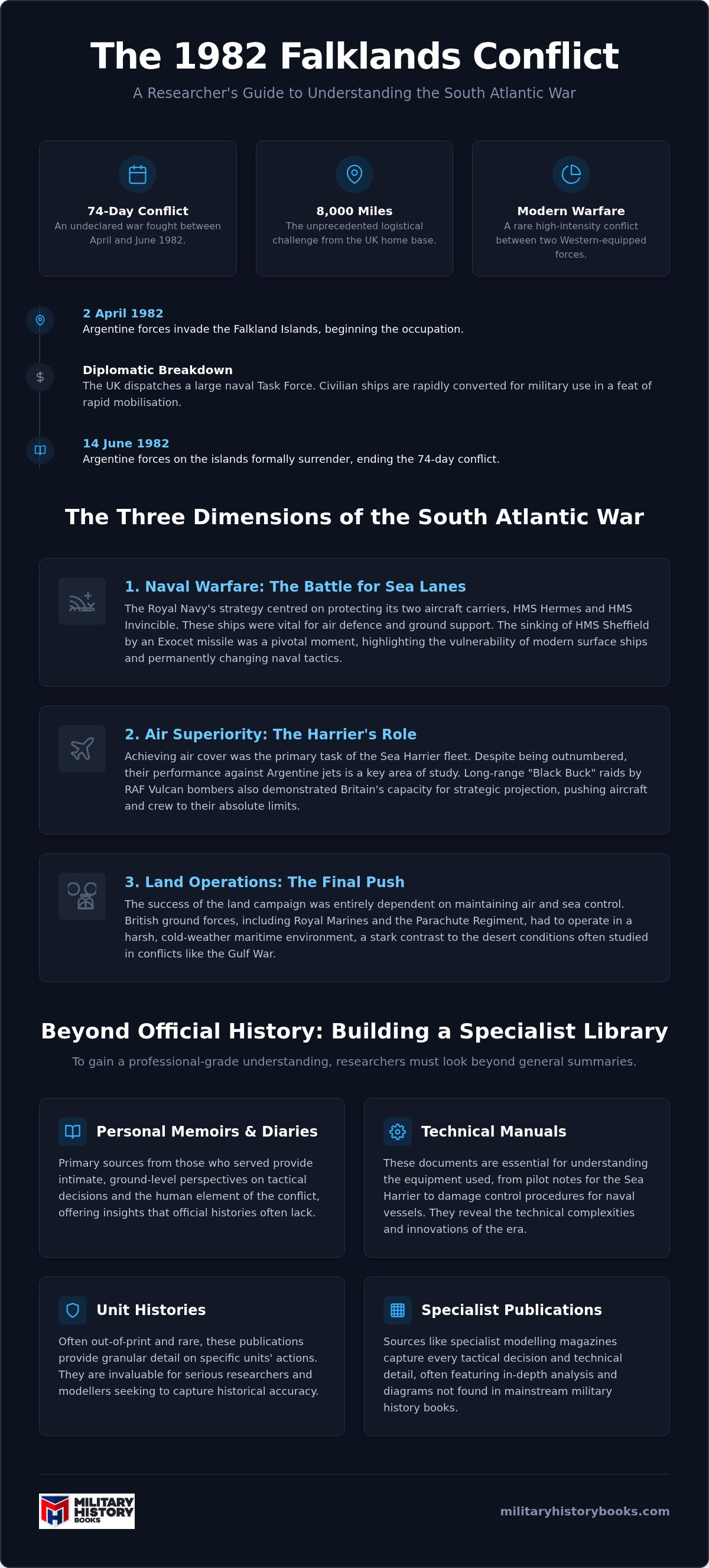
- Learn the precise timeline of the 74-day conflict, from the initial invasion on 2 April to the final Argentine surrender on 14 June 1982.
- Understand how the Task Force integrated naval, air, and land operations to reclaim the islands in a complex, multi-dimensional campaign.
- Discover why technical manuals and personal memoirs offer a deeper level of insight than the official history, much like the detailed accounts found in specialised Gulf War history books.
- Identify the specific challenges and rewards of sourcing out-of-print unit histories and rare technical publications to enhance your research or modelling projects.
- Gain expert advice on building a professional-grade personal library that focuses on the preservation of unique military stories and technical data.
Understanding the 1982 Falklands Conflict
The Falklands Conflict was a 74-day undeclared war between the United Kingdom and Argentina over the sovereignty of the Falkland Islands. It began with the invasion on 2 April and concluded with the Argentine surrender on 14 June 1982. For a comprehensive overview of the Falklands War, researchers often examine the decades of diplomatic friction that preceded the first shots. While many collectors might initially focus on broader 20th-century conflicts or seek out Gulf War history books to understand modern desert warfare, the Falklands offers a distinct, cold-weather maritime challenge that demands its own dedicated study.
This conflict remains a global focal point for military historians and collectors. It represents a rare instance of modern, high-intensity warfare fought between two Western-equipped forces. To truly grasp the nuances of the campaign, you've got to move beyond general summaries. Specialist study through primary sources, such as unit diaries and technical literature, provides the depth required to understand tactical successes and failures in the South Atlantic. It's this level of detail that separates a casual interest from a professional-grade understanding of the era.
The Prelude to Operation Corporate
The breakdown of diplomacy was punctuated by the Argentine junta's decision to occupy the islands, driven by a need for national unity during a period of domestic instability. Britain's response was a feat of rapid mobilisation. The Task Force was assembled with incredible speed, involving not only the Royal Navy but a vast array of civilian merchant vessels refitted for military use. Exploring naval history books is essential here, as they document the technical ingenuity required to convert luxury liners and container ships into troop carriers and helicopter decks in mere days.
The Significance of the South Atlantic Theatre
Operating 8,000 miles from the home base created a logistical environment that was almost unprecedented in modern history. The South Atlantic theatre was unforgiving, with harsh weather and vast distances testing the limits of men and machines. This war fundamentally changed how we view naval and aviation tactics, particularly regarding the vulnerability of surface ships to air-launched missiles. Many wartime history books UK focus on these tactical shifts, preserving the hard-won lessons for future generations. For those who study Gulf War history books, comparing the logistics of the Falklands to the desert campaigns reveals fascinating contrasts in how a nation projects power across the globe.
The Three Dimensions of the South Atlantic War
The 1982 conflict was a masterpiece of tri-service integration, where the success of the land campaign depended entirely on maintaining air and sea superiority. Unlike the desert environments often described in Gulf War history books, the South Atlantic presented a volatile maritime environment where the Royal Navy, RAF, and British Army had to operate as a single, cohesive Task Force. Each branch faced technical hurdles that pushed 1980s military equipment to its absolute limit, requiring rapid field modifications and tactical innovation.
Naval Warfare: The Battle for the Sea Lanes
The Royal Navy's strategy revolved around the protection of the aircraft carriers HMS Hermes and HMS Invincible. These vessels were the lifeblood of the operation, providing the only platform for air defence and ground support. The sinking of HMS Sheffield by an Exocet missile sent shockwaves through the fleet, highlighting the terrifying efficiency of modern anti-ship missiles and changing naval damage control procedures forever. Beyond the surface fleet, the "Silent Service" played a pivotal role. Specialist submarine history titles provide the only way to truly understand the strategic impact of HMS Conqueror and the subsequent containment of the Argentine fleet.
Air Superiority and the Black Buck Raids
Maintaining air cover was the Sea Harrier's primary task, and its performance against superior numbers remains a subject of intense study for researchers. For those interested in the mechanical nuances of these aircraft, aviation history books offer a deep dive into the technical publications and pilot notes from the era. The Black Buck raids, involving Vulcan bombers flying from Ascension Island, represented a logistical feat that redefined long-range bombing operations. If you're building a specialist collection, browsing our Aviation History Books category can help you find these technical resources.
Land Combat: From San Carlos to Stanley
Once the bridgehead was established at San Carlos, the land campaign moved with a ferocity that caught the Argentine defenders off guard. The tactical brilliance of 2 Para at Goose Green and 3 Para during the final push for Port Stanley demonstrated the importance of elite infantry training in sub-antarctic conditions. To get a sense of the gritty reality on the ground, many researchers turn to military biography books. These personal accounts, much like the first-hand narratives found in Gulf War history books, provide the emotional and tactical context that official reports often omit. The assault on Mount Tumbledown remains one of the most significant bayonet charges in modern British history, marking the beginning of the end for the occupying forces.
Primary Sources: Memoirs, Diaries, and Technical Manuals
To move beyond the broad strokes of history, researchers must distinguish between the polished "Official History" and the gritty reality found in personal memoirs. While official records provide the strategic "why," it's the first-hand accounts that reveal the "how" of the campaign. Much like the detailed personal narratives found in Gulf War history books, Falklands literature is rich with stories of individual bravery and logistical improvisation. These primary sources are vital for anyone looking to understand the conflict's human cost and tactical complexity.
Evaluating historical accuracy is another essential skill for the collector. Whilst military fiction can offer an evocative sense of atmosphere, non-fiction accounts backed by contemporary records remain the gold standard for research. For those seeking "as it happened" reporting, back issue military magazines UK published during the summer of 1982 provide a unique window into how the war was perceived at home and in the field before the benefit of hindsight.
The Voice of the Veteran: Essential Memoirs
First-hand accounts from commanders and frontline troops offer tactical insights that rarely make it into general textbooks. Diaries kept during the 74-day struggle are particularly valuable, as they record the raw psychological reality of fighting in a sub-antarctic winter. These documents detail the biting cold, the lack of sleep, and the intense pressure of combat in a way that dry statistics cannot. Memoirs provide the human context often missing from official reports by articulating the sensory and emotional experiences of those who endured the South Atlantic winter.
Technical Documentation for Researchers
For the technical historian or scale modeller, memoirs are only half the story. High-quality research requires access to technical manuals, pilot notes, and specific armour documentation. These resources are essential for accurately recreating the aircraft and ships involved, such as the Sea Harrier or the Type 42 destroyer. Photographic references found in specialist publications are equally important for ensuring every detail of a model or historical analysis is correct.
Today, many of these archives are being preserved through digital titles on disc and downloadable formats. These digital resources provide searchable, high-resolution access to technical data that was once locked away in physical archives. By combining these technical documents with veteran stories, you can build a comprehensive view of the 1982 conflict that is both technically precise and emotionally resonant.
Researching the Conflict: Sourcing Out-of-Print Titles
Sourcing reliable information on the 1982 conflict can be a complex task, especially when you're looking for unit-specific details. Many of the most insightful histories were published in limited runs shortly after the war ended, often by small regimental presses or as private editions for veterans. These aren't the kind of titles you'll find on the shelves of a high-street retailer. Whilst it's relatively straightforward to find mainstream Gulf War history books that cover later 20th-century warfare, tracking down a specific technical manual for a Type 42 destroyer or a 2 Para unit history requires a more methodical approach.
The reality is that many of the most valuable Falklands resources are now out of print military books. This scarcity makes specialist booksellers and their curated catalogues indispensable for the serious researcher. Using a specialist catalogue allows you to track down elusive titles and technical publications that have long since disappeared from general circulation. It's about finding that specific piece of the puzzle that completes your understanding of a particular battle or logistical operation.
Identifying Rare and First Edition Volumes
When building a collector-grade library, knowing what to look for in a first edition is vital. You should pay close attention to the condition of the dust jacket, the presence of original maps, and the binding quality. Signed copies, particularly those inscribed by veterans or high-ranking commanders, add a layer of historical weight that goes beyond the printed word. For military book collectors, the combination of pristine condition and verifiable provenance is the ultimate goal, as these factors preserve the book's value and its connection to history.
The Role of the Specialist Bookseller
General retailers often overlook rare military technical titles because they lack the niche expertise required to identify them. This is where the benefit of buying from a specialist becomes clear. When you deal with a business managed by an RAF veteran, you're consulting someone who understands the subject matter from a professional perspective. They can distinguish between a standard reprint and a rare original edition. If you've been searching for a specific out-of-print title without success, you can often request it through a curated service. This proactive approach is much more effective than browsing generic online marketplaces. To begin your search for these elusive volumes, you can browse our collection of rare military titles today. For those expanding their 20th-century research, our stock also includes a range of Gulf War history books and technical publications.
Preserving the Legacy: Building a Specialist Falklands Library
Building a personal archive is an act of historical stewardship. Whilst museums handle national collections, the private researcher plays a vital role in ensuring that rare unit histories and technical manuals don't simply vanish into obscurity. Moving from a casual interest to a dedicated pursuit of historical preservation allows you to create a legacy of knowledge. For those who have already explored Gulf War history books to understand modern tactical evolution, a curated Falklands library offers a deep dive into the unique challenges of sub-antarctic warfare. A well-curated collection serves as a permanent educational resource that captures the technical and human reality of the 1982 campaign. Just as Gulf War history books provide a window into the 1990s, these Falklands titles preserve the spirit and technical ingenuity of 1982.
To maintain the value and integrity of your library, proper care is essential. Rare books should be stored upright and away from direct sunlight to prevent fading. For your collection of modelling or back-issue magazines, using acid-free sleeves can prevent the paper from yellowing over time. Organising your titles by branch of service or chronological order within the conflict makes your research more efficient. At Military History Books, we invite you to explore our inventory of over 10,000 titles to find those specific volumes that will form the backbone of your archive.
Curating Your Collection for Future Generations
A truly comprehensive library requires a balance across naval, aviation, and land warfare disciplines. This diversity ensures you understand the tri-service nature of the Task Force operations. If you're looking to introduce others to this field, military history gift books UK collectors recommend are an excellent starting point. In an increasingly digital age, the tactile nature of physical books remains irreplaceable for serious study. There's a level of detail in a first-edition technical manual or a regimental history that simply cannot be replicated on a screen.
Final Steps for the Dedicated Researcher
Staying informed is the final piece of the puzzle. Signing up for specialist newsletters is the best way to get notified when rare arrivals or out-of-print titles become available. Because our community of enthusiasts is global, we offer secure international delivery to support researchers wherever they may be based. Building a library is a journey of discovery that connects you directly to the past. Browse our full collection of Falklands history and technical books today and take the next step in your research journey.
Advancing Your Research in South Atlantic History
Mastering the history of the 1982 conflict requires synthesising tactical land accounts, naval records, and aviation technical data. We've explored how primary sources like veteran diaries and out-of-print manuals provide the granular detail that mainstream narratives often miss. For those who typically collect Gulf War history books, the Falklands campaign offers a compelling study of power projection and technical adaptation in a pre-digital maritime environment.
Building a professional library is about more than just acquisition. It's about preserving the intricate stories of those who served. As a business managed by an RAF veteran, we understand the importance of accuracy and depth in military research. With over 10,000 specialist titles in stock, we're dedicated to helping you find the rare and technical publications your collection deserves. We offer secure international shipping to ensure that collectors worldwide can access these vital historical records. Explore our curated collection of Falklands Conflict literature and rare books to find the next cornerstone for your archive. We look forward to helping you uncover the technical and human stories of the South Atlantic war.
Frequently Asked Questions
What was the primary cause of the Falklands conflict?
The primary cause was a long-standing sovereignty dispute between the United Kingdom and Argentina over the Falkland Islands and their dependencies. This tension escalated into an undeclared war following the Argentine invasion on 2 April 1982. Whilst diplomatic efforts were attempted, the military occupation of the islands left the British government with little choice but to dispatch a Task Force to reclaim the territory.
How many British ships were lost during the Falklands War?
During the campaign, the British Task Force lost six vessels to enemy action. These included the destroyers HMS Sheffield and HMS Coventry; the frigates HMS Ardent and HMS Antelope; the logistics ship RFA Sir Galahad; and the merchant vessel Atlantic Conveyor. These losses underscored the lethal nature of modern anti-ship missiles and led to significant changes in naval damage control and ship design for future conflicts.
Where can I find rare first-edition books about the Falklands?
You can find rare first-edition volumes through specialist retailers like Military History Books. We maintain a stock of over 10,000 titles, focusing on rare and out-of-print military publications that general high-street shops often overlook. Our collection is curated by an RAF veteran who understands the specific needs of serious historians. We specialise in sourcing elusive unit histories and technical records that are essential for professional-grade research.
Is it possible to find technical manuals for Falklands-era aircraft?
Yes, technical manuals and pilot notes are available through our specialised inventory. We offer a variety of technical documentation for Falklands-era aircraft, including the Sea Harrier and the Vulcan bomber, available in both physical formats and as digital titles on disc. These resources are indispensable for modellers seeking accuracy or researchers investigating the mechanical performance of 1980s aviation technology during high-intensity maritime operations.
What are the best memoirs written by Falklands veterans?
Highly regarded memoirs include Admiral Sandy Woodward's accounts and first-hand narratives from members of 2 Para and 3 Para. These personal perspectives provide a gritty, psychological depth that official histories frequently omit. Much like the detailed veteran accounts found in Gulf War history books, these memoirs offer vital insights into the tactical realities and human experiences of the South Atlantic winter.
How long did the Falklands conflict last?
The conflict lasted for a total of 74 days. It commenced on 2 April 1982 when Argentine forces landed on the islands and concluded on 14 June 1982 following the surrender of the Argentine garrison in Port Stanley. This relatively short but intense period saw some of the most significant naval and air battles fought by British forces since the end of the Second World War.
Why are out-of-print military books so valuable for researchers?
Out-of-print books are valuable because they often contain primary source material, such as specific unit diaries or technical data, that is never included in mass-market reprints. These original publications were often produced in small numbers for a specialist audience. For the dedicated researcher, they represent the most accurate way to verify tactical decisions and technical specifications from the 1982 campaign.
Do you offer international shipping for rare military history titles?
We provide secure international delivery for our entire collection of rare military history titles. Our global shipping services ensure that researchers and collectors can access our inventory of over 10,000 specialist books regardless of their location. We take great care in packaging these valuable publications to ensure they arrive in pristine condition, supporting a worldwide community dedicated to preserving military history.


