

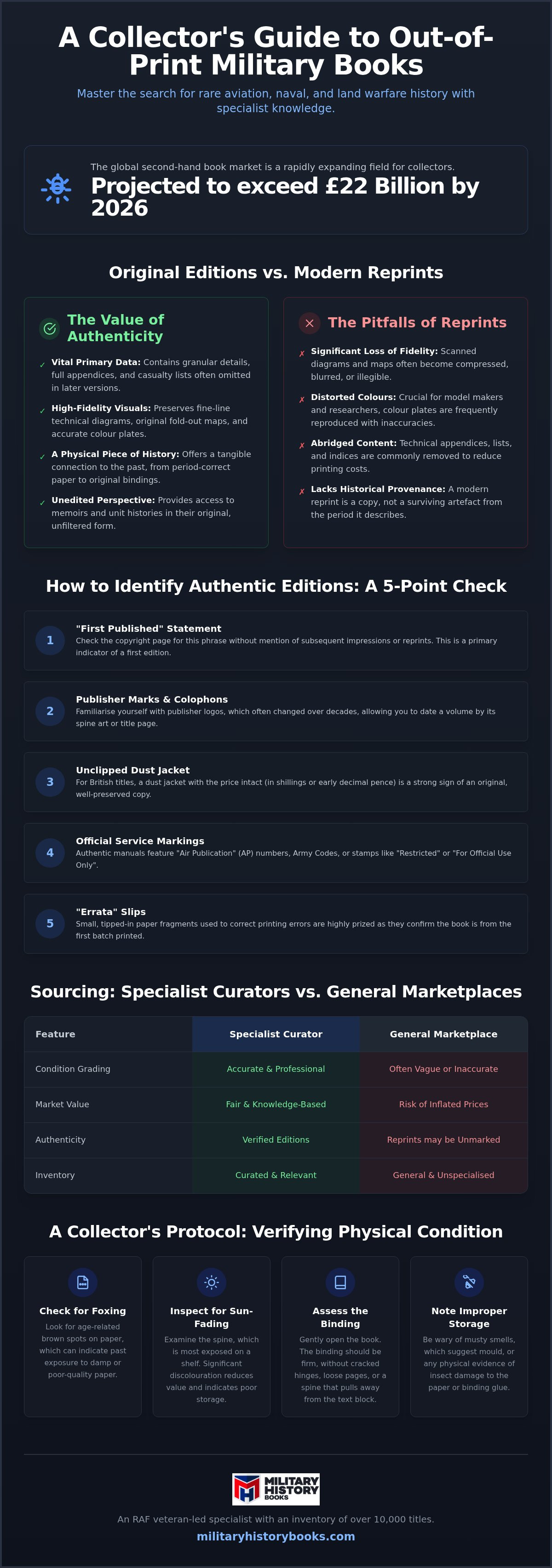
With the global second-hand book market projected to reach a value of over £22 billion in 2026 and mass-market paperbacks being phased out by major publishers, the hunt for rare history has become a high-stakes tactical operation. You've likely experienced the frustration of searching for out of print military books on general marketplaces, only to be met with inflated prices or poor descriptions that fail to mention a damaged binding. It's disheartening to risk your budget on what turns out to be a modern reprint rather than a genuine, period-correct edition.
This guide provides the specialist knowledge required to locate, verify, and acquire elusive military history volumes with absolute confidence. Drawing on our experience as an RAF veteran-led team with an inventory of over 10,000 titles, we'll show you how to master the search for rare material. You will learn to identify authentic editions, understand fair market value, and ensure your collection represents a true record of aviation, naval, or land warfare history. We'll move beyond basic search results to help you acquire the titles your archive is missing.
Key Takeaways
- Learn to distinguish authentic first editions from modern reprints by identifying specific publisher marks and official service branch indicators.
- Discover why sourcing out of print military books through a specialist curator ensures more accurate condition grading and better value than using general marketplaces.
- Master a professional verification protocol to assess physical condition, specifically looking for foxing, sun-fading, and evidence of improper storage.
- Understand the importance of primary sources in historical research and how to verify the provenance of rare technical manuals and archives.
- Explore how a veteran-led specialist inventory can help you secure elusive titles across aviation, naval, and land warfare history.
The Significance of Out of Print Military Books in Historical Research
In the context of specialist publishing, out of print military books are those where the original production run has ended and the publisher no longer maintains inventory. For the serious researcher, these volumes aren't just old paper; they are vital vessels of primary data. Early editions often provide a level of detail that modern summaries simply cannot replicate. This is particularly true for Official Military Histories, which were often produced in limited quantities for government use or academic study immediately following a conflict. These works captured the granular details of logistics, command decisions, and tactical outcomes whilst the memories were still fresh and the records intact.
Owning an original volume also carries an emotional weight. It's a physical piece of history that has survived decades. Whether it is a technical manual for a Spitfire or a memoir from the Great War, these books represent a legacy of service that deserves preservation. They offer a direct link to the technical and human experiences of past generations, serving as an unedited witness to the events they describe.
Why Modern Reprints Often Fall Short
Modern digital reprints frequently suffer from a significant loss of fidelity. Fine-line technical diagrams and fold-out maps, essential for understanding land warfare or naval manoeuvres, often become illegible when scanned and compressed. For those who rely on modelling magazines, original colour renderings are crucial; modern reprints often distort these shades, leading to inaccuracies in historical recreation. Many abridged versions omit technical appendices or casualty lists to save on printing costs, stripping away the very data that researchers need most.
The Rarity Factor: From Unit Histories to Memoirs
The scarcity of these titles is often a result of their original purpose. Regimental and unit histories were frequently produced in tiny print runs, intended solely for the veterans and families of a specific battalion. Similarly, privately published memoirs offer a raw, unedited perspective that never reached the high street. Field manuals and technical instructions were designed to be used in the theatre of operations; many were lost to the elements or destroyed to prevent capture. Finding a surviving copy of these out of print military books is akin to recovering a lost piece of military heritage, providing a tangible connection to the past that a digital screen cannot offer.
How to Identify Rare Editions and Technical Publications
Identifying out of print military books requires a methodical approach that looks beyond the title page. A primary indicator of a first edition is the presence of a "First Published" statement without any mention of subsequent impressions or reprints. Publisher marks, or colophons, also provide clues; for example, certain publishers changed their logos over decades, allowing you to date a volume by its spine art. For those collecting British titles, the presence of a dust jacket with an unclipped price in shillings or early decimal pence is a strong sign of an original state.
Authentic technical manuals from the RAF, Army, or Royal Navy are distinctive. These weren't commercial products but rather functional tools, often marked with "Air Publication" (AP) numbers or specific Army Code sequences. You might find "Restricted" or "For Official Use Only" stamps on the covers. These markings are essential for verification, as modern facsimiles often lack the tactile quality of the original heavy-gauge paper or the specific ink-stamp bleed. Small details like "errata" slips, which are tiny fragments of paper tipped into the binding to correct printing errors, are highly prized because they confirm the book is from the very first batch off the press.
Specialised institutions, such as the National Cryptologic Museum, maintain extensive archives of these technical monographs and declassified documents. Such examples highlight the historical importance of preserving these technical records. If you are looking to build your own archive, you can explore our specialist inventory to find verified editions that meet these strict criteria for authenticity.
Decoding ISBNs and Pre-ISBN Markings
Tracking titles published before the 1970s requires knowledge of the transition from the Standard Book Numbering (SBN) system to the modern ISBN. The Standard Book Numbering system was a nine-digit code introduced in 1967 to help automate book ordering and stock control. For books older than this, you must rely on publisher codes and printers' keys, which are those strings of numbers often found on the copyright page. A "1" in the sequence usually denotes a first printing, whilst its absence suggests a later run.
Spotting Rare Technical and Modelling Publications
Back-issue modelling magazines are often overlooked but contain unique scale drawings and camouflage schemes that are unavailable elsewhere. Original aircraft technical manuals and pilot notes are particularly sought after for their granular operational data. When evaluating ephemera like trench maps or field pamphlets, look for signs of "service wear," which is the honest patina of a document that has actually seen the field. These items are the backbone of a comprehensive collection of out of print military books.
Sourcing Rare Titles: Why Specialists Outshine General Marketplaces
Whilst global marketplaces offer the convenience of a search bar, they often lack the nuanced understanding required to handle out of print military books with the care they deserve. Massive platforms frequently host listings with vague descriptions like "good condition," which might hide a missing map or a cracked hinge. These generalist sellers often don't have the expertise to distinguish a wartime original from a high-quality modern facsimile, leading to disappointment for the serious collector. Additionally, high seller commissions on these platforms can inflate the price you pay, whilst the lack of specialist oversight increases the risk of acquiring a sub-optimal copy.
Specialist booksellers provide a level of security that automated platforms cannot replicate. They understand the historical context of each volume and can provide detailed reports on specific attributes that matter to researchers. For example, academic institutions often maintain similar rigorous standards when curating University Special Collections, where the focus is on the preservation of primary source integrity. By choosing a specialist, you are tapping into a curated environment where the priority is historical accuracy rather than high-volume turnover. For more advice on navigating the domestic market, you can consult our specialist guide for UK collectors.
The Expert Eye: Grading and Authentication
In the world of rare books, condition is everything. A specialist uses a precise grading scale: a "Fine" copy is virtually as new, "Very Good" shows minor wear but remains collectable, and a "Reading Copy" is strictly for data despite its physical flaws. An expert can also spot a "marriage," which occurs when a genuine original book is paired with a later dust jacket to hide damage. Understanding the provenance of out of print military books, such as identifying a bookplate from a known military commander, can significantly enhance both the historical and market value of the volume.
Accessing "Off-Market" Inventory
It's a common misconception that every book for sale is listed on eBay or Amazon. In reality, thousands of titles are held in "off-market" inventory within specialist warehouses. These books are often reserved for customers who have submitted "want lists" or are offered through veteran-led networks that prioritise enthusiasts over the general public. Building a relationship with a dealer who specialises in aviation, naval, or land warfare allows you to get first refusal on new arrivals, ensuring you secure elusive titles before they ever reach the open market.
Verifying Condition and Authenticity: A Collector’s Protocol
Locating out of print military books is a significant achievement, but the acquisition process requires a disciplined protocol to ensure you are receiving a genuine article. Unlike modern publications, older volumes have often passed through multiple hands and varied storage conditions. A systematic verification process protects your investment and ensures the historical data remains intact. Before committing to a purchase, you should follow this five-step protocol to confirm the volume's integrity.
- Step 1: Request high-resolution photographs of the spine, corners, and title page to check for structural integrity and "cocking" of the spine.
- Step 2: Check for "foxing," which are those distinctive brown spots caused by paper oxidation, and look for sun-fading on the spine or evidence of damp and tobacco smoke.
- Step 3: Confirm the presence of all fold-out maps and technical diagrams, as these are often the first items to be removed or damaged in older service manuals.
- Step 4: Cross-reference the edition with known bibliographies to verify the correct plate count and the specific publication date.
- Step 5: Assess the binding to determine if it is the original publisher's cloth or leather, or a later rebinding which may impact the historical value.
Identifying Common Alterations and Repairs
Ex-library marks, such as stamps on the title page or residue from a pocket on the endpaper, impact value differently depending on rarity. For a common title, these marks are a detraction; however, for a unique regimental history, they are often overlooked by serious researchers. You must also distinguish between professional archival restoration and amateur tape repairs, as the latter causes permanent chemical staining to the paper over time. To verify if a 19th-century naval history book is complete, cross-reference the "List of Illustrations" usually found after the preface to ensure no engraved plates have been removed by previous owners.
The Digital Alternative for Rare Content
When a physical copy is either too fragile for regular use or prohibitively expensive, digital titles on disc or download offer a practical solution for pure research. These formats allow you to access critical data without risking further wear to a century-old technical manual or a rare memoir. Digital archives are also searchable, making them an excellent choice for researchers building modern military library resources. If you need assistance verifying the authenticity of out of print military books, you can contact our veteran-led team for specialist guidance on your next acquisition.
Curating Your Collection with Military History Books
Building a library is a lifelong pursuit of knowledge and preservation, requiring a partner who understands the historical weight of the material. Our inventory of over 10,000 titles has been meticulously assembled to serve as a comprehensive resource for researchers and enthusiasts alike. Unlike generalist retailers, our operation is managed by an RAF veteran who brings a deep-seated understanding of service life and technical precision to the curation process. This specialist perspective ensures that every volume we stock is evaluated for its historical contribution and its physical state, providing you with a reliable record of the past.
We organise our collection with the researcher in mind, categorising titles by specific campaigns, regiments, and technical specialities. This methodical approach allows you to bypass the noise of general search engines and move directly to the material that matters to your specific area of interest. Recognising the fragility of out of print military books, we are committed to secure international delivery. We use bespoke packaging solutions designed to protect rare and fragile volumes during transit, ensuring they arrive in the same condition they left our shelves.
From Aviation to Land Warfare: Our Specialist Focus
Our collection spans the full breadth of conflict history, with a particularly extensive range of military aviation history publications. We dedicatedly preserve technical manuals and modelling magazines that are often discarded by general bookshops, recognising their immense value to historians and scale modellers. Every item in our stock is chosen for its significance, whether it is a definitive regimental history or a rare pamphlet detailing wartime technical instructions. We prioritise the preservation of these stories, acting as a bridge between the historical archive and the modern collector.
Start Your Search Today
If you are looking for a specific volume that has eluded your grasp, we invite you to submit a "want list" to our team. We proactively use our networks to source out of print military books that may not currently be visible in our online shop. For those who require immediate access to data for research or modelling projects, our digital archives provide a high-quality alternative to physical titles. To help you plan the future of your archive, you can consult our collector’s checklist for 2026. This resource will help you identify the core pillars of a modern military library and ensure your collection remains both comprehensive and historically significant.
Securing the Future of Your Military History Archive
Building a collection of out of print military books is a pursuit that requires patience, technical knowledge, and a disciplined approach to verification. By moving beyond the unpredictable nature of general marketplaces and adopting a specialist protocol, you ensure that your library remains a credible record of aviation, naval, and land warfare. You now possess the tools to identify authentic technical manuals and the insight to prioritise provenance over mere availability.
As you continue your research, remember that a well-curated archive is a bridge to the past. Our team, managed by an RAF veteran, specialises in locating those elusive titles that define a collection's depth. We offer secure global shipping for collectors to ensure every volume reaches you in its described state. Whether you're a dedicated researcher or a casual reader, we're ready to assist with your next acquisition. Browse our collection of over 10,000 military history titles and find the missing piece of your historical archive today.
Frequently Asked Questions
What does "out of print" actually mean for military history books?
"Out of print" means the publisher has ceased production and no longer holds new stock for distribution. For out of print military books, this often occurs because the original print run was limited to a specific veteran group or academic audience. Once these copies are sold, the title is only available through the second-hand market. This status makes the preservation of existing copies vital for future historical research.
How can I tell if a military book is a genuine first edition?
A genuine first edition is usually identified by the "First Published" date on the copyright page with no mention of subsequent impressions. You should also look for specific publisher marks or a "1" in the printer's key sequence. In military publishing, some early editions also feature unique binding colours or specific errata slips that were corrected in later, more common printings of the same title.
Are digital versions of out-of-print books as good as the originals?
Digital versions are excellent for protecting fragile data, but they rarely match the tactile and historical value of an original. Whilst a download provides immediate access to text, it often lacks the high-fidelity colour of original plates or the large-scale fold-out maps found in physical volumes. For serious researchers, the digital format is a functional tool, whereas the original book remains a preserved piece of military heritage.
Why are some out-of-print military books so much more expensive than others?
Pricing for out of print military books is driven by a combination of scarcity, historical significance, and physical condition. A regimental history with a print run of only 200 copies will naturally command a higher price than a mass-market memoir. Additionally, the presence of an original, unclipped dust jacket or rare technical diagrams can significantly increase the market value compared to a worn or incomplete copy of the same title.
Can you help me find a specific unit history that isn’t listed on your site?
We can certainly assist you through our proactive sourcing service and veteran-led networks. If a particular unit history or technical manual isn't in our current inventory of 10,000 titles, you can submit a "want list" to our team. We regularly engage with other specialists and private collectors to locate elusive volumes, ensuring you have the best possible chance of completing your specific area of research.
Is it worth buying an "ex-library" copy of a rare military book?
Buying an ex-library copy is often a sensible choice if your primary goal is accessing rare information rather than investment. These books usually feature stamps or pocket residue which reduce their market value for collectors. However, if the title is exceptionally rare, such as a privately printed memoir, an ex-library copy may be the only affordable way to secure the historical data for your personal archive.
How do you ensure rare books aren’t damaged during international delivery?
We use bespoke, heavy-duty packaging specifically designed to protect fragile and rare volumes during transit. Every book is wrapped in moisture-resistant materials and cushioned within sturdy, double-walled boxes to prevent corner bumping or spine damage. This methodical approach ensures that even the most delicate technical manuals or century-old histories arrive safely at their international destinations, regardless of the distance travelled by the courier.
Do you offer valuations for out-of-print military book collections?
We do not offer professional book valuation services, as our focus is strictly on the curation and sale of our inventory. If you require a formal valuation for insurance or probate purposes, we recommend contacting a certified member of a recognised bibliographical society. We prefer to remain dedicated to our role as specialist curators, providing high-quality aviation, naval, and land warfare titles to our community of readers.


