
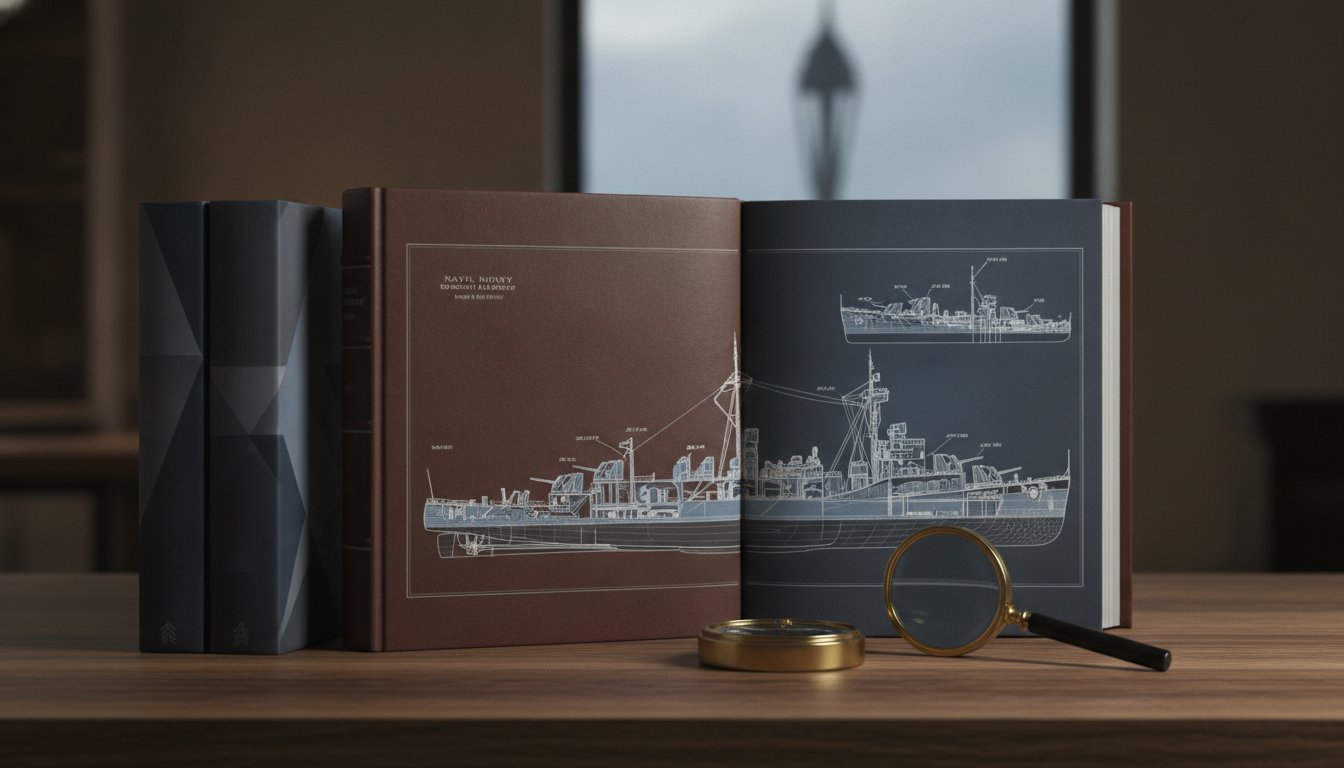
The most significant naval history isn't always found in the latest bestseller; it's often hidden within the precise diagrams of a forgotten technical manual or a rare first edition. We understand the frustration of searching for specific naval history books only to find that mainstream retailers stock little more than a handful of general titles. You likely want a collection that reflects the true complexity of maritime warfare, whether you're researching the tactical nuances of the Second World War or looking for the intricate 192-page detail found in the Seaforth World Naval Review 2026.
By drawing on years of specialist curation, this guide will help you move beyond the basics to build a professional-grade library. You'll learn how to identify essential eras, spot rare editions that hold their value, and verify the historical accuracy of your collection. From the 976-page depth of N A M Rodger's The Price of Victory to obscure out-of-print titles, we provide the expert guidance needed to master your maritime research and find the volumes that truly matter.
Key Takeaways
- Learn how to distinguish authoritative research from generic accounts by prioritising primary sources and technical accuracy in your maritime collection.
- Discover the essential naval history books required to master specific eras, from the strategic nuances of the Age of Sail to the technological shifts of the Dreadnought period.
- Understand why technical manuals and back-issue modelling magazines are indispensable tools for achieving authentic detail in historical research and scale modelling.
- Gain expert tips on identifying genuine first editions and assessing the impact of condition factors like foxing on the long-term value of your library.
- Explore the advantages of building your library through a veteran-led archive that offers over 10,000 specialist titles beyond the reach of mainstream retailers.
What Defines a Great Naval History Book?
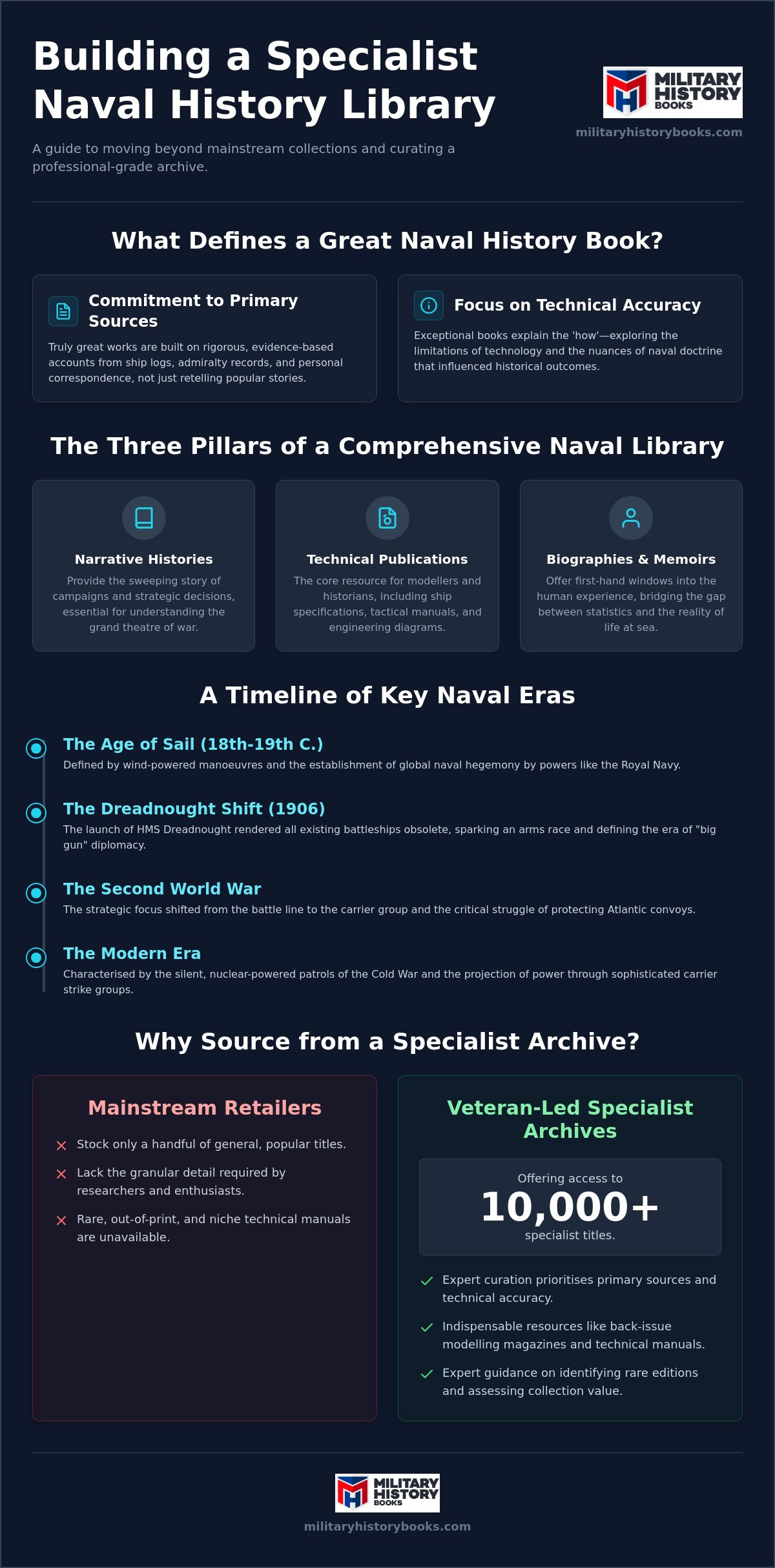
Identifying a truly exceptional naval history book requires looking beneath the surface of popular narratives. Whilst many general retailers stock a standard selection of naval history books, a great publication is defined by its commitment to primary source material and technical accuracy. Naval history isn't just a record of battles; it's a multi-faceted study of maritime conflict, the evolution of technology, and the biographies of those who lived and died at sea. For those exploring the origins of modern maritime power, resources like this Bibliography of early U.S. naval history illustrate the sheer volume of primary documents available to the dedicated researcher.
Specialist publishers often surpass generalist retailers because they prioritise the granular detail that researchers and enthusiasts crave. A great volume provides context, explaining not just what happened, but how the limitations of contemporary technology or the nuances of naval doctrine influenced the outcome. Distinguishing between popular history and academic research is vital. Popular history often focuses on the "story," whilst academic works delve into the "why," using ship logs, admiralty records, and personal correspondence to build a rigorous, evidence-based account.
The Three Pillars of a Naval Library
- Narrative histories: These provide the sweeping story of campaigns and the strategic decisions of admirals. They're essential for understanding the grand theatre of war.
- Technical publications: These include ship specifications, tactical manuals, and engineering diagrams. They're the bread and butter for modellers and technical historians who need to understand the physical reality of the vessels.
- Biographies: These books offer a window into the human experience amongst the "Silent Service". They bridge the gap between dry statistics and the reality of life on deck or in the engine room.
Historical Accuracy vs. Naval Fiction
There's a place for fiction in a maritime library, but it's important to know its role. Fiction is excellent for capturing the atmosphere of a period, the smell of the tar, or the tension of a chase. Authors like Patrick O'Brian or C.S. Forester were famously well-researched, often basing their plots on real naval logs. However, when you're looking for facts, you must stick to technical logs and contemporary memoirs. Memoirs are particularly valuable; they offer a first-hand perspective that even the most detailed official report can't match, providing a sense of the daily routine and the psychological pressures of naval service.
Building a collection that balances these elements ensures you have a comprehensive view of maritime history. It's the difference between merely reading about the sea and truly understanding the complex machinery of naval warfare.
Navigating Eras: Essential Naval Warfare History Books
Eras in naval history are often demarcated by the timber or steel of the vessels themselves. Understanding these shifts is key to selecting the right naval history books for your collection. From the wind-powered manoeuvres of the Georgian era to the silent, nuclear-powered patrols of the present day, each period demands a different analytical lens. These transitions represent more than just engineering milestones; they reflect the changing strategic priorities of global powers over centuries.
The 18th and 19th centuries represent the pinnacle of sail, where the Royal Navy established a global hegemony that lasted for generations. However, the launch of HMS Dreadnought in 1906 rendered every existing battleship obsolete overnight, marking a technical shift that defined the First World War. This era of "big gun" diplomacy is a favourite amongst technical historians who study the rapid evolution of naval architecture and the sudden obsolescence of the pre-dreadnought fleet.
Moving into the Second World War, the focus shifts from the battle line to the carrier group and the desperate struggle of Atlantic convoys. Modern maritime strategy now involves a complex web of Cold War intelligence and the projection of power through sophisticated carrier strike groups. If you're looking to deepen your understanding of these transitions, you can browse our curated collection of naval history books to find titles that cover these pivotal moments in detail.
Royal Navy History Books: A British Perspective
The story of British naval supremacy is a long arc stretching from the Tudor dockyards to the modern day. Nelson's legacy remains pivotal. Many readers begin with the Napoleonic Wars, focusing on the Battle of Trafalgar and the tactical genius of the age. Essential titles also examine the Royal Navy’s monumental transition from coal to oil, and eventually to nuclear propulsion, reflecting Britain's changing role on the global stage.
Submarine History Books: Chronicles of the Silent Service
Submarine warfare changed everything. Researching this area involves tracking the development of the U-boat and its devastating impact on Atlantic trade routes during both World Wars. The narrative then moves into the high-stakes world of Cold War submarine technology, where the war was fought through acoustics and stealth. The "Silent Service" is defined as a specialised branch of naval warfare where crews operate in total isolation and concealment, using stealth as their primary weapon and defence within the 20th-century context.
Technical Publications and Modelling Magazines: The Researcher’s Toolkit
Serious maritime research often requires a shift in perspective from the strategic to the structural. Whilst standard naval history books provide the necessary context for campaigns and fleet movements, technical publications offer the granular detail required for authentic restoration or precision scale modelling. These documents serve as the blueprints of history, providing a physical understanding of the vessels that narrative accounts often overlook. For the technical historian, a ship's engine room schematic or a detailed deck plan is as significant as an admiral's private correspondence.
The transition from general reading to deep-dive research is often facilitated by back-issue military and modelling magazines. These publications are frequently the only remaining sources for contemporary photographs and eyewitness accounts of ship modifications. During a vessel's service life, structural changes and camouflage updates were common, yet these are rarely documented in broad-market history volumes. Accessing these specific details allows a researcher to pinpoint a ship's appearance at a precise moment in time, such as during a specific escort mission or refit.
The Role of Modelling Magazines in Naval Research
Modelling magazines, such as those featuring Airfix projects or other specialist modelling guides, are indispensable for their unique technical diagrams. These publications often feature multi-view drawings that aren't found in academic texts. By cross-referencing these diagrams with photos from back-issue magazines, researchers can verify the accuracy of ship camouflage and armament configurations. This process is vital for building a visual archive, ensuring that every detail from the radar arrays to the life-raft stowage is historically correct.
Technical Manuals and Blueprints
Finding original technical specifications for warships and weaponry can be challenging, especially for out-of-print titles. These manuals provide the raw data of naval warfare: rate of fire, armour thickness, and propulsion efficiency. For many, the preservation of this fragile data is achieved through digital formats. Digital downloads and titles on disc allow immediate access to rare manuals that might otherwise be too delicate for frequent handling. This digital archive approach ensures that the technical secrets of the surface fleet remain accessible to modern enthusiasts without risking the original paper documents.
In an environment where mainstream bookshops focus on the latest bestsellers, the value of a specialist archive becomes clear. Having access to an inventory of over 10,000 titles, including rare technical manuals and back-issue magazines, allows a researcher to move beyond the surface. It's about finding the specific 192-page review or the obscure blueprint that completes the picture of a ship's life at sea.
The Collector’s Compass: Identifying Rare and Out-of-Print Naval Titles
Building a library is an act of preservation that goes beyond simple reading. For the enthusiast, the search for rare naval history books is often driven by a desire to own a primary account that has long since vanished from mainstream circulation. Identifying a true first edition requires a keen eye for detail; you should always check the copyright page for a "first published" statement or a complete number line. Whilst later reprints might contain the same text, they lack the historical proximity and potential investment value of an original release.
Condition is the most significant factor in determining a book's value and longevity. For many 20th-century publications, the presence of an original dust jacket can account for up to 80 per cent of the total market price. You should also be mindful of foxing, those small brown spots caused by acidic paper or moisture, which can spread if not managed. Out-of-print military books are essential for researching niche maritime topics, such as specific destroyer flotillas or obscure coastal engagements, as these subjects rarely receive the attention of modern high-volume publishers.
Spotting Rarity in Naval Literature
Rarity often hides in plain sight within limited-run technical publications. Books produced directly by naval dockyards or internal admiralty departments were never intended for public sale, making them exceptionally scarce today. Signed copies also hold significant weight, particularly those with inscriptions from high-ranking naval officers or decorated veterans. When browsing, look for titles from small specialist publishers that focused on maritime history during the mid-20th century; these were often printed in small batches and are now highly sought after by serious researchers.
Preserving Your Naval Collection
Proper storage is vital to protect your investment from the elements. Physical books should be kept in a temperature-controlled environment away from direct sunlight, which can fade spines and make paper brittle. Organising your library by era, ship type, or branch of service-such as the Submarine Service or Fleet Air Arm-creates a functional archive for research. Many collectors now choose to supplement their physical library with digital titles. This approach allows you to preserve a fragile first edition whilst using a digital copy for the heavy lifting of daily research. If you are ready to find your next cornerstone volume, explore our selection of rare and out-of-print naval titles to see what is currently in the archive.
Why Source Your Library from a Specialist Military Bookshop?
When you are building a professional-grade library, where you source your volumes is just as important as the titles themselves. Mainstream retailers often prioritise high-turnover bestsellers, which means their selection of naval history books is frequently limited to generic accounts of well-known battles. A specialist military bookshop operates differently, functioning more like a curated archive than a standard retail outlet. With an inventory of over 10,000 titles, we provide access to the technical depth and historical nuance that generalists simply cannot match.
This depth is underpinned by veteran-led curation. Having a background in the armed forces provides a unique perspective on the importance of accuracy and primary source material. An RAF veteran’s ingrained respect for technical precision and service history ensures that every naval title is selected for its factual integrity and research value. This eye for detail is particularly beneficial when distinguishing between a surface-level narrative and a definitive technical study that will serve as a reliable reference for years to come.
Specialist shops offer a level of personalised service that is impossible to find in automated online marketplaces. If you are a researcher looking for a specific out-of-print naval manual or an obscure unit history, a specialist bookseller can often track down these rare titles on your behalf. We understand the specific needs of the global maritime community, which is why we provide secure international delivery from our UK base, ensuring that these vital records reach historians and modellers wherever they are stationed.
Expert Curation vs. General Retail
A specialist understands that a serious library requires more than just "sea stories". By focusing exclusively on aviation, land, and naval warfare, we can offer a collection that includes everything from modelling magazines to rare technical blueprints. This niche focus means we can identify which publications offer the most value for specific research projects, whether you are verifying the camouflage of a First World War destroyer or studying the strategic evolution of carrier groups. Whilst generalists look for the lowest price point, we look for the highest historical utility.
Building a Long-Term Relationship with Your Bookseller
The value of a specialist bookseller lies in the long-term support they provide to your research. By staying informed through specialist updates or a naval newsletter, you can be amongst the first to know when a rare first edition or a new digital download becomes available. This relationship supports the broader preservation of maritime heritage, ensuring that the stories and technical achievements of the past are not lost to time but are instead placed in the hands of those who will value and protect them. Military History Books is committed to being that bridge between the historical record and the modern enthusiast.
Master Your Maritime Research
Building a professional library is a journey that requires both passion and precision. You have seen how the combination of narrative accounts and technical manuals creates a multi-layered understanding of maritime conflict. Whether you are assessing the condition of a rare first edition or cross-referencing ship specifications in a back-issue modelling magazine, the quality of your sources defines the depth of your research. A truly comprehensive collection bridges the gap between the grand strategy of admirals and the technical realities of the ships they commanded.
Finding the right naval history books shouldn't be a struggle against the limited inventories of general retailers. Our archive is managed by an RAF veteran who understands the vital importance of historical accuracy and the preservation of maritime stories. With an inventory of over 10,000 military titles in stock, we specialise in tracking down those rare and out-of-print editions that often serve as the final piece of your research puzzle. Explore our full collection of Naval History Books today and discover the definitive technical studies and memoirs your library deserves. We look forward to helping you find the volumes that bring history to life.
Frequently Asked Questions
Where can I find rare first edition naval history books?
You can find rare first editions by browsing specialist military archives and shops that focus exclusively on out-of-print titles. Our curated inventory includes over 10,000 volumes, many of which are scarce first releases from the early to mid-20th century. These are often sourced from private collections or retired officers' libraries, ensuring a level of rarity that generic online marketplaces cannot consistently provide for serious collectors.
Are digital naval history books as good as physical copies for research?
Digital formats are ideal for protecting fragile physical editions whilst allowing for immediate, searchable research. They provide the same technical data and diagrams as physical copies but are more portable and resilient to the wear and tear of daily use. We offer digital titles by download or on disc, which are particularly useful for technical historians who need to zoom in on intricate ship blueprints or engine room schematics.
What are the best Royal Navy history books for beginners?
Beginners should look for comprehensive narrative histories that provide a broad overview of maritime strategy and key engagements. Titles such as N A M Rodger's The Price of Victory offer an accessible yet authoritative entry point into British maritime history. Starting with these narrative works helps you understand the strategic context before moving on to more technical ship specifications or specialised submarine history titles.
How do I identify if a military history book is out of print?
You can identify if a book is out of print by checking if the original publisher still lists the title in their active catalogue. Many naval history books that focus on niche topics or specific ship classes were only printed in limited runs and never received modern reprints. If a book is only available through secondary markets and specialist archives, it's a strong indicator that the title is no longer in active production.
Can I find technical manuals for specific WW2 warships?
Technical manuals for specific Second World War warships are available within our collection, often as rare out-of-print titles or digital downloads. These documents provide the original admiralty specifications for everything from gunnery fire control to hull construction. They are invaluable for researchers and modellers who require exact measurements and structural details that aren't typically found in popular history books or general maritime narratives.
Why should I buy from a specialist military bookshop instead of a general retailer?
Specialist military bookshops provide a level of expertise and curation that generalist retailers lack. As a business managed by an RAF veteran, we prioritise historical accuracy and technical depth over high-turnover bestsellers. You gain access to a dedicated archive of over 10,000 titles, including rare modelling magazines and technical manuals that general retailers simply don't stock in their standard inventories.
Do you offer international shipping for naval history books?
We offer secure international delivery for all our naval history books from our base in the United Kingdom. This service ensures that maritime enthusiasts and researchers across the globe can access our specialist archive. We use robust packaging to protect fragile first editions and out-of-print titles during transit, providing a reliable link between our UK inventory and the international research community.
How can modelling magazines help with my naval history research?
Modelling magazines are vital research tools because they often contain technical diagrams and contemporary photographs not found elsewhere. These publications allow you to verify specific camouflage schemes and structural modifications that a ship may have undergone during a particular refit. They bridge the gap between written history and the physical reality of the vessel, making them essential for visual accuracy in any maritime research project.


