

The most profound stories of naval warfare are often those never intended to be heard, locked away in the pressurised hulls of the Silent Service. It's understandable if you feel overwhelmed by the sheer volume of generic, sensationalist accounts that often prioritise drama over historical accuracy. Finding reliable submarine history books that balance technical precision with the raw human experience of life beneath the waves is a significant challenge, especially when the most valuable manuals have long been out of print. You deserve a collection that reflects the true weight of maritime history rather than just the myths.
This guide will help you build a definitive naval library by distinguishing between popular tropes and the authoritative texts that serious researchers and enthusiasts rely upon. We'll explore essential titles ranging from intricate technical blueprints to moving personal memoirs, whilst providing a clear path to sourcing rare and out-of-print literature for your personal archive. By the end, you'll know exactly which volumes deserve a place on your shelves and how to identify the difference between a narrative memoir and a rigorous technical study.
Key Takeaways
- Learn how to categorise your research by conflict, from the pioneering patrols of the Great War to the high-stakes undersea standoffs of the Cold War.
- Understand the vital distinction between technical manuals and personal memoirs to ensure your collection provides both mechanical accuracy and human perspective.
- Discover expert strategies for sourcing rare and out-of-print submarine history books that are frequently absent from mainstream retail catalogues.
- Gain insights into building a professionally curated naval archive with guidance from specialists who value the preservation of authentic military experiences.
- Identify the specific markers of historical reliability to help you avoid sensationalist accounts in favour of authoritative and well-researched records.
Understanding the Appeal of Submarine History Books
The "Silent Service" is a title earned through decades of clandestine operations and a culture of necessary secrecy. Unlike the surface fleet, where massive engagements were often visible to thousands of observers, the submarine's world is one of isolation and hidden manoeuvres. This fundamental difference shapes the nature of submarine history books. These accounts aren't just records of naval battles; they are studies in endurance, stealth, and the peculiar pressures of a life lived beneath the waves. Because so much of their work was classified, the literature surrounding submarines often feels like a slow unveiling of secrets that were kept for generations.
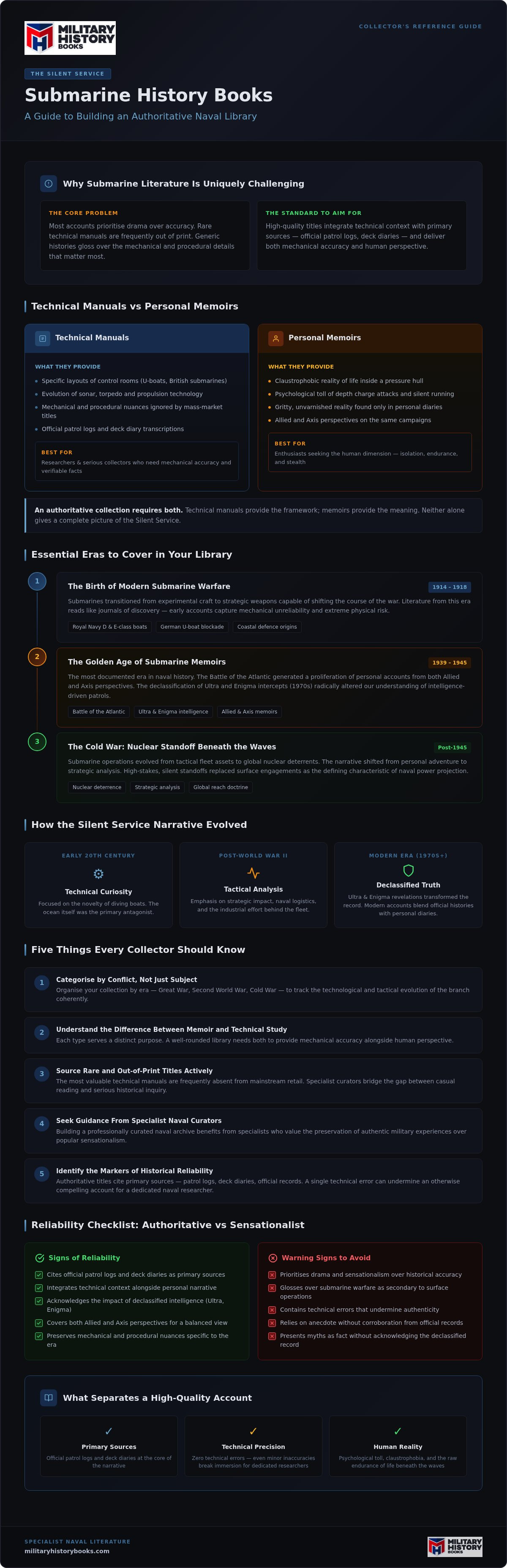
A recurring theme in the most compelling memoirs is the psychological toll of underwater warfare. Authors frequently describe the claustrophobic reality of the pressure hull and the unnerving experience of "pinging" ASDIC or the terrifying silence that precedes a depth charge attack. For a book to be considered high-quality in this niche, it must go beyond simple storytelling. The best titles integrate technical context with primary sources like official patrol logs and deck diaries to provide a complete picture of the mission. Accuracy is paramount, as even a small technical error can break the immersion for a dedicated naval researcher.
The Evolution of the Silent Service Narrative
Submarine literature has changed significantly since the early 20th century. Initial accounts were often driven by a sense of technical curiosity, focusing on the "novelty" of diving boats. Following the Second World War, the narrative shifted toward tactical analysis and strategic impact. The declassification of Ultra and Enigma intercepts in the 1970s radically altered how we view these missions, as it revealed the intelligence-driven nature of submarine patrols. Modern accounts now favour a blend of official histories whilst incorporating the gritty, unvarnished reality found in personal diaries.
Why Specialist Naval Literature Matters
General military histories often gloss over the finer details of submarine warfare, treating them as a secondary branch of the navy. Specialist naval history books are essential because they preserve the mechanical and procedural nuances that mass-market titles ignore. Whether it's the specific layout of a U-boat's control room or the evolution of sonar technology, these details are vital for anyone wishing to understand the reality of the service. Specialist curators help bridge the gap between casual reading and serious historical inquiry by sourcing titles that provide this necessary depth.
Essential Eras: From the Great War to the Cold War
Organising a collection of submarine history books requires an understanding of how each conflict redefined undersea operations. The literature isn't a monolith; it's a series of distinct chapters that track the technological and tactical evolution of the branch. By categorising your library by era, you can better appreciate the transition from short-range coastal defence to global nuclear reach. Each period offers a different perspective on the Silent Service, from the raw, mechanical challenges of early submersibles to the high-stakes, silent standoffs of the modern age.
The Birth of Modern Submarine Warfare (1914–1918)
During the First World War, submarines transitioned from experimental craft to strategic weapons capable of shifting the course of the war. Early literature from this period captures the mechanical unreliability and extreme physical risks faced by crews. These early works often read like journals of discovery, where the enemy is just as likely to be the ocean itself as it is a hostile destroyer. We recommend researchers look for titles covering the Royal Navy Submarine Service's formative years, particularly those documenting the D and E-class boats. It's equally important to include U-boat accounts from this era to gain a balanced view of the blockade that nearly brought Britain to its knees.
The Golden Age of Submarine Memoirs (1939–1945)
The Second World War remains the most documented era in naval history, largely due to the sheer scale of the Battle of the Atlantic. This period saw a proliferation of personal accounts from both Allied and Axis perspectives. These wartime history books UK enthusiasts often seek out provide vital context on naval logistics and the industrial effort required to sustain the fleet. Memoirs by commanders like Peter Cremer or Donald Macintyre have stood the test of time, whilst "must-read" titles frequently highlight the "wolf pack" tactics of the Kriegsmarine versus the technological advancements in Allied radar. These accounts offer unvarnished insights into the tonnage war and the brutal reality of convoy escort duties.
The Cold War introduced a different kind of tension, defined by the "cat and mouse" games of the nuclear age. Literature from this period focuses on the technical sophistication of sonar and the psychological endurance required for months-long covert patrols. These accounts are often more analytical, dealing with acoustic signatures and the strategic balance of power. Finding high-quality submarine history books for this era can be challenging due to the sensitive nature of the operations, but they remain essential for any complete naval library. If you are starting your journey into these fascinating periods, browsing our curated Naval History Books can help you find the specific era that captures your interest.
Technical Manuals vs Personal Memoirs: Choosing Your Focus
Curating a collection of submarine history books usually involves a strategic choice between technical precision and narrative depth. Technical manuals provide the "mechanical accuracy" required to understand how these complex vessels functioned, whilst memoirs offer the "human element" that technical drawings simply cannot capture. For a serious researcher, these two formats are not mutually exclusive; they are complementary tools used to reconstruct the reality of a mission. A patrol report might record a specific depth or a torpedo's trajectory, but a memoir explains the groaning of the hull and the palpable tension amongst the crew at that exact moment. By combining these perspectives, you can build a comprehensive view of naval operations that respects both the machine and the sailor.
High-end naval volumes frequently feature intricate blueprints and technical drawings that allow for a deeper understanding of internal layouts and engineering hurdles. For those who require a precise visual reference, modelling magazines are an invaluable resource. These publications often contain detailed colour plates and scale diagrams that are rarely found in standard prose. These visual aids help bridge the gap between a dry list of specifications and the physical reality of the boat, making them essential for historians and hobbyists alike who want to see the Silent Service in clear detail.
The Researcher’s Choice: Technical and Tactical Studies
When selecting technical studies, look for volumes that detail the evolution of machinery, armament, and sonar systems. These books form the backbone of any serious study into "The Hunt", providing the tactical context needed to understand why certain decisions were made at sea. Many modern researchers now utilise digital military history books to access high-resolution technical diagrams and schematics. These digital formats are particularly useful for zooming in on complex engine room layouts or early torpedo fire-control systems without risking damage to a fragile physical copy.
The Reader’s Choice: Narrative and Biographical Accounts
Personal stories provide a unique window into the culture of the Silent Service, highlighting the psychological endurance required for long-term underwater warfare. These narrative accounts often possess significant literary merit, moving beyond simple combat reports to explore the bonds formed in the close quarters of a pressure hull. Interestingly, some of the best naval fiction books are penned by veterans themselves, offering a vivid sense of life on board that can sometimes surpass the detail found in official reports. These biographies preserve the human experience, ensuring the stories of those who served are not lost to time.
Sourcing Rare and Out-of-Print Submarine Literature
Many of the most definitive submarine history books were never intended for a mass-market audience. Technical manuals and tactical analyses often had extremely limited print runs; these were frequently distributed only within naval circles or to specific military institutions. As vessels were decommissioned and technology evolved, these publications fell out of print. This makes them elusive for modern collectors. Finding a first edition or a memoir signed by a veteran commander adds a layer of tangible history. A standard reprint simply cannot match that connection. Identifying authentic editions requires a keen eye for publisher markings and an understanding of the specific naval presses active during the mid-20th century.
The Value of Out-of-Print Titles
Academics and serious historians view out of print military books as essential primary sources because they contain unedited data and contemporary perspectives. When evaluating the condition of these older naval volumes, you should look for specific indicators of quality:
- Binding Integrity: Ensure the spine hasn't cracked under the weight of heavy technical plates.
- Foxing and Discolouration: Check for "foxing" (brown spots) caused by acidic paper, which is common in wartime editions.
- Completeness: Verify that all fold-out blueprints and diagrams are present, as these are often removed for framing.
- Provenance: Look for bookplates or signatures that connect the volume to a specific naval officer or vessel.
Digital vs Physical: The Modern Collector’s Dilemma
The modern researcher often faces a choice between the convenience of digital downloads and the tactile satisfaction of a physical book. Digital files allow for rapid keyword searches and easy storage, which is ideal for cross-referencing multiple patrol logs during a project. However, physical books retain an investment value and a sense of permanence that digital media lacks. Finding high-quality submarine history books in their original state is a rewarding pursuit for any dedicated naval historian. To support those maintaining legacy archives, we offer specialist digital titles on disc, providing a bridge between traditional collecting and modern accessibility. This ensures that even the rarest technical data remains preserved for future generations of naval enthusiasts.
If you are searching for a specific volume to complete your collection, you can browse our rare and out-of-print titles to discover curated additions for your library.
Building Your Submarine Library with Military History Books
Finding the right volume to complete a collection requires more than just a search engine; it requires a curator who understands the historical weight of the subject. Military History Books serves as a dedicated destination for those who value the legacy of the Silent Service. Managed by an RAF veteran, the business is built on a foundation of genuine expertise and a deep-seated respect for military heritage. This professional background ensures that the curation of submarine history books is handled with the precision and care that serious researchers expect. You aren't just browsing a shop; you are engaging with a specialist archive that prioritises the preservation of human and technical stories.
Our inventory includes over 10,000 specialist titles, covering the full spectrum of land warfare, aviation, and naval history. This breadth allows you to contextualise submarine operations within the wider maritime strategies of their respective eras. Whilst general retailers often struggle to categorise niche technical manuals or rare memoirs, our collection is organised to help you find exactly what you need. This methodical approach saves you time and ensures you discover titles that might otherwise remain hidden in a generic catalogue.
A Curated Selection of Naval Excellence
This curation extends from rare, out-of-print first editions to modern technical magazines and digital downloads. We understand that every researcher has different needs, whether you are looking for the acoustic signatures of Cold War vessels or the personal diaries of Great War commanders. Browsing a specialist site offers a level of focus that larger platforms cannot match, as every title has been selected for its historical value. For those looking to share this passion with others, we recommend exploring our military history gift books UK guide to find the perfect addition for a fellow enthusiast's library.
Secure Global Service and Expert Advice
For researchers working outside the United Kingdom, our secure international delivery ensures that rare naval literature is accessible regardless of your location. We take great pride in our packaging and logistics, understanding that many of these volumes are irreplaceable primary sources. This global reach is paired with a personal touch; we are always ready to assist with specific requests or help you track down an elusive title. Our commitment to service is reflected in our secure checkout and the steady, reliable way we manage every order. We invite you to explore our full catalogue and discover how we can help you build a library that truly honours the history of the Silent Service.
Expanding Your Archive of the Silent Service
Building a comprehensive collection of submarine history books requires a careful balance between mechanical precision and moving personal narrative. You need both. By understanding the distinct eras of undersea warfare, from early coastal patrols to silent nuclear standoffs, you can ensure your library offers a complete perspective on naval history. Sourcing rare and out-of-print titles is often the key to uncovering the most authentic primary sources; having a specialist guide makes this pursuit far more rewarding.
Our collection is managed by an RAF veteran who understands the importance of historical accuracy and specialist expertise. With over 10,000 titles in stock and secure international delivery, we are dedicated to supporting the global research community. Browse our full collection of submarine and naval history books at Military History Books and discover the hidden stories of the Silent Service. We look forward to helping you preserve these vital chapters of maritime history.
Frequently Asked Questions
What is the best book about WWII submarine warfare for a beginner?
Edward Young's One of Our Submarines is an excellent starting point for a beginner as it provides a clear, firsthand account of Royal Navy operations. It avoids overly dense technical jargon whilst capturing the atmosphere of the Silent Service perfectly. Another accessible option is Iron Coffins by Herbert Werner, which offers a vivid perspective from the German U-boat fleet. These titles serve as ideal entry points into the broader world of submarine history books before moving onto technical studies.
Where can I find technical manuals for Royal Navy submarines?
You can find authentic technical manuals and procedural guides within our specialist naval history collection. We curate a range of internal publications that detail the machinery, armament, and sonar systems used by the Royal Navy throughout the 20th century. Because many of these manuals are scarce, we often provide them as digital titles on disc to ensure the information remains accessible to modern researchers without the risk of damaging fragile original documents.
How do I identify a rare first-edition naval memoir?
Identifying a rare first edition involves checking the title page for the original publisher's imprint and matching the publication date with the first known release. Look for specific indicators such as the absence of reprint notices and the presence of original dust jackets in good condition. Our specialist curator uses these markers to verify every rare volume in our inventory. Authentic memoirs often feature unique binding details or maps that were omitted in later, cheaper reprints.
Are digital military history books as reliable as physical copies?
Digital military history books are highly reliable for research as they are typically high-resolution scans of the original physical documents. These digital formats allow you to zoom in on complex blueprints and technical diagrams that might be difficult to see in a standard book. Whilst they lack the tactile value of a physical library, they provide an efficient way to cross-reference data across multiple patrol logs and technical manuals without taking up physical shelf space.
What are the most famous U-boat accounts from the Second World War?
The most famous U-boat accounts include Peter Cremer’s U-Boat Commander and Herbert Werner’s Iron Coffins. These memoirs are highly regarded for their unvarnished look at the Battle of the Atlantic from the perspective of the Kriegsmarine. They describe the tactical challenges of wolf pack operations and the psychological pressure of Allied anti-submarine warfare. Including these perspectives is essential for anyone building a balanced collection of submarine history books that covers both sides of the conflict.
Can I find back issues of naval and modelling magazines online?
Yes, we maintain an extensive inventory of back issue magazines and modelling publications that are available for purchase through our online store. These magazines are invaluable for their contemporary reviews, detailed colour plates, and scale drawings of specific submarine classes. Whether you are looking for historical analysis or visual references for a modelling project, these back issues provide a level of detail that is often missing from general historical overviews and mass-market books.
Why are many specialist submarine books out-of-print?
Many specialist submarine books are out-of-print because they were originally produced in small quantities for a very niche audience of naval officers or technical experts. Unlike general fiction, these volumes weren't designed for mass-market appeal, leading to limited print runs that were never renewed. Over time, as naval technology evolved and original publishers closed or merged, these specific titles became scarce. This scarcity is exactly why we focus on sourcing and preserving these rare technical and narrative works.
How does Military History Books source its rare titles?
We source our rare titles through a dedicated network of specialist contacts, private estate collections, and military history enthusiasts. Our curator uses his professional background as an RAF veteran to identify and verify the historical value of every acquisition. This expertise allows us to find elusive technical manuals and signed memoirs that are often unavailable through mainstream retailers. We prioritise the quality and completeness of our inventory to ensure every book meets the standards of serious researchers.


