

The true history of the Cold War isn't found in the broad strokes of political rhetoric, but in the grease-stained pages of a flight manual or the silent logs of a clandestine submarine patrol. For the dedicated historian, finding high-quality Cold War history books often feels like a mission in itself, especially when generic accounts gloss over the technical specifications and tactical realities that defined the era. You've likely spent hours sifting through surface-level narratives only to find they lack the granular detail required for serious research. We understand that frustration because we share your passion for the preservation of these precise military stories, particularly as new declassified records continue to emerge in 2026.
This guide will help you navigate the complexities of curating a definitive Cold War library, moving beyond academic theory into the practical world of technical manuals and rare accounts of naval operations. You'll discover how to identify essential titles that bridge the gap between air, land, and sea whilst learning to source out-of-print gems that others might overlook. We'll explore the unique value of modelling magazines and back-issue periodicals for technical accuracy, providing a roadmap to connect with a veteran-led archive that treats history with the respect it deserves.
Key Takeaways
- Understand the Cold War as a period of rapid military innovation, where specialist literature offers a deeper perspective on the deterrents and proxy wars that defined the era.
- Identify the most authoritative Cold War history books for your collection, focusing on technical aviation manuals, naval logs, and land warfare studies.
- Recognise the strategic importance of sourcing rare and out-of-print titles to uncover technical data that generic historical narratives often overlook.
- Learn how veteran-led expertise can help you distinguish between academic theory and the practical military reality found in authentic service records.
- Discover the value of incorporating back-issue magazines and digital titles into your archive to ensure a comprehensive and accurate research library.
Defining the Era Through Cold War History Books
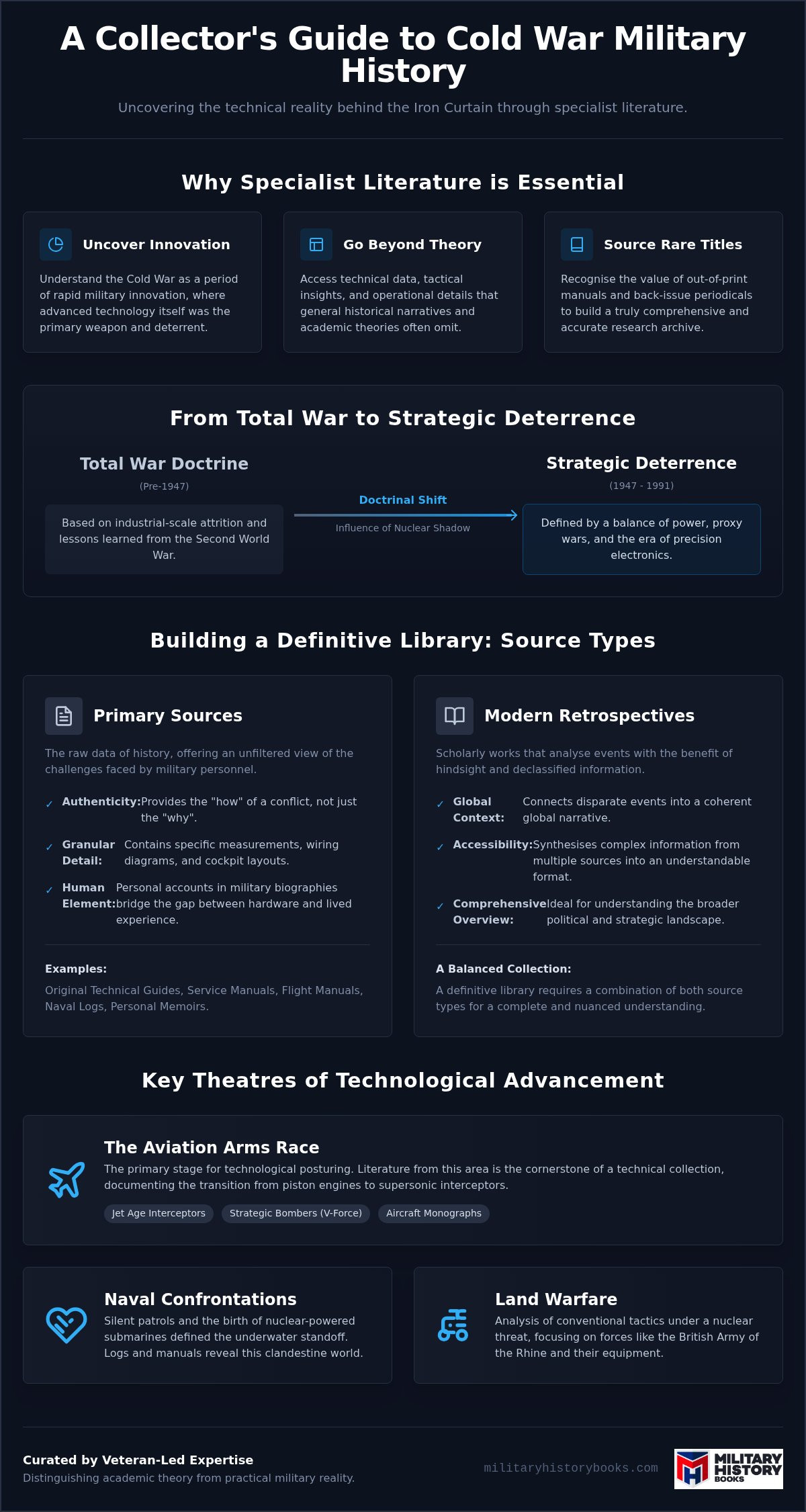
The Cold War, which lasted from roughly 1947 to 1991, represents one of the most intense periods of military innovation in human history. Unlike the total wars of the early 20th century, this era was defined by a delicate balance of power, where the mere existence of advanced technology often served as the primary weapon. For the serious researcher, Cold War history books are the only way to peel back the layers of secrecy that once surrounded this period. These specialist titles provide the technical data and tactical insights that general historical accounts often omit, favouring the tangible reality of military hardware over the "mist and fog" of political speculation.
Specialist literature is vital for understanding how the global standoff influenced "proxy wars" and the development of strategic deterrents. Whilst broad narratives might explain the "why" of a conflict, technical Cold War history books explain the "how." They document the rapid evolution of jet engines, the birth of nuclear-powered submarines, and the complex logistics of the British Army of the Rhine. By studying these records, collectors can see the direct impact of the nuclear shadow on conventional warfare tactics and equipment design.
The Shift from Total War to Strategic Deterrence
Following the conclusion of the Second World War, military doctrine underwent a radical transformation. Literature from the late 1940s and early 1950s tracks this transition, showing how commanders adapted WWII tactics to suit a nuclear-armed world. "Lessons learned" publications were produced at an incredible rate as branches of service analysed the performance of equipment in new, high-stakes environments. Cold War literature serves as a technical archive of the 20th century, documenting the precise moment that human conflict shifted from industrial-scale attrition to the era of precision electronics and strategic standoffs.
Primary Sources vs. Modern Retrospectives
Building a definitive library requires a balance between contemporary field manuals and modern scholarly work. Modern historians like Odd Arne Westad have provided invaluable global context, yet there is no substitute for the raw detail found in an original technical guide or service manual from the 1960s. These primary sources offer an unfiltered look at the challenges faced by personnel on the ground. To truly understand the era, one must also look to military biography books. These personal accounts humanise the nuclear standoff, providing a necessary bridge between the cold, technical specifications of a weapon system and the lived experience of the men and women who operated them.
The Aviation Arms Race: From Jet Age Interceptors to Strategic Bombers
The sky became the primary stage for technological posturing during the mid-20th century, making Cold War history books focused on aviation the cornerstone of any technical collection. As the RAF and USAF transitioned from piston-driven relics to supersonic interceptors, the literature evolved alongside the hardware. This period saw the rise of the strategic bomber, with the British V-bomber force representing the pinnacle of nuclear delivery capabilities. At Military History Books, our archive is managed by an RAF veteran who understands that the value of these records lies in their technical precision and historical weight. We prioritise titles that offer a deep dive into the engineering triumphs and tactical shifts of the jet age.
Technical Manuals and Aircraft Monographs
Modellers and restorers often look for more than just a general history; they require the granular detail found in aircraft monographs and technical manuals. These publications provide the specific measurements, cockpit layouts, and wiring diagrams that are essential for accurate restoration or scale modelling. Titles covering the English Electric Lightning or the ill-fated TSR-2 remain incredibly popular because they document the peak of British aerospace engineering. If you are looking to deepen your understanding of these specific airframes, you can explore our detailed guide to aviation history books to find the right technical resources for your project.
The Role of Aviation Magazines and Back Issues
Whilst books provide a cohesive narrative, back issue military magazines UK offer a month-by-month record of the arms race as it happened. These periodicals capture the atmosphere of the era, featuring contemporary photography and pilot reports that haven't been reproduced in modern retrospectives. Specialist commemorative publications like the "RAF Salute" series provide focused insights that complement broader Cold War history books by highlighting specific anniversaries or squadrons. Browsing our inventory of back issue magazines often reveals these hidden technical gems, providing a level of detail that is difficult to find in standard retail titles. These magazines are particularly useful for researchers who need to track the public perception of military technology as it was being developed.
Beyond the Iron Curtain: Land Warfare and Naval Confrontations
Whilst the supersonic interceptors discussed previously dominated the skies, the ground and sea theatres were where the Cold War reached its highest concentrations of conventional power. Specialist Cold War history books are indispensable for understanding the immense tactical preparation required for a conflict that many feared would start in the plains of West Germany. These works move beyond the broad strokes of political history to examine the granular details of troop movements, logistics, and the hardware that stood ready for decades.
The British Army of the Rhine (BAOR) stood as a central pillar of NATO's defence, positioned directly in the path of a potential Warsaw Pact advance. Literature covering this period often focuses on the "tank battles that never happened" within the Fulda Gap, a strategic corridor that became the focal point of Western defensive doctrine. Researchers value these accounts for their analysis of how land forces were structured to withstand a massive armoured assault whilst maintaining a credible nuclear threshold.
Armoured Evolution and Cold War Tank Doctrine
The technological leap from the post-war Centurion to the formidable Chieftain main battle tank is well-documented in our collection of land warfare titles. These works don't just list specifications; they analyse how British armour was designed to counter the numerical superiority of Soviet T-series tanks like the T-64 and T-72. This technical armour history often crosses over with modelling magazines military, where enthusiasts seek precise details on camouflage patterns and external fittings. These land warfare books also provide a vital record of the tactical shifts in anti-tank technology, from the early Malkara missiles to the sophisticated MILAN system, which fundamentally altered the balance of power on the ground.
Naval Warfare: Submarines and Carrier Groups
The naval theatre was defined by the "Silent Service" and the constant game of cat-and-mouse played beneath the North Atlantic. Submarine history books have a unique appeal, offering rare glimpses into the clandestine world of nuclear-powered vessels and the sailors who manned them. Understanding the Royal Navy's role in maritime deterrence requires a study of technical naval records, which detail the transition from traditional carrier groups to the continuous at-sea deterrent. For researchers looking to expand their archive, our curated list of naval history publications offers a comprehensive starting point. These records are essential for tracking how global maritime influence shifted as the nuclear age matured, ensuring that the history of the "Silent Service" remains accessible to future generations of historians.
Sourcing Specialist Literature: Rare Titles and Technical Manuals
Sourcing Cold War history books from the 1950s and 60s presents a unique set of challenges for the modern collector. Unlike general historical accounts, technical military publications were often produced in limited numbers for a specific professional audience. Many of these documents were once classified or considered disposable once a newer system was introduced. This makes finding an original flight manual or submarine log far more difficult than locating a standard biography. Collectors must look beyond generic marketplaces to find authentic technical records that haven't been sanitised for a general readership.
Identifying and Sourcing Out-of-Print Gems
Determining the rarity of military literature involves looking at several factors. A book's "rare" status is usually driven by its initial print run, the sensitivity of the technical data it contains, and its physical condition. First editions of memoirs from high-ranking officers or clandestine operators are particularly sought after, especially if they include original maps or diagrams. Specialist dealers play a vital role here, as they can verify the provenance of a title and ensure it's not a modern reprint. For those serious about building a high-value collection, our guide to out of print military books provides essential strategies for 2026.
Specialist aviation bookshops offer a distinct advantage when hunting for niche technical titles. Because these shops are often managed by experts who understand the subject matter, they can source material that generic retailers simply don't have access to. If you're struggling to find a specific service manual or a rare account of Cold War operations, you can browse our specialist collection to see our latest acquisitions.
Digital Formats for Modern Research
The rise of digital military history books has changed how researchers manage their archives. Whilst physical copies remain the gold standard for collectors, digital titles on disc or by download offer an excellent way to save space and ensure portability. These formats are particularly useful for preserving fragile technical manuals that might be too delicate for frequent handling. By using digital versions for daily research, you can keep your original rare editions in pristine condition whilst still having instant access to the data you need. Digital downloads also allow for the preservation of rare technical manuals that are no longer in print, ensuring this knowledge remains available for future study.
Curating Your Collection: Why Specialist Expertise Matters
Building a collection of Cold War history books is a journey that requires patience and a keen eye for detail. It isn't just about accumulating volume; it's about selecting titles that offer a genuine window into the tactical and technical realities of the era. A balanced library should span the major disciplines of aviation, land warfare, and naval operations, ensuring no single aspect of the standoff is overlooked. This balanced approach allows you to see how a shift in aircraft technology might have influenced naval patrol patterns or how land-based deterrents shaped diplomatic negotiations.
Algorithms can suggest popular titles based on sales data, but they can't replicate the "cockpit" or "boots on the ground" perspective of a seasoned expert. A veteran-managed archive offers a level of curation that understands the historical weight of a technical manual or a pilot's log. This expertise ensures that even the military fiction titles in the collection are chosen for their historical accuracy and realistic portrayal of service life, providing a narrative depth that complements your technical research.
The Value of Veteran-Led Curation
Managed by an RAF veteran, Military History Books brings a specialised understanding to its inventory of over 10,000 titles. This background informs the selection process, prioritising material that serious researchers and collectors actually need for their archives. Whether you're looking for rare monographs or out-of-print technical guides, the personalised service of a specialist bookseller provides a level of trust that high-volume retailers can't match. We also ensure secure international delivery, allowing global collectors to acquire rare pieces of history with complete peace of mind, regardless of their location.
Starting Your Cold War Library
For those just beginning their journey, starting with a few foundational reference works is a sensible approach. These "starter" titles provide the necessary framework before you dive into more niche technical manuals or clandestine naval accounts. You might also look at wartime history books UK to understand the broader national context that shaped British Cold War policy and military structure. If you're looking to introduce the subject to a fellow enthusiast, military history gift books UK offer an accessible entry point without sacrificing the technical quality of the information provided.
As we move through 2026, the relevance of the Cold War remains as strong as ever. With new declassified records providing fresh insights into 20th-century strategy, the role of the specialist curator is more important than ever. By building a library that respects technical accuracy and the reality of military service, you're not just collecting paper; you're preserving the stories of an era that fundamentally shaped the modern world.
Preserving the Technical Legacy of the Cold War
Building a definitive archive of this era requires a move away from surface-level narratives toward the technical precision found in service manuals and specialist records. By balancing your collection across aviation, land warfare, and naval history, you ensure that every facet of the 20th century's most significant standoff is accurately preserved. We've explored how identifying rare titles and technical monographs can elevate a library from a simple hobby to a professional-grade research archive.
Finding these elusive records is often a challenge, but you don't have to navigate the market alone. Our archive is managed by an RAF veteran who understands the importance of historical integrity. With over 10,000 specialist titles in stock, we're dedicated to helping you find the exact records you need. Whether you're a serious researcher or a dedicated modeller, we provide secure international delivery for all our rare and valuable acquisitions.
Browse our extensive collection of Cold War history books and rare titles today and take the next step in curating your personal history. Your journey into the clandestine world of Cold War strategy starts here.
Frequently Asked Questions
What are the best Cold War history books for beginners?
Beginners should look for comprehensive overviews that define the timeline from 1947 to 1991. These Cold War history books provide the necessary geopolitical context before you move into more technical niches. Look for titles that balance the political standoff with the military realities of the era. Starting with a broad narrative helps you understand the strategic importance of later, more specialised studies on specific airframes or naval operations.
Where can I find rare or out-of-print Cold War military books?
Rare or out-of-print titles are best sourced through specialist retailers who understand the nuances of military literature. Generic marketplaces often lack the expertise to verify the condition or provenance of a technical manual. We maintain an inventory of over 10,000 titles, focusing specifically on aviation, naval, and land warfare. This curated approach makes it much easier to locate elusive first editions or niche publications that have long been out of print.
Are there specialist books on Cold War aviation and the RAF?
Specialist aviation history books are a cornerstone of our collection, covering everything from early jet interceptors to the strategic V-bomber force. Because our business is managed by an RAF veteran, we have a deep-seated passion for documenting the history of the Royal Air Force. You can find detailed monographs on specific aircraft and technical manuals that provide a level of detail unavailable in general histories. These records are essential for both researchers and modellers.
How do I identify a first edition military history book?
Identifying a first edition requires a close inspection of the copyright page and the title page. Look for a "First Edition" statement or a complete number line that starts with the number one. In military history, the condition of the dust jacket and the presence of original maps or technical inserts significantly impact the value. If you're unsure, consulting a specialist bookseller who understands the printing history of specific military publishers is always a wise step.
Can I buy digital versions of old technical military manuals?
Digital versions are an excellent way to access technical military manuals without the risk of damaging fragile original documents. We offer a variety of digital titles available for immediate download or on disc, which is ideal for researchers with limited shelf space. These digital formats preserve the granular detail of wiring diagrams and engine specifications whilst providing a portable solution for modern historians. It's a practical way to manage a large technical archive.
What is the difference between a general history and a technical military publication?
General histories focus on the broad political narratives and the "why" behind the nuclear standoff. In contrast, a technical military publication provides the "how," offering specific data on equipment, tactics, and logistics. These specialist Cold War history books might include pilot notes, field manuals, or detailed engineering monographs. Understanding the difference is key to building a library that balances human stories with the hard technical realities of 20th-century warfare.
Why should I buy from a specialist military bookshop instead of a large retailer?
Specialist military bookshops offer a level of curation that large, algorithm-driven retailers cannot replicate. We understand the historical weight of our subject matter and can assist you in finding niche titles that fit your specific research goals. Buying from a veteran-led business means you're connecting with a curator who knows the difference between a surface-level account and a definitive technical record. This expertise ensures you're investing in quality material that adds genuine value to your collection.
Do you provide international shipping for rare military books?
We provide secure international delivery to collectors and historians across the globe. Rare and out-of-print military literature is often difficult to source locally, so we've established a reliable shipping network to ensure your acquisitions arrive safely. Every item is packaged with the care that a historical document deserves, reflecting our commitment to the preservation of military stories. Whether you're in Europe, North America, or beyond, we can support your research needs with absolute confidence.


