

A true naval library must balance the human narrative of the Senior Service with the technical precision of Admiralty-level detail. If you've ever spent hours scouring shelves only to find repetitive war stories that skip over the complex realities of life at sea, you aren't alone. Many historians and enthusiasts find it difficult to source accurate, specialist Royal Navy history books that offer more than just a surface-level glance at the past. It's often frustrating when you're searching for specific out-of-print memoirs or technical maritime publications and can't be sure which edition holds the most weight for your research.
In this guide, we'll help you cut through the noise to find the volumes that actually matter. You'll discover how to distinguish between general interest titles and the rigorous technical manuals that provide genuine insight into naval life. We'll explore the best ways to track down rare editions and explain why certain historical periods, from the Age of Sail to the post-war era, require a specific approach to sourcing material. By the end, you'll have a clear roadmap for building a collection that is both comprehensive and authoritative.
Key Takeaways
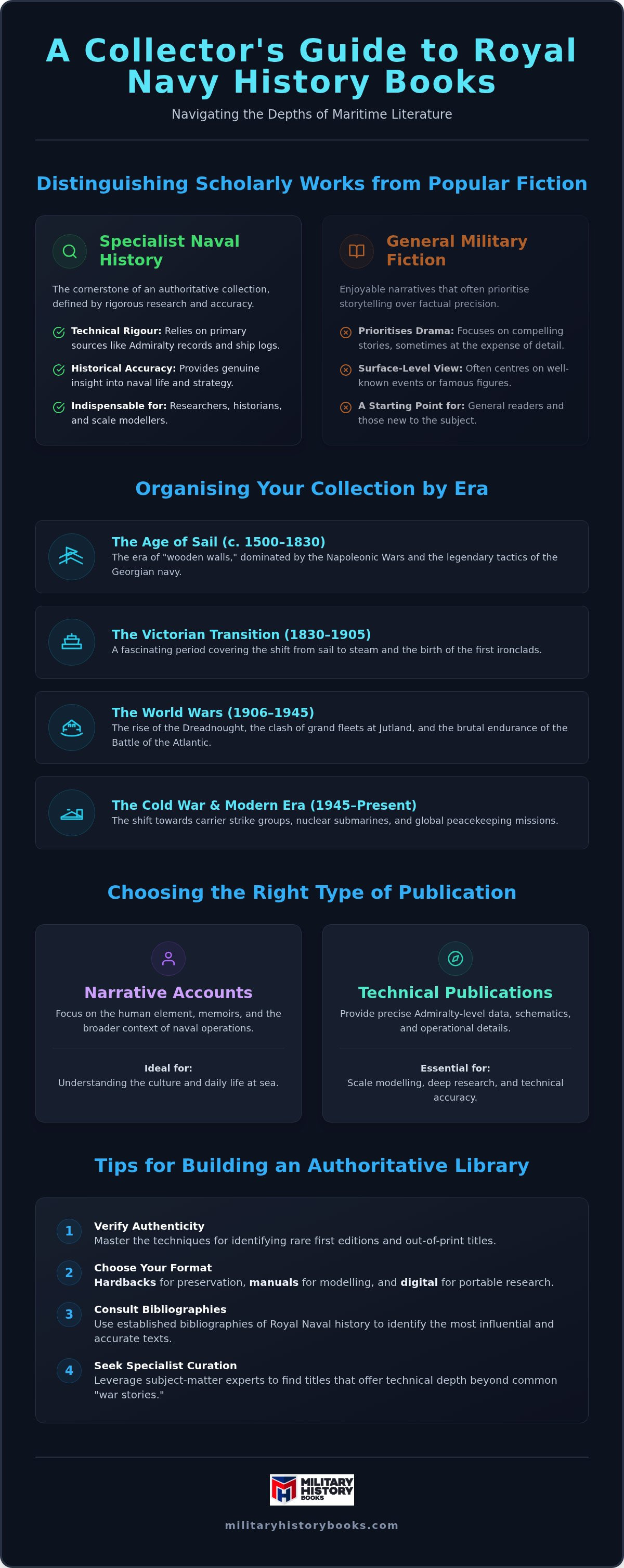
- Learn how to distinguish between general military fiction and high-quality Royal Navy history books that offer technical rigour and historical accuracy.
- Discover a structured approach to organising your maritime library by era, focusing on key periods such as the Age of Sail and the Napoleonic Wars.
- Understand the vital differences between narrative accounts and technical publications to ensure your research or scale modelling projects are supported by precise Admiralty-level data.
- Master the techniques for identifying rare first editions and out-of-print titles, including a practical checklist for verifying the authenticity of specialist naval publications.
- Explore how a curated collection managed by subject-matter experts can help you bridge the gap between historical archives and your personal enthusiast library.
The Enduring Legacy of Royal Navy History Books
Known as the Senior Service because it's the oldest branch of the British Armed Forces, the Royal Navy occupies a unique position in military literature as the primary guardian of the nation's maritime security and global trade. This historical weight has created a vast literary record that stretches far beyond simple accounts of battle. For many enthusiasts, Royal Navy history books represent more than just a hobby; they're a vital link to a heritage of seafaring excellence that has shaped the modern world. Whilst many readers start with popular fiction, the transition to specialist non-fiction marks the beginning of a deeper understanding of maritime strategy and life at sea.
A specialist naval history book is defined by its commitment to primary sources, technical accuracy, and strategic context, distinguishing it from general military fiction which often prioritises drama over detail. These works rely on Admiralty records, ship logs, and contemporary accounts to build a factual narrative. For those building a serious collection, consulting a Bibliography of Royal Naval history is an essential step in identifying the most influential texts. This level of rigour is what makes these books indispensable for professional historians and genealogists tracing an ancestor's service across the globe.
Why Specialist Curation Matters for Researchers
Mass-market titles often focus on well-known figures like Nelson, yet a truly comprehensive library of Royal Navy history books must include the broader evolution of the service through the 20th century. This is where specialist curation becomes invaluable. A knowledgeable curator, such as an RAF veteran with a deep respect for service history, can help you identify titles that offer technical depth rather than just surface-level "war stories". Preserving these accounts through physical hardbacks and digital media ensures that the intricate details of naval architecture and tactical shifts aren't lost to time.
Navigating the Breadth of Naval Literature
The scope of available material is immense, ranging from rare first editions of 18th-century voyages to modern digital downloads of technical manuals. Because the Royal Navy's influence reached every corner of the globe, its history resonates with a worldwide audience. Collectors often find themselves moving between different formats to suit their needs:
- Hardback editions: Ideal for long-term preservation and building a valuable physical archive.
- Technical manuals: Essential for modellers seeking absolute accuracy in scale builds and rigging details.
- Digital titles: Perfect for researchers who need portable, searchable access to large datasets or Admiralty instructions.
Exploring these various naval history publications allows enthusiasts to build a library that balances human stories with the cold, hard facts of maritime life. Whether you're looking for an out-of-print memoir or a data-driven technical study, the right resources act as a bridge between the past and the modern reader.
Categorising British Naval History by Era
Organising a comprehensive collection of Royal Navy history books requires a methodical approach that reflects the service's technological and strategic evolution. It isn't just about wooden ships versus steel. A well-structured library identifies the pivotal moments where ship design, propulsion, and global doctrine shifted. By categorising your volumes into distinct eras, you can better understand how a fleet of sailing men-of-war transformed into a nuclear-powered global force. Most collectors focus on four primary epochs:
- The Age of Sail (c. 1500–1830): The era of the "wooden walls", dominated by the Napoleonic Wars and the legendary tactics of the Georgian navy.
- The Victorian Transition (1830–1905): A fascinating period covering the shift from sail to steam and the birth of the first ironclads.
- The World Wars (1906–1945): The rise of the Dreadnought, the clash of grand fleets at Jutland, and the brutal endurance of the Battle of the Atlantic.
- The Cold War and Modern Era (1945–Present): The shift towards carrier strike groups, nuclear submarines, and global peacekeeping missions.
The Age of Nelson and the Napoleonic Wars
This period remains the most popular amongst historians and collectors alike. Literature from this era often focuses on the tactical brilliance of commanders like Nelson and the daily hardships of life at sea. To truly grasp the reality of the Georgian navy, researchers should look for contemporary journals and officer memoirs. These primary sources provide a level of detail that modern summaries often miss. For those who want to supplement their factual research with evocative storytelling, you can explore the best naval fiction books, which often draw heavily on authentic historical logs. If you're conducting deeper academic work, this National Archives research guide is an invaluable tool for navigating official correspondence from this period.
One area where many collections fall short is the Victorian transition. This era saw the dramatic shift from broadside-firing wooden ships to turreted ironclads. Books covering this period are essential for understanding how the Navy maintained Pax Britannica whilst undergoing a total industrial revolution. It's a niche that provides a bridge between the Age of Sail and the modern dreadnought.
Modern Naval Warfare: 1914 to the Present Day
The 20th century introduced technological leaps that redefined maritime conflict. From the clash of steel giants at Jutland to the desperate struggle of the Battle of the Atlantic, the range of Royal Navy history books covering this period is vast and varied. This era also saw the rise of the "Silent Service". Submarine history books are a specialist category that captures the claustrophobic and high-stakes nature of underwater warfare. Modern accounts now focus on the Navy's role in global peacekeeping and the strategic importance of carrier strike groups. If you're looking to expand your own archive, you can browse our curated naval collection to find rare titles from across these diverse eras.
Choosing Between Narrative Accounts and Technical Publications
Building a collection of Royal Navy history books requires a clear understanding of your research goals. Some readers seek the sweeping drama of fleet engagements, whilst others require the precise measurements of a battleship's secondary armament. Distinguishing between narrative accounts and technical publications is vital for ensuring your library serves its intended purpose. Narrative histories are story-driven, focusing on the strategic movement of fleets and the political landscape that sent them to sea. In contrast, technical publications are data-driven, providing the empirical evidence that underpins our understanding of maritime engineering and warfare.
The Value of Technical Naval Manuals
For serious modellers and academic researchers, technical manuals are indispensable. These documents allow for the verification of ship specifications, armour thickness, and weaponry configurations that narrative accounts often gloss over. If you're working on a scale build of a King George V-class battleship, for instance, you can't rely on a general history; you need the primary data found in Admiralty-level technical literature. This level of detail is also essential for maritime historians who need to understand the mechanical constraints of 20th-century naval operations.
- Ship Plans: Sourcing back-issue magazines often provides access to detailed ship plans and cross-sections not found in modern reprints.
- Searchable Data: Digital formats, whether on disc or as downloads, offer a significant advantage by allowing you to search thousands of pages for specific technical terms or ship names instantly.
- Weaponry Specs: Specialist titles often focus solely on gunnery or radar development, providing a deep dive into the "hardware" of the Senior Service.
Memoirs and Biographies: The Human Element
Whilst technical data tells us what a ship could do, military biography books explain why certain decisions were made under the pressure of command. These accounts provide the human context that technical manuals lack. Reading the personal wartime memoirs of an admiral or the diary of a lower-deck rating offers a unique perspective on the lived reality of naval service. These first-hand accounts help bridge the gap between cold strategy and human endurance during major campaigns like the Battle of the Atlantic. When sourcing these Royal Navy history books, it's important to look for authentic, unedited editions that preserve the original voice and observations of the author, as these offer the most reliable historical value.
Sourcing Rare and Out-of-Print Naval Titles in 2026
The market for Royal Navy history books is often defined by what is no longer in active publication. Many of the most vital technical studies and personal memoirs were produced in limited quantities, making them highly sought after by collectors and serious researchers. Unlike mass-market bestsellers, these specialist titles are frequently out-of-print because the cost of reproducing intricate ship diagrams or folding maps is prohibitive for modern publishers. Finding these elusive volumes requires a shift in strategy, moving away from general retailers and towards those who specialise in the preservation of maritime history. For those just beginning their search, our guide on out of print military books provides expert sourcing tips to help you navigate this complex market.
How to Identify a Rare Naval First Edition
Identifying a true rarity requires a keen eye for detail. The value of a volume is often dictated by its physical condition and specific publisher markings. Collectors should look for several key indicators during their search:
- Dust Jackets: For 20th-century titles, the presence of an original, unclipped dust jacket can significantly increase a book's value.
- Association Copies: Books that were previously owned by notable naval figures or contain official Admiralty stamps carry a unique historical weight.
- Technical Appendices: It's vital to ensure that all original folding plans and technical inserts are present, as these are often missing from poorly maintained copies.
Verifying rare technical publications requires specialist knowledge that generalist sellers simply don't possess. A professional eye can distinguish between a standard reprint and a valuable first edition that may have been part of a limited service-only run.
The Benefits of Sourcing from Specialist Dealers
Generalist online marketplaces are often fraught with inaccurate descriptions and inconsistent grading. A specialist dealer acts as a knowledgeable curator, providing a level of assurance that is vital when investing in rare Royal Navy history books. They understand the historical context of their stock and can provide professional grading that reflects the true state of the binding, pages, and plates. This reliability is essential for those building a library intended for serious research or long-term preservation.
Specialist inventories often include "hidden" titles that never reach major retail platforms. These dealers maintain deep connections within the enthusiast community, allowing them to source rare first editions and out-of-print technical manuals that are otherwise unavailable. By choosing a trusted guide, you gain access to a vast archive of human experiences and technical data. If you are looking to secure a specific title for your collection, you can view our latest rare naval acquisitions here.
Building Your Naval Library with Military History Books
Military History Books isn't just another online retailer; it's a curated archive built on a foundation of deep subject-matter expertise. Managed by an RAF veteran, our business understands the historical weight of the materials we handle. We don't just sell books; we act as a bridge between the past and modern enthusiasts who value the preservation of human experiences. With an inventory of over 10,000 specialist titles spanning aviation, land warfare, and sea power, we've built a collection that caters to both the casual reader and the serious researcher. This breadth allows us to offer everything from rare first editions to contemporary studies, ensuring that every maritime interest is represented whilst maintaining a high standard of technical accuracy.
A Specialist Service for Enthusiasts and Researchers
Our veteran-led expertise allows us to source the most accurate and rare Royal Navy history books, ensuring that our customers receive material that meets the highest standards of historical rigour. Whether you're looking for a specific out-of-print memoir or a data-heavy technical manual, our focused archive simplifies the search process. We're committed to the preservation of military history, offering both physical hardbacks and digital titles on disc or via download to suit every type of collector. For those looking to share this passion with others, our guide to military history gift books UK is an excellent starting point for finding the perfect edition for a fellow enthusiast.
Secure Global Delivery and Customer Support
We understand that rare and out-of-print titles are often fragile, requiring extra care during transit. Our secure international delivery service ensures that your acquisitions reach you safely, regardless of where you are in the world. Being based in the UK, we're at the heart of maritime history, allowing us to manage a steady stream of rare acquisitions that generalist marketplaces often overlook. If you're struggling to find a specific title or need advice on which edition is most accurate for your research, our dedicated team is here to help with individual requests. We take pride in being a reliable partner for your collecting journey, providing a level of service that purely transactional sites cannot match. We invite you to browse our latest collection of Royal Navy history books and discover the technical details and human stories that continue to define the Senior Service.
Securing the Future of Maritime History
Building an authoritative library is a journey that requires patience and a discerning eye for detail. You've seen how categorising your collection by era and distinguishing between narrative accounts and technical manuals can transform a simple shelf of books into a professional-grade archive. Whether you're a modeller looking for precise ship plans or a researcher tracing the lineage of a specific vessel, the quality of your sources remains paramount. Finding rare and out-of-print editions doesn't have to be a struggle when you have a trusted guide who understands the historical weight of the subject matter.
As a specialist shop managed by an RAF veteran, we're dedicated to helping you find those elusive titles that generalist sellers often miss. With over 10,000 specialist titles in stock and secure international delivery from our UK base, we provide the reliability you need to expand your collection with confidence. We invite you to browse our extensive collection of Royal Navy history books today and discover the technical details and human stories that continue to define the Senior Service. Happy collecting.
Frequently Asked Questions
What are the most essential Royal Navy history books for beginners?
Beginners should start with comprehensive narrative histories that cover broad eras, such as the Age of Sail or the World Wars. These provide the necessary context before diving into specialist technical studies. Look for well-regarded authors who balance strategic overview with human stories. Our curated collection includes various introductory Royal Navy history books that serve as an excellent starting point for those new to maritime history, offering a reliable foundation for future research and collection building.
How can I find out-of-print naval history books for my research?
Sourcing out-of-print Royal Navy history books is best achieved through specialist retailers rather than generalist marketplaces. We maintain a significant inventory of rare titles that are no longer in active publication, including technical manuals and personal memoirs. Because these volumes often had limited print runs, they are rarely found on high-street shelves. Working with a knowledgeable curator helps ensure you find authentic editions that have been properly preserved and accurately described for your specific research needs.
Are digital naval history books as accurate as physical editions?
Digital naval history books are accurate reproductions of original printed works, often provided as high-resolution scans of Admiralty manuals or technical papers. We offer various digital titles by download and on disc, which provide the added benefit of being searchable. Whilst physical books are preferred by many collectors for their tactile value, digital versions are an indispensable tool for researchers who need to cross-reference technical data quickly without risking damage to a fragile original.
What is the difference between a first edition and a reprint in naval literature?
A first edition is the very first commercial release of a book, whilst a reprint is a subsequent production run. In naval literature, first editions are often more valuable to collectors because they contain the original maps, plates, and technical diagrams in their highest quality. Later reprints might omit these complex inserts to reduce costs. Verifying publisher markings and checking for original dust jackets are key steps in distinguishing a true first edition from a later reprint.
Can I find technical ship manuals and plans for modelling?
You can certainly find detailed technical manuals and ship plans within our collection. We stock a variety of modelling magazines and specialist technical publications that provide the precise measurements and cross-sections required for accurate scale builds. These resources often include Admiralty-level data on hull design, gunnery, and rigging that general history books skip. Using these primary sources ensures that your model reflects the historical reality of the vessel during its specific period of service.
Do you offer international shipping for rare naval books?
Yes, we provide secure international delivery for our entire inventory, including rare and fragile volumes. All orders are dispatched from our UK base, and we take great care in packaging to ensure that specialist books reach global collectors in their described condition. Whether you're ordering a single digital title or a large collection of hardback histories, we use reliable carriers to manage the safe transit of your items across the world.
How do I verify the condition of a rare military history book online?
Verifying the condition of a rare book online requires looking for detailed, professional descriptions that cover the binding, spine, and internal pages. You should check for mentions of foxing, shelf wear, or missing plates. As a specialist retailer managed by an RAF veteran, we provide accurate grading for all our stock. If you're unsure, it's always best to ask for specific details about the dust jacket's condition or the presence of original technical inserts.
Which books cover the Royal Navy during the Falklands Conflict?
Books covering the Falklands Conflict are found in our modern naval history section, focusing on the rapid deployment of the Task Force and the strategic use of carrier power. These titles often include first-hand accounts from commanders and technical studies of the missile technology used during the campaign. Collectors should look for works that provide a balanced view of both the maritime operations and the logistical challenges faced by the Senior Service during this period of warfare.


