

Why does searching for rare Royal Navy history books often feel like scanning the horizon for a ghost ship that never quite appears? If you've spent hours scrolling through generic online marketplaces only to find common reprints instead of the technical volumes you actually need, you aren't alone. It's a common frustration for serious collectors and researchers who feel overwhelmed by a sea of irrelevant information whilst simultaneously missing out on the truly significant finds.
We understand that building a library of substance requires more than just luck; it requires a direct line to expert curation. This guide promises to show you how to transform a specialist newsletter into a vital research tool that grants you early access to rare out-of-print titles and curated naval news. We will preview the best ways to organise your resources, including insights into the Society for Nautical Research and the Navy Records Society. Whether you are tracking the 70,000 men of the Royal Naval Patrol Service or looking for the latest 2026 publications like Will Iredale's "Churchill's Pirates", you'll learn how to stay ahead of the crowd and secure the most elusive additions for your collection.
Key Takeaways
- Learn why a curated newsletter provides a more reliable stream of intelligence for your research than the fragmented nature of social media.
- Discover how to gain early access to rare and out-of-print Royal Navy history books by subscribing to specialist updates managed by experts.
- Understand the distinct roles that peer-reviewed scholarly journals and specialist bookseller updates play in building a comprehensive naval library.
- Master a simple two-step process to organise your reading list by categorising historical periods and balancing academic and commercial resources.
- Recognise the value of expert curation that distinguishes between technical naval details, ensuring you only receive the most relevant historical news.
Why Every Collector Needs a Reliable Naval Newsletter
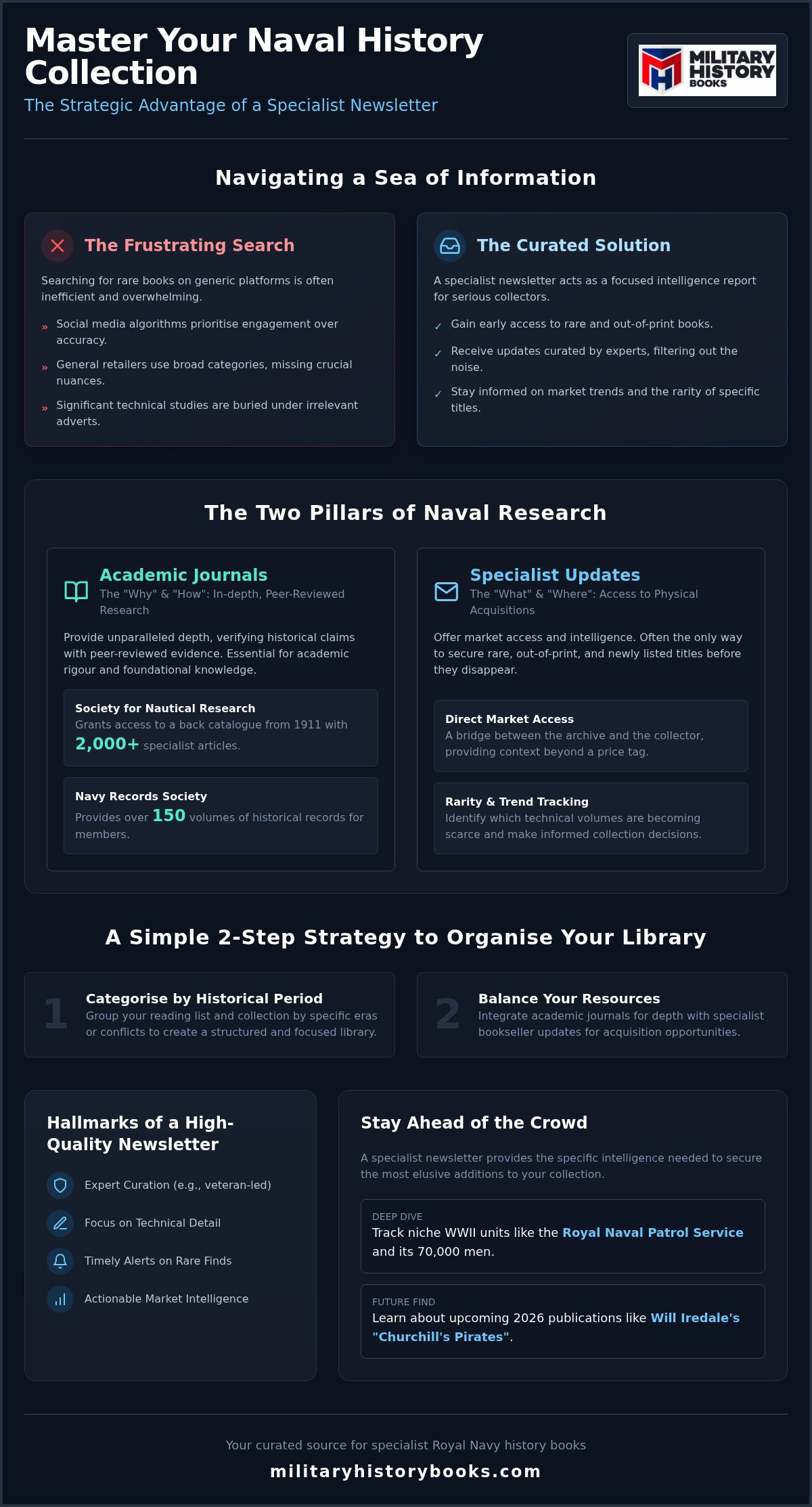
A naval newsletter acts as a curated intelligence report, delivering specific maritime history updates and alerts on new book releases directly to your inbox. While some might view email updates as mere marketing, for the dedicated historian, they are a strategic tool. They provide a steady stream of information that respects the reader's time and depth of interest, providing a calm alternative to the frantic pace of modern digital browsing. By subscribing to a specialist service, you ensure that your research remains focused and your library continues to grow with purpose.
Social media often fails the serious researcher because its algorithms prioritise viral engagement over historical accuracy. A groundbreaking technical study might be buried under a flurry of generic photographs or unrelated adverts. By contrast, a newsletter offers a methodical progression of information that you can digest at your own pace. It serves as a vital safeguard against missing out on rare and out-of-print titles that often disappear from the market within hours of being listed. For those who value the preservation of technical knowledge, these updates are indispensable.
The Problem with General Book Retailers
General retailers rely on broad categorisations that often miss the nuance of the Royal Navy's history. If you search for specific technical naval manuals, an automated system might suggest a popular naval thriller or a generic coffee-table book instead. Human curation, particularly when guided by the expertise of an RAF veteran who understands the weight of service history, is the only way to identify significant new research amongst the thousands of titles published annually. Specialist updates save researchers hours of manual searching by filtering out the noise and focusing on high-quality Royal Navy history books that offer genuine depth.
Newsletters as a Tool for Market Intelligence
Keeping a pulse on the market is vital for collectors who value the preservation of maritime heritage and the stories of those who served. A specialist newsletter serves as a bridge between the archive and the collector, providing context that a simple price tag cannot convey. It allows you to track the rarity of specific military books and identify emerging trends for 2026, such as the increased interest in niche WWII units like the Royal Naval Patrol Service, which consisted of 70,000 men. By understanding which technical volumes are becoming harder to find, you can make informed decisions about your collection's growth and long-term value.
Comparing Scholarly Journals and Specialist Naval History Updates
Collectors often find themselves at a crossroads between academic rigour and practical acquisition. Whilst both sources are essential, they serve distinct functions in the pursuit of knowledge; finding the best Royal Navy history books requires a balanced approach that respects both tradition and modern research. Scholarly journals provide the "why" and "how" of maritime events, whereas specialist bookseller updates offer the "what" and "where" of tangible acquisitions. Physical archives matter. Whilst digital journals provide immediate access to data, the tactile experience of a technical manual or a first-edition history book remains irreplaceable for many researchers.
Academic Journals: Depth and Peer Review
Scholarly publications, such as The Mariner's Mirror provided by the Society for Nautical Research, offer unparalleled depth through peer-reviewed evidence. For instance, a full membership at £45 per year grants access to a back catalogue dating to 1911, containing over 2,000 specialist articles. Similarly, the Navy Records Society offers digital and physical memberships starting from £40, providing access to over 150 volumes of historical records. These resources are vital when you need to verify specific historical claims or explore the British Naval History Collection for academic research. Integrating naval history books as a foundational resource alongside these journals creates a comprehensive view of the Royal Navy's past, ensuring your research is backed by verified data.
Specialist Retailer Updates: Market Access and Rarity
Whilst journals provide the narrative, specialist bookseller updates provide the physical archive. These updates are often the only way to secure early access to War at sea rarities before they reach the general market. For the dedicated collector, technical publications and modelling magazines found in these updates offer a level of detail that generalist shops simply cannot match. Veteran-managed sources, such as those led by an RAF veteran with decades of experience, offer unique insights into the provenance and significance of Royal Navy history books. This expert curation helps you distinguish between a common reprint and a truly significant technical volume. Balancing official society news with independent enthusiast perspectives ensures you don't miss the technical quirks or human stories that official records might overlook. To start building your own archive with expert guidance, you might consider browsing our latest naval acquisitions today.
Key Features of a High-Quality Royal Navy History Newsletter
A high-quality newsletter should feel like a conversation with a seasoned librarian or a fellow enthusiast. It isn't just a list of items; it's a guide that understands the technicalities of the service. For example, does the author recognise the tactical differences between a Frigate and a Destroyer, or do they treat all vessels as the same? This level of precision is what separates a professional update from a generic marketing email. A reliable source will cover the full breadth of the Royal Navy's timeline, from the wooden walls of the Age of Sail to the silent service of modern submarine history.
Technical depth is another hallmark of quality. Serious researchers often seek technical manuals, ship modelling references, or obscure Admiralty records rather than glossy coffee-table books. By providing rarity alerts for out-of-print or signed first editions, a newsletter becomes a proactive partner in your research. It ensures you are the first to know when a specific volume on Royal Navy history books becomes available, allowing you to secure it before it disappears into a private collection.
Curation by Subject Matter Experts
Accuracy is paramount when dealing with military records. Having an editor with a service background, such as an RAF veteran, ensures that the content respects the reality of service life and technical specifications. These experts can identify and avoid "pop-history" clichés that often simplify complex naval operations for a general audience. Instead, they offer deep dives into specific campaigns or significant naval figures, providing a level of detail that satisfies both the hobbyist and the academic. This expert oversight ensures that every recommendation for Royal Navy history books meets a high standard of historical integrity.
Exclusive Content and Early Bird Access
One of the most practical benefits of a specialist update is the early bird access to new stock. Rare titles often don't stay on the shelves for long. By receiving an alert before the stock hits the general market, you gain a significant advantage in building a comprehensive wartime history books UK library. These updates often include special offers on digital titles or back-issue modelling magazines, which are invaluable for those looking to understand the finer points of ship construction or naval camouflage. It's a methodical way to expand your archive whilst staying informed on the latest discoveries in the field.
How to Organise Your Naval Research and Reading List
Systematic research requires a more disciplined approach than simply browsing shop shelves. To build a collection of substance, you need to move beyond impulse purchases and adopt a structured methodology. A well-organised reading list ensures that your acquisition of Royal Navy history books remains purposeful and covers the specific eras or technical subjects that matter most to your research. Without a plan, it's easy to end up with a fragmented library that lacks the technical depth required for serious study.
Start by categorising your interests into distinct periods, such as the Napoleonic era, the transition from sail to steam, or Cold War submarine operations. Once you've defined your focus, sign up for a balanced mix of academic journals and specialist commercial newsletters to ensure you receive both scholarly analysis and market alerts. It's helpful to maintain a "wanted" list for elusive out-of-print titles, which you can then track through regular newsletter updates. Whilst waiting for physical copies of rare volumes to appear on the market, use digital downloads to fill immediate gaps in your knowledge. Finally, make it a habit to review your military history books collection annually to identify new areas for expansion or to refine your focus as your research evolves.
Building a Bibliographic Database
Using newsletter archives allows you to track the publication history of specific technical manuals or memoirs that might otherwise go unnoticed. Organising your library by period, vessel type, or even the rank of the author provides a logical structure that makes cross-referencing information much simpler. By comparing newsletter stock alerts with technical publications, you can verify the rarity and significance of a title before committing to a purchase. This methodical approach transforms a simple bookshelf into a functioning research archive that serves your specific historical interests. It also helps you avoid duplicating information whilst ensuring you have the most authoritative Royal Navy history books for every subject.
Finding Rare Titles Through Expert Networks
Specialist booksellers play a vital role in the global military history community, acting as a bridge between private collections and researchers. Don't hesitate to use the "contact us" features in newsletters to ask about specific title searches; many curators have access to networks that aren't visible on public marketplaces. Leveraging veteran expertise is particularly useful when searching for obscure naval memoirs that may have had limited print runs or were published by small, service-specific presses. If you're looking for a specific volume to complete your research, you can contact us directly to tap into our veteran-managed archive and specialist network.
Discover Specialist Royal Navy History Books with Our Updates
Choosing where to source your research material is as important as the research itself. At Military History Books, we provide more than just a transaction; we offer a connection to a vast, veteran-managed archive dedicated to the preservation of maritime and military heritage. Our collection includes over 10,000 titles, ranging from technical manuals to rare first editions, ensuring that you have access to the most significant Royal Navy history books available today. Whether you're a seasoned academic or a casual enthusiast, our goal is to act as your trusted guide in exploring the complex history of the senior service.
We recognise that the global naval history community extends far beyond the UK's shores. To support this international network of researchers, we provide secure international delivery, ensuring that even the rarest technical volumes reach you in excellent condition. Our approach is methodical and thorough, mirroring the standards of the services we document. By focusing on quality over quantity, we ensure that every title in our inventory offers genuine value to your library. It's a process built on reliability and a shared passion for the subject matter.
The Specialist Advantage
What sets our service apart is the depth of knowledge that comes from a genuine military background. Being managed by an RAF veteran means we understand the technical language of service and the historical weight of the materials we curate. This isn't a generalist bookstore; it's a specialised resource where we personally select each title for its accuracy and significance. Based in Weymouth, our archive serves a national audience of researchers who rely on our expertise to find the technical details that generalist retailers often overlook. Our commitment to preserving military history through literature ensures that these stories and technical specifications aren't lost to time.
Join Our Community of Historians
Subscribing to our regular updates provides you with a curated intelligence report on the latest additions to our collection. You can expect detailed alerts on rare acquisitions, new research on Royal Navy history books, and early access to out-of-print titles before they reach the wider market. We also encourage our readers to be proactive; if you're looking for a specific technical publication or an obscure memoir, you can request specific titles directly through our service. We take pride in being a helpful and accommodating bridge between the past and the modern enthusiast. To begin your journey through our extensive archive, sign up for our specialist naval updates today and ensure you never miss a vital piece of maritime history.
Secure Your Next Maritime Discovery
Building a library that truly reflects the technical and human depth of the senior service requires a methodical approach. By balancing scholarly journals with specialist bookseller updates, you transform a simple reading list into a functioning research archive. This strategic curation ensures you remain at the forefront of new discoveries whilst securing rare out-of-print titles before they vanish into private collections. It's about moving beyond general retailers to find the technical accuracy and specific provenance that defines serious historical study.
Our archive, managed by an RAF veteran, is designed to support this journey by offering a curated intelligence report for the dedicated collector. With over 10,000 specialist titles in stock and expert international delivery, we provide a reliable bridge between historical records and your personal study space. We invite you to browse our extensive collection of Royal Navy history books and discover the technical depth your research deserves. Let your passion for the Age of Sail or modern submarine operations lead you to a more informed and rewarding collecting experience.
Frequently Asked Questions
What is the best naval newsletter for Royal Navy history enthusiasts?
The best newsletter is one that functions as a curated intelligence report rather than a simple list of adverts. It should offer a balanced mix of new research, technical insights, and alerts for rare Royal Navy history books. A service managed by an expert with service experience, such as an RAF veteran, ensures that the content remains accurate and respects the technical details of maritime history.
How often should I expect to receive a specialist naval history update?
Specialist updates are typically sent on a monthly or bi-monthly basis to ensure every edition maintains a high standard of curation. This frequency allows the editor to gather significant rare stock arrivals and technical insights without overwhelming the subscriber. It mirrors the methodical nature of historical research, providing a steady stream of information that builds a complete picture of the current market.
Can a naval newsletter help me find out-of-print Royal Navy history books?
Yes, newsletters are one of the most effective tools for tracking down elusive out-of-print titles before they reach the general market. Specialist booksellers often have access to private collections and veteran networks that aren't visible on generic marketplaces. By receiving stock alerts directly, you gain a strategic advantage in securing rare Royal Navy history books that might otherwise be missed by automated search algorithms.
Are there free newsletters for maritime history research?
Many specialist retailers and historical archives provide free newsletters that offer significant value to the maritime community. These updates often include curated news, previews of upcoming publications, and alerts for new stock arrivals. Whilst academic journals often require a paid membership for full access, these commercial updates serve as a free bridge between the archive and the modern enthusiast.
Do naval newsletters include information on ship modelling and technical manuals?
High-quality newsletters frequently include technical manuals, ship modelling references, and back-issue modelling magazines. These resources are essential for researchers and hobbyists who require precise technical specifications rather than general historical narratives. A specialist update recognises the importance of these niche formats and includes them alongside more traditional historical volumes to support detailed research projects.
How can I distinguish a high-quality naval newsletter from a generic sales email?
Look for technical accuracy and a lack of aggressive sales tactics to identify a quality update. A professional newsletter will use precise terminology, such as distinguishing correctly between different vessel classes, and will prioritise informative content over flashy promotion. It should feel like a guided tour of a well-kept archive, reflecting the quiet authority of a knowledgeable curator who understands the subject matter.
Is it possible to get digital naval history books via a newsletter subscription?
Digital titles are increasingly common and are often featured in specialist updates as a way to fill gaps in a physical library. These may be offered as downloads or on disc, providing immediate access to technical data and historical records. This format is particularly useful for researchers who need to cross-reference multiple sources whilst waiting for a physical copy of a rare volume to appear.
Can I request specific naval campaign books through a specialist update service?
You can certainly request specific campaign books or obscure memoirs through a specialist update service. Most expert curators encourage this interaction, as it helps them tailor their search for new stock to the specific needs of their community. This personalised service is a major advantage of a veteran-managed archive, providing a level of support that general retailers simply cannot match.


