

Imagine paying hundreds of pounds for a rare first edition, only to discover it's a cleverly disguised modern facsimile with no historical soul. For many enthusiasts of the war at sea, this fear is a constant companion whilst searching for technical publications or out-of-print accounts of legendary naval engagements. It's frustrating when you can't distinguish between a common reprint and a genuine piece of maritime history, especially when technical grading seems more like a dark art than a logical system. You want your collection to reflect the true weight of naval heritage, yet the risk of overpaying for a poor-quality copy often holds you back.
We're here to ensure you never have to second-guess a purchase again. This guide provides a comprehensive collector's checklist designed to help you master the art of identifying, verifying, and acquiring rare naval warfare literature. We'll show you how to verify the authenticity of a rare naval tome and explain which specific categories currently hold the most historical value for serious researchers. From understanding maritime book conditions to finding a trusted specialist supplier, you'll gain the expertise needed to build a library that stands the test of time.
Key Takeaways
- Learn how limited print runs for technical manuals and high-ranking memoirs define true rarity in naval literature.
- Use our collector’s checklist to cross-reference copyright dates and dust jacket details to ensure you are purchasing a genuine first edition.
- Master the assessment of maritime provenance and learn to navigate condition issues like foxing that frequently impact volumes documenting the war at sea.
- Explore high-value niches such as submarine warfare technical logs and the structural evolution of dreadnoughts.
- Gain confidence in your acquisitions by sourcing through a specialist curator with deep subject-matter expertise and a vast inventory of out-of-print titles.
Defining Rarity in Naval Warfare Literature
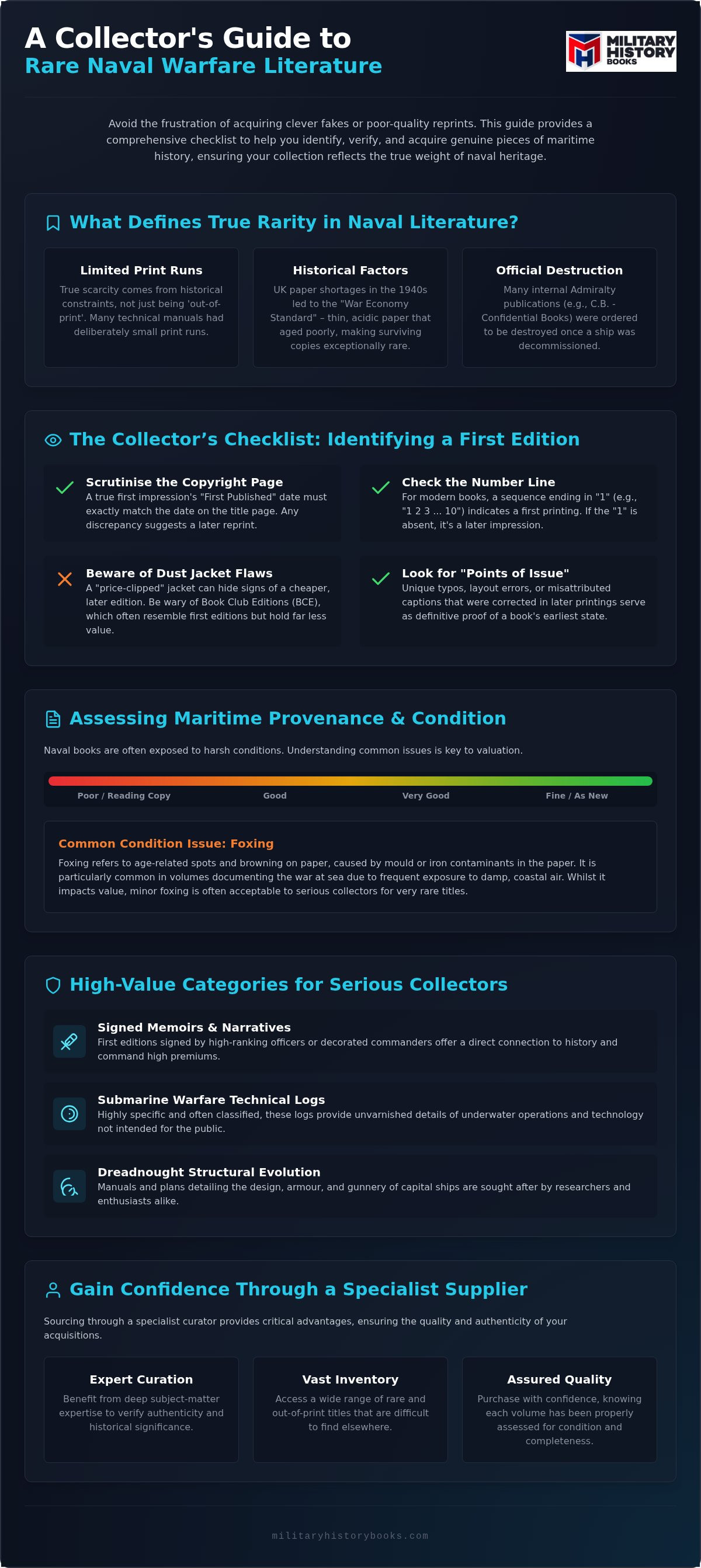
Understanding the value of literature concerning the war at sea requires a shift in perspective. A book isn't necessarily rare just because a publisher stopped printing it. Out-of-print titles are common; they simply wait for a digital reprint or a second-hand listing. True rarity arises from a confluence of historical events and physical limitations. During the 1940s, for instance, the UK faced severe paper shortages. Books produced under the "War Economy Standard" used thinner, more acidic paper that hasn't aged well. This makes surviving first editions from that era remarkably scarce compared to the robust volumes of the Victorian age. Because these books were often read to pieces by sailors or lost in coastal dampness, finding a pristine copy is a genuine challenge.
When researching specific engagements, collectors often refer to a Chronological List of Naval Battles to pinpoint the exact timeframes of interest. This helps in identifying which technical manuals or personal accounts would have been published in the immediate aftermath of a conflict. The closer the publication date is to the event, the higher the potential for historical accuracy and collector interest.
The Scarcity of Naval Technical Manuals
Technical manuals represent a unique category of rarity. Unlike general history books, these were often internal Admiralty publications meant for active service. Many carried "Restricted" or "Confidential" markings, such as the C.B. (Confidential Book) designation. Regulations frequently dictated their destruction once a ship was decommissioned or the technology became obsolete. Finding an original manual with intact ship diagrams or technical specifications is a triumph for any collector. These items provide an unvarnished look at the mechanical reality of the war at sea, offering details that were never intended for public consumption.
Memoirs and Combat Narratives
First editions of memoirs from high-ranking naval officers are amongst the most sought-after items in the field. There is a tangible connection to history when holding a volume signed by a Royal Navy captain or a decorated U-boat commander. Collectors should look for accounts produced by small, independent publishers who often took risks on niche naval histories that larger houses ignored. It's also vital to distinguish between contemporary accounts written whilst the events were fresh and later historical revisions. The former often contain raw, unfiltered details that later editors might have softened for a general audience. A signed first edition from a small 1950s print run will almost always command a higher premium than a mass-market reprint from the 1990s.
The Collector’s Checklist: Identifying Authentic First Editions
Identifying a genuine first edition of a volume documenting the war at sea requires a forensic approach. The most immediate step is to scrutinise the copyright page, often found on the verso of the title page. In a true first impression, the "First Published" date must correspond exactly with the date printed on the title page. If the title page is undated whilst the copyright page lists a later year, you are likely holding a reprint. Authenticating these details is vital, as many significant accounts of maritime conflict were rushed to press and saw multiple impressions within the first year of release.
Collectors should also look for specific "points of issue". These are unique identifiers, such as a specific typo on a certain page or a layout error in the index, which were corrected in subsequent printings. For example, some early editions of famous naval memoirs contain misattributed ship names in the captions. These errors, whilst technically flaws, serve as proof of the book's earliest state. If you are unsure about the details of a particular vessel's history mentioned in a text, cross-referencing with the National Archives Naval Records can help verify the accuracy of the author's original claims.
Physical Indicators of a First Impression
Modern collectors often rely on the "number line" found on the copyright page. A sequence such as "1 2 3 4 5 6 7 8 9 10" indicates a first printing; if the "1" is missing, it's a later impression. However, for older naval titles, the presence of the original dust jacket is the primary driver of value. Check the inner flap for "price-clipping", where the cost has been cut away. This often suggests the book was a gift, but it can also hide indicators of a cheaper, later edition. Be wary of Book Club Editions (BCE), which often lack a price on the jacket and may have a small indented square or circle on the back cover cloth.
Naval-Specific Verification
Rare naval history books frequently include complex fold-out maps and tactical charts. Reprints often omit these or convert them into static, single-page images. You must ensure all original photographic plates are present and securely bound. In many technical publications, these plates were tipped-in by hand and can become loose over time. If a technical appendix or a list of ship specifications appears to have been excised, the volume's historical and commercial value drops significantly. If you are looking to expand your library with verified copies, browsing our curated collection of authenticated titles is an excellent place to start your search.
Assessing Maritime Provenance and Condition
Whilst the content of a volume provides the historical narrative, its provenance offers a direct link to the physical reality of the events described. Provenance refers to the documented history of ownership, and in the context of the war at sea, this can significantly elevate a book's value. Evidence that a particular technical manual or journal was once part of a vessel's onboard library, or belonged to a notable officer, transforms a mere publication into a historical artefact. A book's journey from a shipyard to a private collection tells its own story, often mirroring the service history of the individual who once held it.
Identifying these links requires a keen eye for official markings. Royal Navy library stamps or Admiralty "C.B." (Confidential Book) numbers are primary indicators of official service. These markings aren't just ink on paper; they're proof of the book's presence during active duty. Sometimes, you might find a bookplate from the Royal Naval College or from a naval dockyard library. These details confirm the volume's professional lineage and its role in naval education or administration. In rare military history books, these marks of service are often more desirable than a pristine, uncirculated copy because they validate the item's participation in history.
The Importance of Naval Library Stamps
Stamps from institutions like the Royal Naval College provide a clear chain of custody. Amongst the most prized finds are "Association Copies." These are books containing inscriptions, signatures, or marginalia from significant naval figures. A memoir of the war at sea becomes exponentially more valuable if it was once owned by an Admiral who participated in the battles described. However, service life is often harsh on paper. Books kept in coastal or shipboard environments frequently suffer from "sea air" degradation. This manifests as brittle pages or a distinct salt-tinged scent. Preserving these items involves maintaining a stable, low-humidity environment to prevent further deterioration whilst ensuring the book's historical character remains intact.
Grading Condition for the Serious Collector
Specialist markets use a strict hierarchy for grading. A "Fine" copy is virtually as-issued, whilst "Very Good" suggests minor wear but no significant defects. "Good" usually implies a solid, complete copy that shows clear signs of use. Large, heavy naval reference volumes often suffer from "shaken" bindings, where the text block has pulled away from the covers due to its own weight. This is a common issue for massive technical guides or multi-volume sets. You should also watch for "foxing," those rusty brown spots caused by fungal growth in damp conditions. Be cautious of restored copies; if a book has been rebound using non-period materials or modern adhesives, its historical integrity and market value may be compromised.
High-Value Categories Amongst Naval History Publications
Identifying the most significant volumes within naval literature requires an understanding of which branches of service operated under the strictest veils of secrecy. Whilst general histories of the war at sea are plentiful, specialised categories like submarine warfare and naval intelligence offer a much higher ceiling for collectors. These publications weren't just books; they were often operational tools or restricted records that were never intended for the public eye. Consequently, their survival rate is lower, and their historical value is significantly higher for those seeking a deeper understanding of maritime conflict.
One often overlooked but highly rare category involves Merchant Navy records. Convoy battles were the lifeblood of the British war effort, yet the accounts of these merchant sailors were frequently overshadowed by the glamour of capital ships. Original logs or small-press accounts of convoy engagements are amongst the rarest finds in the market today. Similarly, rare reports on naval intelligence, maritime signals, and early code-breaking efforts provide a fascinating look at the shadow war that took place alongside the physical exchanges of broadsides.
Submarine History and Underwater Warfare
Submarine history books are amongst the most collectable items in the specialist market. The Silent Service earned its name through a culture of extreme secrecy, meaning many technical manuals and patrol reports were classified for decades. Collectors particularly prize original technical guides for early German U-boats or British V-class submarines. These manuals often contain intricate fold-out schematics that are almost never reproduced accurately in modern digital editions. Finding an original patrol report published in book format is a rarity, as these were usually produced in very limited numbers for internal review by the Admiralty.
The Evolution of the Warship
The technological transition from sail to steam and the eventual rise of the dreadnought represents a golden era for naval publishing. Serious researchers often seek out wartime history books UK that focus on specific ship classes or the structural evolution of the modern warship. Back issues of Jane’s Fighting Ships from the early 20th century are essential primary research tools, offering contemporary snapshots of global naval power. These volumes detail the rapid advancements in armour, armament, and propulsion that defined the war at sea during the World Wars. If you are looking to find these specific, high-value titles, you can explore our extensive range of rare naval publications to find your next acquisition.
Securing Your Collection with Military History Books
Building a library of rare naval history is more than a hobby; it's a commitment to preserving the memory of the war at sea. For the serious collector, the challenge isn't just finding a book, but ensuring that the volume is authentic, accurately described, and safely delivered. As a specialist retailer managed by an RAF veteran, we bring deep subject-matter expertise to every title in our collection. This background allows us to distinguish between a common reprint and a significant technical publication with the precision that researchers require. With over 10,000 titles in stock, our inventory serves as a vital resource for those seeking to document maritime heritage through physical and digital records.
We recognise that many enthusiasts need access to rare technical data without necessarily investing in a high-priced first edition. To support this, we offer a range of digital titles available by download and on disc. These resources allow historians to examine original diagrams and specifications from their own screens whilst keeping their budgets intact. For those who do choose to acquire physical rarities, we organise secure international delivery. We take extreme care in packaging, ensuring that fragile bindings and original dust jackets are protected from the rigours of transit across the globe.
Expert Curation and Trust
Our role is that of a curator rather than a simple retailer. We pride ourselves on absolute transparency when describing the condition of our naval history books. Whether it's a minor case of foxing or a slightly shaken binding, we provide the detail you need to make an informed decision. This level of trust is essential when navigating a market where generalist sellers often miss the subtle indicators of rarity that we've discussed in previous sections. We aim to be a reliable bridge between the storied past of the Royal Navy and the modern enthusiast, offering guidance that only comes from years of dedicated study and service.
Building Your Library Today
Finding that one elusive technical manual or a signed memoir from the war at sea can take years of searching. Our curated selection of rare and out-of-print naval titles is constantly evolving, reflecting the breadth and depth of our specialist archive. If you're searching for a specific, out-of-print publication that isn't currently listed, we're always happy to assist with specific requests to help track down the volume you need. Your collection is a testament to history; we're here to help you secure it with confidence. Explore our latest collection of rare military history books today.
Curating Your Maritime Legacy
Building a collection of rare naval literature is a rewarding pursuit that connects you directly to the technical precision and human stories of the past. You've learned how to identify genuine first editions by scrutinising copyright details and how to assess the unique provenance of volumes that served on active duty. These skills are essential for anyone dedicated to documenting the war at sea through authentic primary sources.
As a specialist retailer managed by an RAF veteran, we share your passion for historical accuracy and the preservation of maritime heritage. Our archive contains over 10,000 specialist titles, ranging from out-of-print technical manuals to rare combat narratives. We provide secure international delivery to ensure that every fragile edition reaches your shelf in the condition described. Browse our exclusive range of rare military history books to find the next significant addition to your library. Your commitment to these stories ensures that the lessons and legacies of the past remain accessible for years to come.
Frequently Asked Questions
What makes a naval history book "rare" compared to just "old"?
Rarity is determined by scarcity, demand, and historical significance rather than just the passage of time. Whilst a Victorian-era reprint might be old, a limited print run technical manual from the 1940s is often rarer due to lower survival rates. Factors such as wartime paper shortages and official destruction orders for classified material play a much larger role in establishing true rarity than age alone.
How can I identify a first edition of a Royal Navy memoir?
You can identify a first edition by matching the "First Published" date on the copyright page with the date printed on the title page. Look for specific indicators such as the absence of later impression numbers or the presence of specific publisher markings. In Royal Navy memoirs, you should also check for contemporary binding colours and the inclusion of original photographic plates which were often omitted in subsequent printings.
Are technical naval manuals more valuable than combat narratives?
Value depends on the specific niche, but technical manuals often command higher prices due to their extreme scarcity and detailed diagrams. Whilst combat narratives are popular for their storytelling, technical manuals were frequently destroyed after service, making them harder to find. These manuals provide an unvarnished look at the machinery used in the war at sea, making them essential for technical researchers and modellers.
What is the best way to preserve rare military history books from damp?
The best way to preserve rare books from damp is to maintain a stable environment with a relative humidity between 35% and 50%. Avoid storing your collection against external walls or in basements where moisture levels fluctuate significantly. Using acid-free archival boxes can provide an extra layer of protection against coastal air, whilst ensuring adequate ventilation around your bookshelves prevents the growth of fungal foxing.
Do you provide international shipping for fragile first editions?
Yes, we provide secure international delivery for all fragile first editions and rare technical publications. We understand the historical weight of these items and use professional-grade packaging to protect against the rigours of transit. Every item is tracked and handled with the care you'd expect from a specialist curator who prioritises the preservation of stories and the quality of the material.
Can I find rare naval history books in digital formats?
You can find many rare naval history titles in digital formats, specifically through our collection of titles on disc and by download. These are excellent resources for researchers who need access to out-of-print data, such as ship diagrams or tactical logs, without the high cost of a physical first edition. It's a practical way to study the war at sea whilst keeping your primary collection focused on physical rarities.
What should I look for in a dust jacket when buying rare war books?
When examining a dust jacket, you should look for the original price on the inner flap and check for signs of "price-clipping." A jacket that hasn't been clipped is generally more desirable to collectors. You should also look for later edition indicators, such as mentions of awards or reviews that were published after the book's initial release, which suggest the jacket belongs to a later impression.
Is it worth collecting modern naval history books or only vintage ones?
Collecting modern naval history is certainly worthwhile, as today's specialised first editions are the rarities of the future. Scholarly works from small presses or detailed technical reviews of modern vessel classes often have very limited print runs. Whilst vintage titles hold established historical weight, modern publications provide essential updates on naval technology and recent maritime conflicts that complement a well-rounded library.


