

The aircraft carrier didn't just supplement the battleship; it rendered centuries of naval doctrine obsolete in a single afternoon. For the serious researcher or dedicated enthusiast, finding aircraft carrier history books that capture this technical and strategic evolution can be a frustrating task. You've likely encountered countless generic publications that offer plenty of photographs but very little substance regarding flight deck choreography or the nuanced differences between British and American carrier doctrines.
We understand that your library deserves more than just surface-level summaries. This specialist guide identifies the most authoritative literature on the subject, from the earliest experimental Royal Navy designs to the nuclear-powered giants of the modern era. We'll help you distinguish between standard reference works and the rare, out-of-print titles that provide the deep technical insight you're looking for. By the end of this article, you'll know exactly which definitive texts will help you understand the monumental shift from big-gun ships to the floating airfields that define modern sea power.
Key Takeaways
- Understand the strategic shift from battleship dominance to naval aviation and the doctrinal differences between British and American carrier designs.
- Discover how to select the most authoritative aircraft carrier history books by distinguishing between operational battle accounts and technical monographs.
- Identify the definitive authors and reference works, such as those by Norman Friedman and David Hobbs, that provide essential depth for collectors.
- Learn the advantages of sourcing your naval literature from specialist curators who offer access to rare and out-of-print titles.
The Evolution of the Floating Airfield: Why Carrier History Matters
The aircraft carrier represents one of the most significant shifts in military history, effectively ending the centuries-long supremacy of the battleship. This wasn't merely a change in weaponry; it was a total redefinition of naval warfare that turned the ocean into a launchpad for aerial power. For those who study aircraft carrier history books, the subject offers a fascinating intersection of maritime engineering and aviation technology. Unlike traditional warships, a carrier's effectiveness isn't measured by the weight of its broadside, but by the efficiency of its flight deck choreography and its ability to sustain operations far from friendly shores. To understand the modern carrier, one must first appreciate the complex struggle to prove that a ship could indeed serve as a mobile, resilient airfield.
From HMS Argus to the Modern Super-Carrier
The Royal Navy played a foundational role in this evolution, pioneering the concepts that would eventually lead to the modern super-carrier. Early experiments often involved converted cruisers or merchant vessels, but it was the commissioning of HMS Argus in 1918 that provided the world's first true flush-deck carrier. This experimental period is a central theme in many specialised aircraft carrier history books, as designers grappled with the placement of islands, the necessity of arrestor gear, and the basic physics of landing on a moving deck. You can find a detailed timeline of these technical milestones in the broader history of the aircraft carrier, which highlights the transition from these fragile beginnings to the purpose-built hulls of the 1930s. These early designs were often dangerous and unpredictable, making the literature covering this era particularly gripping for those interested in the bravery of pioneering naval aviators.
The Strategic Impact of Naval Aviation
Before the arrival of the carrier, naval engagements were limited by the horizon and the range of a ship's guns. The carrier changed this dynamic entirely, allowing fleets to strike at one another from hundreds of miles away. This shift moved the focus of naval literature from tactical manoeuvres to grand strategic doctrine. Since 1945, the carrier has become the ultimate tool for global influence. In the context of naval history, power projection is defined as the capacity of a state to apply its military force across vast distances to influence events or deter threats without relying on local land bases. This ability to appear anywhere on the globe makes the carrier a unique strategic asset, and the books that document this era provide essential context for understanding modern international relations and maritime security.
World War II: The Golden Age of Carrier Literature
The Second World War transformed the aircraft carrier from an experimental platform into the cornerstone of naval power. Much of the literature found in aircraft carrier history books focuses on the Pacific Theatre, where vast oceanic distances made carrier-vs-carrier duels the primary mode of engagement. Battles like Midway and the Great Marianas Turkey Shoot are documented in exhaustive detail, yet a truly comprehensive library must also account for the human perspective. Primary source accounts from pilots and deck crews provide the essential "ground truth" of what it was like to operate within the high-stakes environment of a pitching flight deck whilst under heavy fire.
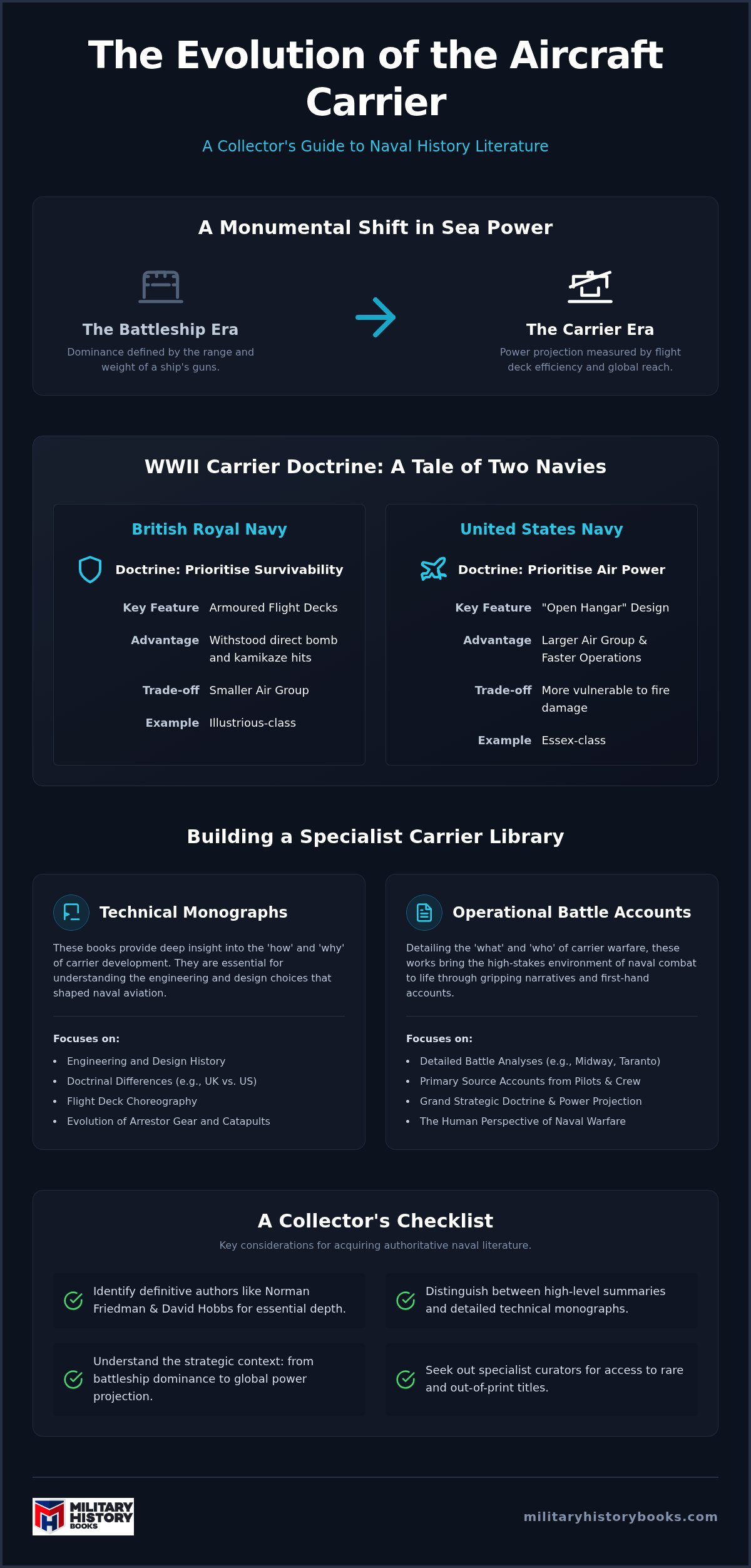
A fascinating area of study for many researchers is the doctrinal divide between the Royal Navy and the United States Navy. British designers prioritised survivability, equipping their Illustrious-class ships with armoured flight decks that could withstand direct hits. This choice proved vital in the Mediterranean and later against kamikaze attacks in the Pacific. Conversely, the Americans favoured the "open hangar" design. This allowed for a larger air group and faster re-arming processes, though it left the ships more vulnerable to fire damage. This technical tug-of-war is brilliantly analysed in specialist literature, such as the Illustrated Design History of U.S. Carriers, which remains a cornerstone for any serious naval researcher.
The Royal Navy at War: Taranto to the British Pacific Fleet
The 1940 raid on Taranto serves as a critical blueprint in naval literature, proving that carrier-borne torpedo bombers could cripple a fleet in harbour. This action directly influenced Japanese planning for the attack on Pearl Harbour. As the conflict progressed, the British Pacific Fleet brought these hard-won lessons to the final stages of the war, operating alongside American forces with distinct tactical styles. For those interested in the broader context of these maritime engagements, exploring the War at sea offers a deeper understanding of how carriers interacted with traditional surface forces during the era's most significant naval battles.
Technical Innovations of the Second World War
Beyond the ships themselves, WWII-era books detail the rapid technological leaps that defined the period. The introduction of radar and the development of the Combat Information Centre (CIC) revolutionised how admirals managed the chaotic airspace around their fleets. We see this evolution mirrored in the aircraft themselves, as biplanes like the Fairey Swordfish eventually gave way to powerful monoplanes like the Grumman Hellcat. If you're looking for these specific technical monographs, our curated collection of naval history books includes many rare and out-of-print titles that provide detailed deck arrangements and hangar layouts not found in modern general-interest volumes.
Analysing Carrier Books: Technical Design vs. Operational History
Distinguishing between different types of literature is essential for building a useful collection. Broadly speaking, aircraft carrier history books fall into two categories: operational histories and technical monographs. Operational histories provide a narrative of battles, movements, and strategic outcomes, essentially telling the story of the ship's life in service. Technical monographs, however, focus on the "bones" of the vessel. They detail the engineering solutions, structural designs, and specific equipment that allowed these ships to function. For a serious researcher, a ship's displacement or hangar height isn't just a dry statistic; it's the data that explains why certain aircraft could or couldn't be used, or why a ship survived a specific type of damage.
Action Reports and declassified documents have become increasingly accessible, offering a bridge between these two styles. These documents provide a raw, unvarnished look at how technical designs performed under the stress of combat. To supplement these texts, many historians turn to modelling magazines. Whilst primarily intended for hobbyists, these publications often feature high-resolution photographs, scale drawings, and colour profiles that provide a visual clarity often missing from standard text-heavy histories.
The Technical Brilliance of British Innovation
British engineering was the catalyst for the modern jet-capable carrier. Literature in this niche often highlights three specific inventions: the angled flight deck, the steam catapult, and the mirror landing sight. These weren't just incremental improvements; they were revolutionary changes that made landing high-speed jet aircraft on a moving platform significantly safer. If you want to keep up with the latest research on these engineering feats, subscribing to a guide on Royal Navy history books is an excellent way to stay informed.
Operational Narratives: Life on the Flight Deck
Whilst technical drawings explain the ship's capacity, operational narratives capture the "choreography" of the flight deck. Managing dozens of aircraft, hundreds of personnel, and thousands of gallons of aviation fuel in a confined space is a feat of human organisation. Memoirs often provide a psychological depth that official histories lack, revealing the intense pressure and fatigue experienced by deck crews and pilots. When comparing these sources, official histories offer the objective "what", whilst memoirs provide the subjective "how", making both necessary for a complete understanding of naval aviation.
Building a Specialist Carrier Library: A Collector’s Checklist
For the dedicated researcher, building a collection of aircraft carrier history books requires a methodical approach. It's easy to become overwhelmed by the sheer volume of "coffee table" books that offer striking photography but lack the technical rigour needed for serious study. A well-curated library should act as a chronological and technical map, guiding you through the complexities of naval aviation. To achieve this, we recommend following a structured checklist to ensure your archive remains both manageable and authoritative.
- Identify your primary niche: Narrow your focus to specific eras, such as the pioneering years of the Royal Navy, the high-stakes duels of the Pacific, or the nuclear-powered developments of the Cold War.
- Seek out authoritative authors: Look for titles by established experts like Norman Friedman or David Hobbs, whose works are often cited as the gold standard for technical and operational accuracy.
- Prioritise rare and out-of-print titles: These often contain detailed ship specifications and deck layouts that modern reprints may omit.
- Supplement with back-issue magazines: Military and modelling magazines provide contemporary accounts and visual references that books alone might lack.
- Utilise digital titles: Digital downloads are excellent for high-resolution technical diagrams that you can zoom in on for closer inspection.
Identifying Rare and Out-of-Print Naval Gems
A book is often considered "rare" in this field due to limited original print runs or because it was produced by a specialist publisher that no longer exists. First editions are particularly prized amongst collectors, as they represent the original scholarship of the time. You may also encounter technical manuals or Admiralty reports that were never intended for general public release. These documents provide the "raw data" of naval history, offering insights into ship behaviour and aircraft handling that were once restricted information. Finding these titles requires a specialist eye, as they are rarely found in general high-street bookshops.
Integrating Digital and Physical Media
Whilst physical books remain the preferred choice for many collectors due to their tactile nature and shelf presence, digital media offers undeniable advantages for research. Digital titles allow you to carry an entire archive on a single device, making it easier to cross-reference data whilst working at a desk or visiting a museum. However, for many, nothing replaces the clarity of a large-format physical diagram or the historical weight of a vintage volume. For a more comprehensive look at how to structure your research, our guide to naval history books offers further advice on blending various media formats.
If you're ready to expand your archive with expert-vetted material, you can explore our curated selection of rare and out-of-print naval history books to find your next definitive reference work.
Why Specialist Booksellers Beat General Retailers for Naval History
General retailers often prioritise high-turnover new releases that satisfy a casual interest but leave the serious researcher wanting more. When you're searching for specific aircraft carrier history books, you need a source that understands the difference between a coffee-table book and a technical monograph. With an inventory exceeding 10,000 titles, we focus on depth and accuracy, providing a resource that general bookstores simply cannot match. This curated approach ensures that rare insights into naval architecture and flight deck operations aren't lost in a sea of generic publications. We don't just sell books; we curate a library for those who appreciate the technical weight of naval history.
A Veteran’s Perspective on Military Literature
Our collection is managed by an RAF veteran, which brings a practical understanding of aviation and maritime service to the curation process. This expertise is vital for identifying the most authoritative aircraft carrier history books, as it allows us to vet titles for technical accuracy and historical significance. We understand the nuances of service life and the importance of preserving the stories of those who operated these massive vessels. This perspective helps us guide researchers toward texts that offer genuine insight rather than surface-level summaries. If you're currently constructing your own archive, our guide on military history books provides practical tips for building a modern library that stands the test of time.
Global Access to Rare Naval Knowledge
Serious historians and researchers are found across the globe, and their needs often extend beyond what is currently in print. We specialise in sourcing rare and out-of-print titles that offer deep dives into specific ship classes or forgotten naval campaigns. Our online platform makes it easy to locate these elusive volumes, providing a level of access that was once restricted to those with physical proximity to specialist archives. Ensuring that rare naval first editions reach their destination in pristine condition requires a specialist approach to secure international delivery that general couriers often overlook. This commitment to reliability gives collectors the confidence to source their material from anywhere in the world, knowing their investment is protected. By acting as a bridge between the past and the modern enthusiast, we ensure that the technical brilliance of the floating airfield remains accessible to everyone.
Securing the Future of Naval Scholarship
Naval aviation history is a vast and complex field where technical innovation meets strategic brilliance. By distinguishing between operational narratives and technical monographs, you can build a collection that offers both human depth and engineering precision. Whether you're tracking the experimental designs of the early Royal Navy or the global reach of modern super-carriers, the right literature is essential for a complete understanding of maritime power. A well-chosen library does more than fill shelves; it preserves the technical heritage of the ships that redefined the 20th century.
Finding definitive aircraft carrier history books shouldn't be a matter of chance. Our inventory of over 10,000 specialist titles is curated by an RAF veteran who understands the importance of technical accuracy and historical preservation. We provide secure international shipping to ensure that even the rarest out-of-print volumes reach collectors across the globe in pristine condition. This level of specialist focus allows you to look beyond the surface level of general publications and find the specific data your research requires.
Explore our extensive collection of Naval History Books at Military History Books and find the next cornerstone for your specialist library. We're here to help you uncover the stories and specifications that define the history of the floating airfield.
Frequently Asked Questions
What are the best aircraft carrier history books for beginners?
Beginners should start with broad operational histories that provide a clear chronological overview of the 20th century. Look for titles that explain the strategic shift at the Battle of Midway or the development of the first Royal Navy flight decks. These introductory aircraft carrier history books offer the necessary context before you move into more technical monographs detailing specific ship machinery or complex aviation electronic systems.
Who are the most authoritative authors on naval aviation history?
Norman Friedman and David Hobbs are widely considered the gold standard for naval aviation scholarship. Friedman’s "Illustrated Design History" series provides unmatched technical depth, whilst Hobbs offers extensive expertise on British carrier operations and innovation. Seeking out their work ensures you are reading peer-reviewed, authoritative research that is frequently cited by academic historians and professional naval officers alike across the globe.
Can I find books specifically on British aircraft carrier innovations?
Yes, several specialist titles focus exclusively on British breakthroughs like the angled flight deck, the steam catapult, and the mirror landing sight. These innovations were essential for the transition into the jet age and are well-documented in Royal Navy technical histories. Our collection includes several rare publications that detail how British engineering allowed for safer deck operations and higher sortie rates compared to earlier experimental designs.
Are there aircraft carrier books that include technical drawings and blueprints?
Technical monographs and the "Anatomy of the Ship" series are the best sources for detailed blueprints and structural drawings. These publications provide a visual breakdown of hangar layouts, machinery spaces, and flight deck arrangements. For serious researchers, these drawings are vital for understanding the physical constraints that dictated aircraft carrier doctrine and the evolution of shipboard safety systems throughout the decades.
Why should I look for out-of-print aircraft carrier books?
Out-of-print aircraft carrier history books often contain technical data and primary source reports that are no longer included in modern, mass-market reprints. These older volumes were frequently written by authors with direct access to declassified Admiralty or Navy Department files. For a collector, these titles represent a more authentic and detailed record of naval development that general retailers typically do not stock in their inventories.
How do I identify a rare first edition naval history book?
Identifying a rare first edition involves checking the publisher's imprint and the number line on the copyright page. Specialist military publishers often had very small initial print runs, making those first copies significantly more valuable to collectors. You should also look for specific binding characteristics or original dust jacket art, as these are reliable indicators of a book’s historical and collectable authenticity amongst the enthusiast community.
Do you offer digital versions of aircraft carrier technical publications?
We provide a wide range of digital titles available by download or on disc for researchers who prefer portable media. These digital formats are particularly useful for viewing high-resolution technical diagrams that can be enlarged for closer study. Whilst many collectors prefer physical copies for their library shelves, digital versions provide an efficient way to access rare technical manuals without the significant space requirements of large-format physical books.
Which books cover the transition from piston-engine to jet aircraft on carriers?
The transition from piston-engine to jet aircraft is best covered in literature focusing on the late 1940s and the Korean War era. Books detailing the Midway-class or the early British Centaur-class carriers provide excellent insight into the structural modifications required for heavier, faster aircraft. These texts explain the necessity of the mirror landing sight and the development of more powerful hydraulic and steam catapult systems during that period.


