

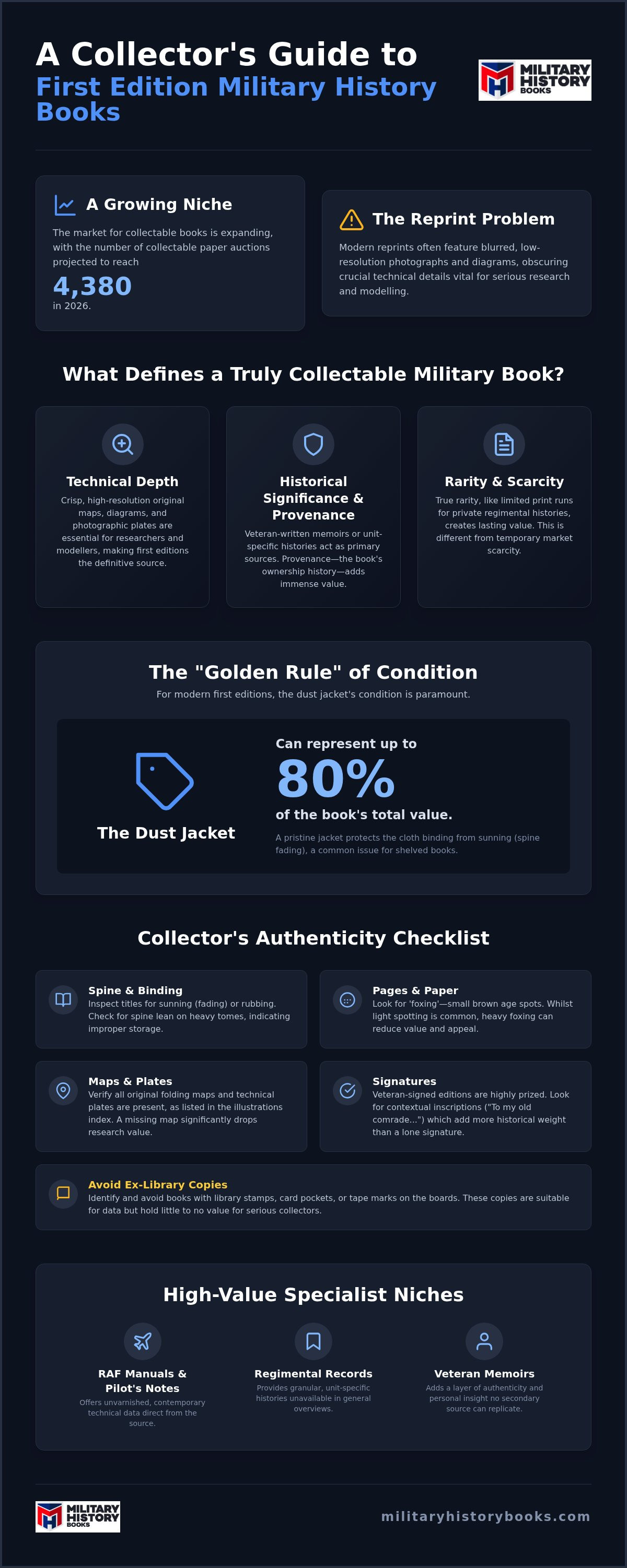
With the number of collectable paper auctions projected to reach 4,380 in 2026, the hunt for authentic first edition military history books has never been more competitive or more vital. You've likely felt the frustration of ordering what looked like a definitive reference only to receive a modern reprint with blurred, low-resolution photographs that obscure the technical details you need for modelling or research. It's often difficult to trust general retailers who lack the specialist knowledge to distinguish a true first-press unit history from a mass-market reproduction. This guide will show you how to identify, value, and source titles that do more than just sit on a shelf; they act as reliable records and hold their value as significant historical artefacts. We'll explore the nuances of verifying condition online, understanding provenance, and navigating the specialist market to ensure your collection remains a source of pride. By focusing on quality and accuracy, you can build a library that serves as both a professional archive and a lasting investment in military heritage.
Key Takeaways
- Learn how to identify authentic first edition military history books by prioritising technical depth and historical provenance over general narratives.
- Understand the "Golden Rule" of condition, where the dust jacket can represent 80% of a modern title's value, and learn to verify original folding maps.
- Discover the specific value of specialist niches, such as RAF technical manuals and regimental records, for building a library with genuine research significance.
- Master professional preservation techniques, including the correct way to shelf heavy tomes to prevent spine lean and maintain the physical integrity of your collection.
- Recognise the benefits of veteran-led curation when navigating a vast archive of over 10,000 titles to ensure accuracy and historical provenance.
What Defines Collectable Military History Books?
What makes a book truly collectable? It isn't merely the date printed on the title page or the thickness of the spine. In this specialised niche, collectibility stems from a trifecta of rarity, historical significance, and technical depth. Whilst many enthusiasts seek out first edition military history books for their potential investment value, others prioritise the granular detail found in specialist publications that were never intended for a mass audience. Collectors often bypass broad narratives to find unit-specific histories. These works provide a level of detail that general overviews simply can't match. For a comprehensive Military History Overview, one might look to academic texts, but the serious enthusiast looks for the specific story of a single battalion, ship, or squadron.
Technical accuracy is paramount to the value of a publication. A book's desirability often hinges on whether its maps, diagrams, and photographic plates provide a definitive record for researchers or modellers. Desirability spikes for out-of-print titles because they represent a finite resource of knowledge. Modern reprints often fail to replicate the crispness of original technical drawings or the depth of high-resolution historical photography, making the original editions the only acceptable choice for the discerning collector.
The Difference Between Rare and Collectable Editions
It's a common misconception that rarity and collectibility are identical. A book might be rare because it was poorly received and few were printed, yet it remains uncollectable due to a lack of interest in the subject. Conversely, a relatively common volume can become highly valuable if it retains a rare, original dust jacket in pristine condition. In the UK market, scarcity often refers to a temporary lack of supply, whereas true rarity implies that only a handful of copies exist globally. Limited print runs for private regimental histories or campaign records often create this kind of lasting scarcity that drives the market.
The Value of Technical Accuracy and Provenance
Collectors frequently hunt for RAF technical manuals or pilot's notes because they offer unvarnished, contemporary data that hasn't been filtered through a later historian's lens. The expertise of the author, such as a veteran-written memoir found in certain first edition military history books, adds a layer of authenticity that no secondary source can mimic. These documents aren't just books; they're primary sources. In the context of military book collecting, provenance is the documented history of a volume's ownership and its connection to specific historical figures or events.
Evaluating Condition and Authenticity in Military Literature
For collectors of modern first edition military history books, the dust jacket is often the most critical factor, frequently accounting for up to 80% of the volume's total value. A pristine jacket does more than just look good; it protects the delicate cloth binding from sunning. This fading of the spine is a common ailment for books kept on open shelves. You should also inspect the pages for foxing, which are the small brown age spots caused by paper oxidation or mould. Whilst some light spotting is expected in mid-century publications, heavy foxing can detract from the reading experience and the book's market appeal.
Authenticity also hinges on the presence of original supplemental materials. Many detailed campaign histories were issued with folding maps or technical plates tucked into rear pockets or bound between chapters. You must verify these against the list of illustrations. If a map is missing, the book's value for technical research or modelling drops significantly. It's equally important to identify ex-library copies. These are usually marked by stamps on the title page, residue from lending pockets, or tape marks on the boards. Whilst these copies remain useful for raw data, they rarely hold their value amongst serious collectors.
Verifying signatures requires a cautious eye. Veteran-signed editions are highly prized, but you should look for inscriptions that provide context or a date that aligns with the book's publication. Inscriptions like "To my old comrade" add more historical weight than a lone signature. If you're looking for verified authentic volumes, you can browse our collection of rare titles to find expertly curated examples.
A Checklist for Grading Military History Books
When grading a potential acquisition, follow this methodical approach:
- Inspect the spine titles for sunning or rubbing.
- Check for errata slips, which are small loose inserts correcting printing errors.
- Verify that all technical inserts or pilot's notes are intact.
- Examine the binding material; original regimental cloth is generally more desirable than a later leather rebinding.
Proper storage is the best way to maintain these grades over time. For expert advice on maintaining your library, the Library of Congress offers a detailed guide on the Preservation of Collections.
Spotting Modern Reprints vs. Original Editions
Identifying true first edition military history books requires a careful reading of the copyright page. Look for the "first published" date and ensure there are no mentions of subsequent impressions or "Print on Demand" (POD) status. POD editions are particularly problematic for military researchers because they often use low-resolution scans that ruin the clarity of technical diagrams. Facsimile editions can also be deceptive. These are high-quality recreations of rare books, but they usually lack the specific paper weight and "feel" of original wartime or post-war stock. Always check for the publisher's current address or modern ISBNs, which are immediate giveaways of a later reprint.
Specialist Categories: From Aviation to Modelling Magazines
Building a collection isn't just about general titles. It's about finding the specific niches that offer technical depth. Whilst many start with first edition military history books that cover broad conflicts, the seasoned collector often moves towards highly specific categories like unit histories or technical manuals. These items serve as functional archives for research. They offer a granular view of operations that broader narratives often gloss over, providing the specific data needed to understand tactical decisions or mechanical performance.
Aviation History and Technical Publications
Aviation enthusiasts prioritise accuracy above all else. Collecting aviation history books that feature original aircraft schematics or engine diagrams provides a level of detail that modern digital scans often lose. Original RAF salute publications and aircrew manuals are in high demand because they offer the exact instructions used by pilots during wartime. Type-specific books on iconic aircraft such as the Spitfire or Hurricane have created a robust market. These volumes often include rare pilot chronicles that humanise the technical data, providing a balance between engineering and the human experience in the cockpit.
In land and naval warfare, the focus shifts to regimental records and ship logs. Sourcing rare unit histories is vital for those tracing a specific battalion's movements or a vessel's service record. These publications were often printed in extremely small numbers for veterans and their families, making them naturally scarce on the open market. These specialist materials are often found in Specialist Military Collections, which serve as benchmarks for the quality and rarity collectors should aim for. They provide a primary source of information that is indispensable for serious historians.
The Role of Military Magazines and Modelling Guides
Magazines shouldn't be overlooked as mere ephemera. Finding back issue military magazines UK provides a wealth of contemporary information that is often lost in later books. These are essential for scale modellers who need to cross-reference camouflage patterns and markings for accurate miniature warfare. Scale modelling journals and vintage Airfix magazines contain technical articles and scratch-building guides that were never published in hardcover books. They offer a unique perspective on how historical details were interpreted at the time of publication.
Beyond the main articles, period advertisements in vintage journals offer a fascinating look at the industry's evolution and the equipment available to researchers of the past. These magazines act as a bridge between the academic researcher and the hobbyist. Whether you are looking for first edition military history books or a specific back issue from the 1970s, the goal is always the same: preserving the technical and human stories of the past. Every technical drawing and pilot’s log contributes to a more complete picture of history.
How to Organise and Preserve Your Military Library
The physical weight of a military library presents unique challenges for the long-term collector. Large volumes, such as regimental histories or technical compendiums, are often significantly heavier than standard hardbacks. If you don't shelf these items correctly, you risk "spine lean," where the weight of the paper block pulls away from the binding over time. To prevent this, always keep books of a similar height together. This ensures even support across the shelf and prevents the covers from warping. For your most valuable first edition military history books, archival-quality Mylar covers are an essential investment. These clear sleeves protect the dust jacket from tears and skin oils without using harmful adhesives that could damage the original paper.
Humidity is the primary enemy of vintage paper and bindings. In the UK, dampness can lead to foxing or the degradation of leather bindings. You should aim for a stable environment with a relative humidity between 35% and 50%. Avoid storing your library against external walls or near radiators. These temperature fluctuations cause paper fibres to expand and contract, which eventually makes them brittle and prone to cracking. A well-ventilated room with consistent conditions is the best way to ensure your collection holds its value for decades.
Sourcing Out-of-Print Titles Safely
Finding out of print military books requires a strategic approach. Whilst general online marketplaces are convenient, they often lack the specialist descriptions needed to verify a book's true condition. Buying from a specialist dealer ensures that the seller understands the specific terminology of the niche. They can confirm if a technical manual is complete or if a folding map is an original rather than a later photocopy. If you're ready to expand your archive with verified items, you can explore our current inventory of rare military titles.
Archiving Technical Manuals and Ephemera
Loose-leaf technical documents and maps require different handling than bound volumes. Acid-free folders and flat-file storage are best for preventing creases in original schematics or pilot's notes. Many modern researchers now maintain a hybrid library. They use digital backups for daily reference to prevent unnecessary handling of fragile first edition military history books. When organising your collection, consider whether a branch-of-service or theatre-of-war system works best for your research. A branch-based system is often more intuitive for those focusing on technical development, whereas theatre-based systems suit historians tracking specific campaigns across different units.
Why Choose a Specialist Military Bookshop?
Choosing where to source your first edition military history books is just as important as the books themselves. General marketplaces rely on broad algorithms that often fail to distinguish between a significant technical record and a decorative reprint. A specialist bookshop provides a level of curation that understands the historical weight of each volume. It's about more than just a transaction; it's about preserving a vast archive of human experience. With an inventory of over 10,000 specialist titles, a dedicated retailer offers a depth of choice that generalists simply cannot match. This focused approach ensures that every book in the collection, from aviation manuals to naval logs, has been selected for its accuracy and research value.
A Veteran-Managed Approach to History
There is a distinct advantage to a library managed by those who have served. An RAF veteran’s perspective provides a unique lens for identifying the most reliable wartime history books UK. This expertise ensures that technical details, such as those found in pilot notes or unit histories, are authentic and complete. It's a commitment to accuracy that respects the intelligence of the reader. Whether you're a serious researcher or a hobbyist, this personalised service helps you find the specific regimental record or technical guide you need without the noise of irrelevant search results. The goal is to act as a bridge between the past and the modern enthusiast, prioritising the quality of the material over flashy self-promotion.
A Modern Library for the Global Collector
Building a collection in the modern era requires a balance of physical rarities and digital accessibility. Sourcing military history books for a comprehensive library involves more than just finding old bindings; it’s about creating a functional archive. A specialist shop understands this need, offering everything from rare land warfare books to modelling magazines that provide essential visual references. We ensure that these items reach collectors across the globe through secure international shipping from the UK. This methodical and thorough service supports the preservation of stories that might otherwise be lost. If you're looking to enhance your library with authentic titles, you can explore our latest acquisitions of collectable military history books.
Building Your Legacy in Military History
Developing a significant collection is a journey that moves beyond simple ownership and into the vital work of historical preservation. We've explored how identifying authentic first edition military history books relies on technical accuracy, from the presence of original folding maps to the crispness of wartime photographic plates. By prioritising specialised knowledge over generalist algorithms, you ensure that every volume in your library acts as a reliable reference for future generations. Whether you're tracking a specific regimental history or seeking out-of-print technical manuals, the key is to source from those who share your dedication to the subject matter.
Our archive, managed by an RAF veteran, specialises in rare and technical publications that are essential for serious researchers and modellers. We provide secure international delivery on every order to ensure your acquisitions arrive safely at your door. Browse our collection of over 10,000 military history titles to find the next cornerstone for your library. Start curating your personal archive today and own a tangible piece of the past.
Frequently Asked Questions
What makes a military history book a collectable rather than just a second-hand book?
A book becomes collectable when it offers technical depth or historical significance that exceeds a standard reading copy. Whilst second-hand books are valued for their content alone, collectables are prized for their rarity, original features, and physical condition. Unit histories with low print runs or technical manuals with original diagrams are prime examples. These items often hold their value because they represent a finite record of a specific service or conflict.
Is it better to collect first editions or books with significant technical detail?
The choice depends on your primary motivation for building a library. Investors often prioritise first edition military history books due to their potential for appreciation over time. However, serious researchers and modellers frequently value technical detail more highly. A later edition that includes updated maps or high-resolution plates might be more useful for study. Ideally, a collection should balance both to ensure lasting historical and commercial significance.
How can I verify if a military history book is a genuine first edition?
You can verify a first edition by examining the copyright page for the phrase "first published" followed by the correct date. It shouldn't list subsequent impressions or later printings. For modern titles, look for a number line where a "1" is present. In older regimental histories, the absence of a "new and revised" note on the title page is often a key indicator of an original press.
Why are out-of-print military books often so expensive?
Out-of-print titles are expensive because they are a finite resource with high demand from researchers. Many specialised unit histories were produced in very small numbers for veterans and their families. Additionally, current trends in 2026 show AI companies purchasing physical books for data training, which further reduces available stock. When original plates or maps are unique to that edition, the price reflects the scarcity of that technical data.
Can I find collectable military history books in digital formats?
Yes, many rare titles are available as digital downloads or on disc for research purposes. Whilst these don't hold the same physical provenance or investment value as first edition military history books, they are invaluable for protecting fragile originals from handling wear. Digital versions allow you to zoom in on complex aircraft schematics or maps without risking damage to a rare binding or brittle paper stock.
How should I store my rare military books to maintain their value?
Store your rare books upright on shelves with volumes of a similar size to prevent spine lean. Use archival-quality Mylar covers to protect dust jackets from oils and tears. It's vital to maintain a stable environment with humidity between 35% and 50%. Avoid placing shelves against external walls or near radiators. Temperature fluctuations cause paper fibres to become brittle, which eventually leads to cracking and loss of value.
Do signed copies of military memoirs always increase in value?
Signed copies don't always guarantee an increase in value, but they often add significant interest. The value depends on the historical stature of the signatory and the nature of the inscription. A signature from a high-ranking officer or a decorated veteran is more desirable than a generic author signature. Inscriptions that provide context, such as a date or a personal note to a comrade, add the most provenance.
Where is the best place to buy collectable military history books in the UK?
The best place to buy is through a specialist retailer that understands military terminology and technical requirements. General marketplaces often lack the expertise to verify the condition of maps or technical inserts. Choosing a shop managed by an RAF veteran ensures that the inventory is curated for accuracy. Specialist dealers offer a curated archive of over 10,000 titles, providing a level of reliability that general algorithms cannot replicate.


