

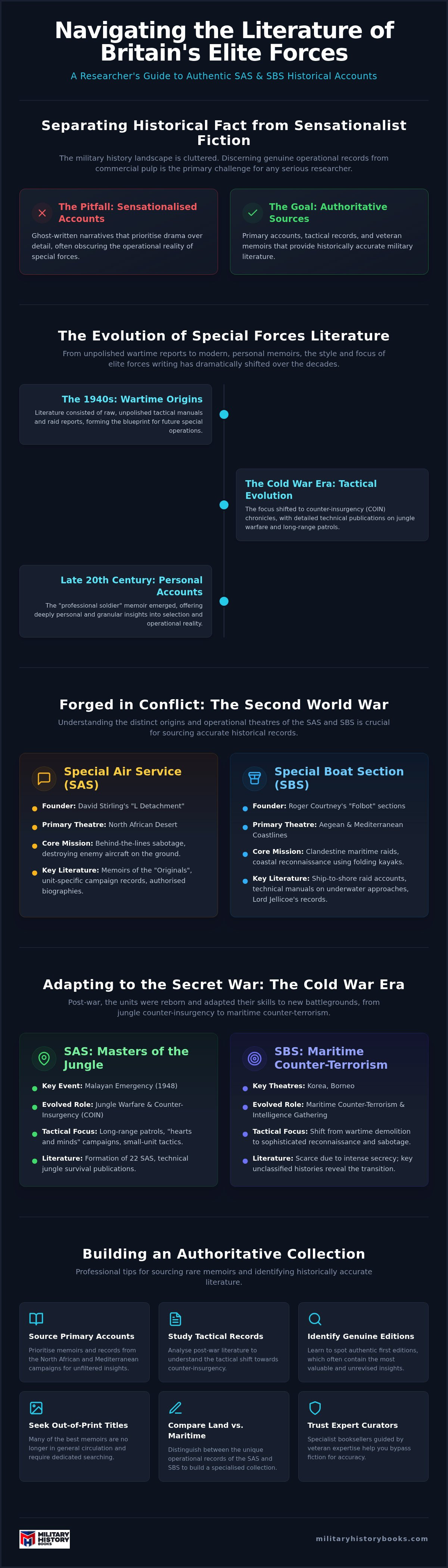
The most treacherous terrain for a special forces researcher isn't a remote desert or a stormy coastline, but the military history shelf of a mainstream bookshop, where sensationalist pulp often smothers the genuine historical record. It's a common frustration for anyone seeking the truth behind the legends. You've likely spent hours sifting through ghost-written accounts that prioritise drama over detail, only to find yourself no closer to understanding the actual operational reality of the SAS & SBS.
We understand that for the serious enthusiast or researcher, accuracy is everything. This guide reveals the definitive history of Britain’s elite special forces by curating the most authoritative books and memoirs. We'll examine how special forces literature has evolved from the technical manuals of the 1940s to the deeply personal accounts of the late 20th century, whilst providing the insights needed to distinguish between commercial fiction and the rare, out-of-print titles that belong in any serious collection. Whether you are looking for technical differences in roles or the raw reality of selection, these titles offer the most reliable records available.
Key Takeaways
- Discover how to source authentic primary accounts from the North African campaign and the earliest days of special operations.
- Understand the literary shift towards counter-insurgency tactics during the Malayan Emergency and the Cold War era.
- Learn to distinguish between the tactical roles and selection processes of the SAS & SBS through a comparison of maritime and land-based operational records.
- Gain professional tips on identifying genuine first editions and sourcing rare special forces memoirs that are no longer in general circulation.
- See how a curated archive, guided by veteran expertise, helps you bypass sensationalised fiction in favour of historically accurate military literature.
The Birth of the Specials: Sourcing Second World War SAS & SBS History
In the early 1940s, the concept of special operations was still in its infancy. The Special Air Service (SAS) history began with David Stirling’s "L Detachment," Special Air Service Brigade. This was a unit designed to drop behind enemy lines in North Africa to destroy aircraft on the ground. Simultaneously, the Special Boat Section (SBS) emerged from Roger Courtney’s "Folbot" sections, focusing on clandestine maritime raids. These early tactical records are vital for researchers today. They provide the raw, unpolished blueprint for every special forces unit that followed. Understanding the distinction between the desert-based sabotage of the SAS and the coastal reconnaissance of the SBS is essential for any serious collector of Land Warfare Books or Naval History Books.
Essential WWII SAS Memoirs
The written legacy of the SAS was largely shaped by David Stirling’s authorised biographies and the personal accounts of the "Originals." These men weren't just soldiers; they were the architects of a new way of fighting. Primary source memoirs from the North African campaign often capture the frantic, high-stakes nature of raids on airfields like Sirte and Agedabia. For those looking beyond general histories, unit-specific campaign records offer a more granular view of operational successes and failures. Finding these Rare and Out of Print Titles requires a keen eye for detail, as many of the most valuable insights are hidden in memoirs published shortly after the war ended.
The SBS in the Mediterranean: Primary Accounts
Literature concerning the SBS often focuses on the brutal, ship-to-shore raids across the Aegean and Mediterranean. These maritime accounts differ significantly from land-based narratives. They often highlight the technical challenges of folding kayaks and underwater approaches. Lord Jellicoe played a pivotal role in the SBS bibliography, both as a commander and a primary source for later historians. Sourcing literature on the SAS & SBS from the Mediterranean theatre requires an understanding of the transition from the early Folbot sections to the more structured Special Boat Squadron. Because these operations were often shrouded in even greater secrecy than their land-based counterparts, sourcing authentic primary accounts from this era is a priority for serious special forces archives. Digital Titles can also be a fantastic resource for accessing these technical manuals and raid reports immediately.
The Secret War: Post-War Operations and Cold War Chronicles
The period between 1945 and 1980 represents a fascinating evolution in special forces literature. While the end of the Second World War saw units like the SAS temporarily disbanded, the onset of the Malayan Emergency in 1948 necessitated their swift return. This "rebirth" moved the narrative away from the desert raids of the previous decade and into the complexities of counter-insurgency (COIN). Literature from this era often focuses on long-range jungle patrols and the technical nuances of "hearts and minds" campaigns. These chronicles are essential for understanding how the SAS & SBS adapted to the ideological battlegrounds of the Cold War.
Jungle Warfare and the SAS in Malaya
The Malayan Emergency produced some of the most detailed technical publications on jungle survival and small-unit tactics. It was here that the modern "professional soldier" memoir began to take shape. Books covering the formation of 22 SAS Regiment provide deep insights into how wartime lessons were formalised into a permanent special operations capability. These aren't just adventure stories; they're tactical blueprints that documented the shift towards modern COIN. You can explore these developments further in our collection of Land Warfare Books, which includes several hard-to-find accounts from this pivotal decade.
SBS: The Evolution of Maritime Counter-Terrorism
Whilst the SAS was refining jungle warfare, the SBS was quietly proving its worth in the frigid waters of Korea and the dense river networks of Borneo. Literature on these operations is often scarcer due to the intense secrecy surrounding maritime sabotage and reconnaissance during the Cold War. However, key unclassified histories reveal the unit's gradual transition towards a maritime counter-terrorism role. These accounts highlight a shift in focus, moving from wartime demolition to sophisticated intelligence gathering and vessel recovery.
The Cold War influence on special forces memoirs cannot be overstated. Authors from this period often wrote under pseudonyms or focused on technical aspects to avoid compromising ongoing operational security. This created a specific style of writing: clinical, precise, and intentionally omitting certain details. For the researcher, these gaps are just as informative as the text itself. They reflect the heightened tensions of an era where special forces were the primary tool for "deniable" operations across the globe. Finding authentic accounts from this era requires looking past the "pulp" and seeking out unit-specific records that capture the true operational tempo of the 1950s and 60s.
SAS vs SBS: Understanding the Distinction Through Tactical Records
Many casual observers view the SBS as a naval version of the SAS. This oversimplification ignores the distinct tactical identities forged through decades of separate development. By examining military biographies and operational records, we can see how the SAS & SBS maintain unique specialisations whilst sharing a common standard of excellence. Their stories are told through different lenses, but they converge on the same high-stakes objectives.
Selection and Training in Literature
Selection is the most documented aspect of special forces literature. SAS memoirs often focus on "The Hills" of the Brecon Beacons, where endurance and navigation are tested to the limit. In contrast, SBS biographies highlight the SC3 course. This adds the gruelling dimension of maritime competency, including sub-surface swimming and canoe handling. Statistical records indicate that fewer than 10% of candidates typically succeed in the UK Special Forces selection process. This high failure rate creates a shared psychological profile amongst survivors. It's a capacity for extreme self-reliance and an unrelenting pursuit of excellence that transcends their specific branch of service.
Tactical Specialisations
Operational focus remains the primary differentiator in technical publications. SAS literature, often found in Land Warfare Books, details high-mobility desert patrols and jungle sabotage. Conversely, SBS records, curated within Naval History Books, emphasise beach reconnaissance and clandestine sub-surface insertion. There is significant cross-pollination in modern operations, particularly in counter-terrorism. However, their historical lineage as Army and Royal Marine units respectively continues to dictate their core tactical specialisms. The best technical publications for each unit reflect these environments, focusing on either terrestrial survival or littoral warfare.
| Feature | SAS (Special Air Service) | SBS (Special Boat Service) |
|---|---|---|
| Historical Lineage | Army (L Detachment, 1941) | Royal Marines (Folbot Sections, 1940) |
| Primary Environment | Terrestrial (Desert, Jungle, Mountain) | Maritime (Sea, River, Coastal) |
| Key Insertion Methods | Parachute, Vehicle, Foot | Submersible, Kayak, Fast Boat |
| Core Focus | Direct Action, Sabotage, CT | Maritime Reconnaissance, Coastal Raiding |
| Selection Focus | Endurance, Navigation, Land Survival | Swimming, Diving, Small Craft Operations |
Whilst their methods of insertion differ, the psychological resilience required is identical. Modern records show that both units have moved towards a more integrated approach under the UK Special Forces directorate. This has led to a shared written legacy in recent years, though the rare memoirs from the 1950s and 60s still provide the clearest evidence of their separate tactical evolutions.
Sourcing Rare Special Forces Memoirs and Out-of-Print Titles
Finding authentic records of the SAS & SBS often feels like a tactical exercise in itself. Many of the most insightful memoirs were produced in limited print runs shortly after the conflicts they describe, intended for a small audience of veterans and military professionals. These titles didn't stay on high-street shelves for long. Today, they're highly sought after by serious collectors who value historical accuracy over the polished narratives found in modern paperbacks. Specialist booksellers play a vital role here, acting as curators who preserve these fragile stories before they're lost to time.
Identifying Rare Special Forces Titles
When you're hunting for 1940s and 50s military first editions, condition and provenance are everything. Authentic first editions from this era often feature distinctive dust jacket art and specific publisher imprints that are hard to replicate. Signed copies by unit veterans add a layer of historical weight that goes beyond the text itself; they turn a book into a tangible link to the past. For a deeper look at the nuances of collecting, you can read our guide to out of print military books, which covers the complexities of sourcing rare titles in the current market.
Digital Titles and Technical Publications
Whilst a physical first edition is a prize for any shelf, digital formats offer a practical solution for active research. We provide many Digital Titles via download and on disc, ensuring that fragile paper records are preserved for future generations. These digital archives are particularly valuable for modellers and technical researchers who need access to detailed equipment manuals and raid reports that are too delicate to handle frequently. They allow you to zoom in on technical diagrams or search through hundreds of pages of operational history in seconds.
Our inventory includes over 10,000 titles, many of which are Rare and Out of Print Titles that you won't find in generalist retailers. As a business managed by an RAF veteran, we understand the importance of selecting quality material that stands up to academic scrutiny. If you're looking to build a serious archive, you can browse our full collection of Rare and Out of Print Titles to find that elusive memoir you've been searching for.
Curating an Elite Library: Why Specialist Booksellers Matter
Building a library that serves as a reliable archive requires more than just a list of titles; it demands a curator who understands the historical weight of the subject matter. Whilst generalist retailers often stock the latest commercial bestsellers, they lack the discernment to separate historical fact from dramatised fiction. For those researching the SAS & SBS, this distinction is critical. A specialist bookseller acts as a bridge between the past and the modern enthusiast, ensuring that the material you collect is both authoritative and accurate.
Our collection is managed by an RAF veteran who brings professional military context to the selection process. With over 10,000 titles in stock, we focus on material that offers genuine technical or historical value. This expertise ensures that every volume, whether it's a 1940s raid report or a modern tactical analysis, has been vetted for its contribution to the wider historical record. We don't just sell books; we preserve the stories of those who served in the most demanding environments.
The Specialist Advantage
Expert knowledge is the primary filter used to maintain the quality of our archive. We help serious researchers avoid the "pulp" and find the primary sources that actually matter. We also recognise that our collectors are located across the globe. This is why we prioritise secure international delivery, ensuring that rare and out-of-print editions arrive in the condition described. If you are looking for a present for a fellow enthusiast, our guide to Military history gift books UK offers tailored recommendations for the specialist collector.
Expanding Your Research
Special forces history doesn't exist in a vacuum. It is deeply intertwined with other branches of service, and a truly elite library reflects this breadth. Understanding SAS paratroop insertions often requires a deeper dive into Aviation history books, whilst the clandestine origins of the SBS are best understood through Naval history publications. By exploring these adjacent fields, you gain a more comprehensive view of how elite units operate within the broader military machine.
We invite you to delve into our curated archive and discover the definitive records of Britain’s special operations. Whether you are a serious researcher or a casual reader, our collection offers a reliable source for both rare physical editions and immediate digital downloads. Browse our full SAS & SBS collection today and find the next essential addition to your personal library.
Building Your Special Forces Archive
The journey through special forces literature reveals a profound shift from the raw tactical manuals of the 1940s to the introspective memoirs of the modern era. By prioritising authentic primary sources over sensationalised accounts, you gain a clearer understanding of the operational realities that defined the SAS & SBS. Whether you're tracing the "Originals" through the North African desert or examining the maritime counter-terrorism evolution of the Cold War, the right books act as essential guides to this clandestine world.
Finding these rare records requires a specialist's eye. Our archive is expertly curated by an RAF veteran and features over 10,000 titles, including many elusive out-of-print editions that aren't available in general circulation. We ensure these stories are preserved and accessible to researchers across the globe with secure worldwide shipping. It's our privilege to help you source the definitive history of Britain's most elite units and provide the technical detail serious collectors demand.
Explore our extensive collection of SAS and SBS books and start building a library that truly honours the historical weight of special operations. We're here to help you find the next landmark title for your collection.
Frequently Asked Questions
What is the difference between the SAS and the SBS?
The primary difference between the SAS & SBS lies in their operational environments and historical parent units. The SAS is an Army unit focused on land-based sabotage and direct action. The SBS is part of the Royal Marines and specialises in maritime reconnaissance and littoral warfare. While both units now operate under the UK Special Forces umbrella, their core training remains distinct, with the SBS requiring additional maritime certifications and sub-surface insertion training.
Which books are considered the most accurate for SAS history?
The most accurate accounts of SAS history are generally considered to be those written by original members or authorised historians who utilise primary source material. Books that incorporate unit-specific campaign records and David Stirling's authorised biographies offer the most reliable insights. Serious researchers should prioritise accounts that focus on tactical detail rather than sensationalised drama, as these provide a truer reflection of the unit's operational evolution since its formation in 1941.
Can I find out-of-print SBS memoirs online?
You can find out-of-print SBS memoirs through specialist retailers who maintain extensive archives of rare military literature. Since many of the most detailed accounts were published in limited quantities shortly after the Second World War or the Cold War, they're rarely found in high-street shops. Our collection includes over 10,000 titles, focusing specifically on hard-to-find memoirs and unit-specific histories that preserve the authentic experiences of those who served in maritime special operations.
Are there technical manuals available for special forces equipment?
Technical manuals for special forces equipment are available, particularly those covering historical kit like the 1940s folding kayaks or early desert patrol vehicles. These documents are invaluable for modellers and researchers looking for precise specifications. We specialise in sourcing these rare technical publications, often providing them as digital titles on download or disc to ensure the fragile original paper records are preserved whilst remaining accessible for immediate research and reference.
Who founded the Special Boat Service (SBS)?
The SBS was founded by Roger Courtney, a former commando who established the first "Folbot" sections in 1940. Courtney's vision was to create a unit capable of clandestine maritime insertion using folding kayaks. His early raids in the Mediterranean proved the concept's viability, leading to the expansion of the unit under various names before it became the Special Boat Service. Literature regarding Lord Jellicoe's leadership also provides essential context for the unit's later development.
What is the best way to start a special forces book collection?
The best way to start a special forces book collection is to focus on a specific era or unit, such as the Second World War origins of the SAS & SBS. Begin with reputable authorised histories to build a foundation of knowledge before seeking out rarer, out-of-print memoirs. Consulting a specialist bookseller with veteran expertise helps you identify genuine first editions and avoid commercial fiction, ensuring your library remains a reliable historical archive.
Do special forces memoirs require Ministry of Defence approval?
Special forces memoirs written by serving or former members have been subject to strict confidentiality contracts since 1996. This policy requires personnel to seek Ministry of Defence approval before disclosing any information related to their service. This regulation has significantly influenced the style of modern special forces literature, often leading to more clinical accounts or focusing on historical periods where secrecy requirements are less restrictive, whilst still preserving the technical integrity of the narrative.
Where can I find digital military history books about the SAS?
You can find a wide range of digital military history books about the SAS in our specialist online collection. We offer digital titles by download and on disc, providing immediate access to rare records and out-of-print campaign histories. These digital formats are particularly beneficial for researchers who need to search technical manuals or examine high-resolution diagrams without the risk of damaging fragile physical copies. Our veteran-managed archive ensures all digital content meets a high standard.


