

What if the victory in the summer of 1940 was decided not by the agility of the Spitfire, but by a series of telephone lines and radar towers hidden in the British countryside? Most of us grew up with the romantic image of "The Few" soaring through summer skies to save a nation. It's a powerful narrative that rightfully honours the 2,936 pilots who stood in the gap during the Battle of Britain. You've likely felt the frustration of sifting through generic histories that gloss over technical details or provide conflicting data on Merlin engine performance. We're here to help you move past the surface-level stories.
This article promises to guide you through the essential literature that defines this era, curated with the insight of a specialist military historian and RAF veteran. We'll examine the strategic genius of the Dowding System in detail and highlight the technical manuals vital for accurate modelling. By the end, you'll know exactly how to distinguish between raw primary memoirs and the rigorous secondary analyses that provide the full historical picture. Whether you're a dedicated researcher or a casual reader, finding the right resources will transform your understanding of this pivotal conflict.
Key Takeaways
- Understand the strategic situation of 1940 and why this campaign remains unique as the first in history fought entirely by air forces.
- Clarify technical misconceptions by examining the distinct combat roles and specifications of the Supermarine Spitfire and the Hawker Hurricane.
- Discover how the Dowding System functioned as the world's first integrated air defence organisation through radar and ground observation.
- Master specialist research techniques by learning how to locate and interpret primary evidence like official squadron combat reports.
- Build a balanced and authoritative personal library on the Battle of Britain by focusing on essential technical, biographical, and tactical titles.
The Strategic Crisis: Understanding the Battle of Britain in 1940
The Battle of Britain represents a unique chapter in military history, as it was the first major campaign decided entirely in the skies. By the summer of 1940, the strategic situation was incredibly dire. France had collapsed under the weight of the Blitzkrieg, and the remnants of the British Expeditionary Force had only just escaped the beaches of Dunkirk. Isolated and facing an imminent invasion, Britain became the final obstacle to German hegemony in Western Europe. For the Luftwaffe, the objective was clear: they had to achieve total air superiority to protect the vulnerable transport barges of Operation Sea Lion. This period remains a favourite for researchers because the sheer volume of available records, from pilot logbooks to technical manuals, allows us to reconstruct almost every combat sortie with remarkable precision.
The Timeline of Conflict: From Kanalkampf to the Blitz
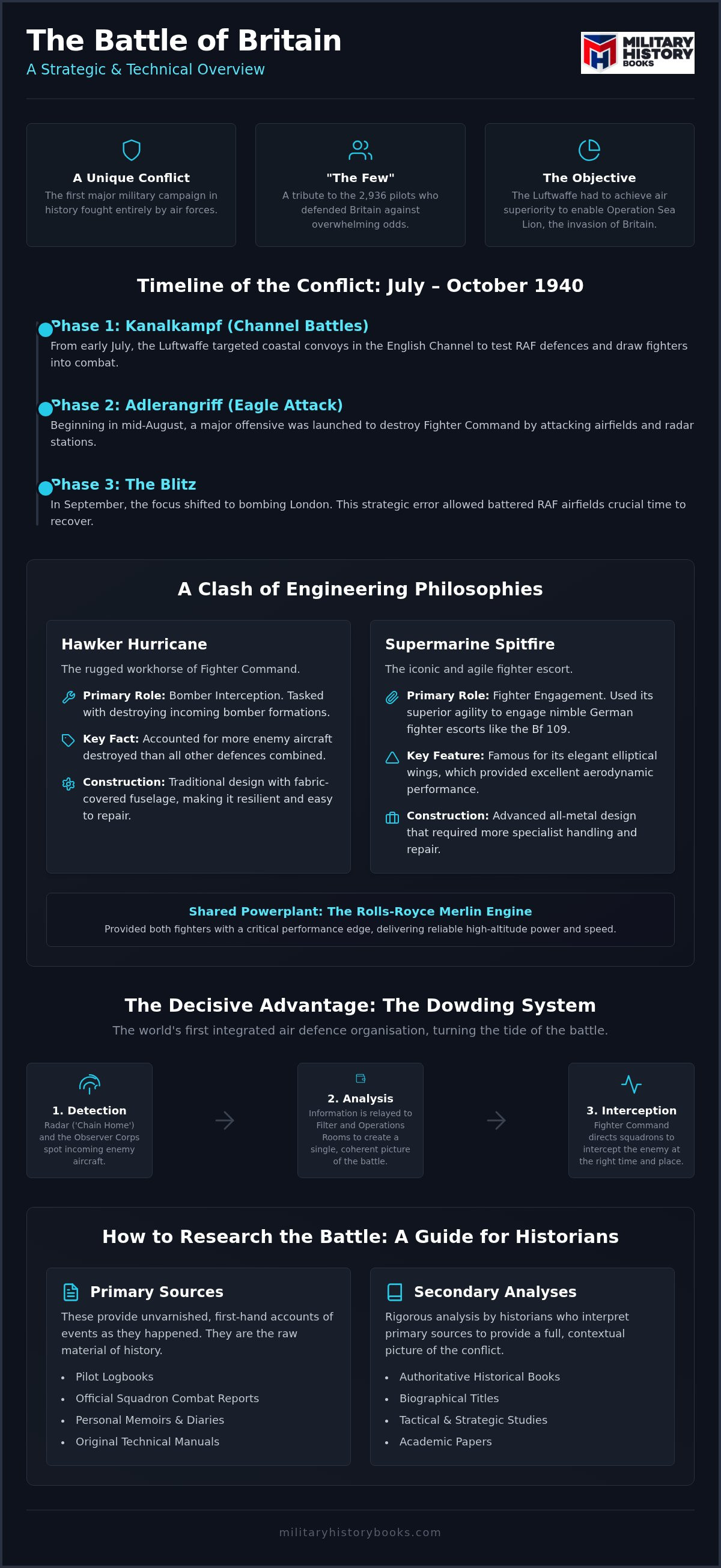
The conflict unfolded in distinct phases between July and October 1940. It began with the *Kanalkampf*, or the Channel Battles, where the Luftwaffe targeted coastal convoys to draw out the RAF and test their resolve. By August, the focus shifted to "Eagle Attack," a concerted effort to dismantle the infrastructure of Fighter Command by bombing airfields and vital radar stations. The final pivot occurred in September when the Luftwaffe began the bombing of London. Whilst this brought immense suffering to the civilian population, it proved to be a strategic blunder. It gave the battered RAF airfields a vital chance to recover and ultimately led to the indefinite postponement of German invasion plans.
Cultural Legacy: Cinema vs. Historical Record
Public perception of this era is often filtered through the lens of the 1969 film *Battle of Britain*. Whilst the movie captured the visceral nature of dogfights, it often prioritised cinematic drama over the methodical logistics of air defence. To find a deeper understanding, collectors often turn to wartime history books UK to cross-reference film scenes with actual combat reports and squadron diaries. Cinematic accounts can't replace the unvarnished truth found in primary memoirs written by those who were there. These personal records reveal the exhaustion and technical challenges that pilots faced, providing a grounded perspective that goes far beyond the silver screen's romanticism.
Technical Superiority: Aircraft and Armament of the Air War
The technical dimension of the Battle of Britain was a clash of engineering philosophies as much as a test of pilot skill. Whilst the Supermarine Spitfire often captures the public imagination with its elliptical wings and grace, it worked in tandem with the rugged Hawker Hurricane to secure the skies. The Rolls-Royce Merlin engine provided the RAF with a critical performance edge in 1940 by delivering reliable high-altitude power and consistent speed across both primary fighter types. Understanding these nuances requires a look at the Phases of the Battle of Britain, where the deployment of these aircraft shifted based on tactical needs. It's often forgotten that the Spitfire was primarily used to engage the nimble German fighter escorts, whilst the Hurricane was tasked with the vital job of intercepting the heavy bomber formations.
The Hawker Hurricane: The Workhorse of Fighter Command
The Hawker Hurricane was the true workhorse of Fighter Command, accounting for more enemy aircraft kills than all other defences combined. Its design was somewhat traditional, featuring a fabric-covered rear fuselage that made it remarkably resilient and easy to repair under combat conditions. Many historians use aviation history books to study the intricate technical diagrams that show how these aircraft were maintained in the field. Ground crews could often patch a Hurricane and return it to the air in hours, whereas the all-metal Spitfire required more specialist handling. If you're looking for the mechanical specifics of these machines, you can browse our collection of technical manuals to see the original specifications.
The Messerschmitt Bf 109: A Formidable Opponent
Opposing the RAF was the Messerschmitt Bf 109, a formidable interceptor that excelled in vertical manoeuvres and high-altitude performance. Unlike the early Merlin engines, the Bf 109's Daimler-Benz engine featured direct fuel injection, allowing German pilots to dive steeply without the engine cutting out. However, the Luftwaffe faced a severe handicap: fuel capacity. German fighters often had mere minutes of combat time over London before they were forced to turn back across the Channel or risk ditching in the water. The Junkers Ju 87 Stuka, whilst terrifying in previous campaigns, proved too slow and vulnerable against modern British fighters. Finding out of print military books that contain translated German pilot manuals is often the only way to understand the tactical frustrations felt by the Luftwaffe during these sorties. These rare texts provide a balanced view of the technical struggle, showing that victory was never a foregone conclusion.
The Dowding System: A Revolution in Air Defence
The Battle of Britain was won on the plotting tables of Bentley Priory as much as it was in the cockpits of the Spitfire. Air Chief Marshal Hugh Dowding developed the world’s first integrated air defence organisation, a complex network of technology and human intelligence that remains a masterclass in logistics. This system allowed Fighter Command to husband its limited resources by only launching interceptors when and where they were needed. As noted by the UK Government on the Battle of Britain, this strategic efficiency was the decisive factor that prevented the Luftwaffe from overwhelming the RAF. Information management became the invisible weapon of 1940, proving that data was just as vital as pilot bravery.
Chain Home Radar: The Invisible Shield
The foundation of the system was the Chain Home radar network. These towering steel masts emitted radio waves that bounced off incoming aircraft, allowing operators to calculate distance and bearing with surprising accuracy for the time. Whilst the physics of early RDF (Radio Direction Finding) was rudimentary, it provided a vital early warning that removed the need for constant, exhausting standing patrols. The Luftwaffe frequently underestimated these static targets, often failing to realise that destroying the masts was more important than bombing the airfields. For those interested in the evolution of electronic warfare, technical military publications offer a deep dive into the specific frequencies and mechanical challenges of these early sets.
Air Chief Marshal Hugh Dowding: The Architect of Victory
Dowding was a reserved, often difficult leader, yet his foresight was impeccable. A detailed military biography of the man reveals a commander who prioritised the preservation of his "chicks"—his pilots—over flashy tactical victories. This cautious approach led to the "Big Wing" controversy, an internal political struggle within Fighter Command over whether to engage the enemy with small, agile groups or massive formations. Dowding’s refusal to squander his strength in futile gestures ensured the RAF remained a potent force throughout the summer. The system he built functioned through a series of vital filters:
- Chain Home Stations: Detected aircraft movements over the sea to provide 20 minutes of warning.
- The Observer Corps: Tracked enemy movements visually once they crossed the coast and radar lost them.
- The Filter Room: Correlated all incoming data to remove conflicting reports and "noise."
- The Sector House: Directed individual squadrons via radio to the exact point of interception.
This methodical approach ensured that British pilots didn't waste fuel or energy searching for an elusive enemy. It turned the sky into a controlled environment where the RAF could strike with maximum impact, even when outnumbered.
How to Research the Battle of Britain: A Guide for Historians
Researching the Battle of Britain requires a transition from accepting popular narratives to scrutinising primary evidence. It's a rewarding journey. For the serious historian, the goal is to move beyond general overviews and into the granular details found in squadron or combat reports. These wartime documents offer an unvarnished look at daily operations, often revealing the confusion and intensity of air combat that modern summaries might gloss over. Verifying the accuracy of a modern account involves cross-referencing it with these original records to see if the claims about kill ratios or mission objectives hold up. You can often find niche articles on specific engagements or individual pilot actions by consulting back issue military magazines UK, which serve as an excellent bridge between general history and academic research.
Identifying Rare and First Edition Memoirs
Personal accounts provide the emotional core of aviation history. Key titles to look for include Richard Hillary’s *The Last Enemy* and Geoffrey Wellum’s *First Light*, both of which offer profound insights into the psychological toll of the conflict. When sourcing a first edition, pay close attention to the condition of the dust jacket and the specific publisher markings, such as those from Jonathan Cape or Collins. A 1940s printing provides a tangible connection to the era that digital copies cannot replicate. These physical volumes often contain contemporary maps or photographs that are lost in later reprints, making them essential for a serious collection.
Utilising Technical Manuals and Modelling Guides
Scale modellers and technical enthusiasts often require a level of detail that standard histories don't provide. Whilst a general history might mention a "Spitfire," a technical "type" study will detail the specific cockpit layout or the transition from two-blade to three-blade propellers. For those building replicas, historical accuracy is paramount. We suggest sourcing Airfix and modelling magazines for detailed camouflage patterns and squadron marking references. These resources often include high-resolution diagrams and paint chips that are vital for recreating a specific aircraft from a particular week in August 1940. If you're ready to deepen your research, we invite you to explore our collection of aviation history books and rare technical publications today.
Preserving the Legacy: Building Your Battle of Britain Library
Building a personal library is an act of historical stewardship. Whilst digital archives offer speed, physical books remain the most reliable way to preserve the intricate details of 1940 for future generations. A well-curated shelf serves as a permanent reference that doesn't rely on internet connectivity or software updates. For many collectors, the goal is to create a balanced collection that covers every angle of the Battle of Britain. Achieving this requires more than just buying the latest bestsellers; it involves a methodical approach to sourcing different types of literature. We believe a comprehensive library should include three essential categories:
- Technical Publications: Original air ministry manuals or detailed "type" studies that explain the mechanical nuances of the aircraft.
- Biographical Records: First-hand memoirs from pilots, ground crews, and radar operators that provide the human context of the conflict.
- Tactical Analyses: Academic or specialist works that examine the broader strategic decisions made by both the RAF and the Luftwaffe.
Sourcing these titles can be a challenge, especially when dealing with elusive publications that have been out of print for decades. This is where the expertise of a specialist bookseller becomes invaluable. Our shop is managed by an RAF veteran who understands the historical weight of these materials, ensuring that every volume in our inventory meets a high standard of accuracy and relevance. Whether you're a serious researcher or a dedicated hobbyist, having a trusted guide can help you navigate the vast sea of military literature to find the truly essential works.
The Value of Out-of-Print Titles
Many of the most profound tactical analyses were published in small runs during the mid-20th century and never saw a second printing. These rare volumes often contain specific data points and veteran interviews that haven't been digitised or included in modern syntheses. There is a genuine thrill in the hunt for these rare aviation history books. To support collectors in this pursuit, Military History Books maintains a specialised catalogue of over 10,000 titles. This extensive inventory allows us to help you locate the specific, hard-to-find accounts that turn a standard book collection into a world-class reference archive.
The Future of Military History Research
Digital archives are expanding, providing excellent access to raw data and scanned documents. These tools complement physical books but they don't replace them. A physical reference library remains the gold standard for serious researchers because it allows for easy cross-referencing and provides a tangible connection to the past. The weight of a first-edition memoir or the smell of a vintage technical manual adds a layer of experience that a screen simply cannot match. As we look to the future, the preservation of these physical records is vital for keeping the stories of 1940 alive. If you're ready to start or expand your archive, we invite you to explore our extensive collection of Battle of Britain and aviation history books today.
Advancing Your Study of the Air War
The victory in 1940 was a triumph of integrated air defence and technical resilience. By moving beyond popular myths and exploring the mechanical specifics of the Merlin engine or the logistical genius of the Dowding System, you gain a far richer perspective on the Battle of Britain. Whether you're a dedicated modeller seeking technical accuracy or a researcher hunting for rare primary memoirs, the right literature is the bridge that connects you to the past. Preserving these stories through a physical library ensures that the technical and human details of this pivotal era aren't lost to time.
Our collection is expertly curated by an RAF veteran who understands the nuances of aviation history. With over 10,000 specialist titles in stock and secure UK and international shipping available, we're here to help you find those elusive out-of-print volumes. We invite you to Browse our curated collection of specialist Aviation History Books today. We look forward to helping you discover the next essential addition to your archive.
Frequently Asked Questions
Who were "The Few" in the Battle of Britain?
"The Few" refers to the 2,936 airmen who flew at least one authorised operational fighter sortie between 10 July and 31 October 1940. Whilst most were British, the group included pilots from Poland, Czechoslovakia, and other Allied nations. Their nickname comes from Winston Churchill’s 1940 speech. He stated that never in the field of human conflict was so much owed by so many to so few. Their contribution remains a cornerstone of history.
What was the most successful British fighter aircraft in 1940?
Whilst the Spitfire is more famous, the Hawker Hurricane was statistically the most successful British fighter in 1940. It accounted for the majority of Luftwaffe aircraft destroyed by the RAF during the campaign. This was largely due to its rugged design and stable gun platform, which made it ideal for intercepting heavy bomber formations. Its ease of repair ensured that squadrons could maintain high operational readiness throughout the desperate summer months.
How long did the Battle of Britain last?
The official dates for the campaign are 10 July to 31 October 1940, lasting a total of 114 days. These dates were established by the Air Ministry to define eligibility for the Battle of Britain clasp. The conflict began with attacks on Channel convoys and ended as the Luftwaffe shifted its primary focus toward night-time bombing raids. Historians often break this period into distinct tactical phases based on the changing strategic objectives of the German High Command.
What was the significance of the Dowding System?
The Dowding System created the world’s first integrated air defence network, combining radar, ground observers, and radio control into a single organisation. This allowed Fighter Command to use its limited resources with surgical precision rather than wasting fuel on constant patrols. By filtering raw data through a central command structure, the RAF could predict enemy movements and intercept raids before they reached their targets. It proved that technological integration was as vital as aircraft performance in 1940.
Can I still find first edition books about the Battle of Britain?
Yes, first edition books from the 1940s are still available through specialist military booksellers, though they are increasingly sought after by collectors. Titles published during the war or shortly after provide a unique, contemporary perspective on the Battle of Britain. When sourcing these rare volumes, you should look for original dust jackets and specific imprints. Our inventory includes many out of print titles that offer a tangible connection to this pivotal moment in our national history.
What happened if the RAF had lost the battle?
If the RAF had lost air superiority, the German military would have likely launched Operation Sea Lion, the planned amphibious invasion of Britain. Without control of the skies, the Royal Navy would have been vulnerable to Stuka dive-bombers, making it difficult to defend the English Channel. Defeat would have removed Britain as a base for future Allied operations. This victory was essential for the eventual liberation of the continent and the preservation of British independence.
Why was the Battle of Britain a turning point in World War II?
This campaign was a major turning point because it handed Nazi Germany its first major setback of the war. It demonstrated that the Luftwaffe was not invincible and prevented the total collapse of Western resistance. By securing the UK as a sovereign base, it ensured that the United States had a staging ground for the eventual entry into the European theatre. The victory shifted the strategic momentum and forced the German High Command to look elsewhere.
How can I start a collection of rare military history books?
Starting a collection is best achieved by focusing on a specific niche, such as technical manuals or pilot memoirs, rather than buying general histories. You should consult specialist retailers who understand the provenance and condition of rare titles. Building a library takes time, but focusing on quality over quantity is key. We recommend beginning with foundational texts and gradually seeking out out of print titles from our inventory of over 10,000 specialist publications to deepen your expertise.


