

How many times can a historian read the same recycled accounts of Waterloo before the details begin to lose their impact? For the dedicated collector, the primary challenge isn't a lack of napoleonic wars books, but rather the exhausting task of sifting through generic narratives to find true technical accuracy. You likely recognise the frustration of a shelf crowded with repetitive "grand tours" of the era, whilst the precise regimental histories and rare memoirs you actually need remain hidden in the shadows of out-of-print catalogues.
This guide serves as your definitive roadmap for exploring the immense breadth of Napoleonic literature, moving beyond the well-trodden paths into the specialised archives that serious research demands. We will establish a clear hierarchy of essential texts, distinguishing between the broad strokes of narrative history and the granular detail of technical tactical studies. By the end, you'll understand how to balance your library with both strategic overviews and those elusive specialist titles that bring the unpolished voices of the ranks back to life.
Key Takeaways
- Learn how to categorise your collection into strategic overviews, tactical studies, and personal memoirs to ensure a balanced historical perspective.
- Identify the essential napoleonic wars books that form the foundation of any serious library, ranging from 19th-century classics to modern analytical works.
- Understand the technical value of regimental histories and how they provide the precise data required for accurate historical modelling and wargaming.
- Gain expert guidance on identifying valuable out-of-print titles and first editions that often preserve more raw detail than contemporary summaries.
- Discover why a specialist curator with professional military experience is better equipped to assist with complex research requests and rare title sourcing.
Navigating the Vast Landscape of Napoleonic Wars Books
The Napoleonic era is arguably the most documented period in military history. This isn't merely due to the scale of the conflict, but because it represents a turning point where literacy amongst the ranks began to rise alongside the professionalisation of the military. When searching for napoleonic wars books, the modern researcher is often overwhelmed by choice. Building a definitive library requires a methodical approach, moving beyond the surface level of popular history to understand how different types of works interact to form a complete picture.
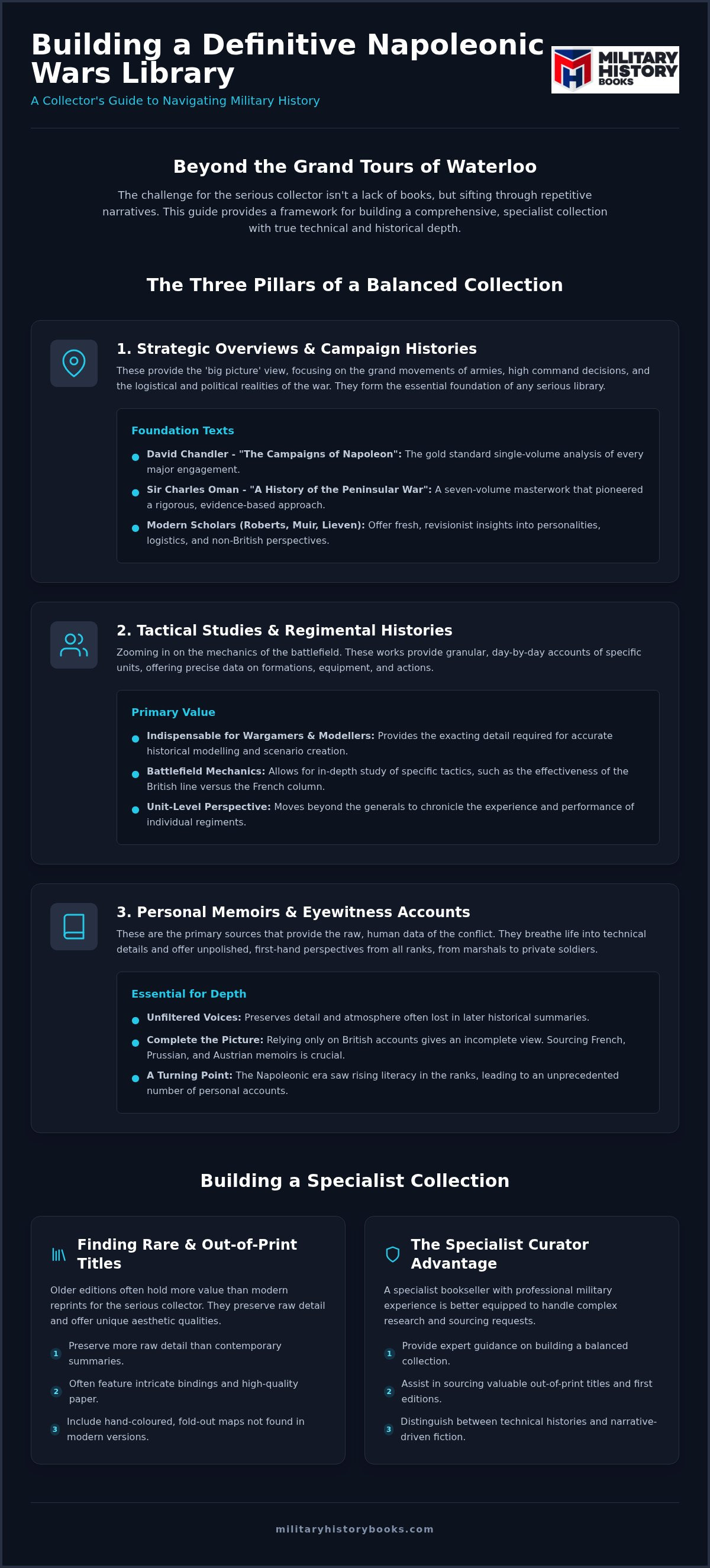
We can divide this vast landscape into three essential pillars. Strategic overviews provide the broad view of the conflict, focusing on the grand movements of armies and the decisions of the high command. Tactical studies zoom in on the mechanics of the battlefield, such as the effectiveness of the British line versus the French column. Finally, personal memoirs provide the raw, human data that breathes life into these technical details. A balanced library must incorporate all three to be truly comprehensive.
Categorising the Conflict: From Strategy to the Front Line
Many readers begin with "Great Captain" biographies, focusing on the genius of Napoleon or the stoicism of Wellington. Whilst these are valuable, they often differ significantly from broader campaign histories that examine the logistical and political realities of the war. For those seeking granular detail, regimental histories are indispensable. These works offer a day-by-day account of a specific unit's actions, making them a primary resource for modellers and wargamers. It's vital to distinguish these technical publications from narrative-driven military fiction, which prioritises drama over historical accuracy.
Why Napoleonic Literature Remains a Collector’s Favourite
The aesthetic appeal of 19th-century military volumes remains a significant draw for collectors. These older editions often feature intricate bindings and hand-coloured fold-out maps that modern reprints simply cannot replicate. The Napoleonic enthusiast is often a unique blend of dedicated historian, meticulous modeller, and passionate collector. This enduring appeal is particularly evident amongst those studying wartime history books UK, where the focus remains on the preservation of these vital stories. A truly definitive collection of napoleonic wars books must also seek out primary source material from both sides of the conflict. Relying solely on British accounts provides only half the picture; understanding the French, Prussian, or Austrian perspective is essential for a professional-grade library.
The Essential Foundation: Strategic Overviews and Campaign Histories
A serious collection of napoleonic wars books begins with the heavyweights of campaign history. Whilst the temptation to focus on the climactic events of 1815 is strong, a professional-grade library requires a broader perspective. This foundation is built on works that manage to marry grand strategy with operational reality, often spanning multiple volumes to capture the sheer scale of the conflict. Understanding the transition from the patriotic narratives of the 1800s to the analytical rigour of modern scholarship is vital for any collector.
The Defining Works: David Chandler and Charles Oman
David Chandler’s "The Campaigns of Napoleon" remains the gold standard for single-volume strategic overviews. It provides a methodical analysis of every major engagement, setting a template that modern historians still follow. For the Peninsular War, Sir Charles Oman’s seven-volume history is an essential acquisition. His work moved historiography away from the hero-worship of the early 19th century toward a more rigorous, evidence-based approach that remains surprisingly relevant for modern researchers.
Modern Perspectives: Challenging the Traditional Narrative
In recent decades, scholars like Andrew Roberts and Rory Muir have revitalised the field by offering fresh strategic insights into the personalities of the era. These modern napoleonic wars books often take a revisionist stance, examining the independent commands of Napoleon’s marshals or the intricate logistics of the British army. Dominic Lieven’s research into the Russian perspective has significantly shifted our understanding of the 1812 invasion, proving that the Tsar's victory was a product of calculated strategy rather than just "General Winter."
Building a library also requires looking beyond the famous battlefields of Spain and Belgium. The early campaigns in Italy and the expedition to the Levant are often overlooked, yet they were the crucibles in which Napoleon’s reputation was forged. Understanding these "forgotten" theatres is what separates a casual reader from a dedicated historian. If you are looking to build your own definitive archive, you can find many of these foundational land warfare books within our specialist collection.
Technical Detail and Eyewitness Accounts: Memoirs and Regimental Histories
Whilst grand strategy provides the necessary framework, it's the granular detail found in primary accounts that truly defines a superior collection of napoleonic wars books. These works offer the raw data of the battlefield, stripping away the polished prose of later historians to reveal the chaotic reality of 19th-century combat. For the researcher or wargamer, these texts aren't just reading material; they're technical manuals for understanding the human and mechanical components of the era. Moving from the "why" of a campaign to the "how" of a skirmish requires a shift toward regimental histories and personal journals.
The Voice of the Soldier: Essential Napoleonic Memoirs
To understand the British perspective, one must look toward the ranks. The memoirs of Rifleman Harris provide a visceral account of the retreat to Corunna, whilst Captain John Kincaid of the 95th Rifles offers a more sardonic, officer-level view of the Peninsular War. Contrasting these with French accounts is vital for a balanced library. The memoirs of Baron de Marbot, filled with cavalry dash and perhaps a touch of exaggeration, stand in stark contrast to the gritty, stoic recollections of Jean-Roch Coignet, a soldier of the Old Guard. These primary sources offer unique insights into the daily behaviour, morale, and survival instincts of the troops that traditional histories often overlook.
Uniforms, Tactics, and Logistics: The Technical Library
Technical accuracy is the lifeblood of historical modelling and serious wargaming. Specialist napoleonic wars books that focus on specific uniform changes are essential, as a regiment’s appearance could alter significantly between the start of a campaign and its conclusion. Beyond the aesthetics, the strategic importance of logistics cannot be overstated. Napoleon’s reliance on "living off the land" was a double-edged sword that ultimately dictated the pace of his movements and the sustainability of his conquests. To truly understand the mechanics of the battlefield, collectors should seek out technical studies on cavalry formations and infantry drills, linking these to artillery history books for a complete view of the combined arms tactics that defined the period.
Sometimes, the most specific tactical research isn't found in a hardcover volume but in the pages of specialist periodicals. For those hunting for niche details on unit strengths or obscure skirmishes, back issue military magazines UK serve as an invaluable archive. These publications often feature peer-reviewed articles and detailed maps that provide a level of specificity rarely found in general market histories, making them a cornerstone for any serious researcher’s desk.
Building a Specialist Collection: Finding Rare and Out-of-Print Titles
For many enthusiasts, the transition from reading history to collecting it marks a significant evolution in their study of the period. Identifying truly valuable napoleonic wars books requires an eye for detail that goes beyond the title on the spine. Whilst modern mass-market reprints offer accessibility, they often omit the intricate folding maps and high-quality steel engravings that defined 19th-century publishing. These original elements aren't just decorative; they provide geographical context that is frequently lost in digital scans or modern summaries.
Certain out of print military books remain the most accurate sources available because they were written by contemporaries or compiled from regimental records that have since been lost or damaged. A specialist bookseller acts as a vital curator in this process, vetting the authenticity and completeness of rare military memoirs to ensure that the maps and plates are present and correct. This level of verification is something that generalist marketplaces simply cannot provide.
Identifying Valuable First Editions and Specialist Reprints
Building a collection involves learning the specific terminology of the trade. You'll often encounter "foxing", which refers to the age-related browning or spotting of paper, or "clipped dust jackets" where the original price has been removed. A "first state" copy represents the earliest printing before any corrections were made, often making it the most desirable for a serious archive. Limited edition regimental histories, often printed in small batches for veterans' associations shortly after the wars ended, carry immense historical weight. Conversely, some modern specialist reprints are highly valued for the addition of exhaustive scholarly footnotes that clarify obscure 19th-century references.
The Rise of Digital Military History Research
The landscape of collecting has been transformed by technology. Whilst they lack the tactile satisfaction of a leather-bound volume, digital military history books offer unparalleled advantages for active researchers. The ability to search through thousands of pages for a specific officer's name or a particular date is a powerful tool for those conducting deep genealogical or tactical studies. Many rare technical manuals and fragile pamphlets are now preserved as digital downloads or on disc, ensuring that the information remains accessible even when the physical originals are locked away in private collections.
If you're ready to expand your library with vetted, high-quality volumes, you can browse our full range of Rare and Out of Print Titles to find your next acquisition.
Sourcing Your Library: Why a Specialist Bookseller Makes the Difference
The final step in building a definitive library is identifying a reliable source that values the material as much as you do. Large, automated retailers often rely on algorithms that prioritise turnover over historical significance. When you are searching for napoleonic wars books, this lack of subject-matter expertise can lead to missed opportunities or incorrectly described editions. A specialist curator understands that a researcher's needs are vastly different from those of a casual reader, requiring a level of precision that only comes from years of dedicated study and a genuine passion for the niche.
The Expertise of a Veteran-Managed Collection
Our collection is managed by an RAF veteran, which ensures that every title is selected with an eye for military accuracy and historical relevance. This professional experience allows us to distinguish between works that offer genuine tactical insight and those that merely repeat popular myths. With an inventory of over 10,000 specialist titles, we provide a breadth of choice that spans every theatre of the Napoleonic conflict. We pride ourselves on offering a personalised service, assisting collectors in sourcing specific out-of-print rarities that are often absent from general catalogues. This curated approach ensures that your library grows in both value and academic utility, moving beyond the bestseller lists to find the true gems of the era.
Secure National Delivery and Collector Support
The logistics of moving rare military literature requires a specialised touch. We understand that a first edition from the 1800s is a piece of history that cannot be easily replaced. Because of this, we use robust packaging techniques designed to protect fragile spines and prevent damage to internal maps during transit. We offer secure national delivery across the UK, ensuring that your acquisitions arrive safely at your door. Our role is to act as a bridge between the past and the modern enthusiast, providing the support you need to preserve these vital stories for future generations. We encourage you to look beyond the mainstream titles and explore our extensive selection of land warfare books to find the specific detail your research demands.
Building Your Definitive Napoleonic Library
Developing a collection that truly captures the spirit of the era requires more than just gathering popular narratives. It's about achieving a precise balance between grand strategic overviews and the technical, unpolished voices found in regimental memoirs. By recognising the difference between narrative history and primary technical studies, you can move from being a casual reader to a dedicated historian with a library that offers genuine academic depth. Tracking down rare first editions and out-of-print napoleonic wars books is a rewarding process of preservation, ensuring that these vital human stories remain accessible for years to come.
Whether you're a seasoned researcher, a meticulous modeller, or a passionate collector, your next significant discovery is waiting amongst our carefully curated archives. We invite you to browse our extensive collection of Land Warfare and Napoleonic Wars Books. Managed by an RAF veteran with specialist expertise, we maintain an inventory of over 10,000 military history titles and provide secure national delivery for even the rarest volumes across the UK. We look forward to helping you find those specific technical details or elusive memoirs that will finally complete your latest research project.
Frequently Asked Questions
What is the best introductory book for the Napoleonic Wars?
David Chandler’s "The Campaigns of Napoleon" remains the most comprehensive strategic starting point for many researchers. If you prefer a modern narrative, Andrew Roberts’ "Napoleon: A Life" offers an accessible entry into the Emperor's career. These napoleonic wars books provide the necessary context before you dive into granular tactical studies. Starting with a broad overview allows you to understand the wider political landscape before exploring specific regimental memoirs or campaign histories.
Why are David Chandler’s books considered so important for historians?
David Chandler’s work is essential because he established a methodical framework for analysing 19th-century warfare. His technical precision and ability to synthesise vast amounts of operational data set a standard that remains unchallenged. Historians value his books for their clear maps and rigorous breakdown of Napoleon’s command structure. His influence is so pervasive that almost every subsequent study of the era references his findings, making his titles a cornerstone for any serious military library.
How can I identify a rare first edition of a Napoleonic memoir?
Identifying a rare first edition requires careful inspection of the publication date and publisher’s details on the title page. You should look for specific indicators such as a "first state" copy, which contains the earliest printing of the text. It's vital to ensure that all original folding maps and hand-coloured plates are intact, as their absence significantly reduces the volume's value. Consulting with a specialist curator can help you verify the authenticity of these fragile historical records.
Are there specialist books that focus only on Napoleonic uniforms?
Specialist uniform guides are a distinct genre within the literature of the era. Works such as the classic Funcken volumes or the detailed Osprey Men-at-Arms series provide the granular detail required by modellers and wargamers. These books focus on the technical evolution of dress, equipment, and weaponry across different campaigns. They are indispensable for anyone seeking to understand the visual reality of the battlefield, offering a level of specificity that general narrative histories often lack.
Where can I find out-of-print regimental histories of the British Army?
Out-of-print regimental histories are best sourced through specialist military booksellers who understand the rarity of these unit-specific records. These volumes were often published in limited runs for veterans' associations, making them difficult to find in generalist marketplaces. A curator with professional military experience can help you locate these niche titles, which provide the day-by-day technical data essential for deep tactical research. Our collection includes over 10,000 titles, focusing on these elusive and highly sought-after historical accounts.
Is it better to buy physical or digital military history books for research?
The choice depends on your specific research goals. Physical napoleonic wars books are vastly superior for examining high-quality plates and complex folding maps that don't translate well to small screens. Conversely, digital formats offer searchable text that makes tracking specific names or dates across multiple volumes much faster. Many serious researchers maintain a hybrid library, using digital copies for quick reference whilst preserving physical first editions for their tactile value and uncompressed historical detail.
What role did the Royal Navy play in the Napoleonic Wars according to modern books?
Modern historians highlight that the Royal Navy was the strategic engine that ultimately defeated Napoleon. Whilst land battles like Waterloo receive the most attention, books like N.A.M. Rodger’s "The Command of the Ocean" explain how the Navy’s global blockade strangled French commerce. This seapower allowed Britain to sustain the Peninsular War and support its allies financially. Understanding this naval dominance is essential for a complete view of how the Napoleonic Empire was eventually brought to ruin.
How do I start a collection of rare military history books on a budget?
Starting a collection on a budget is possible by focusing on specialist reprints and well-kept second editions. You don't need a first edition to gain technical insight; many high-quality modern reprints include valuable scholarly footnotes that weren't in the originals. Monitor specialist catalogues for out-of-print titles that may have minor cosmetic wear but remain internally complete. This methodical approach allows you to build a functional research library without the immediate expense of sourcing rare museum-grade volumes.


