

A digital file might lack the distinct scent of aged paper, but it often holds the key to unlocking the technical secrets hidden within your most prized physical volumes. Many researchers find that as their collection grows, the sheer weight of heavy military tomes and the challenge of locating a single engine specification amongst thousands of pages becomes a significant hurdle. It's a common struggle for those of us who value historical precision; we want the depth of a rare manual without the frustration of a manual search. By integrating digital aviation history books into your library, you can bridge the gap between traditional preservation and modern efficiency.
We understand that nothing replaces the satisfaction of a well-stocked bookshelf, yet the practical benefits of a searchable archive are impossible to ignore. This guide will show you how digital formats enhance your research through superior portability whilst solving the problem of limited physical space. We'll compare the advantages of direct downloads, physical discs, and traditional print to help you decide which format best serves your specific needs. Whether you're looking for instant access to rare technical manuals or a way to reduce shipping costs, you'll find a path to a more versatile and capable aviation archive.
Key Takeaways
- Understand how digital aviation history books provide instant access to rare technical manuals and high-resolution scans that were previously difficult to source.
- Compare the practical advantages of digital downloads for immediate study against the archival reliability of military history books on disc.
- Learn how to leverage text-search functions to find specific technical specifications in seconds, bypassing the time-consuming process of manual page-turning.
- Discover best practices for categorising and protecting your digital library to ensure your research remains accessible and well-organised for years to come.
- Recognise the importance of specialist curation in ensuring that digital scans maintain the technical accuracy and depth required for serious historical study.
The Rise of Digital Aviation History Books for Modern Researchers
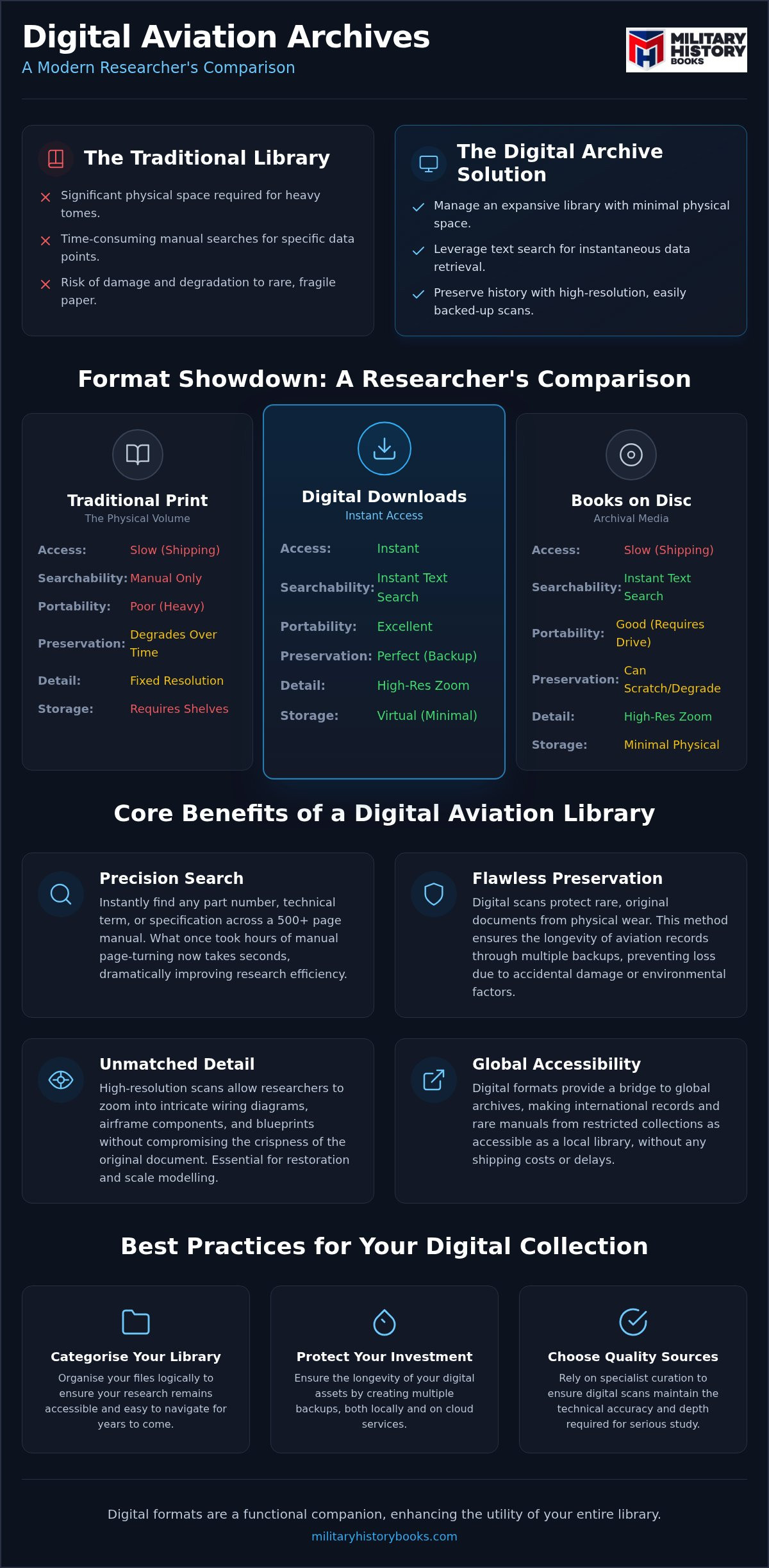
Digital aviation history books represent a sophisticated evolution in how we document and study flight. Beyond simple text files, this category encompasses high-resolution scans of technical manuals, pilot notes, and rare archival material that was previously inaccessible to the general public. For the dedicated military historian, the shift towards digital archives is amongst the most significant changes in the field. It provides a way to manage an expansive library without the logistical challenges of housing thousands of physical volumes. This format doesn't just offer convenience; it offers a reliable method for preserving the intricate technical details of aircraft that might otherwise be lost as paper degrades over time.
The Evolution of Military Aviation Literature
The transition from heavy paper archives to portable digital downloads has fundamentally changed the researcher's workflow. In the past, searching for a specific airframe modification or a squadron's operational record required hours of manual page-turning and careful handling of fragile bindings. Now, the increasing availability of primary source technical documents allows for instantaneous data retrieval. Many enthusiasts now favour digital access because it simplifies the process of cross-referencing multiple sources at once. When studying a comprehensive history of aviation, being able to compare blueprints from one era with performance logs from another on a single screen is invaluable for accuracy.
Preserving History Through Digital Formats
One of the greatest benefits of digital media is its ability to protect rare original documents from physical wear and tear. Aviation manuals from the mid-20th century were often printed on low-quality paper that becomes brittle and discoloured with age. By utilising digital formats, we ensure that the information remains intact whilst the physical artefacts are safely stored in climate-controlled environments. This approach ensures the longevity of aviation records through multiple digital backups, preventing the loss of history due to accidental damage or environmental factors. For researchers based in the UK, these digital titles provide a bridge to global archives, making international records as accessible as a local library. Ultimately, digital aviation history books don't seek to replace your physical collection; they act as a functional companion that enhances the utility of your entire library of military history books.
Formats and Technical Manuals: Exploring the Digital Inventory
Technical military publications often contain hundreds of pages of intricate diagrams, electrical schematics, and performance data. In a physical format, these manuals are frequently oversized, fragile, and difficult to handle without causing damage to the spine. Digital aviation history books solve this by providing high-resolution scans that allow researchers to zoom into specific wiring diagrams or airframe components without compromising the original document. This level of detail is essential for those involved in aircraft restoration or high-fidelity scale modelling, where every rivet and panel line must be historically accurate. It is often the only way to access rare aircraft manuals that are otherwise unavailable to the public or held amongst restricted museum archives.
Technical Aviation Manuals and Blueprints
Digital formats are the ideal medium for large-scale technical drawings. Unlike a folded paper blueprint that eventually tears at the seams, a digital file preserves the crispness of the original line work indefinitely whilst allowing for easy duplication. The utility of searchable PDFs cannot be overstated; being able to search for a specific part number or technical term across a 500-page manual saves hours of manual searching. For those looking for a broad overview before diving into the technicalities, resources like Flight: 100 Years of Aviation offer a foundational understanding of how these designs evolved over a century. These digital assets ensure that even the rarest Air Publications (APs) are now accessible for detailed historical study.
Digital Titles on Disc vs. Instant Downloads
When building a digital library, you must choose between the permanence of physical media and the speed of a network connection. Digital titles on disc offer long-term archival stability. They aren't reliant on a specific server remaining active and they feel like a tangible part of your collection. Conversely, an instant military books download provides immediate access for researchers working on a specific project. It's important to consider your hardware compatibility; many modern laptops lack internal disc drives, so you may need an external reader to access disc-based content. Both formats offer a space-saving solution that sits perfectly alongside your physical library. If you're ready to expand your archive with expert-curated material, you might consider browsing our range of digital aviation history books to find rare technical manuals.
Digital Downloads vs. Physical Books: A Researcher’s Comparison
Choosing between a physical volume and a digital file isn't a zero-sum game. Many collectors find that digital aviation history books serve as the engine room of their research whilst their physical library remains the gallery. A physical collection of 1,000 titles would require a dedicated room with reinforced flooring, yet the same archive in digital form fits comfortably on a tablet in your pocket. This portability is a game-changer for researchers visiting museums or airfields, allowing them to carry an entire reference library into the field without the burden of heavy military tomes.
Beyond space, there is a significant cost advantage to consider. Large, high-quality aviation books are notoriously heavy, often resulting in shipping costs that rival the price of the book itself. Digital titles eliminate these logistical expenses, providing better value for information-seekers who prioritise the data over the physical object. This shift allows you to reallocate your budget towards acquiring more titles rather than paying for the transit of heavy paper.
Searchability and Cross-Referencing
The ability to use "Ctrl+F" to instantly locate obscure pilot names, specific squadron codes, or minor unit details is perhaps the greatest advantage of the digital medium. Instead of scanning hundreds of index pages, you can pinpoint data across multiple volumes simultaneously. For those exploring official records, the U.S. Government Bookstore's Aviation History collection offers an excellent example of the type of detailed documentation that benefits from digital indexing. By utilising these search functions, researchers often find that digital searchability reduces research time by hours, allowing more focus on analysis rather than data retrieval.
Tactile Value vs. Information Density
There is an undeniable pleasure in the tactile experience of a rare first edition, and we always recommend buying a physical copy for your favourite aircraft legends or beautifully illustrated works. However, for the "heavy lifting" of extracting data from technical logs or operational record books, the digital format is far superior. Digital copies allow for high-resolution zooming and the ability to copy text for academic referencing without risking the integrity of a fragile binding.
Finding the right balance involves using your physical military history source books for inspiration and your digital aviation history books for the rigorous, detail-oriented work that defines modern historical scholarship. This hybrid approach ensures you enjoy the aesthetic beauty of your collection without sacrificing the analytical power required for deep historical investigation.
Organising and Preserving Your Digital Aviation Library
Acquiring a collection of digital aviation history books is only the first step; the true value lies in how you manage and protect that data for the long term. Unlike physical books that sit visibly on a shelf, digital files can easily become lost in a labyrinth of generic folders if not properly handled. A well-organised digital archive allows you to transition from a casual reader to a serious researcher who can recall specific technical data in seconds. Establishing a methodical system ensures that your investment remains a functional tool rather than a cluttered hard drive.
Preservation is equally vital. Digital files don't yellow or tear, but they are susceptible to hardware failure and software obsolescence. We recommend following the "Rule of Three" for your most important historical documents. This involves maintaining three separate copies of your library: the original on your primary device, a local backup on an external drive or disc, and a third copy in a secure cloud storage service. This redundancy protects your research against accidental deletion, device theft, or technical malfunctions.
File Management for Historians
Effective organisation starts with a logical folder hierarchy. Many researchers find success by categorising their files by aircraft type, specific conflict, or branch of service. For example, a folder dedicated to the RAF might be subdivided into "Fighter Command" and "Bomber Command," with further subfolders for specific airframes like the Spitfire or Lancaster. Standardising your file names is also essential for easy retrieval amongst thousands of documents. A format such as "[Year] [Aircraft] [Document Type]" makes your entire library searchable at a glance. You can further enhance your private database by using metadata tags, allowing you to filter your collection by pilot name, squadron number, or engine type without opening a single file.
Hardware and Software Recommendations
To get the most out of high-resolution technical scans, your hardware must be up to the task. Large-format tablets with high pixel density are the best choice for viewing intricate aviation diagrams and blueprints, as they allow you to zoom in on fine details without pixelation. For software, choose applications that support robust annotation and highlighting. This allows you to mark up technical manuals with your own research notes without altering the original file. Whilst cloud storage offers convenience, always keep a local physical backup to ensure your library remains accessible even without an internet connection. If you are looking to start or expand your collection, you can browse our digital titles to find expertly scanned manuals and rare historical texts.
Why Specialist Sources Define the Quality of Military Books Downloads
Not all digital files are created equal. When you source digital aviation history books from a generalist retailer, you often encounter low-resolution scans that obscure vital technical data. These generic e-books frequently suffer from poor formatting, missing appendices, or diagrams that become unreadable when enlarged. For a serious researcher, these flaws aren't just minor inconveniences; they represent a breakdown in historical accuracy. Specialist sources understand that a technical manual is only as good as its legibility. By choosing a specialist aviation bookshop, you ensure that every page is crisp, complete, and curated with an expert eye for detail.
Our inventory is managed by an RAF veteran who understands the historical weight of these documents. This subject-matter expertise ensures that our collection of over 10,000 titles meets the rigorous standards of both academics and enthusiasts. Whether you're looking for a rare out-of-print technical manual or a detailed squadron history, our oversight guarantees that the material is authentic and technically sound. This level of reliability is something general retailers simply cannot replicate; it's the difference between a simple file and a professional research tool.
Expert Curation in Aviation History
Knowledgeable curators select specific editions based on their technical depth and historical significance. A specialist retailer doesn't just list every available title; they actively source out-of-print rarities that provide the most value to the community. This careful selection process builds a foundation of trust. You aren't just buying a file; you're accessing a preserved record that has been vetted for its contribution to the field. This expertise is particularly vital when dealing with complex aircraft systems where every schematic must be precise and every performance table must be accurate.
Taking the Next Step in Your Research
Starting your collection with a military books download is a practical way to gain instant access to a wealth of information. You can begin your study within minutes, bypassing the wait for international post and the costs of shipping heavy volumes. However, we also recognise that many researchers value the physical supplements to their digital files. With over 10,000 titles in stock and secure international delivery, we can provide the rare physical tomes that sit beautifully on your shelf whilst your digital library does the analytical heavy lifting. You don't have to choose between speed and prestige; you can have both. Explore our extensive collection of digital and physical aviation history books to find the next addition to your archive.
Advancing Your Aviation Research
Integrating digital aviation history books into your library isn't just about saving shelf space; it's about unlocking the technical depth of your collection. We've explored how searchable formats and high-resolution scans transform the way you extract data from technical manuals and rare records. By choosing specialist sources, you ensure that every document is accurate and legible, providing a reliable foundation for your historical study. Whether you prefer the immediate access of a download or the archival stability of a disc, these tools complement your physical volumes perfectly.
Our business is managed by an RAF veteran with deep subject-matter expertise, ensuring that our inventory of over 10,000 specialist titles meets the highest standards. We provide secure international delivery for all orders, making rare aviation history accessible regardless of your location. It's time to elevate your research capabilities and preserve these vital stories for the future. Explore our archive today and find the technical details you've been searching for.
Browse our specialist collection of digital aviation history books and downloads and take the next step in building your comprehensive aviation library.
Frequently Asked Questions
What are the main advantages of digital aviation history books for researchers?
The primary advantages include instant searchability, portability, and space efficiency. Digital aviation history books allow you to use text search to find specific technical details across hundreds of pages in seconds. This format also eliminates the physical bulk of heavy military tomes, making it easier to carry your entire archive to museums or airfields. It's a cost-effective way to access rare data without the high shipping fees often associated with heavy physical books.
Can I download military history books directly to my tablet or smartphone?
Yes, you can download these titles directly to most modern mobile devices for immediate reading. Most digital files are provided in universal formats like PDF, which are compatible with standard e-reader apps on both iOS and Android platforms. This allows you to reference technical diagrams or squadron histories whilst on the move. We recommend using a device with a high-resolution screen to ensure that intricate blueprints and fine text remain sharp and legible during your research.
What is the difference between a digital download and a book on disc?
The main difference lies in delivery speed and archival preference. A digital download provides instant access to the material, which is ideal for researchers working under a deadline. Conversely, a book on disc offers a physical backup that doesn't rely on internet connectivity or server availability. Some collectors prefer discs as a tangible addition to their library, whilst others choose downloads to avoid wait times and domestic or international postage costs.
Are digital technical manuals high enough resolution for scale modelling?
High-quality digital technical manuals are scanned at resolutions specifically intended to preserve fine detail for restoration and scale modelling. These scans allow you to zoom in on specific components, such as cockpit instrumentation or landing gear assemblies, without significant pixelation. This level of clarity is often superior to older physical reprints where the printing process might have obscured small text. It's an essential resource for ensuring historical accuracy in your modelling projects.
How do I ensure my digital aviation library is backed up safely?
Safeguarding your digital aviation history books is best achieved through a redundancy strategy. Maintain your primary library on your main computer, keep a secondary copy on an external hard drive or disc, and use a secure cloud storage service for the third. This approach protects your investment against hardware failure, accidental deletion, or physical damage to your home. Regularly updating these backups ensures that your latest acquisitions are always protected from technical malfunctions.
Do digital aviation books include the same illustrations as physical editions?
Digital editions typically include all the original illustrations, photographs, and technical drawings found in the physical books. In many cases, the digital format actually improves the viewing experience because you can enlarge high-resolution images to see details that are difficult to discern on a printed page. This is particularly useful for studying camouflage patterns or identifying specific aircraft markings in historical photographs, as the digital zoom provides a much clearer perspective than a magnifying glass.
Is it possible to find rare or out-of-print aviation titles in digital format?
Digital formats have made it significantly easier to find and acquire rare or out-of-print aviation titles that are no longer available in shops. Many technical publications from the mid-20th century were produced in limited quantities and are now quite fragile. Digital preservation allows these scarce documents to be shared with the wider research community without risking the original artefacts. This ensures that vital historical data remains accessible to enthusiasts regardless of the physical book's rarity.
Why should I buy digital military books from a specialist rather than a general store?
Buying from a specialist ensures that you receive expertly curated material vetted for technical accuracy. General retailers often sell generic scans with missing pages, poor formatting, or low-resolution images that are useless for serious research. Our inventory is managed by an RAF veteran who understands the specific needs of aviation historians. This oversight guarantees that every title in our collection of over 10,000 books meets the high standards required for rigorous historical and technical study.


