

Could a single man's meticulous preparation and unwavering self-confidence really turn the tide of an entire global conflict? For many, Field Marshal Montgomery remains the defining figure of British military prowess, yet his legacy is often obscured by a fog of contradictory memoirs and generic summaries. You've probably felt the frustration of searching for specialist depth only to find superficial accounts that ignore the nuances of his professional character. It's a common struggle for serious researchers who want to move beyond the headlines and understand the actual mechanics of his command.
In this guide, we promise to clarify the reality behind his most debated decisions and help you understand why he earned the title Master of the Battlefield. We'll explore his revolutionary approach to soldier morale whilst providing a curated look at the essential literature, including rare and out-of-print biographies that offer a clearer perspective than modern reprints. By the end, you'll have a comprehensive view of Montgomery's life and the specific resources required to deepen your own historical research into his campaigns.
Key Takeaways
- Trace the evolution of his tactical approach from the trenches of the Great War to his eventual appointment as Field Marshal.
- Analyse the turning points of the Second World War, specifically focusing on how Montgomery secured victory at El Alamein and led the Eighth Army through Italy and Normandy.
- Discover the "Montgomery Method" which prioritised soldier morale and direct communication as the foundation for successful large-scale operations.
- Gain a balanced perspective on the interpersonal frictions between the Allied high command and the complex personality traits that defined his leadership style.
- Identify the most reliable military biography books and learn how to locate rare first editions for your personal archive or research project.
Field Marshal Bernard Montgomery: The Architect of Allied Land Warfare
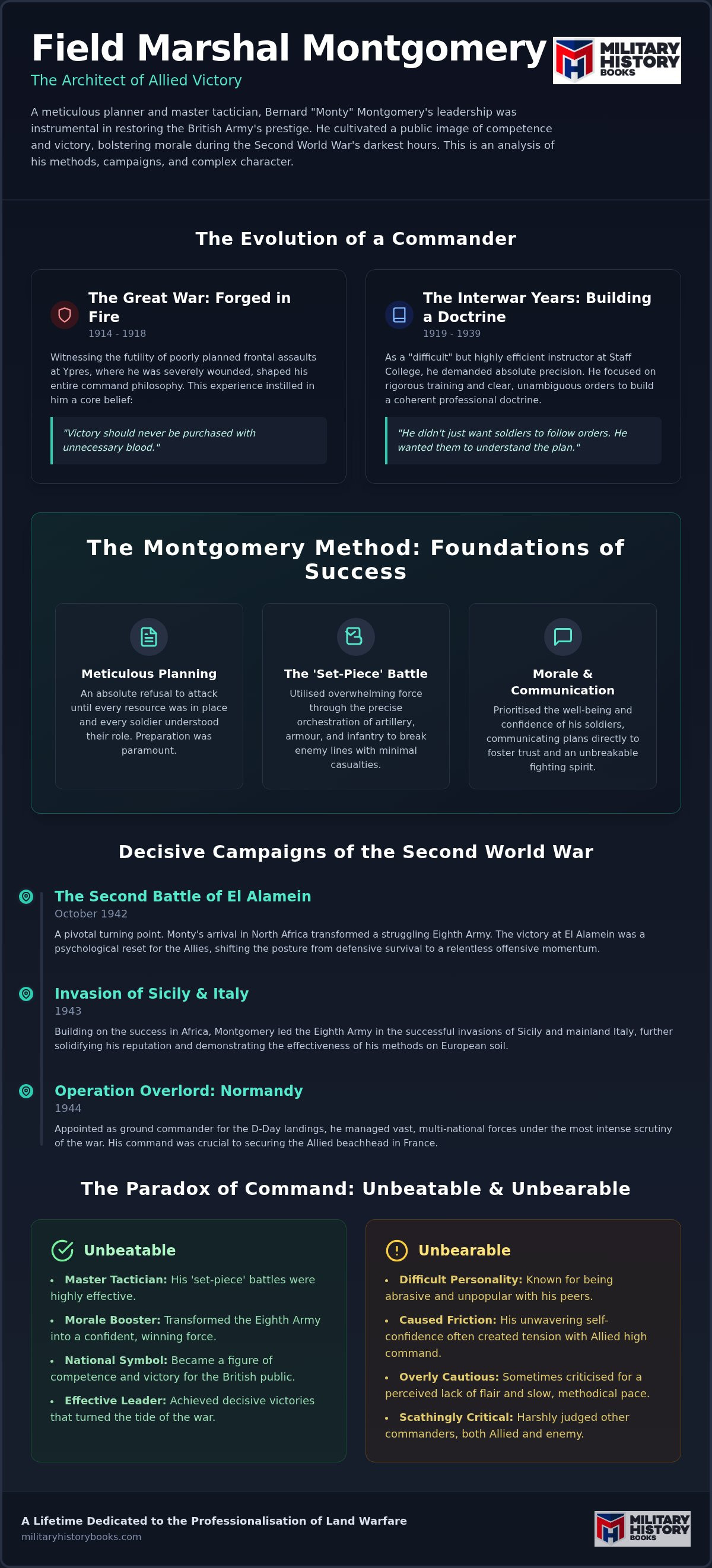
Within the annals of British military history, few names command as much immediate recognition as Field Marshal Bernard Montgomery. Often referred to simply as "Monty", he emerged as the most prominent British field commander of the Second World War, a leader whose influence extended far beyond the tactical map. He was instrumental in restoring the prestige of the British Army after the harrowing setbacks of the early 1940s. By carefully cultivating his public image, he transformed himself into a national symbol of competence and victory, effectively using the "Monty" brand to bolster civilian and military morale during the darkest hours of the conflict. His rise from a meticulous staff officer in the Great War to the rank of Field Marshal represents a lifetime dedicated to the professionalisation of land warfare.
Early Career and the Lessons of the Great War
His journey began in the Royal Warwickshire Regiment, where he served with distinction during the First World War. The horrific casualty rates seen between 1914 and 1918 didn't just scar a generation; they fundamentally shaped Montgomery's future command philosophy. He witnessed first-hand the futility of poorly planned frontal assaults, particularly during the brutal fighting at Ypres where he was nearly killed. This experience led him to be scathingly critical of so-called "good fighting generals" who seemed to disregard the preservation of human life in favour of aggressive, uncoordinated action. He became convinced that victory should never be purchased with unnecessary blood, a belief that would later define his meticulous approach to preparation and his refusal to attack until every resource was in place.
The Interwar Years: Developing a Professional Doctrine
During the interwar period, he refined his craft at the Staff College, Camberley. He gained a reputation for being an exceptionally efficient, albeit "difficult", instructor who demanded absolute precision from his students. He focused heavily on the necessity of rigorous training and the development of a coherent professional doctrine that could be applied across the entire army. He understood that a commander's intent must be communicated through clear, unambiguous orders to avoid the confusion he'd seen in the trenches. His early publications and lectures during this time laid the groundwork for the modern study of military history, emphasising that a well-prepared army is an unbeatable one. He didn't just want soldiers to follow orders. He wanted them to understand the plan.
It's a trajectory that requires a deep dive into the specific military biographies and land warfare books that document his early writings. These texts reveal a man who was often unpopular with his peers but undeniably effective in his results. For the serious researcher, these interwar years provide the essential context for his later triumphs in the desert.
From El Alamein to Normandy: Monty’s Decisive Campaigns
The transition from theoretical doctrine to active command reached its zenith in the Western Desert. When he arrived in North Africa in August 1942, the Eighth Army was a force struggling with a crisis of identity and confidence. The subsequent Second Battle of El Alamein in October 1942 wasn't just a tactical victory; it was a psychological reset for the entire British military establishment. By halting the German advance and forcing a retreat, he shifted the Allied posture from defensive survival to a relentless offensive momentum. This success followed him through the invasion of Sicily and the Italian campaign, eventually leading to his appointment as the ground commander for Operation Overlord. His oversight of Montgomery's command in Normandy demonstrated his ability to manage vast, multi-national forces under the most intense scrutiny of the war.
The Master of the Set-Piece Battle
A "set-piece" battle was the hallmark of his strategic approach. He didn't rely on flair or sudden intuition; instead, he utilised meticulous planning and the application of overwhelming force. This method involved the precise orchestration of artillery, armour, and infantry to break through hardened German lines. He believed in suppressing the enemy with a massive weight of shells before risking a single soldier in the advance. Technical military publications from the era detail how these tactical evolutions became the standard for British land operations. If you're interested in the specific mechanics of these engagements, you might enjoy exploring our collection of land warfare books which cover these desert and European campaigns in forensic detail.
Operation Market Garden: Ambition and Controversy
Whilst his record was largely defined by success, Operation Market Garden in September 1944 remains a point of intense historical debate. The ambitious airborne assault on the Netherlands aimed to seize a series of bridges and end the war by Christmas. However, a combination of logistical bottlenecks and intelligence failures regarding German strength at Arnhem led to a costly setback. It's a campaign that highlights the limits of even the most detailed planning when faced with the "fog of war". This period of Montgomery's career is essential for anyone wishing to understand the complexities of high command. The failure at Arnhem didn't diminish his status, but it added a layer of necessary scrutiny to his legacy that continues to fascinate researchers today.
The Montgomery Method: Morale, Training, and Preparation
At the core of his success lay a fundamental belief: "the soldier is the most important factor in war." Whilst other commanders focused primarily on the movement of divisions or the technical specifications of tanks, he centred his efforts on the psychological state of his men. He understood that a well-fed, well-informed, and confident soldier would perform far beyond the expectations of a demoralised one. This wasn't mere sentimentality. It was a cold, calculated military necessity. He insisted on a concept he called "balance," ensuring that his forces were always positioned so that an enemy counter-stroke could not disrupt his overall plan. This stability allowed his troops to maintain their focus on the objective, even under intense pressure.
To achieve this, he organised rigorous "battle schools" across the UK, where training was designed to be as realistic and physically demanding as possible. He wanted his troops to be hardened to the sights and sounds of the modern battlefield before they ever stepped foot in France or Italy. This preparation ensured that the British Army was not just a collection of recruits, but a professional force capable of sustained offensive action. His insistence on direct communication meant that he would often address thousands of troops at once, standing on the bonnet of a jeep to explain exactly what was expected of them. By sharing the plan, he gave every man a stake in the victory.
Revolutionising Military Communication
He broke away from the distant, formal style of the previous generation of commanders by adopting a more accessible persona. His choice of the famous black beret, often adorned with two badges, served as a powerful visual signal of his connection to the common soldier. He didn't hide in a remote château; instead, he operated from a mobile "Caravan" headquarters, staying close to the front lines. He utilised a team of young, energetic liaison officers to bypass traditional bureaucratic delays, ensuring he had an accurate, real-time understanding of the battlefield. This approach fostered a sense of rapport and trust that was rare amongst high-ranking officers of the era.
The Importance of Meticulous Logistics
His background as a staff officer informed a logistical genius that few could match. He famously refused to launch a major offensive until he was satisfied that he held at least a 2-to-1 advantage in supplies, fuel, and ammunition. This cautiousness often frustrated his superiors and American allies, yet it guaranteed that once the Eighth Army started moving, it didn't stop due to a lack of resources. For those interested in the intricate details of how these massive operations were sustained, we recommend consulting wartime history books UK for a deeper logistical study. Understanding these supply chains is vital to grasping how Montgomery managed to maintain the momentum of the Allied advance across Europe.
Unbeatable and Unbearable: Navigating the Controversies of Command
Montgomery's tactical brilliance was often overshadowed by a personality that many found abrasive. His relationships with American counterparts, particularly Dwight D. Eisenhower and George S. Patton, were frequently strained by his perceived arrogance. This wasn't just a matter of social etiquette; it had real consequences for the Allied high command structure. A prime example occurred during the Battle of the Bulge in late 1944. After being given command of American forces on the northern flank, he held a press conference that many interpreted as him single-handedly saving the US Army. The resulting outrage nearly led to his dismissal, requiring a humble apology to Eisenhower to salvage his position. It highlighted a fundamental flaw: he was often his own worst enemy regarding international diplomacy.
The Anglo-American Rivalry
Beneath the personal clashes lay a genuine strategic divide that defined the final year of the war. Montgomery advocated for a "single thrust" into northern Germany, arguing that a concentrated, powerful blow would end the conflict more rapidly. In contrast, Eisenhower favoured a "broad front" approach to keep the entire German army engaged and avoid the risk of overextending Allied supply lines. These debates were often masked by his lack of diplomatic tact, which made even sound military arguments seem like personal attacks on his superiors. To truly understand the friction between these leaders, it's helpful to consult military biography books that explore these complex dynamics through the eyes of those who served in the high command.
Legacy and Historical Re-evaluation
Since the 1950s, historians have shifted from a purely celebratory view to a more balanced re-evaluation of his career. His own memoirs, whilst providing invaluable insight, are often seen as an attempt to settle old scores and secure his place in military history. This makes it vital for serious researchers to cross-reference his personal accounts with official technical military publications to find the objective truth. His legacy remains a paradox: he was a commander who saved countless lives through meticulous planning, yet he frequently alienated the very people he needed to work with most. If you want to clarify the reality behind these controversies, you can find rare and out-of-print military biographies in our extensive collection that offer the specialist depth required for such a task.
Sourcing Montgomery: A Specialist’s Guide to Military History Books
Building a definitive library on Field Marshal Montgomery requires more than just picking up the latest paperback from a high street shop. For the serious researcher, the focus must shift towards primary sources and authoritative biographies that offer a level of detail often missing from generic histories. A well-curated collection allows you to trace the development of his tactical thought and the reality of his command decisions through the eyes of those who witnessed them. Identifying rare first editions, particularly of his personal memoirs, adds a tangible connection to the history whilst ensuring your archive holds long-term value for future study. It's about finding the specific accounts that clarify his reputation as a Master of the Battlefield.
Essential Titles for the Montgomery Collector
Nigel Hamilton’s definitive three-volume biography stands as the undisputed cornerstone of any collection. Covering his early life, his rise to fame, and his post-war career, these volumes provide a forensic level of detail that remains unmatched in modern scholarship. Equally vital is "The Memoirs of Field-Marshal Montgomery," first published in 1958. When sourcing this title, collectors should look for the original Collins editions, paying close attention to the condition of the dust jacket and the presence of original maps. These first-hand accounts are indispensable, yet they are often best understood when cross-referenced with out of print military books that provide a more objective view of the campaigns. Sourcing these rare titles requires patience and a specialist's eye, but the reward is a deeper, more authentic insight into the period.
Researching Beyond the Biography
A truly comprehensive library extends beyond individual life stories. To understand the mechanics of his victories, one must also examine the technical and unit-level details of his operations. This is where back issue military magazines UK become invaluable. These publications often feature contemporary interviews, detailed battle maps, and soldier-level perspectives that broader biographies might overlook. Technical manuals for the tanks and artillery pieces used by the Eighth Army provide the necessary context for his "set-piece" tactics. By combining these varied sources, you can build a multi-dimensional view of Montgomery's legacy. We invite you to browse our full collection of Land Warfare Books to find the specific titles and rare editions needed to complete your research archive.
Advancing Your Research into Britain’s Most Famous Commander
Field Marshal Montgomery left behind a legacy that's as complex as it's significant. The transition from the trenches of the Great War to the triumph of the Eighth Army reveals a commander who prioritised the lives of his men through meticulous preparation. Whilst his personality often sparked friction amongst the Allied high command, his professional dedication to training and logistics remains a model for military excellence. Understanding the man behind the beret requires looking past generic accounts and engaging with the specialist literature that preserves the technical details of his campaigns.
Whether you're a serious researcher or a dedicated collector, finding the right resources is essential for a clearer perspective. At Military History Books, we're managed by an RAF veteran with deep historical expertise and hold over 10,000 specialist titles in stock. From rare first editions to out-of-print biographies, we provide secure international delivery for collectors worldwide. We invite you to explore our vast collection of rare and out-of-print Land Warfare Books at Military History Books. Your journey into the finer details of military history is just beginning.
Frequently Asked Questions
Who was Field Marshal Bernard Montgomery?
Field Marshal Bernard Montgomery was the most prominent British field commander of the Second World War, famously leading the Eighth Army to victory. Often known by his nickname, "Monty," he became a national hero whose leadership restored the prestige of the British Army. His long career began in the trenches of the Great War and culminated in his role as Deputy Supreme Allied Commander Europe. He remains a central figure in any serious study of 20th-century land warfare.
What was Montgomery’s most famous victory?
His most celebrated triumph was the Second Battle of El Alamein in 1942, which turned the tide of the North African campaign. By halting the advance of the Afrika Korps, he provided the British people with a much-needed success after years of setbacks. This engagement demonstrated his signature style of meticulous preparation and overwhelming force. It wasn't just a tactical win; it was a psychological breakthrough that proved the German army could be defeated in open battle.
Why was Montgomery considered a controversial figure?
He was often seen as controversial due to his supreme self-confidence and a perceived lack of diplomatic tact when dealing with allies. His strained relationships with American generals like Eisenhower and Patton were well-documented, often stemming from his habit of claiming personal credit for joint successes. Whilst his soldiers admired his focus on their welfare, his peers frequently found his ego unbearable. This friction within the high command remains a major point of discussion in modern historical analysis.
What was the "Montgomery Method" of leadership?
The "Montgomery Method" was a leadership philosophy that prioritised meticulous planning, logistical superiority, and the psychological state of the troops. He famously stated that the soldier is the most important factor in war, and he worked tirelessly to build rapport with his men. By refusing to launch an offensive until every resource was in place, he ensured his operations had the highest possible chance of success whilst keeping casualty rates as low as possible.
Did Montgomery and George S. Patton get along?
The relationship between these two famous commanders was notoriously difficult and marked by a fierce professional rivalry. They represented two different schools of thought: Patton’s aggressive, high-speed armour thrusts versus the calculated, set-piece approach favoured by Montgomery. Their competition for supplies and the "race" to capture key objectives, such as Messina in Sicily, highlighted the deep-seated tensions that existed between the British and American components of the Allied high command.
Where can I find rare books about Montgomery’s campaigns?
Serious researchers can find rare and out-of-print titles through specialist retailers like Military History Books. We maintain a collection of over 10,000 titles, including scarce first editions of campaign histories and tactical manuals. We're managed by an RAF veteran, ensuring that we offer the specialist depth required for academic study. We provide international delivery, making it easier for collectors worldwide to source the specific literature needed to understand his complex military legacy.
What did Montgomery do after the Second World War?
Following the cessation of hostilities in 1945, he was appointed Chief of the Imperial General Staff, the professional head of the British Army. He later transitioned into a key international role as the Deputy Supreme Allied Commander Europe for NATO, serving from 1951 until his retirement in 1958. Even in his later years, he remained a vocal and sometimes provocative commentator on global affairs, ensuring that his influence on military thought continued long after his active service.
Is Montgomery’s autobiography still worth reading for historians?
His 1958 autobiography is an indispensable primary source for historians, though it's best read with a critical eye. It offers a unique window into his strategic reasoning and his personal perspective on the war's most pivotal moments. Whilst he used the text to settle old scores and polish his reputation, the detail regarding his command philosophy is invaluable. For a truly objective view, researchers should cross-reference his memoirs with technical manuals and modern biography books.


