

A private military library is a tactical asset, requiring strategic curation of primary sources, technical data, and rare narratives. If you've ever felt overwhelmed by the sheer volume of literature available, you aren't alone. Many enthusiasts find that searching for military history books for beginners quickly leads to a cluttered shelf rather than a cohesive archive. You want a collection that reflects your specific interests, whether that's land warfare or aviation history, whilst avoiding the frustration of missing out on rare titles or watching expensive hardbacks deteriorate due to poor storage.
We understand the weight of these stories and the importance of preserving them correctly. This guide provides a comprehensive roadmap for 2026 to help you curate, source, and protect a world-class collection. We'll explore expert methods for tracking down out-of-print gems, the benefits of digital downloads for space-saving, and a methodical system for organising your personal archive. By the end, you'll have the confidence to build a library that serves as both a professional resource and a dedicated tribute to history.
Key Takeaways
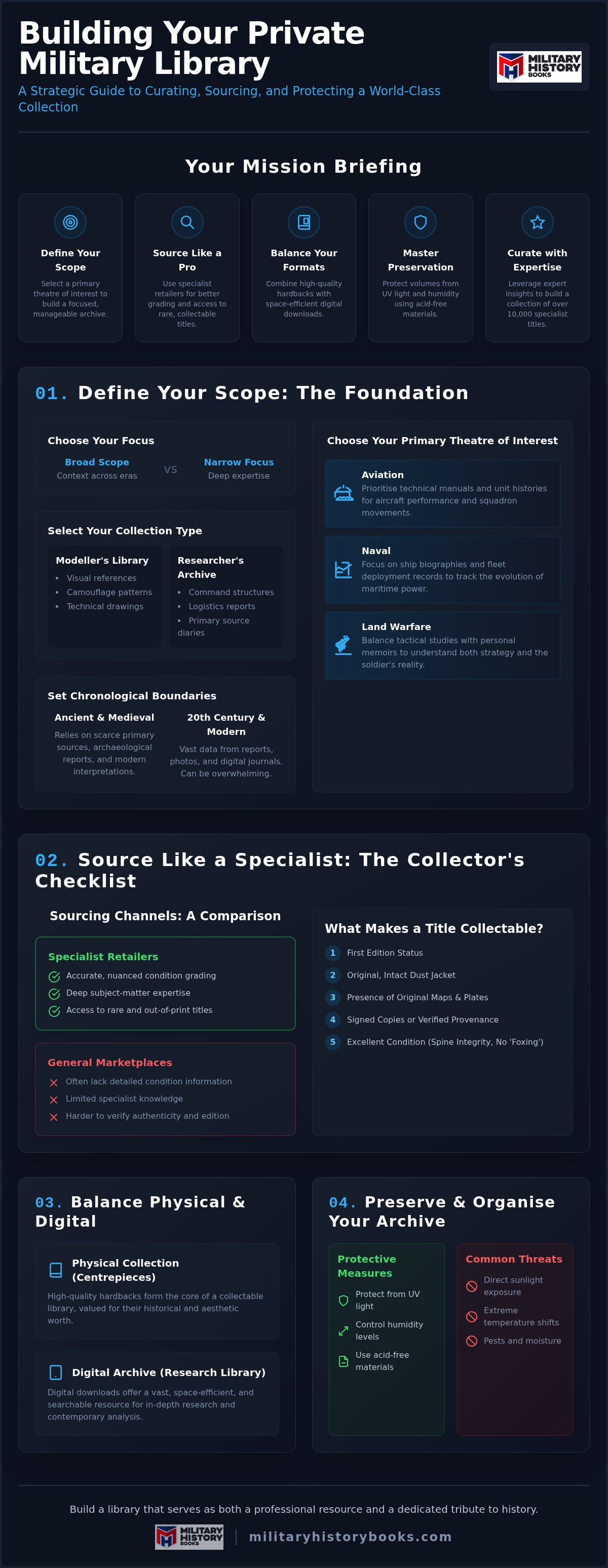
- Learn how to define your collection's scope by selecting a primary theatre of interest, such as aviation or naval warfare, to build a focused and manageable archive.
- Discover why sourcing military history books for beginners from specialist retailers ensures better condition grading and access to rare, collectable titles.
- Understand the strategic balance between high-quality hardback centrepieces and digital downloads for building a vast, space-efficient research library.
- Master the essentials of preservation, including how to protect your volumes from UV light and humidity whilst using acid-free materials for organisation.
- Gain insights on curating a world-class collection of over 10,000 specialist titles by leveraging the expertise of an RAF veteran curator.
Defining Your Scope: The Foundation of a Specialist Collection
A professional military library isn't merely a shelf of paperbacks; it's a structured repository of human experience, technical specifications, and primary accounts. When you begin searching for military history books for beginners, the first step is to recognise that your collection will likely include a mix of narrative literature, technical manuals, and unit histories. This military history overview illustrates the vastness of the field, which is why defining your scope early prevents your archive from becoming unmanageable.
You must decide between a broad chronological sweep or a narrow focus on a specific campaign. A broad collection provides context across eras, whilst a narrow focus allows for deep expertise in a single subject, such as the Battle of Britain or the Falklands Conflict. It's also helpful to distinguish between a 'Modeller’s Library' and a 'Researcher’s Archive'. Modellers typically require visual references, camouflage patterns, and technical drawings to ensure accuracy in their hobby. Researchers, however, look for command structures, logistics reports, and primary source diaries that explain the strategic decisions behind the front lines.
Choosing Your Branch: Aviation, Naval, or Land Warfare
Your primary 'Theatre of Interest' will dictate the types of volumes you seek. Aviation enthusiasts should prioritise technical manuals and specific unit histories, as these provide the granular detail needed to understand aircraft performance and squadron movements. Naval history relies heavily on ship biographies and fleet deployment records to track the evolution of maritime power. For those interested in land warfare, the best approach is often balancing tactical studies with personal memoirs to understand both the strategic map and the soldier's reality. This ensures your collection remains balanced and informative.
Setting Your Chronological Boundaries
Ancient and medieval warfare present a unique challenge for the collector. Reliable primary sources are often scarce, meaning you'll rely more on archaeological reports and modern interpretations. In contrast, the 20th century offers an explosion of available data. From 1914 onwards, the sheer volume of after-action reports, aerial photography, and personal correspondence can be overwhelming. If your interest lies in modern conflict, contemporary journals and digital titles are vital for capturing history as it unfolds. These sources provide immediate insights that traditional books might take years to document, keeping your archive relevant and accurate.
Sourcing Specialist Literature: The Collector’s Checklist
Building a library requires more than just a casual search on a global marketplace. Whilst generalist sites offer convenience, they often lack the nuanced condition grading and subject-matter expertise required for serious archiving. Sourcing military history books for beginners through specialist retailers ensures that you're receiving accurately described volumes. A dedicated curator knows the difference between a standard reprint and a scarce first edition, providing a level of reliability that general marketplaces simply cannot match.
Identifying what makes a title collectable is a skill that develops over time. It isn't just about the age of the book; it's about the edition, the presence of original maps, and the condition of the dust jacket. Signed memoirs or volumes with a verified provenance add significant value and historical weight to your collection. For those seeking the highest level of accuracy, technical publications and official manuals are indispensable. These documents provide the raw data used by historians, and referencing materials similar to those found in the National Archives military records allows you to build a library based on primary evidence rather than secondary interpretation.
Finding Rare and Out-of-Print Titles
First editions are the gold standard for many collectors, particularly those focusing on 20th-century conflicts. When assessing a vintage book, look for spine integrity and the absence of 'foxing' (brown age spots on pages). Specialist bookshops are vital for finding these scarce titles, as they often maintain networks to track down specific unit histories or out-of-print memoirs that never see a digital release. Use this checklist when inspecting potential additions:
- Check if the dust jacket is original and unclipped.
- Ensure all fold-out maps and plates are present and intact.
- Verify the binding is tight; heavy volumes are prone to 'cocking' if stored poorly.
- Look for library stamps or previous owner inscriptions which may affect the value.
Beyond the Book: Magazines and Technical Manuals
Monographs provide the narrative, but magazines and manuals provide the detail. Many military aviation history publications are essential for technical researchers because they contain contemporary diagrams and pilot notes not found elsewhere. Back-issue magazines are equally valuable for filling gaps in unit-level history. Modelling publications, for instance, often serve as the best visual references for historical equipment, providing colour profiles and stowage diagrams that are vital for both hobbyists and historians. If you are struggling to find a specific technical detail, it's worth browsing a specialist inventory of rare titles to find those elusive primary sources.
Physical vs Digital: Balancing Space and Accessibility
Choosing the right format is a strategic decision for any collector. Whilst many seek out military history books for beginners in physical form to enjoy the tactile experience, modern technology offers unparalleled advantages for research. A hybrid archive often serves as the most effective solution for the serious enthusiast, allowing you to enjoy the prestige of a physical library without sacrificing the utility of a digital database.
Hardback editions form the centrepiece of any world-class library. They hold an inherent investment value, particularly when they are rare or out-of-print titles. For those building a reference shelf of core wartime history books UK, the physical format is often preferred for tactical study. Fold-out maps and complex technical diagrams are frequently easier to examine in print than on a screen; they allow you to trace troop movements across a physical page without the limitations of a digital interface. There is also a sense of reliability in a physical book that requires no battery and will never suffer from a corrupted file.
The Advantages of Digital Archives
Digital archives solve the problem of physical space. You can house a library of over 1,000 titles on a single tablet, making your entire research archive portable. Digital military history books also offer superior searchability. Instead of flicking through a printed index, you can search for specific keywords within technical publications or unit histories instantly. Many rare documents have been digitised for preservation, providing access to content that is otherwise too fragile or expensive to handle. Consulting resources like the Chief of Staff of the Army's suggested reading list can help you identify which core texts are worth acquiring in digital format for quick reference.
Longevity and the Hybrid Model
When choosing digital, consider the medium. Titles on disc provide a physical backup that isn't reliant on cloud servers, whilst direct downloads offer immediate accessibility. A tactical collector often uses a hybrid model: keep your favourite memoirs and rare editions on the shelf, but use digital versions for technical data, back-issue magazines, and technical manuals. This approach ensures your library remains both a beautiful display and a functional research tool. It's a method that respects the history of the book whilst embracing the efficiency of the modern age, ensuring your collection is as practical as it is impressive.
Preservation and Organisation: Protecting Your Archive
Acquiring a significant volume is only half the battle; the true challenge lies in the long-term preservation of your archive. For those just starting with military history books for beginners, environmental factors are the primary threat to a collection's longevity. Paper, leather, and cloth are organic materials that react to their surroundings. In the United Kingdom, humidity is a constant concern, as it can lead to foxing or, in extreme cases, mould that spreads amongst adjacent volumes. You should aim for a stable environment away from direct sunlight, which causes irreversible UV damage to dust jackets and spines.
Proper shelving is equally vital. Heavy technical manuals and large-format aviation books require sturdy support to prevent the binding from 'cocking' or pulling away from the text block. Use bookends to keep volumes upright and avoid packing them too tightly, which can cause friction damage when a book is removed. For those with extensive collections of back-issue magazines or modelling publications, acid-free backing boards and sleeves are essential to prevent the high-acid paper from yellowing and becoming brittle over time. To ensure your library is stocked with titles in the best possible condition, you can browse our curated inventory of specialist military literature.
Conservation Basics for the Home Library
Handling rare books requires a deliberate approach. Always ensure your hands are clean and dry to prevent the transfer of natural oils, which can leave permanent marks on delicate pages. If you own modern first editions, investing in clear, acid-free dust jacket protectors is one of the most cost-effective ways to maintain the book's value. When cleaning second-hand finds, a soft-bristled brush is usually sufficient to remove dust without stripping away the historical patina that gives a volume its character. Avoid using chemical cleaners on leather or cloth bindings unless you're a trained conservator.
Cataloguing and Classification Systems
A logical classification system makes your archive functional. The 'Conflict-First' method is popular amongst researchers, as it groups all materials related to a specific war, such as the Napoleonic Wars or the Great War, in one place. Alternatively, a chronological arrangement allows you to observe the evolution of warfare through the centuries. If your interests are technically focused, keeping aviation, naval, and land warfare sections distinct ensures you can find specific data quickly. Tracking your inventory using a simple spreadsheet or dedicated cataloguing software helps prevent duplicate purchases and provides a record for insurance purposes.
Curating Your Library with Military History Books
Building a world-class archive requires a partner who understands the historical weight of the material. When you choose to buy military history books from a specialist, you're benefiting from a curated selection that general retailers simply cannot match. Managed by an RAF veteran with deep subject expertise, our inventory of over 10,000 specialist titles covers everything from technical aviation manuals to comprehensive naval battle reports. This level of professional curation ensures that even military history books for beginners meet the high standards of accuracy and condition required by serious collectors.
For those pursuing rare and out-of-print titles, secure international delivery is a vital service. High-value acquisitions require careful handling and robust packaging to arrive in the same condition they left the shelf. Whilst physical books are the heart of any library, you can also use digital downloads to supplement your archive instantly. This is particularly useful for accessing technical data or back-issue magazines that might otherwise be difficult to source in print. By combining these formats, you create a robust research tool that is both prestigious and practical.
Specialist Support for Researchers
Our focus on aviation, naval, and land warfare allows us to identify and stock the technical manuals that general bookshops often overlook. A specialist understands that a researcher needs more than just a broad overview; they need the specific unit histories and technical specifications that define an era. This expertise acts as a bridge between the past and the modern enthusiast, providing a level of service that respects the intelligence of the reader. Whether you're looking for a specific squadron record or a rare technical drawing, having a trusted guide makes the search far more efficient.
Starting Your Collection Today
If you're just beginning, we recommend starting with a core list of narrative histories and primary accounts to establish a solid foundation. Signing up for updates on newly acquired rare titles is an excellent way to ensure you don't miss out on scarce additions to your theatre of interest. Whilst facts and technical data are the priority, including military fiction titles in your library can provide valuable historical context and a sense of the human experience amongst the technical details. Start your journey by exploring a collection that values preservation and the sharing of history as much as you do.
Building Your Legacy: The Next Steps for Your Archive
Curating a private library is a journey of discovery that transforms a simple interest into a lasting research asset. By defining a clear theatre of interest and adopting professional preservation techniques, you ensure that your archive remains valuable for years to come. Whether you prefer the tactile prestige of rare first editions or the searchability of digital downloads, the key is to build a collection that reflects your passion whilst remaining organised and protected. Finding high-quality military history books for beginners is much easier when you have access to a specialist source that understands the nuances of technical accuracy and condition grading.
Expertly curated by an RAF veteran with deep subject expertise, our inventory offers an extensive range of aviation, naval, and land warfare literature. With over 10,000 titles available and secure global delivery for rare acquisitions, we're here to help you source the elusive gems your collection deserves. Browse our collection of over 10, 000 military history titles to find your next addition today. Every great library starts with a single volume; we look forward to helping you write the next chapter of your collecting journey.
Frequently Asked Questions
How do I know if a military history book is a rare first edition?
Identifying a first edition involves checking the copyright page for a "first edition" statement or a number line that ends in "1". For older volumes, you should cross-reference the publication date with known bibliography records to ensure no earlier reprints exist. The presence of an original, unclipped dust jacket and the absence of later printing dates are also strong indicators that you have found a scarce original copy.
What are the best shelves for a heavy military history book collection?
Solid wood or reinforced steel shelving is essential to prevent bowing under the significant weight of large format volumes and technical manuals. You should avoid thin MDF boards; instead, look for units with a high weight capacity, ideally supporting at least 25kg per shelf. Ensuring your shelving is deep enough to provide full support for the base of heavy books prevents the binding from pulling away over time.
Should I buy hardback or paperback for my library?
Hardbacks are the preferred choice for a centrepiece library due to their durability and long-term investment value. Whilst paperbacks are excellent for casual reading copies, hardback editions better withstand the rigours of frequent reference. For those just starting with military history books for beginners, prioritising hardbacks for core reference texts ensures your archive remains in good condition for decades, even with regular use during research.
Are digital military history books as good as physical ones for research?
Digital titles offer superior searchability and space-saving benefits, allowing you to carry a massive archive of technical data on a single device. They are particularly useful for keyword searching within dense unit histories or technical manuals. However, physical books remain superior for studying complex tactical maps and diagrams. A hybrid collection, combining physical prestige with digital utility, provides the most effective setup for serious historical research.
How can I find out-of-print military books that are not on general marketplaces?
Specialist retailers are the most reliable source for out-of-print titles that general marketplaces often overlook. These curators maintain deep networks to track down scarce unit histories, technical publications, and signed memoirs. Unlike generalist sites, a specialist understands the specific terminology and historical context of the inventory. This expertise ensures you receive an accurately described volume that meets the specific requirements of your research or collection.
How do I organise a library that covers multiple branches of service?
Organising by branch of service, such as Aviation, Naval, or Land Warfare, is often the most logical method for a diverse archive. This system allows you to keep technical manuals and branch-specific journals together for easy reference. You might also consider a secondary chronological layer within each section. This approach helps you track the evolution of warfare across different eras whilst keeping your specialist literature distinct and accessible.
Is it worth collecting back-issue military magazines?
Back-issue magazines are highly valuable for filling the gaps left by traditional monographs, offering unit-level detail and visual references. They are essential for modellers and technical researchers who require contemporary diagrams or camouflage profiles. Many military history books for beginners provide a broad overview, but magazines offer the granular, month-by-month accounts of conflicts that are often missing from larger volumes. They remain a vital primary source for any serious archive.
How do I protect my books from fading in a sunny room?
Protecting your collection from UV damage is vital for preserving the colour and integrity of dust jackets and spines. You can apply UV-filtering film to your windows or use closed cabinets with solid doors to block out direct light entirely. For books on open shelves, acid-free dust jacket protectors provide an additional layer of protection. These simple measures prevent the irreversible fading that can significantly reduce the historical and financial value of your library.


