

Most historical accounts of the 1982 Falklands conflict barely scratch the surface of the logistical and technical reality faced by the Task Force as it sailed eight thousand miles into the South Atlantic. You've likely found that while general overviews provide the essential dates and names, they often lack the granular detail that serious researchers and enthusiasts crave. It's frustrating when you're searching for the specific technical specifications of a Type 42 destroyer or the raw, unvarnished perspective found only in a rare, out-of-print veteran's memoir.
This guide changes that by offering a definitive history of the conflict through the curated lens of specialist military literature, technical manuals, and personal accounts. We'll explore the strategic nuances of the campaign and identify the essential titles needed to build a comprehensive specialist library. You'll also learn about the technical complexities of the Task Force, moving beyond the headlines to understand the true mechanics of this unique maritime and land campaign. Whether you're a dedicated researcher or a casual reader, we're here to help you navigate this complex history with the expertise of a seasoned curator.
Key Takeaways
- Understand the complex sovereignty dispute and the strategic realities of the 74-day undeclared war in the South Atlantic.
- Analyse the technical triumphs and tragedies of the Falklands conflict, from the revolutionary impact of the Sea Harrier to the vulnerabilities of modern naval vessels.
- Explore the infantry tactics employed during the gruelling 'yomp' and the fierce battles for the high ground surrounding Port Stanley.
- Learn how to identify and source essential technical publications and modelling magazines to build a comprehensive specialist library.
- Discover how to access rare, out-of-print memoirs and digital technical manuals that provide a deeper level of historical detail than generic accounts.
Understanding the Falklands Conflict: A Strategic Overview
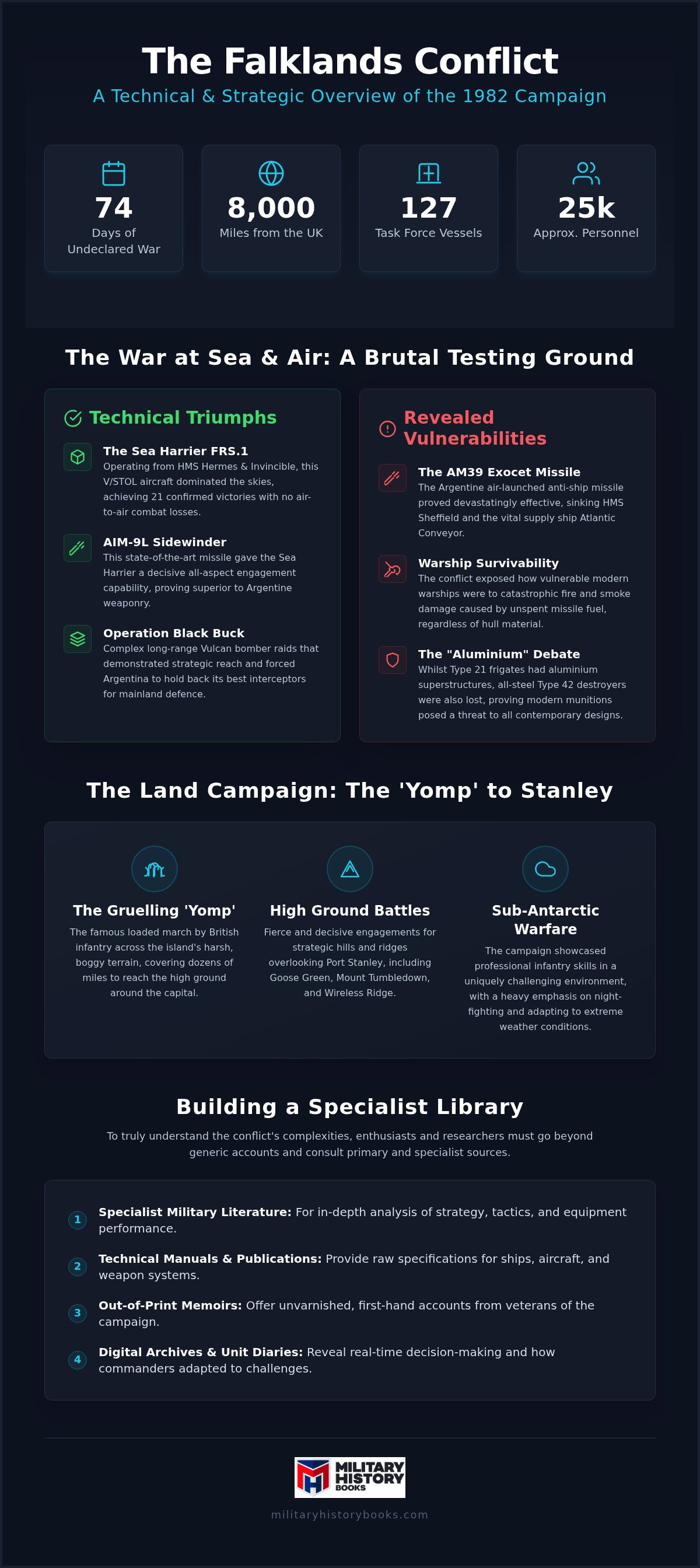
The 1982 Falklands conflict remains one of the most distinctive military campaigns of the twentieth century. It was a 74-day undeclared war fought in the challenging environment of the South Atlantic, where the core tension lay between long-standing British sovereignty and Argentine claims to the Islas Malvinas. For the United Kingdom, the deployment of Task Force 317 was a logistical miracle; it required moving a massive naval and land force over 8,000 miles from home ports to a sub-Antarctic theatre. Whilst general summaries often focus on the political drama, a deeper understanding of this campaign requires a look through the lens of specialist literature. This is where wartime history books UK researchers value become indispensable, providing the technical depth that generalist titles often lack.
The Origins of Operation Corporate
The conflict began in earnest with the Argentine invasion on 2 April 1982. This move caught the international community by surprise, though tensions had been simmering for decades. In London, the Thatcher government faced immense pressure to respond, whilst in Buenos Aires, the military junta sought to bolster domestic support through nationalistic fervour. Early naval planning was remarkably swift; within days, the first vessels of the Task Force were heading south. Operation Corporate, which officially commenced on 2 April 1982, eventually comprised over 100 ships and approximately 25,000 personnel.
The Significance of Specialist Research
Generic histories frequently overlook the technical and tactical nuances that defined the South Atlantic campaign. To truly grasp the complexity of the Falklands War, researchers must turn to primary sources such as official naval logs, unit diaries, and technical manuals. These documents reveal how equipment performed under extreme stress and how individual unit commanders adapted to unforeseen challenges. For those building a serious archive, seeking out of print military books is often the only way to access these granular details. This specialist approach ensures that the strategic reality of the conflict isn't lost to oversimplified narratives.
The War at Sea and Air: Technical Triumphs and Tragedies
The naval and air elements of the Falklands conflict transformed the South Atlantic into a brutal testing ground for modern weapon systems. For the Royal Navy, the campaign highlighted the stark vulnerability of modern surface vessels to high-velocity missile strikes. Much has been made of the 'aluminium' construction of certain ships; whilst the Type 21 frigates did utilise aluminium in their superstructures, the Type 42 destroyers were largely steel. Regardless of the materials used, the conflict proved that modern hulls were susceptible to the devastating fire and smoke damage caused by unspent missile fuel. Understanding these technical nuances is a priority for serious researchers, and exploring specialist aviation history books provides the necessary data on airframe performance and weapon loadouts that generalist accounts often miss.
Carrier Operations and Air Superiority
HMS Hermes and HMS Invincible served as the indispensable hubs of the Task Force, providing the only mobile platforms for the Sea Harrier FRS1. These aircraft, equipped with the state-of-the-art AIM-9L Sidewinder missile, achieved a remarkable kill-to-loss ratio against Argentine Mirages and Skyhawks. The tactical landscape was further complicated by Operation Black Buck, a series of long-range Vulcan bomber raids that required a complex 'daisy-chain' of aerial refuelling from Ascension Island. Many naval history books detail how these operations forced the Argentine Air Force to keep their best interceptors on the mainland, fearing a strike on Buenos Aires, which fundamentally altered the battle for air superiority.
The Loss of HMS Sheffield and the Atlantic Conveyor
The sinking of HMS Sheffield on 4 May 1982 was a watershed moment in naval history. It demonstrated the lethal efficiency of the AM39 air-launched variant of the Exocet missile when deployed by Argentine Super Étendard pilots. The Type 42 destroyers, designed for high-altitude air defence, struggled with the 'sea-skimming' profiles of these missiles and the radar clutter of the islands. Later, the loss of the Atlantic Conveyor proved even more damaging to the overall campaign. The destruction of this merchant vessel resulted in the loss of three vital Chinook helicopters, which stripped the British land forces of their heavy-lift capability. This technical and logistical blow forced the infantry into the gruelling 'yomp' across East Falkland. If you're looking for specific unit diaries or technical manuals from this era, you can browse our collection of rare titles to find the exact details of these engagements.
The Land Campaign: Infantry Tactics from Goose Green to Stanley
Following the precarious naval situation, the land campaign began in earnest with the amphibious landings at San Carlos Water on 21 May 1982. This phase of the Falklands conflict is perhaps best remembered for the sheer physical endurance of British troops. Deprived of their intended helicopter transport after the loss of the Atlantic Conveyor, the men of 3 Commando Brigade and the Parachute Regiment were forced to 'yomp' and 'tab' across the peat-soaked, treeless terrain of East Falkland. This logistical challenge defined the subsequent tactical movements, as units carried loads exceeding 100lbs over miles of broken ground to reach their objectives. It's a testament to the training of the Royal Marines and the Paras that they maintained combat effectiveness after such a gruelling approach.
Goose Green: The First Major Land Battle
The assault on the settlement of Goose Green on 28-29 May was a pivotal moment that tested the mettle of 2 Para. Facing a numerically superior Argentine force entrenched in well-prepared positions, the battalion engaged in a ferocious 36-hour battle. This engagement highlighted the tactical importance of aggressive infantry spirit and the effective use of support weapons like the 105mm light guns. It was here that Lieutenant Colonel 'H' Jones led the charge that would earn him a posthumous Victoria Cross. For researchers, unit histories of this battle are vital; they offer a soldier's-eye view of the Darwin Ridge that generic summaries simply cannot replicate. These accounts detail the raw reality of trench clearing and the vital role of the MILAN anti-tank missile in a direct-fire role.
The Final Push: Mount Tumbledown and Wireless Ridge
By mid-June, the focus shifted to the high ground surrounding Port Stanley. The final push involved a series of coordinated night attacks on the 'outer ring' of mountains that formed the last line of Argentine defence. These battles relied heavily on the precise coordination of naval gunfire support and the psychological pressure of silent night advances. The collapse of Argentine morale on these heights led directly to the surrender on 14 June, ending the land war. Accessing rare Land Warfare Books and veteran memoirs is the only way to truly understand the psychological toll and tactical complexity of these final hours. Key engagements during this phase included:
- Mount Longdon: A brutal close-quarters battle for 3 Para against the Argentine 7th Infantry Regiment.
- Mount Tumbledown: A classic set-piece assault by the Scots Guards, supported by intensive naval gunfire.
- Wireless Ridge: The final objective for 2 Para, which broke the remaining Argentine resolve.
Specialist literature also reveals the essential role of the SAS and SBS in reconnaissance and raids, such as the strike on Pebble Island. These elite units provided the intelligence that allowed the regular infantry to strike where the enemy was most vulnerable, often operating for weeks behind enemy lines in atrocious weather conditions.
Researching the Conflict: Building a Specialist Falklands Library
Developing a comprehensive archive on the Falklands conflict involves more than just acquiring popular titles. It requires a methodical approach to curation, focusing on literature that provides technical depth and primary-source reliability. For the serious researcher, the goal is to move past surface-level narratives and find the granular details of logistics, weapon performance, and tactical decision-making. You'll find that the most valuable libraries are built on a foundation of diverse sources, including official records, unit-specific accounts, and technical specifications that generalist books often ignore.
Essential Categories for the Collector
When organising your collection, it's helpful to categorise titles by their level of detail and perspective. Official histories remain the gold standard for understanding the overarching strategic and political landscape; they provide the context for every movement of the Task Force. Unit histories offer a much tighter focus, delivering specific details on the actions of individual battalions or ships that are often lost in broader accounts. For modellers and technical historians, technical manuals are indispensable. These documents explain the exact hardware of the 1980s, from the intricacies of Sea Harrier avionics to the layout of a Type 42 destroyer's operations room.
Sourcing Reliable Information
Contemporary reporting can be found in back issue military magazines UK collectors often use to track the immediate reactions and technical assessments of the time. These magazines frequently feature detailed diagrams and veteran interviews that haven't been reprinted elsewhere. For those researching specific acts of bravery, 'The London Gazette' is a vital resource for official citations and honours. To ensure your library maintains its historical integrity, use this 4-step checklist when evaluating a new military memoir:
- Verify the author: Confirm their specific role, unit, and location during the events described.
- Check for primary references: Does the text cite official logs, unit diaries, or contemporary signals?
- Cross-reference timelines: Match the events against established chronologies from official histories.
- Analyse technical accuracy: Ensure the descriptions of weapon systems and equipment align with technical manuals from the era.
Balance is also vital amongst serious researchers; cross-referencing British accounts with Argentine perspectives provides a more complete view of the 'missile war'. If you're ready to expand your research, you can browse our specialist Falklands collection to find rare and out-of-print titles that bring these technical details to life.
The legacy of the 1982 campaign is preserved not just in monuments but in the pages of specialist literature. For many collectors, the market for out of print military books related to the Falklands conflict is particularly active; these volumes often contain the raw data and personal reflections that larger publishing houses might omit. Specialist booksellers play a crucial role here. They act as custodians of veteran stories, ensuring that limited-run battalion histories or ship logs don't disappear into obscurity. Whilst digital formats offer incredible convenience, physical books remain the preferred choice for serious historians who value the provenance and tactile reality of a first edition. There is a sense of connection to the past when holding a volume that might have once sat on a researcher's desk in the 1980s.Finding Rare First Editions
Certain titles have become highly sought after amongst enthusiasts, especially those that offer unique perspectives on the naval or land battles. Works published immediately after the cessation of hostilities or those produced in small quantities by specific units are particularly prized for their immediacy. When searching for these volumes, you should look for specific indicators of provenance:
- Signatures: Autographs from key commanders or authors add significant historical and monetary value to a collection.
- Unit Markings: Original stamps or inscriptions from regimental libraries provide a direct, physical link to the units involved.
- Original Maps: Many rare editions contain detailed fold-out maps that are often missing or damaged in later reprints.
The condition of the binding and the lack of foxing are also vital factors that determine a book's value to a collector. Specialist retailers curate these hard-to-find volumes with a focus on historical significance, often sourcing titles that haven't seen a reprint in decades.
The Rise of Digital Archives
Modern technology has introduced new ways to interact with this history, bridging the gap between rare physical archives and the modern researcher. Digital titles, often available by download or on disc, are making rare technical manuals accessible to a global audience for the first time. These formats allow researchers to search for specific technical data, serial numbers, or unit mentions in seconds. This is a significant advantage when you're cross-referencing complex data sets across multiple sources. Digital preservation also protects fragile magazines and manuals from the physical degradation that affects paper over time. It's a way of ensuring that the technical lessons of the Task Force remain available for future generations of modellers and historians who need precision.
If you're looking to deepen your understanding or find a specific technical manual from the era, we invite you to explore our curated collection of Falklands titles at Military History Books. Our veteran-led expertise ensures that every title in our inventory is selected for its quality and historical value, helping you find the exact resources your research requires.
Deepening Your Historical Insight
Grasping the full complexity of the 1982 campaign requires looking beyond the headlines and into the granular details of technical performance and tactical decision-making. We've explored how specialist literature, from unit diaries to naval technical manuals, provides a level of clarity that general histories can't match. Whether you're interested in the logistics of the 'yomp' or the mechanics of the missile war at sea, the right resources are essential for any serious researcher or modeller.
Our archive is expertly curated by an RAF veteran and contains over 10,000 specialist titles, including rare and out-of-print volumes that are difficult to find elsewhere. With secure international delivery from the UK, we're dedicated to helping you build a library that truly honours the history of the South Atlantic campaign. You can browse our specialist collection of Falklands conflict books and magazines today to find the next addition to your archive. We look forward to supporting your research and helping you preserve these vital military stories.
Frequently Asked Questions
What was the primary cause of the Falklands conflict?
The primary cause was a long-standing sovereignty dispute over the islands, which the Argentines call Islas Malvinas. Whilst tensions had existed for over a century, the conflict was ignited by the Argentine military invasion on 2 April 1982. This move sought to assert control over the territory, leading the British government to dispatch a Task Force to reclaim the islands and uphold the right of the islanders to self-determination.
How many British ships were lost during the Falklands War?
Six British vessels were lost during the campaign due to direct enemy action. These included the Type 42 destroyer HMS Sheffield, the Type 21 frigates HMS Ardent and HMS Antelope, and the destroyer HMS Coventry. Additionally, the logistics ship RFA Sir Galahad and the merchant vessel Atlantic Conveyor were destroyed. These losses highlighted the lethal effectiveness of modern anti-ship missiles and aerial bombing in the sub-Antarctic theatre.
Which aircraft played the most critical role in the Falklands conflict?
The Sea Harrier FRS1 is widely considered the most critical aircraft used by the British Task Force. Operating from the decks of HMS Hermes and HMS Invincible, these short take-off and vertical landing jets provided essential air cover against numerically superior Argentine forces. Their success in the Falklands conflict was bolstered by the use of the AIM-9L Sidewinder missile, which allowed pilots to engage enemy aircraft with unprecedented reliability.
Where can I find rare first-hand accounts of the Falklands War?
Rare first-hand accounts are best sourced through specialist military booksellers who curate out-of-print memoirs and unit histories. General retailers often lack the deep inventory required to find limited-run publications or signed veteran diaries. At Military History Books, we specialise in identifying these hard-to-find volumes, offering researchers a direct link to the personal experiences of those who served on the front lines during the 1982 campaign.
What is the best book for a technical overview of the naval Task Force?
For a comprehensive technical overview, researchers often turn to the "Official History of the Falklands Campaign" by Sir Lawrence Freedman. Whilst this provides the strategic framework, specific technical manuals and naval history publications are better for understanding ship specifications and weapon systems. These specialist texts offer the granular data needed by modellers and historians to reconstruct the exact capabilities of the fleet during the Falklands conflict.
Was the SAS involved in the Falklands conflict?
Yes, the Special Air Service (SAS) played a vital role in reconnaissance and direct-action missions throughout the war. Their most famous engagement was the raid on Pebble Island, where they destroyed eleven Argentine aircraft on the ground. Beyond this, SAS teams operated deep behind enemy lines to provide intelligence on troop movements, which was instrumental in planning the final infantry assaults on the mountains surrounding Port Stanley.
How long did the Falklands conflict last in total?
The conflict lasted for a total of 74 days. It began with the Argentine invasion on 2 April 1982 and concluded with the formal surrender of Argentine forces on 14 June 1982. This relatively short but intense period saw significant casualties on both sides, with the deaths of 255 British personnel, 649 Argentine military personnel, and three Falkland Islanders before the islands were returned to British administration.
Can I buy digital versions of out-of-print Falklands military books?
You can find a growing range of digital versions of rare military literature through our specialist shop. These digital titles, available by download or on disc, make technical manuals and fragile out-of-print books accessible to a global audience. This format is particularly useful for researchers who need to search for specific technical data or for those looking to preserve the information without risking damage to a rare physical first edition.


