

What if the most vital record of a legendary 18th-century vessel isn't held in a national museum, but is currently sitting unnoticed in a private library? For many enthusiasts, the hunt for authentic Royal Navy history books often feels like an endless battle against the tide of generic, mass-produced reprints found on major retail platforms. You likely recognise the frustration of missing out on a rare, out-of-print technical manual simply because you weren't alerted to its arrival in time.
We understand that building a serious collection requires more than just luck; it demands a reliable stream of expert intelligence. This guide promises to help you navigate the complexities of naval research by showing you how to curate the finest resources and gain early access to scarce publications. We'll explore how a specialist newsletter acts as a strategic tool, providing professional insights and first refusal on rare stock. By the end of this article, you'll know exactly how to stay informed without the burden of information overload, ensuring your personal archive reflects the true depth of British maritime heritage.
Key Takeaways
- Learn why specialist newsletters provide more reliable research intelligence than the fragmented and often unreliable landscape of social media.
- Discover how to source rare Royal Navy history books by leveraging expert-curated updates that focus on technical accuracy and historical depth.
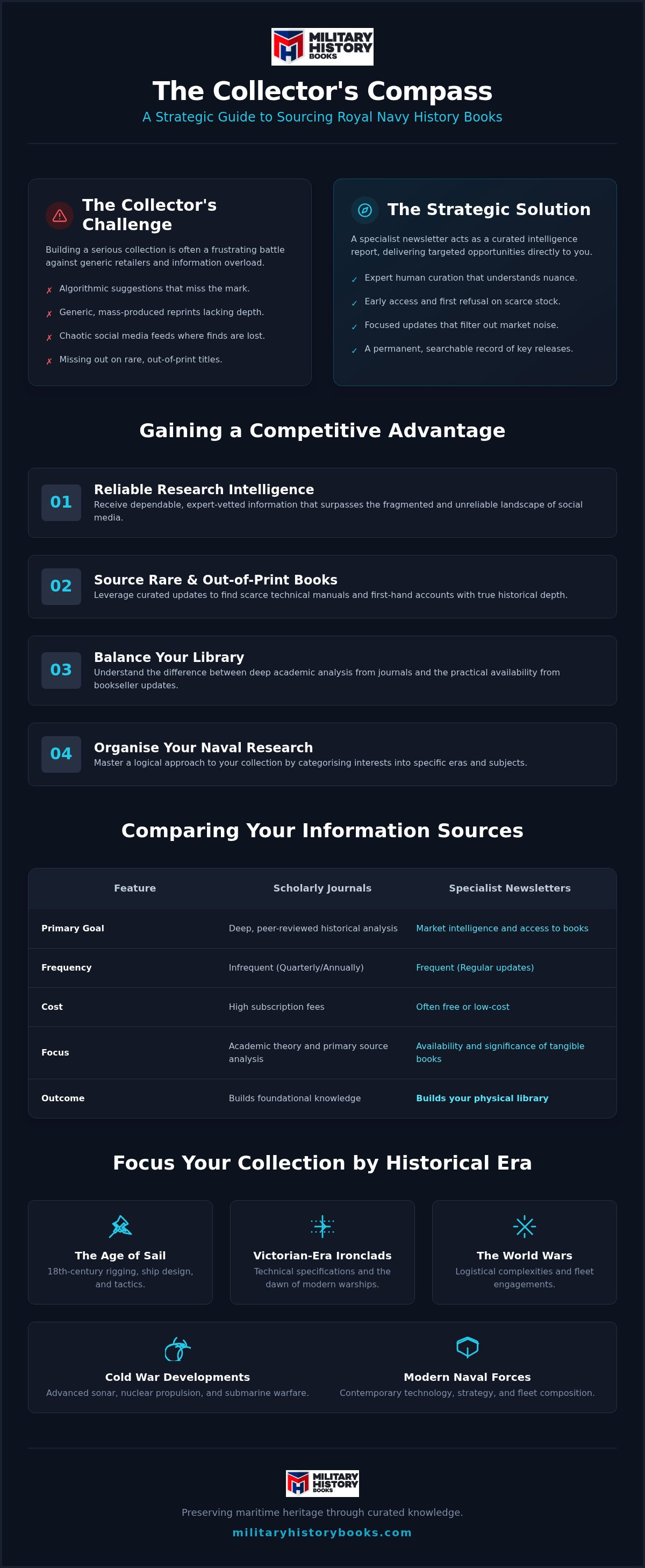
- Understand how to balance your library by distinguishing between the deep analysis of academic journals and the practical availability of bookseller updates.
- Master a logical approach to organising your naval research by categorising your interests into specific eras, from the Age of Sail to modern submarine warfare.
- Secure a competitive advantage in the collectors' market with strategies for gaining early access to scarce, out-of-print titles before they reach general retailers.
Why Every Collector Needs a Reliable Naval Newsletter
A specialist naval newsletter is far more than a simple marketing email; it's a curated intelligence report designed for the serious researcher. It serves as a direct link to the latest maritime history updates and significant book releases, filtering out the noise of the general market. Unlike social media, where valuable discussions often vanish into a chaotic feed, a newsletter offers a permanent, searchable record of scholarly developments and new acquisitions. When you're searching for specific Royal Navy history books, having a focused resource delivered to your inbox ensures you don't miss critical information amidst the clutter of irrelevant digital content.
Staying informed about the availability of rare and out-of-print titles is perhaps the greatest advantage for any dedicated collector. Many of the most significant technical manuals and first-hand accounts were produced in small print runs and haven't seen the light of a printing press in decades. These documents are vital for preserving the History of the Royal Navy, as they contain the technical nuances and personal experiences that larger, more commercial volumes often overlook. By subscribing to a specialist service, you're not just buying books; you're participating in the preservation of maritime heritage and ensuring that technical knowledge remains accessible to the next generation of historians.
The Problem with General Book Retailers
Large online retailers rely heavily on algorithms to suggest your next read, but these systems are notoriously poor at understanding the subtleties of naval warfare. An algorithm might suggest a generic coffee-table book when what you actually need is a detailed analysis of 18th-century rigging or Cold War sonar developments. Human curation, particularly when guided by the expertise of an RAF veteran who understands the weight of military service, provides a level of discernment that no computer can match. Specialist updates identify why a particular volume is significant, saving you hours of manual searching and preventing the frustration of purchasing a book that lacks the depth your research requires.
Newsletters as a Tool for Market Intelligence
Beyond simple notifications, these updates function as a barometer for the collector's market. They allow you to track the fluctuating value and rarity of specific military titles, helping you decide when to invest in a scarce volume and when to wait. As we look toward trends in naval historical publishing for 2026, we're seeing a renewed interest in the technical specifications of Victorian-era ironclads and the logistical complexities of the world wars. A specialist newsletter serves as a bridge between the archive and the collector. This targeted approach ensures that the most relevant Royal Navy history books reach the individuals who can best utilise the information they contain.
Comparing Scholarly Journals and Specialist Naval History Updates
Navigating the vast sea of maritime information requires a clear understanding of your sources. Peer-reviewed academic journals and specialist bookseller updates serve different but complementary purposes. Journals provide the dense, slow-burn analysis of specific historical events, whilst bookseller updates offer immediate market intelligence and access to physical volumes. If you're building a serious library, you'll need to weigh the frequency and cost of these resources against your specific research goals. Academic subscriptions can be costly and infrequent, whereas specialist updates are often more accessible and focused on the tangible items you can add to your shelves.
Digital formats have revolutionised how we receive these updates, offering searchability and speed that physical catalogues can't match. However, many researchers still value the tactile experience of a physical newsletter or a well-organised reading list. Balancing "official" naval news from institutions like the National Museum of the Royal Navy with independent enthusiast perspectives ensures a well-rounded view of the subject. This combination allows you to stay grounded in verified facts whilst remaining open to the unique discoveries and niche interests of the wider naval community.
Academic Journals: Depth and Peer Review
Scholarly publications are the bedrock of new historical evidence. They're essential when your research demands deep dives into primary sources or contested theories. These journals often carry high subscription costs and follow a rigorous, slow peer-review process that prioritises accuracy over speed. For those laying the groundwork of a collection, naval history books often serve as the first point of entry before moving into these dense academic texts. Choosing an academic subscription is a commitment to the long-form study of naval evolution and strategy.
Specialist Retailer Updates: Market Access and Rarity
In contrast, specialist retailer updates focus on speed and rarity. They're the primary way to secure early access to War at sea rarities that rarely appear in mainstream bookshops. These updates often include technical publications and back-issue modelling magazines, which are invaluable for those who value the minute details of ship construction or fleet movements. A veteran-managed archive offers a unique perspective on Royal Navy history books, as the curator understands the operational reality behind the text. This practical insight bridges the gap between dry historical facts and the lived experience of service. If you're looking to expand your own library with carefully selected titles, you might consider browsing our collection of specialist naval history books to find your next rare acquisition.
Key Features of a High-Quality Royal Navy History Newsletter
Identifying a superior newsletter begins with assessing technical precision. A high-quality update doesn't just list titles; it interprets them with the eye of a seasoned curator. Does the editor recognise the tactical distinctions between a Frigate and a Destroyer, or do they treat all naval vessels as interchangeable? This level of detail is essential for anyone serious about collecting Royal Navy history books. A reliable resource should offer a broad scope, covering everything from the Age of Sail to the silent service of modern submarine warfare. It must also cater to the technical enthusiast by including ship modelling references and authentic technical manuals that general retailers often overlook.
Curation by Subject Matter Experts
The background of the individual selecting the titles is paramount for accuracy. When an RAF veteran manages an archive of over 10,000 titles, they bring an operational perspective that filters out "pop-history" clichés. This expertise allows for "deep dives" into specific campaigns or figures that might be overlooked by generalists. By focusing on specialised research rather than sensationalist narratives, these updates ensure that the information you receive is both accurate and historically significant. This professional oversight transforms a simple list into a curated intelligence report that respects your intelligence as a researcher.
Exclusive Content and Early Bird Access
One of the most practical benefits of a specialist update is the advantage of early bird access. Rare stock, such as signed first editions or scarce out-of-print volumes, often sells within minutes of being listed. Receiving a direct alert gives you the first opportunity to secure these items before they reach the wider market. These updates also provide special offers on digital titles and back-issue magazines, helping you build a comprehensive wartime history books UK library. This strategic access is particularly useful for those who value technical depth and historical preservation over generic gift-shop selections.
How to Organise Your Naval Research and Reading List
Systematic organisation is the hallmark of a serious researcher. Without a structured approach, a collection of Royal Navy history books can quickly become a disorganised heap of unrelated titles rather than a cohesive archive. The first step in building a functional library is to categorise your primary interests. Whether you focus on the tactical manoeuvres of the Napoleonic era, the industrial shifts of WWI, or the silent tension of Cold War submarine warfare, defining these boundaries helps you filter incoming information. It's best to sign up for a mix of academic journals for deep theory and specialist commercial newsletters for immediate inventory updates. This dual approach ensures you're informed about both new scholarly evidence and the sudden arrival of rare physical stock.
A vital part of your strategy should be maintaining a "wanted" list for out-of-print titles. Specialist updates act as your eyes on the ground, alerting you to the presence of these scarce volumes before they're snapped up by other collectors. Whilst you wait for a physical copy of a particularly elusive manual, digital downloads can fill the immediate gaps in your research. Finally, make it a habit to review your military history books collection annually. This allows you to identify missing links in your bibliography and refine your focus for the coming year.
Building a Bibliographic Database
Newsletter archives are a goldmine for tracking the publication history of specific Royal Navy history books. By organising your personal records by period, vessel type, or rank, you create a reference system that mirrors professional archives. It's important to cross-reference these bookseller updates with technical publications to ensure your library remains grounded in operational reality. This methodical tracking allows you to see how historical interpretations of certain battles or vessels have evolved over time, providing a deeper layer of context to your studies.
Finding Rare Titles Through Expert Networks
Direct communication is often the most effective tool in a researcher's arsenal. Most specialist newsletters provide a direct line to the curator, allowing you to use "contact us" features for specific title searches. Specialist booksellers are deeply embedded in the global military history community; they often know where a rare volume is held long before it reaches the open market. Leveraging veteran expertise is particularly useful for finding obscure naval memoirs or technical ship modelling references that haven't been widely digitised. To begin building your systematic research library, you can browse our current selection of Naval History Books and identify the foundational titles you need.
Discover Specialist Royal Navy History Books with Our Updates
Finding the right resources shouldn't be a matter of chance. At Military History Books, we've developed a specialist update service that acts as a direct conduit between our vast archive and your research desk. Managed by an RAF veteran with a profound respect for military service, our curation process prioritises historical accuracy and technical depth over commercial trends. We maintain an inventory of over 10,000 titles, specialising in those elusive rare and out-of-print naval publications that define a truly comprehensive collection. Whether you're looking for detailed vessel histories or obscure first-hand accounts, our updates ensure that Royal Navy history books of genuine significance are brought to your attention first.
Our commitment extends beyond simply listing stock. We understand that the global naval history community is interconnected, which is why we offer secure international delivery to researchers across the world. Each volume in our collection is handled with the care it deserves, ensuring that these vital pieces of maritime heritage reach you in the condition described. By focusing on the preservation of stories and technical data, we provide a reliable alternative to the automated and often impersonal experience of general book retailers. It's about building a connection between the past and the modern enthusiast through a shared passion for accuracy.
The Specialist Advantage
Choosing a specialist retailer provides a level of personalised service that generalists simply cannot replicate. Our deep knowledge of naval warfare history books allows us to assist with specific queries, helping you identify the most relevant texts for your particular field of study. We're dedicated to preserving military history through literature, ensuring that technical manuals and operational records remain accessible to those who value them most. Based in Weymouth, our archive serves a national audience of researchers who rely on our expertise to build their personal libraries. This local presence combined with a global reach makes us a trusted partner in your historical journey.
Join Our Community of Historians
Our regular naval newsletter updates are designed to keep you at the forefront of maritime research. You can expect curated lists of new arrivals, spotlights on rare technical publications, and insights into the latest additions to our Royal Navy history books collection. If you're searching for a specific title or a particular back-issue modelling magazine, our direct communication channels allow you to tap into our expert network. We don't just sell books; we support the ongoing study of naval evolution. We invite you to sign up for our specialist naval updates today and become part of a community that values the weight and wisdom of naval history.
Securing Your Place in Maritime History
Building a definitive research library is a lifelong pursuit that requires both patience and precise intelligence. By moving beyond the limitations of general retailers and embracing specialist curation, you ensure that your collection remains grounded in technical accuracy and historical depth. We've explored how a dedicated naval newsletter acts as a vital tool for identifying rare editions and organising your research into a cohesive archive. Whether you're a seasoned academic or a dedicated hobbyist, the right information stream is what separates a simple shelf of volumes from a significant historical resource.
Our archive is managed by an RAF veteran who understands the importance of preserving these stories with integrity. With over 10,000 specialist titles in stock and expert international delivery available, we're here to help you find the most elusive maritime records. We invite you to browse our extensive collection of Royal Navy history books and discover the rare publications that will complete your next research project. Start your journey today and let us help you uncover the hidden depths of Britain's maritime past.
Frequently Asked Questions
What is the best naval newsletter for Royal Navy history enthusiasts?
The best newsletter for enthusiasts is one that offers expert curation and early access to rare stock. A service managed by a veteran, such as the one provided by Military History Books, ensures that the titles selected meet a high standard of historical accuracy. These updates act as a bridge between the collector and the archive, providing insights into Royal Navy history books that general retailers often miss.
How often should I expect to receive a specialist naval history update?
You should generally expect to receive a specialist update once or twice a month. This schedule allows the curator enough time to source, verify, and describe new additions to their collection of over 10,000 titles. This methodical pace ensures that every update contains meaningful information and high-quality resources, rather than a constant stream of irrelevant marketing material that clutters your inbox.
Can a naval newsletter help me find out-of-print Royal Navy history books?
Specialist newsletters are one of the most effective tools for locating out-of-print volumes. Because rare titles often sell within minutes of being listed, these updates provide the necessary speed to secure a purchase. By subscribing, you gain a strategic advantage in the collectors' market, receiving alerts for scarce technical manuals and first-hand accounts that rarely appear on mainstream retail websites.
Are there free newsletters for maritime history research?
Most specialist booksellers provide their update services free of charge to encourage the preservation of maritime heritage. These free resources allow you to track the availability of Royal Navy history books and stay informed about new research developments. They offer a cost-effective way to stay connected with the global naval history community whilst receiving expert guidance on building your personal research library.
Do naval newsletters include information on ship modelling and technical manuals?
Specialist naval updates often include technical manuals, ship modelling magazines, and back-issue periodicals. These niche publications are vital for researchers who require detailed specifications of vessel construction or fleet organisation. A high-quality newsletter understands that technical depth is just as important as narrative history, providing a balanced view of the maritime service that appeals to both modellers and serious historians.
How can I distinguish a high-quality naval newsletter from a generic sales email?
A high-quality update is defined by its technical accuracy and the depth of its descriptions. You can distinguish it from generic emails by the use of specialised terminology and the presence of rare, technical, or out-of-print titles. If the author demonstrates a clear understanding of naval rank, vessel types, and historical context, it is likely a reliable resource for serious maritime research.
Is it possible to get digital naval history books via a newsletter subscription?
Yes, many newsletters now feature digital titles that are available via download or on disc. This format is particularly beneficial for researchers who need immediate access to technical data or rare texts that are difficult to find in physical form. Digital options allow you to expand your library quickly whilst you continue to hunt for original, out-of-print physical copies.
Can I request specific naval campaign books through a specialist update service?
You can certainly request specific books or campaign histories through a specialist service. Specialist booksellers often use their extensive networks to track down obscure memoirs or technical reports on behalf of their subscribers. This proactive approach shows a willingness to assist individual researchers, making the newsletter a collaborative tool for those seeking the most elusive records of naval service.


