

What if the secret to Napoleon’s greatest victories lay not in a flash of divine intuition, but in the meticulous technical manuals and logistical innovations often ignored by modern biographers? It's understandable if you feel overwhelmed by the sheer volume of literature surrounding the First Empire, as the weight of tens of thousands of documents and biographies makes it difficult to distinguish between romanticised legend and technical military history. You likely want to move beyond the surface level, yet finding those rare, out-of-print specialist titles that detail the actual mechanics of the Grande Armée can be a significant challenge for even the most dedicated researcher.
This article provides the clarity you need to build a truly specialist library. You'll discover the essential texts and historical perspectives required to understand the evolution of 19th-century land warfare and the specific tactical shifts that defined the era. We'll guide you through the process of sourcing rare military memoirs and identifying the key technical works that reveal how the French military machine actually functioned on the ground. By the end, you'll have a clear roadmap for deepening your expertise and securing the most authoritative resources for your collection.
Key Takeaways
- Understand how the transition from 18th-century "Cabinet Wars" to the era of Total War fundamentally revolutionised modern military strategy.
- Explore the organisational brilliance of the Grande Armée through a technical analysis of the decentralised Corps System and innovative tactical formations.
- Identify the most reliable primary sources and contemporary memoirs to help you separate historical fact from the romanticised myths surrounding Napoleon.
- Learn how to assemble a specialist library by prioritising comprehensive campaign histories alongside technical works on specific branches of service.
- Discover professional methods for sourcing rare first editions and out-of-print titles through expert curators with deep expertise in land warfare history.
Napoleon: The Man Who Redefined Modern Warfare
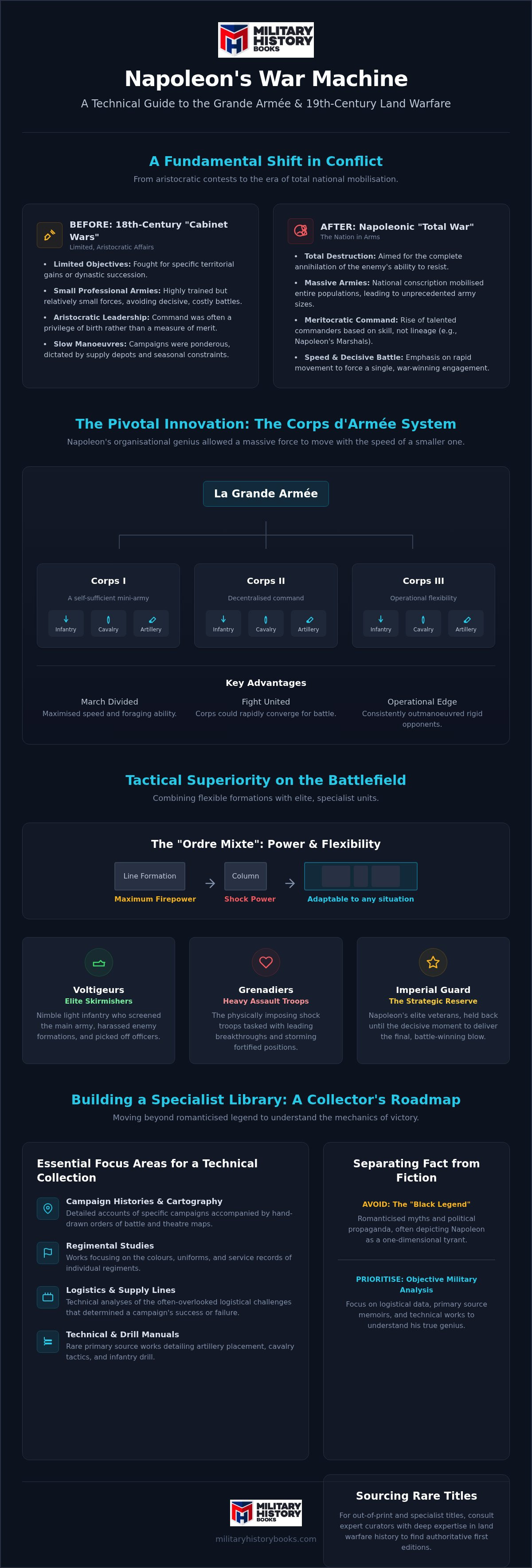
Napoleon didn't just win battles; he fundamentally altered the DNA of conflict. Historians often describe his tenure as a true "Revolution in Military Affairs" (RMA). Before his rise, 18th-century "Cabinet Wars" were limited, aristocratic affairs fought by small professional armies for specific territorial gains. He shifted the paradigm toward "Total War," where the entire resources of a nation were mobilised for the total destruction of the enemy's ability to resist. The Napoleonic Wars, spanning from 1803 to 1815, saw armies of unprecedented size clashing across the European continent. These campaigns remain the bedrock of modern military doctrine because they introduced concepts of speed, mass, and decisive manoeuvre that are still taught at staff colleges today.
The Napoleonic Legend vs. Historical Reality
Understanding the man requires peeling back layers of centuries-old propaganda. The "Black Legend," largely a product of early British literature and political caricature, depicted him as a bloodthirsty tyrant. Whilst these accounts provide insight into the period's anxieties, serious researchers must prioritise objective military analysis over hagiography to understand his true genius. It's about looking at the logistical data and the mechanics of the supply line rather than just the heroics. Napoleon’s "Corps d’Armée" system was his most pivotal innovation, as it allowed for a massive force to march divided for speed but converge rapidly for battle, ensuring he always held the operational advantage.
Why Napoleon Remains a Favourite Amongst Collectors
The era's aesthetic and technical complexity continues to captivate enthusiasts across the United Kingdom. Collectors often focus on specific elements that define the period's unique character:
- Intricate orders of battle and hand-drawn cartography.
- Detailed studies of regimental colours and uniform variations.
- Primary accounts of logistical challenges and supply line management.
- Technical manuals for artillery placement and cavalry tactics.
For those interested in military history books, building a curated collection is the best way to preserve these stories. From rare first editions of campaign memoirs to modern technical analyses, the right library acts as a bridge to the past. This enduring appeal is why specialist titles remain so sought after by those who value both history and the art of the book.
The Grande Armée: Organisation, Tactics, and Innovation
The efficiency of the Grande Armée was not a matter of luck. It was the result of a revolutionary organisational structure that allowed Napoleon to outmanoeuvre larger coalition forces with startling regularity. The introduction of the "Corps System" turned the army into a collection of self-sufficient mini-armies, each containing its own infantry, cavalry, and artillery. This decentralised command meant that a Corps commander could act independently whilst remaining within supporting distance of the main force. It created a level of operational flexibility that his opponents, still tethered to rigid 18th-century structures, simply could not match.
Tactically, the French utilised the "Ordre Mixte", or Mixed Order. This formation combined the firepower of the line with the shock power of the column, allowing battalions to adapt quickly to the terrain and the enemy's disposition. Behind this tactical flexibility sat the Imperial Guard. These elite troops were more than just a bodyguard; they functioned as a potent strategic reserve, often held back until the final, decisive moment of a battle to deliver the killing blow. Their presence on the field was frequently enough to shatter the morale of opposing forces before a shot was even fired.
Land Warfare and the Evolution of the Infantry
The infantry underwent a massive transformation during this period. Soldiers moved away from the slow, ponderous line formations of the past toward more aggressive column attacks that prioritised speed and impact. Specialists played a vital role in this new system. Voltigeurs acted as nimble skirmishers to harass the enemy, whilst Grenadiers provided the heavy muscle required for breakthroughs. For researchers looking to understand the specific drills and unit structures of the era, studying land warfare books provides the necessary technical depth that general histories often skip.
Cavalry and Artillery: The Hammer and the Anvil
Napoleon’s background as an artillery officer meant he understood the "Gribeauval System" better than any contemporary commander. This system standardised gun calibres and lightened carriages, making the artillery highly mobile and interchangeable. He pioneered "Grand Battery" tactics, massing dozens of guns to blast a hole in the enemy centre. The cavalry then acted as the hammer. Massive charges, like the 80-squadron surge at Eylau or the desperate fighting at Borodino, demonstrated the sheer impact of heavy cuirassiers.
If you are a modeller or a serious historian, technical manuals from the era are indispensable for getting the details of equipment and carriage colours correct. You might consider browsing our collection of Napoleonic land warfare titles to find these specific references and deepen your understanding of the period's technical evolution.
Contemporary Memoirs vs. Modern Historiography
To truly grasp the reality of the Napoleonic era, one must balance the visceral, often biased accounts of the men who fought there with the detached analysis of modern scholars. Primary sources, such as the Memoirs of Baron de Marbot, offer a unique "flavour" of life in the Grande Armée that modern texts can't replicate. Marbot’s tales of survival and tactical daring provide an emotional connection to the period, yet they are notoriously prone to exaggeration. This is where modern historiography becomes essential. Renowned historians like David Chandler have spent decades synthesising thousands of these individual accounts to create a more objective narrative. By cross-referencing memoirs with technical military publications, such as official orders of battle and logistical records, researchers can verify the often-inflated claims found in personal diaries.
The Peninsular War: A Literary Goldmine
The conflict in Spain and Portugal, often referred to as Napoleon’s "Spanish Ulcer," generated an extraordinary volume of literature. These accounts highlight the stark differences between the French marshals and the disciplined British forces under Wellington. Whilst the French memoirs often focus on the frustration of guerrilla warfare, British accounts provide a fascinating look at the "thin red line" and the logistical support provided by the Royal Navy. For those seeking these specific British perspectives, exploring wartime history books UK offers a comprehensive reference for both researchers and collectors. This literature reveals how the British successfully maintained a foothold on the continent whilst the French struggled with fragmented command.
Naval Warfare: The Battle of Trafalgar and Beyond
Whilst land battles often dominate the narrative, the war at sea was the silent engine of Napoleon’s eventual downfall. The Battle of Trafalgar ensured British naval supremacy, allowing for the crippling blockades that strangled French trade and limited their strategic options on land. However, first-hand naval accounts are significantly rarer than those of the infantry. Sailors were often less literate than their officer counterparts, and the isolated nature of life at sea meant fewer journals survived. To gain a complete view of how the conflict was won and lost on the waves, it's helpful to consult specialist naval history books. These publications often rely on official ship logs and admiralty records to reconstruct the technical reality of life on a man-of-war, providing a necessary counterpoint to the more common soldier's diary.
Building a Definitive Napoleonic Library: A Collector’s Checklist
Assembling a definitive library dedicated to Napoleon requires a methodical approach that moves beyond general biographies. It’s a process of building a hierarchy of sources that offer both broad context and granular technical detail. Whilst generalist biographers provide a narrative of his life, a specialist library must focus on the technical mechanics of the First Empire. To achieve this, you should prioritise a structured checklist of acquisitions:
- Single-Volume Campaign Histories: Start with a comprehensive work that outlines the strategic landscape of the entire period.
- Specialist Branch Studies: Acquire dedicated volumes on the technical evolution of the Artillery, Cavalry, and Engineers.
- Topographical Atlases: Invest in high-quality maps and topographical studies to understand the influence of terrain on his manoeuvres.
- Technical Diagrams: Seek out titles that include detailed orders of battle and schematics of period weaponry.
- Niche Research Material: Look for back issues of military magazines that cover specific regimental histories or obscure engagements.
By following this structured approach, you ensure your collection serves as a functional research tool rather than just a shelf of books. If you are looking to source these essential checklist items, you can browse our curated selection of Napoleonic land warfare books to find the authoritative texts your library requires.
Identifying Rare and Out of Print Titles
A book is often considered "rare" in this field when it contains specialist technical data from limited print runs that was never digitised or widely reprinted. For the serious collector, the presence of original folding maps and hand-coloured plates is a significant marker of value and historical utility. These physical attributes provide a level of detail that modern scans often miss. If you are struggling to track down a specific volume, our guide on out of print military books offers expert advice on navigating the specialist market to secure these elusive titles.
The Role of Modelling Magazines in Historical Research
There is a significant crossover between the world of historical research and scale modelling. Modelling publications are often the best source for accurate uniformology, providing detailed colour plates that show the evolution of regimental facings and equipment over time. For those researching specific unit appearances, back issue military magazines UK are an invaluable resource. These magazines frequently feature articles written by specialist historians that detail the exact nuance of Napoleon’s tactical genius in a way that general history books might overlook, making them a vital addition to any specialist archive.
Sourcing Rare and Specialist Napoleonic Literature
Finding the exact volume that details the finer points of 19th-century logistics requires more than a simple search on a mass-market retail site. Generalist retailers often lack the deep subject-matter expertise needed to distinguish between a standard reprint and a rare first edition containing vital technical data. This is why many serious collectors turn to Military History Books. Managed by an RAF veteran with decades of experience in the field, we act as a dedicated curator rather than just a shop. We understand the historical weight of the period and the specific needs of those researching the military genius of Napoleon, ensuring that every book in our collection meets a high standard of historical accuracy.
Expert Curation for the Serious Historian
Our archive houses over 10,000 specialist titles, ranging from broad campaign overviews to highly technical manuals on cavalry drill and artillery placement. This depth allows us to support both the casual reader and the academic researcher with equal precision. If a specific, hard-to-find title isn't currently on our shelves, we proactively use our network to help source it for you. This level of personalised service is essential for researchers looking to fill the gaps in their bibliographies with authoritative sources. For those looking to share this passion with others, our guide to military history gift books UK provides an excellent starting point for selecting high-quality volumes that any specialist collector would value.
Digital vs. Physical: Choosing the Right Format
The modern researcher often has to balance the need for immediate information with the desire for long-term preservation. Digital titles, available by download or on disc, are incredibly convenient for technical manuals that you might want to reference quickly whilst working or modelling. They provide a portable way to carry an entire library of tactical drills without taking up physical space. Conversely, physical out-of-print books offer a tactile connection to the past and hold significant investment value. There is a unique satisfaction in holding a volume that may have been read by a contemporary of the era, complete with the original plates and maps discussed in previous sections.
To ensure these rare items reach you in perfect condition, we provide secure international delivery for all our out-of-print works, using robust packaging designed for delicate historical material. Whether you are looking for a digital download of an artillery manual or a rare first edition of a marshal's memoirs, we invite you to browse our full online collection to find the next essential addition to your archive. Our goal is to act as a bridge between the past and the modern enthusiast, preserving the stories of the Grande Armée for future generations.
Deepening Your Understanding of the Napoleonic Era
Understanding the true nature of the First Empire requires moving beyond general narratives to examine the technical brilliance of Napoleon and the organisational innovations that defined the era. You've seen how the decentralised Corps System and the tactical flexibility of the Mixed Order created a military machine that outpaced all contemporaries. Every book preserves history. By balancing visceral contemporary memoirs with the objective analysis found in technical manuals, you can build a library that offers a truly comprehensive view of the period.
Finding these specific, high-quality resources is easier when you partner with a curator who shares your passion. Managed by an RAF veteran with deep historical expertise, our collection includes over 10,000 specialist military titles. Whether you're seeking rare first editions or digital downloads, we provide secure global delivery for all rare and out-of-print works. Browse our specialist collection of Napoleonic and Land Warfare books to start your next research project today. The stories of the Grande Armée are waiting to be rediscovered through the pages of these exceptional works.
Frequently Asked Questions
What is the best book for a beginner to start learning about Napoleon?
David Chandler's "The Campaigns of Napoleon" is widely considered the gold standard for anyone beginning a technical study of his military career. It provides a comprehensive overview of his strategic evolution and major battles. For those seeking a more accessible biographical narrative, Andrew Roberts' "Napoleon the Great" offers an excellent modern perspective on his life and the broader impact of his rule across Europe.
How can I identify a rare first edition Napoleonic memoir?
Identifying a rare first edition requires looking for specific markers such as the publisher's imprint, the date of publication, and the presence of original hand-coloured plates or folding maps. First editions from the early 19th century often feature unique binding styles and intricate topographical details that were frequently omitted in later mass-market reprints. Expert curators can help you verify these details by cross-referencing bibliographical data from the era.
Are there specialist books that focus only on Napoleon’s Marshallate?
Yes, several authoritative works focus exclusively on the "Twenty-Six Marshals" of the Empire. These titles analyse their individual tactical styles, their complex relationships with the Emperor, and their performance in independent commands. Books like "Napoleon's Marshals", edited by David Chandler, provide detailed biographical and military assessments of each commander. Such works are essential for understanding the strengths and weaknesses of the French high command during the wars.
Where can I find technical details on Napoleonic artillery and uniforms?
Technical details are best found in specialist land warfare books and back issue modelling magazines. These publications often feature high-resolution colour plates of regimental uniforms and precise schematics of the Gribeauval artillery system. For those interested in the exact technical evolution of equipment, out-of-print technical manuals provide the most accurate data. These resources are invaluable for both serious historians and dedicated scale modellers seeking authentic references.
Can I find out-of-print Napoleonic books in digital format?
Many rare and out-of-print titles are now available as digital downloads or on disc. This format is particularly useful for researchers who need to access technical data or tactical manuals without the high cost of acquiring a physical first edition. Our collection includes a variety of digital titles that preserve the content of elusive historical works, ensuring that these vital primary sources remain accessible for modern study.
What is the difference between a general biography and a military history of Napoleon?
A general biography focuses on the personal life, political reforms, and character of Napoleon, whilst a military history prioritises his tactical innovations, logistical challenges, and campaign strategies. Military histories usually include detailed orders of battle and topographical maps. They provide a more technical analysis of how he functioned as a commander on the battlefield rather than focusing on his domestic policies or private relationships.
How do I source back issue magazines that cover Napoleonic battles?
You can source these through specialist military booksellers who maintain extensive archives of modelling and history magazines. These back issues are invaluable for niche research, as they often contain detailed articles on specific regiments or minor engagements that general histories skip. Browsing a curated selection of back issue magazines is the most reliable way to find these specific resources for your historical or modelling projects.
Does Military History Books ship Napoleonic titles internationally?
We provide secure global delivery for all our titles, including rare and out-of-print works. Every order is packaged using robust materials designed to protect delicate historical books during transit. Whether you are building a library in the United Kingdom or overseas, we ensure your specialist literature arrives in excellent condition. Our team is experienced in handling international customs requirements to make the delivery process as smooth as possible.


