

A truly great naval novel isn't just a story; it's a meticulously rigged vessel that allows you to feel the spray of the Atlantic and the tension of a gun deck without leaving your armchair. You likely know the frustration of opening a promising volume only to find a captain using modern slang or a ship that defies the laws of 18th-century physics. It's difficult to immerse yourself in a narrative whilst constantly spotting errors in rank or rigging. We understand that for the dedicated enthusiast, historical accuracy is just as vital as a gripping plot.
This guide will help you navigate the vast horizon of maritime literature to find the best naval fiction books that respect both the history and the technical craft of the sea. We'll show you how to identify prose that captures the authentic human experience of life under sail or steam. You'll discover a curated selection of foundational classics and modern masterpieces, alongside expert advice on building a specialist library. We'll also share our secrets for sourcing those elusive, out-of-print editions that often remain hidden from the casual reader, ensuring your collection is as seafaringly sound as it is enjoyable.
Key Takeaways
- Understand how the finest maritime prose bridges the gap between dry historical facts and the sensory reality of life aboard a naval vessel.
- Explore a curated selection of the best naval fiction books spanning from the wooden walls of the Age of Sail to the steel warfare of the 20th century.
- Learn why technical and historical accuracy are the hallmarks of a quality naval novel and how veteran-led curation ensures realism.
- Gain practical advice on how to organise a specialist maritime library by conflict or service branch whilst choosing the best formats for your collection.
- Discover effective methods for sourcing rare and out-of-print titles that are frequently missed by general high-street retailers.
What Makes the Best Naval Fiction Books Worth Reading?
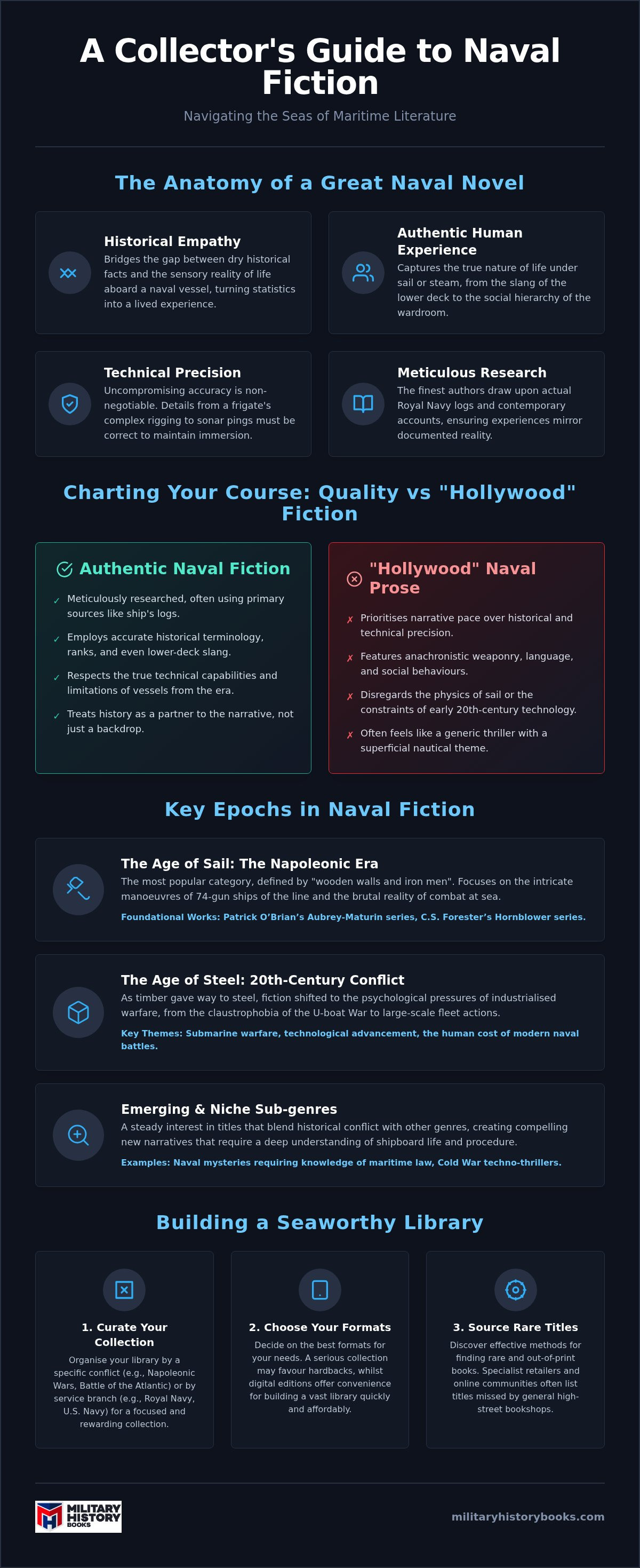
Naval fiction is a distinct branch of literature that centres on maritime conflict, the intricacies of the "silent service", and the unique human experience of life aboard a vessel. While technical manuals provide the "what" and "how" of maritime history, the best naval fiction books offer the "why". They bridge the gap between dry statistics and the visceral reality of a storm or a broadside. This genre allows a reader to experience the sensory overload of a gun deck or the claustrophobia of a submarine in a way that academic texts often can't.
For the serious collector, these novels are essential components of a broader military history books collection. They provide the emotional context that turns a ship's specification into a lived reality. Accuracy in terminology, from the complex rigging of a frigate to the nuances of sonar pings and naval rank, is non-negotiable. Without this precision, the immersion is broken, and the historical value is lost.
The Balance of Historical Fact and Narrative
The finest authors in this genre treat history as a partner rather than a backdrop. Patrick O’Brian, for instance, famously drew upon actual Royal Navy logs and contemporary accounts to inform his prose, ensuring that his characters' experiences mirrored documented reality. There is a clear distinction between generic nautical thrillers, which often prioritise pace over precision, and the best naval fiction books which are meticulously researched. This research extends to the language used amongst the crew, where the slang of the lower deck must be as accurate as the tactical manoeuvres performed during a chase. High-quality naval fiction serves as a vital vehicle for historical empathy, allowing readers to inhabit the mental state of a crew facing the overwhelming power of the sea.
Why Specialist Readers Reject "Hollywood" Naval Prose
Serious enthusiasts often find mainstream representations of naval life frustrating. Common pitfalls include anachronistic weaponry, modern social behaviours grafted onto historical settings, and a blatant disregard for the technical constraints of the era. A ship is a machine of its time; its capabilities and limitations dictate the story. At Military History Books, our management by an RAF veteran ensures a rigorous standard for technical realism. We filter our stock of over 10,000 titles to ensure we provide works that respect the intelligence of our readers. Specialist retailers act as a necessary gatekeeper, separating the historically sound accounts from the "Hollywood" style fiction that ignores the true nature of seafaring life.
Essential Categories of Naval Fiction: A 2026 Roundup
To identify the best naval fiction books, you must first determine which era of maritime history resonates with your interests. The genre isn't a monolith; it's a vast ocean divided into specific epochs, each with its own technical demands and narrative styles. Whether you prefer the intricate manoeuvres of a 74-gun ship of the line or the silent, tense sonar pings of a Cold War submarine, there's a category designed for your specialist interest.
The 2026 landscape of naval prose continues to celebrate the foundational series whilst embracing new perspectives. We see a steady interest in titles that blend historical conflict with investigative elements, creating a sub-genre of naval mysteries that require a deep understanding of shipboard life and maritime law. For the serious collector, categorising your library by conflict or service branch is often the most rewarding approach.
The Napoleonic Era: Aubrey, Maturin, and Hornblower
The Age of Sail remains the most popular category for many enthusiasts. Patrick O’Brian’s Aubrey-Maturin series is frequently cited as the gold standard for technical maritime prose. His work doesn't just describe a battle; it explains the physics of the wind and the social hierarchy of the wardroom with surgical precision. Similarly, C.S. Forester’s Hornblower series remains foundational, shaping how modern readers perceive the Napoleonic naval officer. These stories do more than entertain; they provide a vital human lens that complements the strategic data found in official wartime history books UK.
20Th-Century Maritime Conflict: The U-boat War
As timber gave way to steel, the nature of naval fiction shifted towards the psychological pressure of industrialised warfare. Stories of the World Wars often focus on the "silent service", capturing the claustrophobia and technical reality of submarine life. Authors like Lothar-Günther Buchheim have set a high bar for realism in the Battle of the Atlantic. Meanwhile, the Pacific theatre offers a different scale of conflict, focusing on carrier warfare and the rapid transition to naval aviation. These narrative accounts offer a necessary layer of context to the technical specifications found in naval history publications from the period. If you're looking to expand your own shelf, you can browse our curated selection of military fiction titles to find works that meet these high standards of accuracy.
Why Technical Accuracy is the Priority for Serious Collectors
For the dedicated enthusiast, the merit of a maritime novel rests on its technical integrity. Whilst the plot and characters are products of the author's imagination, the vessel they inhabit and the tactical environment they operate in must remain historically sound. At Military History Books, our curation is guided by a "Veteran Lens". Managed by an RAF veteran, we apply a professional framework to our inventory, ensuring that the titles we stock respect the technical reality of service life. Poorly researched prose doesn't just annoy the reader; it erodes the credibility of the entire work and fails to honour the history it attempts to depict.
Spotting Research-Backed Maritime Authors
Quality authors often leave a trail of their research within the pages of their work. When searching for the best naval fiction books, look for volumes that include detailed bibliographies or acknowledgments to naval archives. These writers frequently consult primary sources, such as back issue military magazines UK, to verify the specifics of ship handling or period-correct equipment. The precise use of nautical terminology, such as the correct naming of specific ropes in a sailing frigate or the operational procedure for a 20th-century depth charge attack, is a hallmark of a master craftsman. Technical errors act as a jarring interruption that instantly breaks the immersion for specialist readers who understand the mechanics of the sea.
The Problem with Maritime Anachronisms
Anachronisms are the primary enemy of immersion. Using a ship class that hadn't yet been commissioned or describing radar technology that wouldn't exist for another decade ruins the reader's experience. Beyond entertainment, the best naval fiction books play a role in preserving the technical history of naval manoeuvres that might otherwise be forgotten. We encourage our community to cross-reference their favourite prose with factual accounts found in military biography books. This comparative reading deepens your understanding of the period whilst highlighting the skill of authors who get the details right. A library built on accuracy is a library that serves as a genuine tribute to maritime heritage.
How to Organise and Build a Specialist Naval Fiction Library
Building a specialist collection requires a methodical approach that balances your personal interests with the preservation of maritime history. Whilst casual readers might settle for whatever is on the high-street shelf, a serious collector looks for depth and technical merit. Your library should serve as a comprehensive archive of the sea, reflecting the evolution of naval warfare through the best naval fiction books alongside factual records. A well-organised shelf is more than just a storage solution; it's a curated timeline of human endeavour and naval architecture.
Physical vs Digital Naval Literature
The choice between formats often depends on how you intend to use the material. Vintage hardbacks offer a tactile connection to the past. Their weight and the scent of older paper add a layer of atmosphere that digital screens cannot replicate. However, older paperbacks require specific care to prevent yellowing and spine damage. It's best to keep them away from direct sunlight and maintain a stable humidity level to preserve the glue and paper. Digital titles, available by download or on disc, are invaluable for researchers who need to carry a vast reference library whilst travelling or on the move. They allow for quick keyword searches that are impossible with physical copies.
Curating a Thematic Naval Collection
A truly valuable library often focuses on a specific niche rather than attempting to cover every ocean. You might choose to concentrate on the Royal Navy's actions in the Mediterranean during the Second World War or perhaps the transition from sail to steam. By narrowing your focus, you can build a more significant collection that includes an author’s full maritime bibliography. To achieve a 360-degree view of a conflict, it's effective to blend your chosen best naval fiction books with memoirs and technical manuals from the same period. This multi-layered approach provides the technical data of a manual alongside the emotional weight of a novel.
If you are ready to expand your collection with specialist titles, you can browse our extensive range of naval history and fiction to find your next essential volume. Investing in collectible editions, such as signed copies or first editions, can also turn a hobby into a significant historical investment. Whether you organise by conflict, service branch, or chronological era, the goal is to create a cohesive narrative of human experience at sea.
Sourcing Rare and Out-of-Print Naval Fiction
Many titles widely regarded as the best naval fiction books have slipped out of active print, leaving a void for those who prioritise historical authenticity over modern trends. General retailers focus on high-volume bestsellers, which means obscure or technically dense maritime prose often disappears from high-street shelves. Collectors frequently find that the most authentic accounts of life at sea were published decades ago and never received a modern reprint. Finding these volumes requires moving beyond general search engines and into the archives of specialist booksellers who value the preservation of history over mass-market appeal.
The Hunt for Forgotten Maritime Masterpieces
Tracking down forgotten classics of the 20th-century naval genre is a task that demands deep specialist knowledge. Many of these works don't exist on major digital platforms or in modern ebook formats; they remain locked in physical volumes, often in small print runs from niche publishers. At Military History Books, we manage a massive inventory of over 10,000 titles to ensure that collectors can find the exact volume they need to complete a series or a research project. Our curation process involves identifying these "forgotten" masterpieces and ensuring they find a home with readers who appreciate their technical realism. This methodical approach allows us to source rare naval literature amongst thousands of more common titles, providing a resource that generalists simply cannot match.
Why a Specialist Curator Matters for Collectors
There is a distinct advantage to buying from a curator who understands the subject matter from a professional perspective. Being managed by an RAF veteran means we recognise the historical weight and technical nuances within these stories. We don't just sell books; we act as a trusted guide for the dedicated enthusiast community. This background allows us to offer a personalised service, helping you find the exact book for your research or collection. We understand that for a serious collector, the condition of a rare edition is just as important as the words on the page. Our expertise ensures you receive a volume that meets the highest standards of realism whilst being handled with the care it deserves.
Browse our curated collection of naval fiction today to discover rare and out-of-print titles that bring maritime history to life. Our secure international delivery ensures that these preserved stories can reach collectors anywhere in the world, maintaining the legacy of the "silent service" for future generations. By choosing a specialist, you ensure that your library is built on a foundation of accuracy and expertise.
Charting Your Course Through Maritime Literature
Finding the best naval fiction books requires a keen eye for technical detail and a deep respect for historical authenticity. By focusing on research-backed authors and categorising your library by specific maritime eras, you transform a simple reading habit into a dedicated act of preservation. Whether you're drawn to the tactical complexity of the Napoleonic period or the psychological tension of 20th-century submarine warfare, the right prose serves as a vital bridge to the past.
At Military History Books, we're dedicated to helping you find these elusive masterpieces. Our store is managed by an RAF veteran who understands the importance of realism in every volume we stock. With over 10,000 specialist titles currently in our inventory, we're a trusted resource for both serious researchers and casual enthusiasts. We provide secure international delivery for collectors, ensuring that rare and out-of-print titles reach your shelves safely.
Explore our extensive range of Naval Fiction and History Books today and discover stories that honour the technical reality of life at sea. Your next great maritime adventure is waiting to be uncovered amongst our carefully curated archive.
Frequently Asked Questions
What are the best naval fiction books for beginners to the genre?
Start with C.S. Forester’s Hornblower series. It’s widely considered the perfect entry point because it balances engaging storytelling with a clear introduction to naval life. Patrick O’Brian’s work is another excellent choice, though it’s slightly denser. Beginners should focus on these foundational series to understand the best naval fiction books before moving into more technical or obscure titles found in specialist collections.
Is naval fiction historically accurate enough for researchers?
Many titles are exceptionally accurate, especially when authors use primary sources like ship logs or contemporary accounts. Whilst the characters are invented, authors such as Alexander Kent ensure the technical environment remains authentic. Researchers often find that these novels capture the "human factor" and sensory details that dry technical manuals might omit. This makes high-quality maritime prose a valuable tool for understanding the lived reality of historical service.
Where can I find out-of-print naval fiction books in the UK?
Specialist retailers like Military History Books are the premier source for out-of-print maritime literature in the UK. We maintain a vast inventory of over 10,000 titles, focusing specifically on military and naval history. Unlike general high-street shops, we actively source hard-to-find editions that have been out of active print for decades. This allows collectors to find specific volumes that are no longer available through mainstream digital or physical platforms.
Who are the most respected authors in the naval fiction genre?
Patrick O’Brian and C.S. Forester are the most respected figures, but the genre includes many other master craftsmen. Alexander Kent, Dudley Pope, and Julian Stockwin are also highly regarded for their commitment to historical precision. These authors are celebrated amongst the enthusiast community for their ability to depict the technical complexities of naval warfare, whether they are writing about the Napoleonic era or the steel ships of the 20th century.
How does naval fiction differ from standard historical fiction?
Naval fiction differs through its intense focus on the vessel as a central character and the technicalities of the sea. Standard historical fiction often uses a period setting as a mere backdrop, whereas maritime prose centres on ship handling, naval hierarchy, and the "silent service". The environment dictates every plot point, requiring authors to possess a specialised understanding of navigation, rigging, and naval tactics that general fiction rarely demands.
Can naval fiction be used as a supplement for historical research?
High-quality fiction can certainly supplement research by providing emotional context and sensory detail. Whilst it doesn’t replace primary documents, well-researched novels help historians understand the daily routines and social dynamics of a crew. Many serious collectors cross-reference their fiction with our technical manuals and back issue magazines. This multi-layered approach helps build a complete picture of specific historical maritime conflicts and the people who fought in them.
What is the best way to collect first edition naval novels?
The most effective way to collect first editions is to work with a specialist bookseller who understands provenance and preservation. You should look for copies with original dust jackets and minimal spine wear. We help collectors identify these rare editions amongst our inventory of over 10,000 titles. It’s a methodical process that requires verifying the printing history and ensuring the volume has been stored correctly to maintain its historical and financial value.
Do you offer digital versions of rare naval fiction titles?
We offer a wide selection of digital titles available via download or on disc. This includes technical publications and various military fiction titles that are often difficult to source in physical form. Digital formats are an excellent solution for researchers who need to access a large library whilst on the move. You can browse our digital offerings alongside our physical collection of rare and out-of-print best naval fiction books.


