

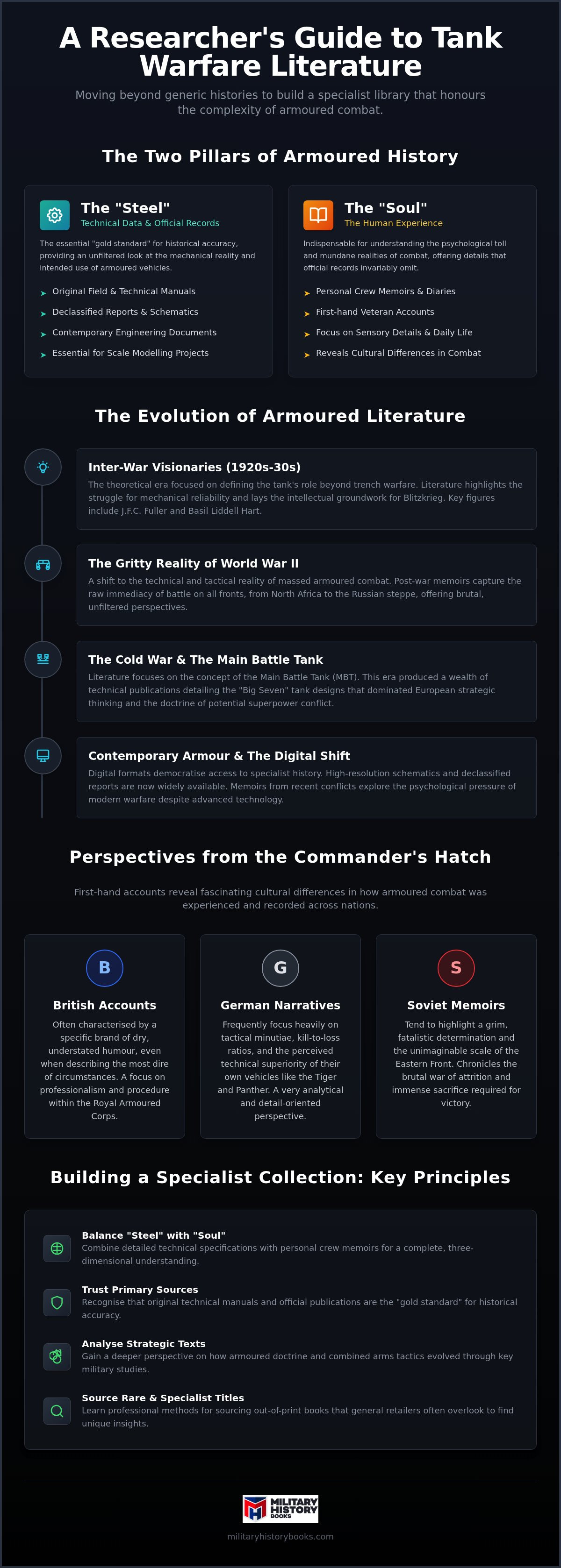
The true history of armoured combat isn't found in broad sweeping maps of troop movements, but rather in the grease-stained maintenance logs and private letters of the crews who lived within the steel. If you've spent years building a library, you'll know the frustration of wading through repetitive, generic histories that offer little new insight. It's often difficult to find the precise technical details of a specific variant or to locate those elusive, out-of-print titles that provide the missing piece of a historical puzzle. Finding the right tank warfare books requires a discerning eye and a passion for the preservation of military heritage.
This guide serves as your curated roadmap to the most significant literature in the field, bridging the gap between high-level strategy and the mechanical reality of the battlefield. We'll help you distinguish between the "steel" of technical manuals and the "soul" of personal memoirs. This ensures you know exactly which volumes provide the depth your research requires. From classic land warfare studies to rare specialist publications, you'll discover a structured list of essential reading that honours the weight and complexity of armoured history.
Key Takeaways
- Learn how to balance technical data with the human experience by selecting tank warfare books that combine detailed specifications with personal crew memoirs.
- Understand why technical manuals and official publications remain the essential "gold standard" for historical accuracy and scale modelling projects.
- Gain a deeper perspective on how armoured doctrine and combined arms tactics evolved through the analysis of key strategic military texts.
- Discover professional methods for sourcing rare and out-of-print specialist titles that general retailers often overlook.
- Identify the specific literature required to move beyond generic histories and into the realm of specialist armoured research.
The Evolution of Armoured Combat in Specialist Literature
Armoured combat literature is a unique intersection of mechanical engineering, tactical doctrine, and human endurance. To understand the field, one must look beyond popular history. True tank warfare books provide a comprehensive view of the vehicle as both a weapon system and a crew's home. This evolution in writing mirrors the technology itself, shifting from the visionary theories of the 1920s to the gritty, technical reality of the 1940s. Primary sources, such as original field manuals and contemporary technical reports, are essential. They offer an unfiltered look at how commanders actually intended to use their machines, rather than how later historians interpreted those actions. Specialist publishers play a vital role here, preserving niche documents that larger houses might consider too granular for a general audience.
From the Great War to Blitzkrieg
The earliest literature was often speculative and visionary. Pioneers like J.F.C. Fuller and Basil Liddell Hart wrote extensively during the inter-war years, attempting to define a role for the tank beyond its initial use as a trench-breaker. These works laid the intellectual foundation for what would become the Panzer divisions. For the serious researcher, inter-war technical manuals are particularly fascinating. They highlight the desperate struggle for mechanical reliability that defined early armoured development. Without these records, it's easy to forget that the greatest enemy of a 1930s tank was often its own transmission rather than an anti-tank gun.
Modern Perspectives on Cold War and Contemporary Armour
As the Cold War progressed, the literature shifted focus towards the concept of the Main Battle Tank (MBT). This era produced a wealth of technical publications detailing the "Big Seven" designs that dominated European strategic thinking. Modern tank warfare books now frequently incorporate digital titles and downloads, allowing researchers to access high-resolution schematics and declassified reports that were once impossible to find. This digital shift has democratised access to specialist military history, ensuring that the technical nuances of modern combat are preserved for future generations of historians and enthusiasts alike.
First-Hand Accounts: Memoirs of the Tank Crews
While technical manuals provide the "steel" of history, crew memoirs offer the "soul". These personal narratives are indispensable for understanding the psychological toll of armoured combat. Authentic tank warfare books written by those who actually sat in the commander's seat or loaded the 17-pounder gun provide details that official records often omit. Distinguishing between genuine veteran accounts and ghost-written fiction is a skill every serious collector develops. Authentic memoirs usually focus on the mundane realities: the smell of hot oil, the deafening noise of the engine, and the constant maintenance required to keep the tracks turning.
Comparing international perspectives reveals fascinating cultural differences in how combat was recorded. British accounts, particularly those from the Royal Armoured Corps, often lean into a specific brand of dry, understated humour even in the most dire circumstances. In contrast, Soviet memoirs frequently highlight a grim determination and the sheer scale of the Eastern Front, whilst German narratives often focus heavily on tactical minutiae and the technical superiority of their mounts. These differences help historians build a more three-dimensional view of the battlefield.
Essential WWII Memoirs for the Serious Reader
Robert Kershaw’s "Tank Men" changed the landscape by weaving together disparate voices into a cohesive narrative of the human experience. However, for those seeking deeper detail, sourcing out-of-print memoirs from the North African or Italian campaigns is often the most rewarding path. These niche publications, often released shortly after the war, capture a raw immediacy that later histories lose. The Eastern Front remains a significant area of interest, with translated diaries providing a brutal look at the war of attrition that defined the Russian steppe.
The Personal Side of Modern Armoured Conflict
Modern military biography books have evolved from the formal, stiff prose of the early 20th century into more candid, psychological explorations of conflict. Accounts from the Gulf War and more recent peacekeeping missions show that despite advanced thermal optics and digital fire control, the fundamental experience of the tank crew remains one of isolation and intense pressure. Preserving these stories is vital for future historians. If you are looking to expand your collection with these deeply personal stories, you can browse a wide range of land warfare books that capture these unique veteran perspectives.
Technical Manuals and Modelling References
Moving from the personal accounts of the previous section to technical specifications requires a shift in perspective. While memoirs tell us how it felt to serve, technical military publications tell us exactly how the machinery functioned. These documents are the gold standard for historical accuracy because they were never intended for public consumption; they were functional tools for crews and mechanics. For the researcher, these tank warfare books provide the definitive answer to questions about armour thickness, engine output, and ballistic performance. They strip away the myths of post-war legend and replace them with the cold, hard data of the era.
Visual researchers often find that standard histories lack the granular detail needed to reconstruct a vehicle's appearance. This is where series like "Images of War" become essential. They offer a bridge between dry text and visual evidence, providing high-quality photographic plates that show vehicles in their true operational environments. Using back-issue magazines alongside these volumes allows you to find rare diagrams and internal photographs that clarify complex mechanical systems, such as the intricate cooling fans of a Panther or the hydraulic systems of a Centurion.
Sourcing Technical Manuals for Specific Vehicles
Finding accurate technical data for vehicles ranging from the Tiger I to the Chieftain isn't always straightforward. Many modern summaries gloss over the finer points of internal layouts. Serious historians and restorers look for stowage diagrams and internal drawings that show where every shell, tool, and personal item was kept. It's vital to identify authentic technical reprints rather than modern summaries that might simplify the data. These reprints preserve the original formatting and nomenclature, ensuring that your research remains rooted in the primary source material.
Modelling Magazines as a Historical Resource
Scale modelling and historical research are deeply interconnected. Serious modellers often possess a more thorough understanding of specific vehicle variants than general historians because their hobby demands physical accuracy. This is why modelling magazines military titles are such a valuable resource for the library. Back-issue magazines often contain rare photographs and 1/35th scale drawings that haven't appeared in traditional tank warfare books. They document field modifications, unique camouflage patterns, and the subtle differences between production batches that define a vehicle's history. These specialist titles offer a level of insight that general history books simply cannot match, making them indispensable for anyone building a comprehensive armoured warfare archive.
Strategic Studies and Pivotal Tank Battles
Strategic analysis requires a different mindset from the researcher. Whilst a memoir tells you what it was like to be in the turret, a strategic study explains why the tank was there in the first place. High-quality tank warfare books focusing on doctrine examine the "big picture" of how armoured forces integrate with infantry, air support, and logistics. This combined arms approach is the foundation of modern military thought. Understanding these concepts requires reading authors who provide objective, data-driven analysis rather than those who rely on popular myths. Campaign-specific histories are particularly vital here, as they often reveal how supply lines and fuel shortages dictated the outcome of battles more than the thickness of a tank's glacis plate.
If you're looking to build a library that covers these complex strategic themes, you can explore our curated collection of land warfare books. These titles are selected for their depth and historical accuracy, providing the context needed to understand the true nature of armoured conflict.
Decisive Armoured Engagements in Print
While the Battle of Kursk often dominates historical discussion, other engagements offer equally valuable lessons in tactical doctrine. Literature covering the North African campaign, specifically El Alamein, highlights the immense logistical challenges of desert warfare. Similarly, accounts of the Golan Heights during the 1973 Yom Kippur War demonstrate the lethality of modern Main Battle Tanks in defensive positions. To fully grasp how these battles were fought, one must also consider the role of anti-tank defences. Consulting artillery history books is essential for understanding how the "King of Battle" frequently dictated the movement and survival of armoured formations on the field.
The Evolution of Tank Doctrine
The transition from the inter-war "cavalry" role to the development of the modern MBT is a central theme in specialist literature. Early texts often debate whether tanks should be used as infantry support or as independent breakthrough forces. The "Tank Destroyer" concept, popularised during the 1940s, provides a fascinating look at how different nations attempted to solve the problem of enemy armour through specialised, high-velocity gun platforms. For those focusing on the British experience, wartime history books UK offer an unparalleled reference for how the Royal Armoured Corps evolved from the light tanks of the 1930s to the heavy hitters that crossed the Rhine.
Sourcing Rare and Specialist Tank Warfare Titles
Building a comprehensive collection of tank warfare books is more than a simple hobby; it's an act of historical preservation. General retailers often lack the nuance to distinguish between a mass-market reprint and a rare first edition, focusing instead on what is currently trending. They miss the depth required for a research-grade library, whilst the most valuable information often resides in volumes long since forgotten by commercial publishers. Sourcing out of print military books requires a specialist who understands the technical and historical weight of the material. A veteran-owned bookshop, managed by those with genuine service experience, offers a distinct advantage. The stock is selected with deep subject expertise rather than by a generic algorithm, ensuring that every title adds real value to your archive.
The Specialist Advantage for Collectors
With an inventory exceeding 10,000 specialist titles, a dedicated curator provides access to rare land warfare books that have been out of commercial circulation for decades. These aren't just products; they're historical documents that require careful handling. Identifying a genuine first edition or a signed memoir from a decorated tank commander requires a keen eye for detail that only comes from years of immersion in the field. Collectors also need the peace of mind that their investment is protected. Secure, specialist packaging is a hallmark of a professional service, ensuring that fragile dust jackets and aged bindings arrive in the same condition they left the archive.
Starting Your Tank Warfare Library
For those beginning their journey into armoured history, the initial search can feel daunting. A solid foundation starts with a mix of the technical and the personal, as we've explored in the preceding sections. If you're looking to introduce a fellow enthusiast to the subject, military history gift books UK selections provide an excellent starting point. Before purchasing a rare title, use a consistent checklist to verify its condition. Look for original maps, check the integrity of the spine, and confirm the authenticity of any signatures. A reliable specialist is always willing to assist with these specific requests, helping you build a library that stands as a true testament to armoured history.
Building Your Definitive Armoured Warfare Archive
Establishing a research-grade library requires a careful balance between the technical precision of official manuals and the raw honesty of veteran memoirs. By understanding how doctrine evolved and where to source those elusive out-of-print gems, you ensure your collection remains both accurate and deeply personal. Finding the right tank warfare books is a journey that connects you directly to the steel and the stories of the past.
At Military History Books, we're dedicated to helping you locate those missing pieces. Our shop is expertly curated by an RAF veteran with deep subject expertise, offering a stock of over 10,000 specialist titles. We specialise in rare and out-of-print land warfare titles that general retailers often overlook; we also provide secure international delivery for collectors worldwide. Explore our collection of over 10,000 military history titles at Military History Books and discover the literature that defines your interest.
Whether you're a serious researcher or a dedicated modeller, the right volume is waiting to be discovered. Your next great find is just a few clicks away.
Frequently Asked Questions
What are the best tank warfare books for beginners?
Beginners should start with titles that balance technical detail with a strong narrative. Robert Kershaw's "Tank Men" is an excellent entry point as it focuses on the human experience across multiple nations. For a broader overview, look for general land warfare books that explain the development of armoured doctrine during the World Wars. These provide the necessary context before you dive into more granular tank warfare books or specific unit histories.
How can I find out-of-print technical manuals for WWII tanks?
Locating out-of-print technical manuals requires searching beyond general retailers. Specialist military bookshops are the most reliable source, as they often stock rare publications that are no longer in commercial circulation. You can find original stowage diagrams, maintenance logs, and internal layout drawings that were once restricted to crew members. These documents are often available as physical reprints or digital titles on disc, providing essential data for historians and restorers alike.
Are there any accurate novels about tank warfare?
Accurate military fiction titles can provide a visceral understanding of armoured combat that traditional histories might miss. Look for novels written by veterans or those that rely heavily on primary source research to ensure technical details are correct. Whilst these are dramatised, they often capture the claustrophobia and mechanical stress of life inside a tank. We stock a curated selection of military fiction that respects the historical reality of the crews who served.
Which books cover the history of the Royal Armoured Corps in detail?
Detailed histories of the Royal Armoured Corps are often found in unit-specific publications and official regimental records. These books document the transition from cavalry roles to modern armoured warfare, covering everything from the early light tanks to the heavy Churchill and Centurion models. For a comprehensive view, look for titles that analyse British armoured development through the lens of wartime history books UK collectors frequently seek for their accuracy and depth.
Where can I buy rare military history books in the UK?
You can buy rare military history books through specialist online retailers who focus exclusively on this niche. General bookstores rarely carry the deep, out-of-print inventory required by serious researchers. A UK-based specialist managed by a veteran offers the best expertise for sourcing rare first editions and technical publications. These shops provide secure international delivery, ensuring that valuable land warfare books reach collectors in pristine condition, regardless of their location.
What is the difference between a technical publication and a general history book?
Technical publications focus on the mechanical and operational specifications of a vehicle, such as engine output, armour thickness, and internal stowage. They are functional tools rather than narratives. In contrast, general history books provide a broader overview of campaigns, strategic decisions, and political contexts. For a complete understanding of tank warfare books, a serious library should include both technical manuals for accuracy and general histories for strategic perspective.
Are digital military history books as good as physical copies for research?
Digital military history books are an excellent resource for active research, as they allow for quick keyword searching and high-resolution zooming on technical diagrams. They are often available via download or on disc, making rare information more accessible and affordable. However, many collectors still prefer physical copies for their tactile value and historical presence. Both formats serve a purpose, with digital versions being ideal for frequent reference and physical books for long-term preservation.
Why should I buy from a specialist military bookshop instead of a general retailer?
Specialist military bookshops offer a level of curation and subject-matter expertise that general retailers simply cannot match. Instead of relying on a generic algorithm, a specialist understands the historical significance of their inventory. You'll have access to over 10,000 titles, including rare land warfare books and back-issue modelling magazines that are often missing from mainstream shops. This expertise ensures you find the most accurate and valuable literature for your specific research needs.


