

For the dedicated enthusiast, the true history of the Royal Air Force isn't captured in a brief digital summary, but in the weathered pages of a 1940s Pilot's Notes manual or the candid reflections found within a rare, out-of-print memoir. You likely understand the frustration of searching for precise technical details for a scale modelling project, only to find surface-level accounts that lack the depth required for serious research. It's a common challenge to distinguish between general history and the expert-level insights that bring a specific aircraft's story to life.
This guide promises to bridge that gap by exploring the storied evolution of the service, from its pioneering 1918 origins to its current fleet of 657 active aircraft in 2026. You'll learn how to identify essential technical literature, source elusive aviation titles, and understand the shifting landscape of British aerospace power. We will preview the key eras of flight, provide tips for finding reliable research materials amongst a sea of generic titles, and help you build a library that serves as a trustworthy bridge to the past.
Key Takeaways
- Understand how the Royal Air Force was formed in 1918 through the strategic merger of the RFC and RNAS to become the world's first independent air arm.
- Explore the evolution of British air power, from the defensive strategies of the Battle of Britain to the nuclear deterrent role of the Cold War V-Force.
- Gain insight into modern frontline operations and the technical capabilities of the current fleet, including the Eurofighter Typhoon and F-35B Lightning II.
- Learn how to identify and source specialist aviation literature, such as rare out-of-print memoirs and technical manuals, that offer more depth than general history books.
- Discover practical tips for building a comprehensive research library, including the benefits of digital titles for immediate access to specialist data.
The Origins of the Royal Air Force: A Century of Air Power
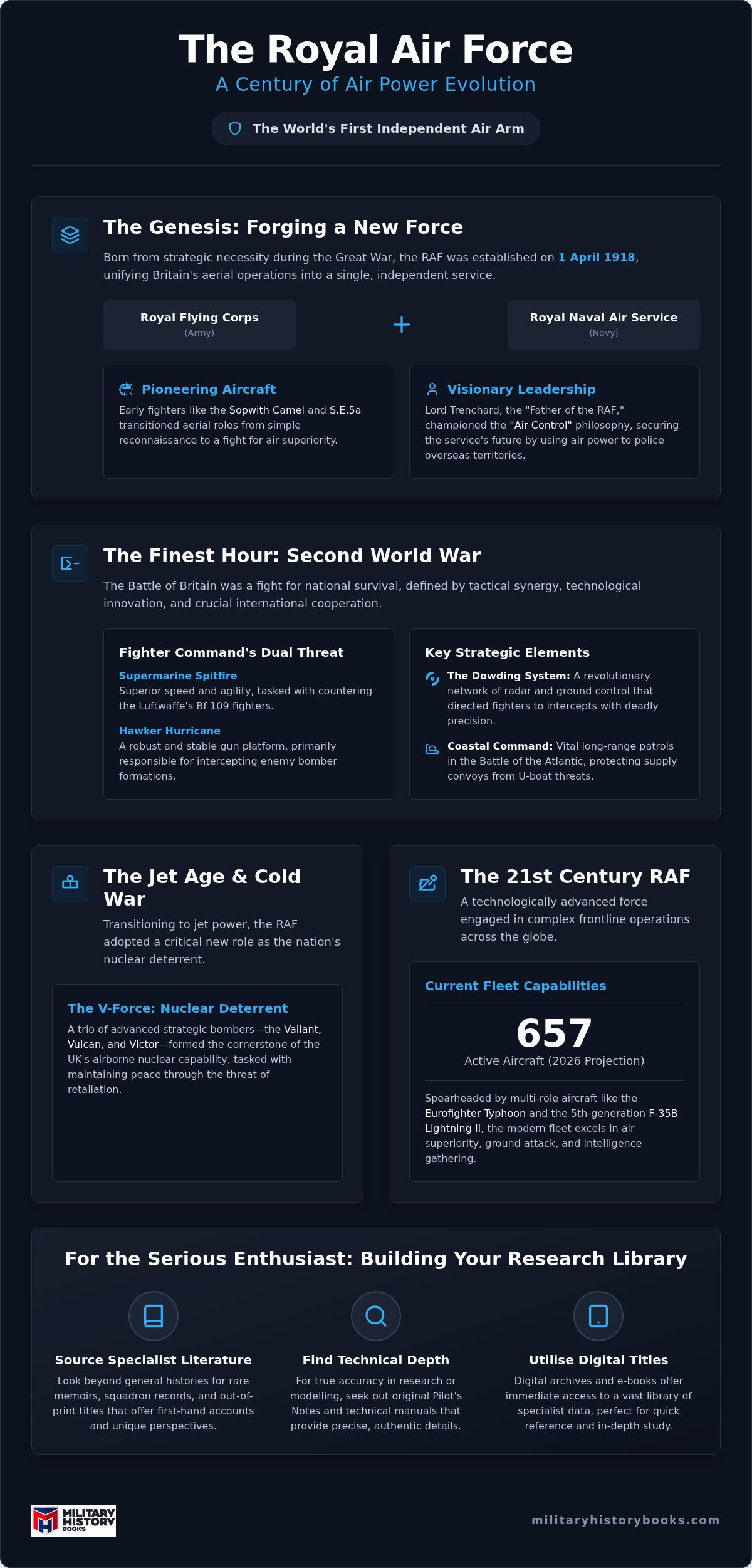
The Royal Air Force was founded on 1 April 1918, marking the moment it became the first service in the world to operate as an independent air arm. It emerged during the final, desperate months of the Great War, born from a strategic necessity to unify British aerial operations. Before this, the Royal Flying Corps (RFC) served the British Army whilst the Royal Naval Air Service (RNAS) supported the fleet. This division often led to competition for resources and conflicting tactical goals. The merger created a singular entity capable of conducting strategic bombing and defending the home front with a unified command structure.
The transition from reconnaissance to aerial combat happened rapidly. Early crews flew fragile biplanes like the Royal Aircraft Factory B.E.2 for spotting artillery, but the arrival of dedicated fighters such as the Sopwith Camel and the S.E.5a changed the nature of warfare. These machines were no longer just the "eyes" of the army; they were weapons of air superiority. Lord Trenchard, widely regarded as the "Father of the RAF," was instrumental during these formative years. He fought tirelessly to ensure the service wasn't dismantled after the Armistice, envisioning a force that could project power far beyond the reach of traditional ground troops.
The 1918 Merger and the Birth of a New Service
The Royal Air Force was established as an independent branch of the British Armed Forces to centralise aviation strategy and provide a dedicated command for air warfare. Creating this third service was an administrative feat. It required merging two distinct cultures with different traditions and pay scales. To forge a new identity, the RAF adopted a unique light blue uniform and a rank structure entirely separate from the Army and Navy. Ranks like Wing Commander and Squadron Leader replaced traditional military titles, cementing the idea that air power required its own specialised expertise.
Inter-war Expansion and the "Air Control" Philosophy
During the lean years of the 1920s, the service faced constant pressure from the older branches of the military. Trenchard secured the RAF's future through the "Air Control" philosophy, using aircraft to police vast overseas territories more cheaply than traditional garrisons. This era saw significant leaps in long-range flight and engine reliability. Collectors and researchers can find many aviation history books that detail these early colonial operations and the record-breaking flights that defined the inter-war period. These specialist titles provide the technical depth and personal accounts that general histories often omit, documenting the RAF's evolution into a global aerospace power.
The Second World War: The RAF’s Finest Hour
The Battle of Britain remains the most iconic chapter in the history of the Royal Air Force. It wasn't just a tactical victory but a struggle for national survival. Whilst the "Few" are often depicted as purely British, the force relied heavily on pilots from across the Commonwealth and occupied nations like Poland and Czechoslovakia. This international cooperation was vital to the air campaign's success, providing seasoned veterans at a time when training schools were stretched to their limits. These pilots brought varied combat experience that proved essential in countering the Luftwaffe's tactics.
Often overshadowed by the drama of dogfights, Coastal Command played a pivotal role in the Battle of the Atlantic. Their long-range patrols protected vital supply lines from U-boat threats, ensuring the UK could continue the fight. This campaign required immense endurance and technical precision, as crews spent long hours over the grey Atlantic. For those looking to explore these operational records, you might browse our collection of rare aviation titles to find specific squadron histories and technical logs that detail these maritime missions.
Fighter Command and the Defence of the Skies
The tactical synergy between the Supermarine Spitfire and the Hawker Hurricane defined the summer of 1940. The Spitfire's superior speed and agility often countered the Bf 109, whilst the Hurricane's robust construction made it the primary tool for intercepting enemy bombers. This aerial success was underpinned by the Dowding System, a sophisticated network of early radar and ground-based control. Researchers can find detailed accounts of this period in specialised wartime history books UK, which offer a deeper look into the home front's defensive architecture and the technical evolution of radar technology.
Bomber Command: The Heavy Metal Campaign
As the war progressed, the focus shifted from defence to a strategic air campaign. The evolution from light, twin-engine bombers to the "Heavenly Twins"—the Avro Lancaster and Handley Page Halifax—allowed for unprecedented payloads. The sacrifice was immense, with over 55,000 airmen lost in the pursuit of degrading the enemy's industrial capacity. To truly understand this campaign, one must look beyond statistics. Personal memoirs provide a harrowing human perspective, whilst technical publications on navigation aids like Oboe and H2S radar reveal the scientific battle fought in the dark. For more historical context on these developments, the official Royal Air Force website provides excellent archives on legacy platforms and the heritage of Bomber Command.
The Jet Age and Cold War Evolution
The post-war era saw the Royal Air Force undergo a rapid technological metamorphosis. It wasn't merely a case of replacing piston engines with turbines; it was a fundamental shift in how air power was projected in a world of supersonic speeds and nuclear standoffs. The Gloster Meteor paved the way as the first operational jet, yet it was the English Electric Lightning that truly defined the interceptor role. Capable of Mach 2, the Lightning was designed to climb to 60,000 feet in minutes, acting as a high-speed shield against potential threats. During this period, the service also managed "brushfire" conflicts across the globe, from the jungles of Malaya to the arid landscapes of Aden, proving that air power was as much about tactical support and transport as it was about high-altitude interception.
Tracking the logistical and operational shifts of this era requires access to contemporary accounts. For researchers and collectors, back issue military magazines UK provide an invaluable window into Cold War squadron movements and the day-to-day realities of life on high-readiness airbases. These periodicals often capture technical details and base-level insights that broader historical surveys might overlook.
The V-Force and the Nuclear Deterrent
Central to the UK's strategic posture was the V-Force, comprising the Vickers Valiant, Handley Page Victor, and the iconic Avro Vulcan. Each aircraft was born from a distinct design philosophy: the Valiant was the conventional pathfinder, the Victor utilised a crescent wing for aerodynamic efficiency, and the Vulcan employed a delta-wing configuration that became a symbol of British engineering. The "Scramble" culture defined life on V-Force stations, where crews lived in constant readiness to launch within four minutes. Collectors often seek original technical manuals for these platforms to better understand the complex systems required for early electronic countermeasures and nuclear delivery.
Tactical Innovation: From Harrier to Tornado
The late Cold War introduced the Harrier, a revolution in Vertical Short Take-Off and Landing (VSTOL) technology. This allowed the Royal Air Force to operate from hidden woodland clearings, making them less vulnerable than those tied to fixed concrete runways. This era of tactical flexibility culminated in the Panavia Tornado, a multi-role platform designed for low-level penetration. Understanding how these aircraft integrated with ground-based units is often best explored through artillery history books, which detail the joint land-air operations essential for modern territorial defence and the coordination of fire support during complex campaigns.
Modern Operations: The RAF in the 21st Century
Since the turn of the millennium, the Royal Air Force has transitioned from the large-scale conventional deployments of the Gulf War and Balkans to a more agile, technologically integrated model. Recent operations demonstrate this high-readiness posture, such as the four-month NATO air policing deployment in Romania which concluded on 31 July 2026. During Operation Biloxi 2026, RAF Typhoons conducted 49 Quick Reaction Alert scrambles, maintaining crews at very high readiness for more than 1,500 hours. This modern era is defined by a shift away from legacy platforms like the Tornado and C-130J Hercules towards a smaller but more capable fleet of 657 active aircraft.
Global reach is maintained through a sophisticated logistics backbone. The fleet of 22 A400M Atlas transport aircraft, alongside the Voyager tanker fleet, ensures the UK can project power and provide humanitarian aid across vast distances. This capability was recently highlighted by the Red Arrows' 2024 North American tour, with the team returning to the UK in August 2026. If you are looking to document these modern deployments or find technical details for current airframes, browse our latest modelling magazines and digital titles for expert-level research and high-resolution references.
The Typhoon and F-35B: Integrated Air Power
The current combat fleet is built around 107 Typhoon FGR4s and 47 F-35B Lightning II aircraft. Whilst the Typhoon provides air-to-air dominance and will remain the primary combat platform until at least 2040, the F-35B offers fifth-generation stealth and advanced sensor fusion. These platforms are increasingly operated under the "Agile Combat Employment" doctrine. This strategy focuses on dispersing aircraft to austere locations to increase survivability against modern threats. Contemporary aviation journals are essential for readers tracking these 2026 developments, as they detail the integration of these two distinct airframes in complex multinational exercises like Pitch Black.
Space Command and the Future of the RAF
The formation of UK Space Command marks a fundamental shift towards multi-domain operations. The Royal Air Force now integrates satellite data and space-based surveillance into its core strategy, protecting UK interests above the atmosphere. This technological evolution is mirrored in the growth of Remotely Piloted Air Systems (RPAS). The Protector RG Mk1 is currently replacing the legacy Reaper, providing persistent ISTAR capabilities that allow for long-endurance missions. As the service looks toward the Global Combat Air Programme (GCAP), the focus is moving towards uncrewed collaborative platforms that will operate alongside future sixth-generation fighters.
Building Your RAF Research Library: Sourcing Specialist Titles
Specialist aviation literature provides a level of granular detail that general history titles simply cannot match. Whilst a broad survey might mention the 1918 merger, a specialist title will explore the specific administrative hurdles and the personal journals of those who lived through it. For serious researchers, out of print military books are often the only way to access primary source material that hasn't been diluted by modern interpretation. At Military History Books, we curate an inventory of over 10,000 titles, managed by an RAF veteran who understands the importance of technical accuracy and historical preservation. This expertise ensures that whether you're looking for a specific squadron history or a detailed airframe study, the material meets the high standards required for expert-level research.
How to Source Rare and Out-of-Print RAF Titles
Finding specific records within the vast history of the Royal Air Force requires a methodical approach. General marketplaces often lack the nuanced categorisation needed for military research, making it difficult to distinguish between surface-level accounts and expert-level documentation. Follow these steps to build a reliable archive:
- Step 1: Identify the specific squadron, station, or aircraft variant of interest to narrow your search parameters.
- Step 2: Search specialist inventories like ours, where titles are organised by subject matter expertise rather than broad genres.
- Step 3: Verify the edition and physical condition. This is particularly important for technical manuals where diagrams and fold-out schematics must be intact.
- Step 4: Utilise digital downloads for immediate access to technical data when a physical copy is unavailable or for use in a workshop environment.
The Value of Technical Manuals and Modelling Magazines
For the scale modeller or technical enthusiast, Air Publication (AP) manuals are the ultimate reference tool. These original documents, often sourced as rare and out-of-print titles, provide exact specifications for everything from cockpit layouts to camouflage schemes. Back-issue magazines also play a vital role, acting as a chronological record of specific airframe histories and camouflage transitions that might only be mentioned in passing elsewhere. We support our global community of collectors with secure international delivery, ensuring that these fragile pieces of history reach you in excellent condition. By acting as a bridge between the past and the modern enthusiast, we help preserve the technical stories of the Royal Air Force for future generations.
Preserving the Legacy of British Air Power
The journey of the Royal Air Force is a testament to constant innovation, moving from the fragile biplanes of 1918 to the multi-domain capabilities of the 21st century. By understanding the strategic shifts of the Cold War and the technical complexities of modern stealth platforms, you gain a deeper appreciation for the service's global impact. True insight, however, requires looking beyond general summaries and engaging with the specialist literature that records these events in detail. Whether you're a serious researcher or a dedicated modeller, the right technical manuals and out-of-print titles provide the precision needed to bring history to life.
As a business managed by an RAF veteran with deep subject-matter expertise, we're proud to offer an inventory of over 10,000 titles. You can browse our extensive collection of Royal Air Force history books and rare titles to find everything from technical Air Publications to elusive squadron memoirs. With global secure delivery and a focus on rare aviation literature, we're here to help you build a library that truly honours the past. We look forward to assisting you with your next research project.
Frequently Asked Questions
What is the oldest squadron in the Royal Air Force?
No. 1 Squadron is the oldest unit in the Royal Air Force, tracing its lineage back to the Balloon Section of the Royal Engineers established in 1878. This unit later became No. 1 Company of the Air Battalion in 1911 before being incorporated into the Royal Flying Corps. Such deep historical roots are often documented in specialist squadron histories that provide far more detail than general military overviews found in mainstream bookstores.
How did the RAF get its name?
The name was formalised through the Air Force (Constitution) Act 1917, which created the legal framework for a third, independent branch of the British Armed Forces. This title was chosen to reflect its status alongside the Royal Navy and the British Army. It signified a shift in military doctrine, acknowledging that air power required its own dedicated command structure and identity rather than remaining a secondary wing of the older services.
What is the difference between the RFC and the RAF?
The primary difference is their command structure and independence. The Royal Flying Corps (RFC) operated as a wing of the British Army, focusing primarily on reconnaissance and artillery spotting. In contrast, the new service established in 1918 was formed as a sovereign branch, merging the RFC with the Royal Naval Air Service. This independence allowed for a unified air strategy, enabling the command to conduct strategic bombing and home defence missions.
Where can I buy rare RAF history books online?
You can source rare and out-of-print aviation history books through specialist retailers like Military History Books. Our inventory includes over 10,000 titles, curated by an RAF veteran with extensive subject-matter expertise. We specialise in finding elusive memoirs, technical manuals, and modelling magazines that aren't typically available through general marketplaces. We provide global secure delivery for collectors worldwide, ensuring that these specialist titles reach you in excellent condition for your research.
Are there digital versions of RAF technical manuals available?
Digital versions of many technical publications are readily available for immediate research. We offer a variety of digital titles by download or on disc, which is particularly helpful for modellers who need high-resolution diagrams of specific airframes. These files often include original Air Publication (AP) manuals and Pilot's Notes. Accessing these digital resources allows researchers to cross-reference technical data quickly without waiting for physical delivery of rare or fragile out-of-print titles.
What aircraft does the RAF currently fly in 2026?
As of August 2026, the Royal Air Force operates a fleet of 657 active aircraft. This includes 107 Typhoon FGR4s, which remain the primary combat aircraft, and 47 F-35B Lightning II stealth fighters. The transport fleet is anchored by 22 A400M Atlas aircraft, whilst training is supported by 170 aircraft. With 37 more aircraft on order, the service continues to modernise its capabilities through the integration of uncrewed systems and advanced sensor platforms.
How can I find information on a relative who served in the RAF?
To research a relative's service history, you should begin by applying for their official service records from the Ministry of Defence. Once you have their squadron number, you can consult operational record books (ORBs) held at the National Archives. These documents provide a daily log of a squadron's activities. For a more personal perspective, searching for out-of-print memoirs or back-issue magazines from the relevant era can help you understand the daily life and challenges they faced.
Why are out-of-print aviation books valuable for researchers?
Out-of-print aviation books are essential because they frequently contain primary source data and technical schematics that modern reprints omit. These older volumes often feature first-hand accounts from aircrew and engineers, providing a level of granular detail necessary for accurate historical research or scale modelling. They serve as a bridge to the past, preserving technical specifications and personal stories that might otherwise be lost as legacy platforms are retired and original documents become increasingly rare.


