

Can a technical manual ever truly capture the visceral reality of a trench? For many historians, the primary challenge isn't just finding infantry warfare books, but distinguishing between sensationalised fiction and the authoritative literature that defines a conflict. You likely recognise the difficulty in sourcing material that offers both precise technical diagrams and the raw human narrative of the front line. It's a delicate balance to strike when you're trying to build a collection that is both historically significant and deeply personal.
This guide will show you how to source, categorise, and collect a library that balances tactical theory with the reality of combat. We'll explore the evolution of infantry equipment and behaviour, whilst highlighting how to identify reliable UK-based specialists for rare and out-of-print titles. From the latest June 2025 ATP 3-21.8 doctrine for rifle squads to the comprehensive August 2025 updates on mortar training, we provide a roadmap for building a collection that serves both the serious researcher and the dedicated enthusiast. Whether you're looking for digital titles or rare first editions, understanding how to navigate this vast archive is the first step towards preserving these vital stories.
Key Takeaways
- Learn to distinguish between technical field manuals and first-hand accounts to create a comprehensive and well-rounded historical perspective.
- Understand the evolution of small unit tactics, from the static trench warfare of the Great War to the complex integration of modern combined arms.
- Discover why veteran memoirs are essential for capturing the psychological reality and the "fog of war" that technical diagrams often omit.
- Master the skills needed to source rare infantry warfare books, focusing on identifying authentic dust jackets and significant out-of-print editions.
- Gain insights into curating a high-quality library by leveraging specialist veteran expertise and an inventory of over 10,000 authoritative titles.
Understanding the Scope of Infantry Warfare Literature
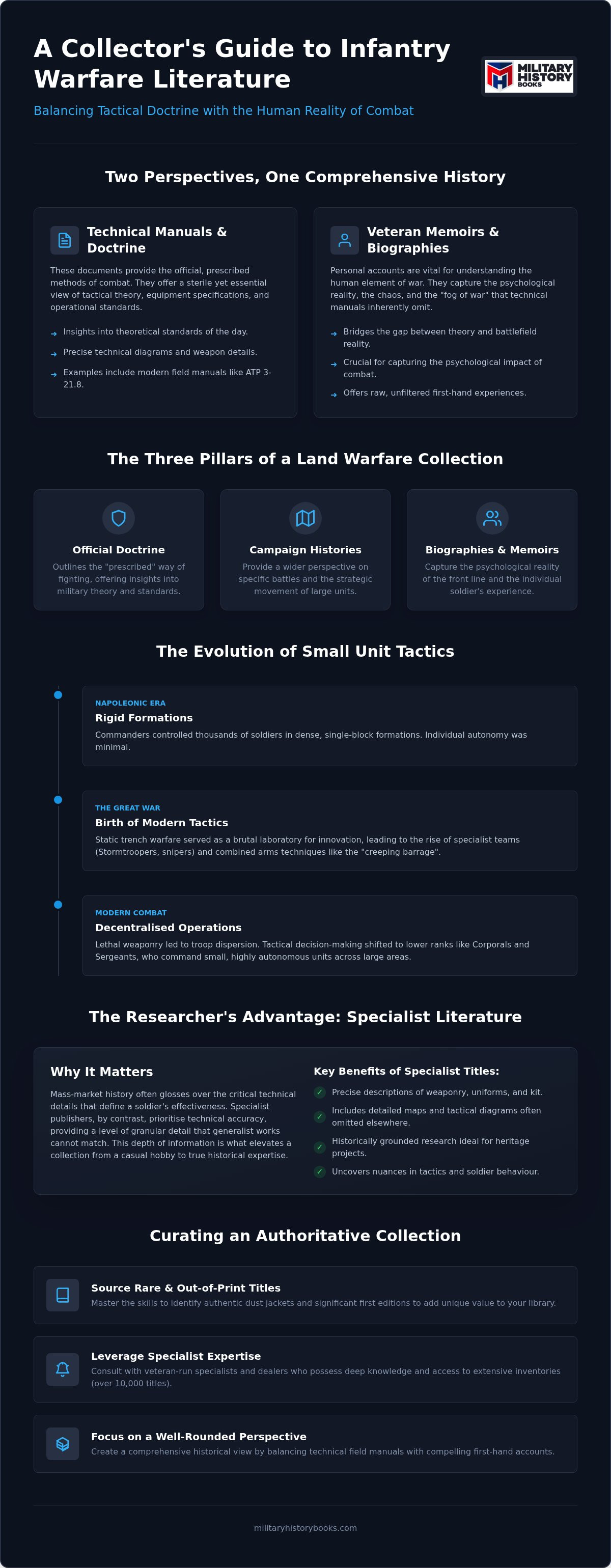
Ground-based combat remains the most intimate and enduring form of conflict. For the serious researcher, infantry warfare books represent far more than a simple record of past skirmishes; they are the essential study of the "Queen of the Battle." These works focus on the evolving tactics, specialised equipment, and the lived experiences of soldiers who hold the ground. Whether you're examining the rigid formations of the Napoleonic era or the fluid, high-tech nature of modern asymmetrical combat, this literature provides the necessary framework to understand how wars are truly won or lost at the tactical level.
The scope of this field is vast, covering centuries of human development. A comprehensive understanding of the History of Infantry Warfare requires looking at how the individual soldier's role has shifted from a cog in a massive machine to a highly autonomous decision-maker. This transition is documented across various formats, each offering a unique lens through which to view the battlefield. It's why infantry literature remains the cornerstone of any serious land warfare library; it is the only genre that captures the intersection of high-level strategy and the granular reality of the individual rifleman.
The Core Sub-genres of Land Warfare Books
Building a robust collection involves categorising literature into three primary pillars. First, there are official training manuals and doctrine. These documents, such as the recently updated ATP 3-21.8, outline the "prescribed" way of fighting, offering insights into the theoretical standards of the day. Second, campaign histories provide a wider perspective, focusing on specific battles and the strategic movement of battalions. Finally, biographies and memoirs offer the psychological reality of the front line. These personal accounts bridge the gap between the sterile instructions of a manual and the chaotic reality of the "fog of war."
Why Specialist Literature Beats General History
Mass-market history often glosses over the technical nuances that define a soldier's effectiveness. Specialist publishers prioritise technical accuracy, ensuring that descriptions of weaponry, uniforms, and kit are precise and historically grounded. These books often include detailed maps and tactical diagrams that are frequently omitted from general titles. For those conducting national heritage research, sourcing wartime history books UK provides a level of granular detail that generalist works simply cannot match. It's this depth of information that allows a collector to move beyond a surface-level understanding and into the realm of true historical expertise.
The Evolution of Small Unit Tactics and Strategy
The transition from the rigid lines of the 19th century to the decentralised chaos of modern combat is a central theme in the most authoritative infantry warfare books. As weaponry became more lethal, the density of troops on the battlefield decreased. This dispersion fundamentally altered soldier behaviour. Whilst a Napoleonic Colonel might command a thousand men in a single block, a modern Lieutenant often operates with a fraction of that number across a much larger area. This shift placed the Corporal and Sergeant at the centre of tactical decision-making. The adoption of the bolt-action rifle and, later, sophisticated optics, meant that small units could exert influence far beyond their physical footprint. Understanding this decentralisation is key to interpreting modern doctrine, including the latest June 2025 updates to infantry squad techniques.
Trench Warfare and the Birth of Modern Tactics
The Great War served as a brutal laboratory for tactical innovation. Literature covering the Somme often highlights the evolution of the "creeping barrage," a technique that required pinpoint coordination between infantry and artillery. This era saw the end of the generalist rifleman and the rise of specialist teams. Stormtroopers, snipers, and machine-gun sections emerged to break the static deadlock of the Western Front. For a deeper look at these developments, researchers often consult resources on Infantry Tactics and Combat to understand how these early small-unit doctrines laid the groundwork for today's military techniques. Essential titles from this period focus on how the infantryman survived and adapted amongst the mud and wire.
World War II and the Mobile Infantry
By 1939, the focus had shifted from static defence to rapid mobility. Combined arms operations became the standard, requiring infantry to integrate seamlessly with armour and aviation. Books detailing the Blitzkrieg illustrate how mechanisation allowed ground troops to keep pace with tanks, fundamentally changing the tempo of operations. This period also refined urban combat, with the ruins of Stalingrad and the streets of Berlin providing a grim template for modern MOUT (Military Operations in Urban Terrain). Elite formations, such as airborne and commando units, added a new vertical dimension to the battlefield. If you're looking for specific tactical manuals or narrative histories from these conflicts, you can explore our land warfare titles to find rare and out-of-print editions.
Beyond the Manual: The Vital Role of Infantry Memoirs
While tactical manuals define the theory of engagement, infantry warfare books that focus on personal memoirs provide the essential human context. These accounts are vital for understanding the "fog of war," where the clean lines of a map dissolve into sensory chaos. Memoirs explore the psychological behaviour of men under fire, a dimension often missing from official records. It's crucial for collectors to distinguish between authentic veteran experiences and ghost-written "pulp" that prioritises sensationalism over accuracy. Authentic accounts often focus on the mundane as much as the combat. They offer invaluable data on daily life, from the frustration of wet rations to the unexpected unreliability of specific equipment in the field. This level of detail is exactly what makes a library feel complete.
Classic Infantry Memoirs Every Collector Should Own
Every collection should hold voices from different eras to understand the shared lineage of the ground soldier. First World War classics capture the static misery of the mud and trenches, where survival was often a matter of chance. Second World War accounts follow the infantry through a global theatre, from the scorching deserts of North Africa to the humid jungles of Burma. Modern narratives reflect the changing face of the soldier in the 21st century, dealing with asymmetric threats and the mental toll of urban insurgency. These stories provide a continuity of experience that links the modern rifleman to his predecessors, showing that while technology changes, the core experience of the infantry remains remarkably consistent.
The Accuracy of Military Biography Books
Evaluating the reliability of military biography books is a critical skill for any historian. While personal stories are evocative, they should be cross-referenced with official unit diaries to confirm dates and locations. This process doesn't diminish the memoir; it contextualises the individual's perspective within the larger operation. For those involved in scale modelling or historical reenactment, these books are goldmines of practical information. They describe exactly how kit was worn in the field, how uniforms weathered under specific conditions, and the unofficial modifications soldiers made to their gear. These "field-expedient" changes tell us more about the reality of warfare than any factory manual ever could.
Sourcing and Collecting Rare Infantry History Titles
Collecting infantry warfare books is a pursuit that blends rigorous historical research with the quiet thrill of the hunt. For many, the goal is to secure a library that captures the evolution of the soldier's craft through its most elusive primary sources. Identifying rare first editions requires a keen eye for detail; the presence of an original dust jacket can significantly impact a volume's value, as these were frequently discarded in barracks or lost during active service. Beyond aesthetics, the condition of the binding and the presence of original tactical fold-outs are critical markers of quality. Sourcing these items often involves navigating a niche market for out-of-print technical manuals, where the expertise of a veteran-led specialist becomes indispensable for authenticating rare finds. Once acquired, preserving your collection is paramount; using acid-free storage and protecting volumes from direct sunlight ensures these records of human experience survive for future generations.
Finding Out-of-Print Military Books
Tracking down elusive titles requires more than a simple search engine query. Many of the most authoritative infantry manuals were produced by publishers that no longer exist, making them rare survivors of a bygone era. These publications are highly sought-after because they contain the granular tactical data and equipment specifications that modern histories often omit. If you're struggling to locate a specific volume, our out of print military books guide provides specialist strategies for navigating the 2026 market. Whether you're looking for a 1940s platoon manual or a Victorian drill book, understanding the provenance of these works is essential for any serious collection.
Digital vs. Physical: The Modern Researcher’s Dilemma
The modern historian often has to choose between the convenience of digital downloads and the permanence of paper. Digital titles offer unparalleled searchability, allowing you to find specific technical terms or equipment references in seconds. This makes them ideal for quick reference whilst working on a research project. However, physical infantry warfare books remain the preferred choice for bibliophiles who value the tactile connection to history. There is a unique weight to a century-old manual that a screen cannot replicate. Building a hybrid library is often the most practical solution; you can use digital versions for heavy research whilst reserving your shelf space for rare paperbacks and cloth-bound first editions. To find the next cornerstone of your collection, you can browse our extensive land warfare inventory to see our latest acquisitions.
Curating Your Collection with Military History Books
Sourcing the right material is only half the battle; the other half is finding a partner who understands the weight of the history you're preserving. Military History Books offers a distinct advantage with an inventory of over 10,000 titles. This isn't just a warehouse of paper; it's a curated archive managed by an RAF veteran who brings professional insight to the selection process. Whether you're looking for specialised infantry warfare books or broader land warfare studies, having access to such a deep collection ensures you can find the specific technical details or narrative accounts your research demands. We understand that our global community of historians requires reliability, which is why we offer secure international delivery to ensure these vital records reach collectors wherever they are.
A Vast Inventory of Land Warfare Literature
Our collection spans the entire history of conflict, from the tactical formations of the ancient world to the complexities of modern asymmetric warfare. We don't just stop at traditional volumes. Integrating back issue magazines and modelling publications into your library provides a more complete view of military development. These periodicals often capture contemporary reactions and technical diagrams that aren't found in later retrospective works. Periodicals are particularly useful for tracking the evolution of equipment in real-time, offering a "snapshot" of soldier behaviour during specific eras. If you're looking to share this passion with others, finding the perfect military history gift books UK collectors prize is a simple process through our categorised inventory.
Expert Guidance for Serious Researchers
We aim to be more than just a shop; we're a bridge between the past and the modern enthusiast. Our expertise supports academic researchers who need precise technical specifications and hobbyists who are passionate about the human experience of the soldier. By maintaining a diverse and rare inventory, we remain committed to the preservation of military stories that might otherwise be lost to time. We understand that building a library is a lifelong project, and we're here to help you find the elusive titles that fill the gaps in your knowledge. We invite you to explore the Military History Books collection and discover how a specialised archive can transform your understanding of the battlefield.
Preserving the Legacy of the Infantryman
Building a library of infantry warfare books is a commitment to preserving the technical precision and human resilience that defines ground combat. By balancing the rigid doctrine of tactical manuals with the visceral honesty of veteran memoirs, you create a comprehensive record that captures both the theory and the reality of the battlefield. We've explored how small unit tactics evolved from the static trenches of the Great War to the decentralised operations of today, and why sourcing rare, out-of-print titles is essential for any serious researcher.
As a veteran-led specialist managed by an RAF veteran, we offer the expertise needed to navigate this vast archive. With an inventory of over 10,000 titles, including rare and out-of-print works, we provide a trusted bridge to the past for the global community. Browse our extensive collection of over 10,000 military history titles to find the authoritative literature your collection deserves. Our secure international delivery as standard ensures that these vital stories are preserved for generations to come. We look forward to helping you find the next cornerstone of your library.
Frequently Asked Questions
What are considered the best infantry warfare books for beginners?
Beginners should start with comprehensive narrative histories that provide a broad overview of tactical shifts across the centuries. Works that cover the 20th century are often the most accessible, as they bridge the gap between historical formations and modern combat. We recommend starting with titles that focus on the evolution of the platoon or squad level, as these provide a manageable entry point into the complexities of ground warfare and soldier behaviour.
How can I tell if a military history book is a rare first edition?
You can identify a rare first edition by checking the copyright page for a specific number line or a direct statement from the publisher. For military titles, the presence of an original dust jacket and the condition of the cloth binding are primary indicators of value. Collectors should also look for specific technical fold-outs or maps that were often lost or damaged in later reprints. Veteran-led shops can help verify these details through their specialised knowledge.
Are digital military history books as accurate as physical copies?
Digital military history books are typically direct scans of original documents, meaning they retain the same technical accuracy as physical copies. They offer the added benefit of searchability, which is invaluable for researchers looking for specific terms or equipment references. However, physical copies remain the preferred choice for collectors who value the tactile experience and the historical permanence of a printed volume. We offer both formats to cater to different research and collecting preferences.
Do you stock out-of-print infantry tactical manuals?
We maintain a significant inventory of out-of-print infantry warfare books and technical manuals that are no longer available through traditional retailers. Our collection includes rare tactical guides from various eras, providing researchers with primary sources that detail original doctrines and equipment specs. Because these items are often scarce, our inventory changes frequently as we acquire new collections. We recommend checking our land warfare section regularly for these elusive tactical publications that define the soldier's craft.
How do infantry memoirs differ from official military history books?
Infantry memoirs focus on the personal and psychological experiences of the individual soldier, whilst official histories provide a broad, strategic view of unit movements. Memoirs capture the "fog of war" and the daily reality of front-line life, including details on rations and gear reliability. Official records are essential for verifying dates and locations, but they often omit the human dimension that only a first-hand veteran account can provide for a complete historical view.
Can I find books on special forces and elite infantry units?
Yes, we stock a wide range of literature dedicated to special forces, airborne units, and elite infantry formations. These books often detail the specialised training, unique equipment, and high-stakes operations that distinguish these units from standard infantry. Our collection covers everything from the origins of the Commandos in the Second World War to modern special operations tactics. These titles are particularly popular amongst collectors looking for accounts of unconventional warfare and elite soldiering.
Do you offer international shipping for your infantry warfare books?
We provide secure international delivery as standard for all our infantry warfare books and magazines. Our global community of historians and collectors relies on us to ensure that rare and out-of-print titles reach them safely, regardless of their location. We use robust packaging to protect these valuable historical records during transit. This commitment to service allows researchers worldwide to access our curated archive of over 10,000 specialist military history titles with complete confidence.
Why is it important to use a specialist military bookshop for research?
Specialist military bookshops offer a level of curated expertise that generalist retailers cannot match. Because we are veteran-led, we understand the technical nuances of the material and can assist researchers in finding the most authoritative sources. We focus on the preservation of history, ensuring that our inventory includes rare first editions and out-of-print manuals that are essential for serious academic study. Our deep-seated passion for the niche translates into a more reliable and helpful service for every collector.


