

You have spent weeks meticulously assembling a 1/35 scale AFV, only to discover that the kit instructions contradict the historical reality of the vehicle. It's a common frustration amongst serious modellers, where a lack of high-resolution walkaround photos or specific weathering guides can bring a complex project to a complete standstill. We understand that for the dedicated enthusiast, a model is more than just plastic; it's a three-dimensional record of history that demands absolute technical precision.
By curating a personal library of modelling magazines military experts rely upon, you can bypass inaccurate instructions and master advanced scratch-building techniques. This guide explores the most authoritative reference publications available today, from current digital subscriptions to those elusive, out-of-print back issues that hold the keys to rare vehicle details. You will learn how to identify the best sources for technical research and how building a physical archive can transform your approach to the hobby.
Key Takeaways
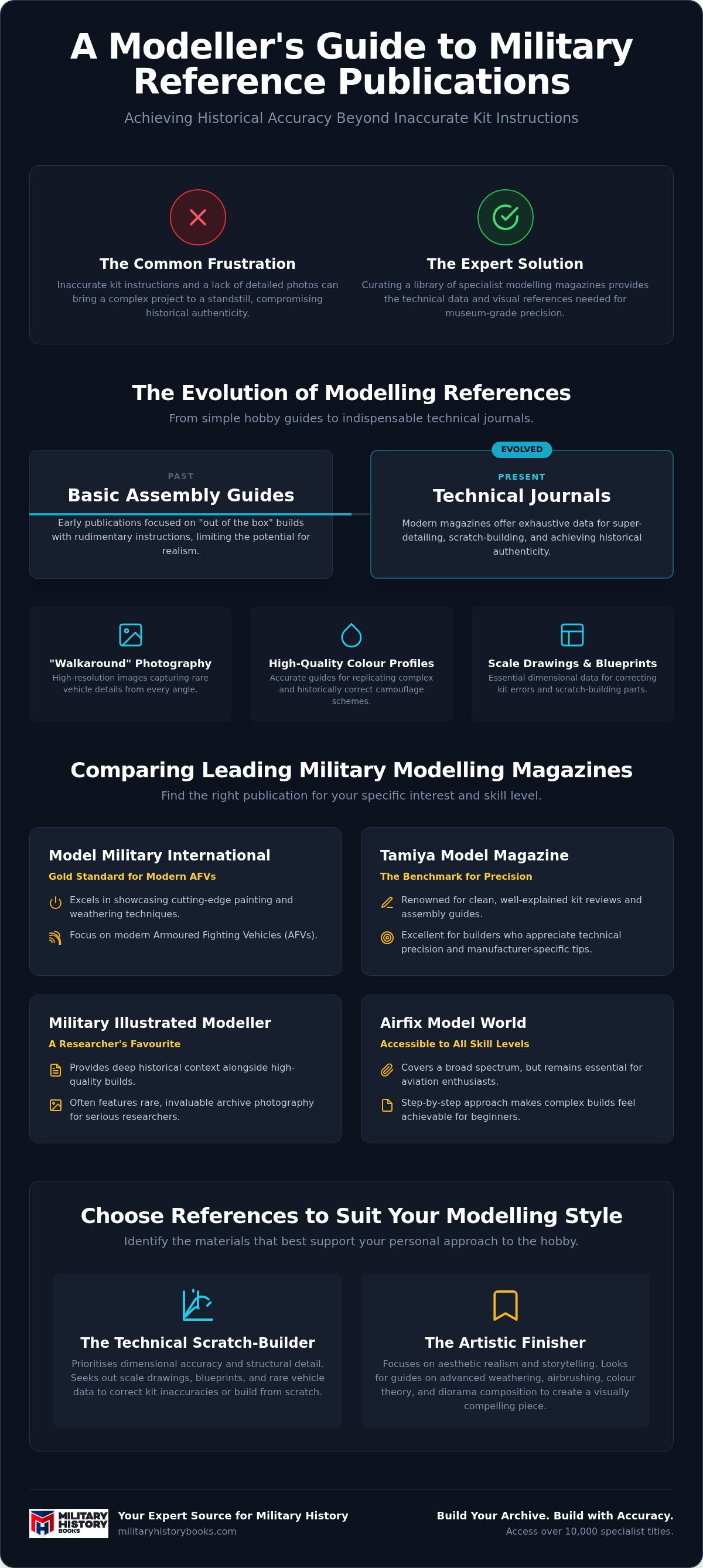
- Learn how the evolution of military modelling publications from simple guides to technical journals ensures your builds achieve museum-grade historical authenticity.
- Compare the industry's leading modelling magazines military enthusiasts trust for mastering advanced weathering, airbrushing, and kit-specific assembly.
- Understand the immense research value of out-of-print back issues for accessing rare vehicle blueprints and high-resolution "walkaround" photography.
- Identify the specific reference materials that best suit your personal style, whether you are a technical scratch-builder or an artist focused on aesthetic finishing.
- Discover how to curate a physical reference library using an expert-led archive of over 10,000 specialist military history and modelling titles.
The Evolution of Military Modelling Magazines
The landscape of the military modelling hobby has transformed significantly since its early days of basic plastic kits and rudimentary instructions. What began as a pastime focused on simple assembly has matured into a sophisticated pursuit where technical precision is paramount. During the 1980s and 90s, a pivotal shift occurred as modellers moved away from "out of the box" builds toward a philosophy of super-detailing. This era saw the rise of specialised modelling magazines military enthusiasts used to bridge the gap between a standard kit and a museum-quality replica. These publications evolved from simple newsletters into high-end technical journals, providing the exhaustive data required for historical authenticity.
One of the most significant contributions of these magazines was the introduction of "walkaround" photography. For those building rare Armoured Fighting Vehicles (AFVs) or aircraft, seeing the specific placement of a rivet or the exact texture of a cast turret was once nearly impossible. Magazines began sending researchers to remote museums and private collections to document vehicles before they were scrapped or underwent inaccurate restorations. This archival work preserved technical details that might otherwise have been lost to history. Alongside these photos, the introduction of high-quality colour profiles allowed modellers to replicate complex camouflage schemes with a level of accuracy that general history books often overlooked.
Magazines as Historical Reference Tools
Whilst a general historian might focus on the strategic impact of a tank division, a modeller requires a much narrower, technical focus. They need to understand the structural nuances that differentiate a mid-production variant from a late-production one. Specialist modelling magazines military titles provide the scale drawings, blueprints, and dimensional data that are essential for scratch-building or correcting kit errors. These publications often serve as the only surviving record of a vehicle's original "as-found" condition; this makes them indispensable for anyone aiming for true historical realism.
The Authority of Expert Contributors
The credibility of a modelling publication often rests on the shoulders of its contributors. Names like Brett Green and Marcus Nicholls have become synonymous with excellence, offering masterclasses in technique and research. This tradition of expertise is carried forward by veteran-led publications where first-hand tactical knowledge informs the build. Understanding how a vehicle was actually used in the field, from the way mud accumulates on the tracks to how crews stowed their gear, adds a layer of technical realism that only an expert can provide. Today, this wealth of knowledge is preserved in both print and digital formats, ensuring that the hard-won skills of the past remain accessible to the modern builder.
Comparing the Best Military Modelling Magazines
Choosing the right publication depends heavily on your specific interest and skill level. Whilst some titles focus on the artistic side of weathering, others prioritise technical historical accuracy and dimensional precision. The market for modelling magazines military enthusiasts enjoy is diverse, offering everything from high-end journals to accessible monthly guides.
- Model Military International: Often regarded as the gold standard for modern Armoured Fighting Vehicle (AFV) techniques, this title excels in showcasing cutting-edge painting and weathering methods.
- Tamiya Model Magazine: This publication is renowned for its focus on precision and manufacturer-specific tips. It's an excellent choice for builders who appreciate clean, well-explained kit reviews and assembly guides.
- Military Illustrated Modeller: With high-end production values, this magazine provides deep historical context alongside its builds. It often features rare archive photography that is invaluable for serious researchers.
- Airfix Model World: Whilst it covers a broad spectrum, it remains essential for aviation enthusiasts and those just starting their journey in the hobby. Its step-by-step approach makes complex builds feel achievable.
AFV and Land Warfare Titles
For those dedicated to land warfare, certain titles offer a specialist focus on armour and diorama construction that is hard to find elsewhere. These magazines are particularly useful when you're looking for information on obscure Eastern Bloc prototypes or specific wartime modifications. The quality of step-by-step painting guides in these publications has reached a level where they function as masterclasses in miniature realism. If you're struggling to find a specific reference for a rare vehicle, browsing our collection of back issue magazines often reveals the exact technical data you need.
Aviation and Naval Modelling Publications
Aviation modellers face unique challenges, such as replicating complex cockpit details or modifying airframes to match a specific squadron's history. Magazines in this niche provide the high-resolution internal photos and colour profiles necessary for a perfect finish. Similarly, naval modelling requires a focus on scale and rigging that is rarely covered in generalist titles. To truly elevate your research, it's often beneficial to integrate military aviation magazine back issues into your workflow. These archival sources provide contemporary reports and technical drawings that were published when the aircraft were still in active service, offering a level of detail that modern kit instructions simply cannot match.
The Research Value of Back Issue Modelling Magazines
Whilst many hobbyists focus on the latest monthly releases, the seasoned builder knows that "out of print" rarely means out of date. Back issues of modelling magazines military titles produced decades ago often contain technical nuances that modern publications might overlook. These archives allow you to track specific vehicle variants with microscopic precision, providing a chronological record of field modifications that kit instructions frequently omit. Vintage advertisements within these pages also serve a practical purpose; they help identify the original toolings of re-boxed kits, ensuring you understand the heritage of the plastic on your workbench.
Sourcing Rare and Out-of-Print Titles
Sourcing specialist journals from the 1970s and 80s requires patience, yet these titles are essential for a truly comprehensive reference library. These back issues work in tandem with military history books, filling the technical void between broad historical accounts and specific model assembly. As noted by Heritage Museums & Gardens on military miniatures, these models are significant tools for preserving military history. We focus on maintaining the quality of these paper-based resources because they often house "lost" techniques from the pre-digital era. These manual methods for scratch-building and weathering remain incredibly effective, offering a tactile alternative to modern digital tutorials.
Specific Build Research: A Case Study
A single article from a 1980s issue can sometimes provide the only surviving photographs of a specific unit's markings or a rare field-expedient modification. Cross-referencing these magazine profiles with official technical manuals allows you to build with a degree of confidence that internet searches can't provide. Whilst some prefer digital storage, many enthusiasts value the reliability of a physical archive. Having a tangible library of modelling magazines military references ensures your research is never interrupted by a lost connection or a defunct website. It's about building a foundation of knowledge that stays with you, issue by issue, as your skills as a modeller continue to evolve.
Choosing the Right Magazine for Your Modelling Style
Every modeller approaches their workbench with a different set of priorities. For some, the thrill lies in the mechanical logic of a vehicle, whilst others are captivated by the artistic challenge of replicating decades of rust and grime. Because of this, the modelling magazines military enthusiasts collect should reflect their personal goals. Finding the right publication ensures that your reference library actually serves your specific needs rather than just taking up shelf space.
- The Scratch-Builder: This builder requires technical precision above all else. They seek out magazines that provide 1/35 or 1/48 scale drawings, blueprints, and exact technical dimensions to correct kit errors or build parts from raw materials.
- The Artist: For those focused on the "Spanish Style" or extreme weathering, the priority is high-resolution photography. They look for publications that offer clear, well-lit shots of oil staining, paint chipping, and pigment application.
- The Historian: This modeller wants to know the story behind the steel. They value articles that provide unit histories, theatre-specific markings, and anecdotal evidence from the crews who operated the machinery.
- The Collector: Some enjoy the history of the hobby itself. These readers favour "kit-ography" sections that detail the lineage of old toolings and provide updates on the latest market news and rare kit finds.
Evaluating Magazine Content Quality
When selecting a new title, it is helpful to look for specific markers of quality. A reliable publication should feature high-resolution "walkaround" photos that show a vehicle from multiple angles, including the often-overlooked underside or engine bay. Clarity is also essential in instructional photography; a "step-by-step" guide is only useful if the lighting and focus allow you to see exactly where the brush or airbrush is being applied. Finally, look for unbiased kit reviews. The most trustworthy modelling magazines military experts recommend are those that aren't afraid to point out a kit's flaws alongside its strengths.
Physical vs. Digital Modelling References
Digital titles offer incredible convenience and portability, but many veteran builders still prefer a physical copy for the workshop. A magazine can be left open on a cluttered workbench without the risk of an expensive screen being splashed by thinners or glue. There is a tactile benefit to flipping through physical pages whilst your hands are busy with a complex build. Physical archives are also more durable in a workshop environment over the long term. If you are looking to expand your technical archive, you can browse our full range of modelling magazines to find the perfect match for your next project.
Building Your Reference Library with Military History Books
A reference library is more than just a collection of books; it's the technical foundation for every project on your workbench. Whilst the publications we've discussed provide the "how-to" for assembly, broader historical texts provide the essential "why" behind the machinery. We offer a curated selection of over 10,000 titles, spanning every major conflict and branch of service. This vast inventory is managed by an RAF veteran who understands the importance of technical accuracy and historical weight. This expertise ensures that every title in our collection, from rare modelling magazines military enthusiasts rely on to deep-dive histories, meets the standards of a serious researcher.
Sourcing rare and out-of-print modelling magazines military collectors covet is a core part of our mission. We understand that these publications are often the only places where specific technical drawings or "walkaround" photos still exist in print. Whether you're looking for obscure land warfare titles, aviation journals, or naval references, our specialist approach ensures you can find the data you need. For those in the United Kingdom and across the globe, we provide secure international delivery, ensuring these valuable records reach your workshop in excellent condition.
A Specialist Approach to Military Literature
Our inventory doesn't stop at assembly guides. We believe that a well-rounded modeller should understand the tactical environment and operational history of their subject. By supporting your hobby with wartime history books UK researchers trust, you gain the context needed to place your model in a specific time and place. This comprehensive approach also makes our collection an ideal place to find the perfect gift for any military history enthusiast, whether they are a builder, a reader, or a dedicated collector of technical manuals.
Securing Your Collection
Building your own archive is a rewarding journey that pays dividends with every new project you start. You can browse our extensive range of both digital and physical titles, allowing you to choose the format that best fits your research style. Our worldwide shipping and dedicated customer service reflect a deep-seated commitment to the global modelling community. Start your reference archive today by focusing on the subjects that truly fascinate you; over time, these individual issues and books will form an invaluable technical library that elevates your work to a professional standard.
Elevate Your Craft with Authoritative Reference
Mastering the technical nuances of a historical build requires more than just skill; it demands access to precise and reliable data. We have explored how the right modelling magazines military experts recommend can provide the walkaround photos, scale drawings, and weathering guides essential for museum-grade accuracy. Whether you are a scratch-builder seeking blueprints or an artist focused on aesthetic realism, your personal library serves as the ultimate technical archive for your workbench.
Our collection is curated with the deep-seated passion of an RAF veteran, ensuring that every title supports your pursuit of historical truth. With over 10,000 titles in stock and secure international delivery, we are here to help you find those rare and out-of-print publications that remain the gold standard for research. We invite you to explore our extensive collection of military modelling magazines and back issues to find the missing piece for your next project. Your dedication to preserving history through scale modelling is a vital pursuit; we are proud to provide the resources that bring your vision to life.
Frequently Asked Questions
Which military modelling magazine is best for beginners?
Airfix Model World is widely considered the best starting point for those new to the hobby. It offers clear, step-by-step guides and focuses on accessible kits that help build foundational skills without overwhelming the reader with complex jargon. The magazine strikes an excellent balance between basic assembly tips and the introduction of more advanced painting and weathering techniques.
Where can I find back issues of out-of-print modelling magazines?
Specialist curators like Military History Books are the premier source for rare and out-of-print titles. We maintain a vast archive of over 10,000 titles, including hard-to-find modelling magazines military collectors have sought for decades. These back issues are essential for builders who need specific technical data or historical profiles that are no longer available in current monthly releases.
Are digital modelling magazines as good as printed versions for builders?
Digital versions provide excellent portability and the ability to zoom into high-resolution photos, but many builders prefer physical copies for the workbench. A printed magazine doesn't require a power source or clean hands to operate a touchscreen. It also removes the risk of spilling aggressive paint thinners or polystyrene cement onto an expensive electronic device during a complex assembly.
What are the most collectible military modelling magazines?
Early editions of Military Modelling from the 1970s and specialised Japanese titles like Armour Modelling are highly collectible. These publications often contain unique scale drawings and technical research that have never been digitised or reprinted. Collectors prize them for their historical value and the rare, contemporary photography they provide of vehicles that may no longer exist in their original wartime condition.
Do modelling magazines include scale drawings and blueprints?
Many high-end modelling magazines military enthusiasts trust include precise 1/35, 1/48, or 1/72 scale drawings. These blueprints are vital for scratch-builders who need to verify kit dimensions or fabricate their own parts from plasticard. Titles such as Military Illustrated Modeller are particularly renowned for providing these technical illustrations to help modellers achieve museum-grade accuracy in their projects.
How do I use a modelling magazine for historical research?
You should use these publications to cross-reference kit instructions with "walkaround" photography and unit-specific colour profiles. Magazines often feature archive photos that document field-expedient modifications or unique stowage arrangements used by specific crews. This research allows you to move beyond the generic markings provided in a box and create a model that represents a specific historical moment.
Which magazines focus specifically on WWII AFV modelling?
Model Military International and AFV Modeller are the primary choices for enthusiasts of World War II armour. These titles frequently dedicate entire issues to specific vehicle families, such as the Panzer IV or the Sherman, providing exhaustive details on production variants. They offer expert guidance on replicating theatre-specific weathering, from the dust of North Africa to the deep mud of the Eastern Front.
Can I find technical manuals for aircraft in modelling publications?
Whilst they don't replace original pilot handbooks, many aviation modelling magazines feature excerpts from technical manuals and maintenance notes. These sections are incredibly useful for detailing complex areas like cockpits, engine bays, and undercarriage wells. They provide the micro-level technical data required to ensure that every wire and pipe in your aircraft replica is placed in its historically correct position.


