

A pixelated digital scan found on a forum can never truly replace the tactile precision of a technical drawing or a high-resolution period photograph printed on original paper. While the internet offers instant access to fragments of history, these snippets often lack the context and clarity required for serious historical research or high-fidelity scale modelling. You likely understand the frustration of trying to verify a specific airframe modification or a camouflage pattern, only to be met with inconsistent descriptions and blurry images from unreliable sources. Finding high-quality military aviation magazine back issues from legendary but defunct publishers like Air Pictorial or RAF Flying Review is the only way to secure a definitive primary-source archive.
We recognise that tracking down these rare titles can be difficult, especially when descriptions of their condition vary so wildly online. This article will show you how to source, evaluate, and preserve these essential publications to ensure your library serves as a reliable reference for years to come. We will examine the distinct roles of technical journals versus general interest titles, whilst providing a clear path to completing your magazine runs and uncovering the precise details your projects demand.
Key Takeaways
- Understand why contemporary accounts in back issues provide more reliable data for researchers than modern digital summaries.
- Learn to distinguish between general interest magazines and high-end technical journals to find the specific airframe details your project requires.
- Master the process of sourcing and verifying the authenticity of military aviation magazine back issues to complete your collection with confidence.
- Compare the technical advantages of physical print versus digital downloads for capturing high-resolution reference photos for scale modelling.
- Discover how to leverage a curated archive managed by an RAF veteran to find rare, out-of-print specialist titles.
Why Collectors and Historians Seek Military Aviation Magazine Back Issues
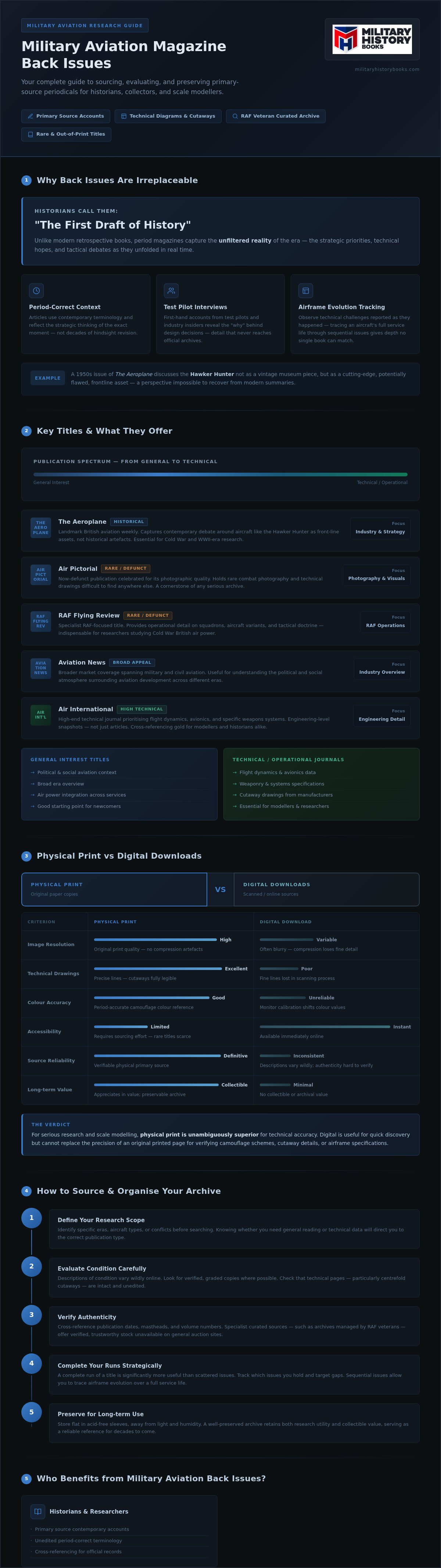
Historians frequently describe specialist periodicals as the "first draft" of history. Unlike modern books that look back with the benefit of hindsight, these magazines capture the immediate, unfiltered reality of the era they document. If you're researching a Cold War interceptor or a Second World War bomber, the articles written at the time reflect the strategic priorities and technological hopes of that exact moment. This immediacy is vital for understanding why certain design choices were made or how a specific squadron's operational role was perceived whilst they were still on the front line.
These publications serve as a bridge between official records and the public's understanding of aviation development. Whilst a government archive might provide the "what" and "when" of a project, military aviation magazine back issues often provide the "why" through interviews with test pilots and contemporary industry analysis. For the dedicated enthusiast, these pages hold the stories that haven't been distilled or edited by decades of retrospective summary. They represent a preserved moment in time, offering insights that are often lost in the transition to digital-only archives.
The Role of Primary Source Aviation Research
Original articles offer a perspective that modern books often overlook. They use period-correct terminology and reflect the contemporary strategic context of the time. For instance, a 1950s issue of The Aeroplane discusses the Hawker Hunter not as a vintage museum piece, but as a cutting-edge, potentially flawed, frontline asset. By studying these issues, researchers can track the evolution of specific airframes through their service lives. You can observe how technical challenges were reported as they happened, providing a more nuanced view of an aircraft’s development than a single chapter in a modern book could ever achieve.
Completing Photographic and Technical Archives
For the scale modeller or aircraft restorer, the visual data held within these pages is often superior to modern digital reprints. You can find high-quality, unedited combat photography and rare "cutaway" drawings that reveal the internal architecture of an aircraft in immense detail. These technical diagrams were often produced by specialist illustrators who had direct access to the manufacturers, ensuring a level of accuracy that is difficult to replicate. These primary sources provide the granular detail needed to verify a technical specification or a specific camouflage scheme. They serve as the essential foundation for the detailed narratives found in many aviation history books, offering a level of clarity that helps turn a good project into a historically perfect one.
Key Titles and Specialist Publications in the Aviation Back Issue Market
The landscape of military aviation magazine back issues is diverse, ranging from mass-market monthlies to highly technical bulletins that were never intended for the general public. Names like The Aeroplane, Aviation News, and RAF Flying Review are familiar to any serious collector, yet each served a distinct purpose. Whilst some focused on the broader industry, others provided the minute technical data that remains invaluable for cross-referencing details found in wartime history books UK collectors often possess. Understanding these distinctions is crucial when building a library that serves both as a hobbyist's delight and a researcher's tool.
General interest titles often provide a fantastic overview of the political and social atmosphere surrounding aviation. However, the specialist market is where the most granular information resides. These publications often bridge the gap between naval and land warfare, documenting how air power integrated with other branches of service. For the historian, these magazines are not just items to be collected; they are technical archives that preserve the specifics of an era.
Technical and Operational Journals
High-end journals such as Air International or earlier technical bulletins often prioritised flight dynamics, avionics, and specific weaponry systems. These aren't just articles; they are engineering snapshots. Former service personnel and aerospace engineers often seek these out because they provide the precise operational context that general magazines miss. Identifying rare, limited-run technical bulletins requires a keen eye for detail. These were often printed on lower-quality paper or distributed only within specific military and industrial circles. Their scarcity today makes them some of the most sought-after items in the aviation back issue market.
Modelling and Scale Reference Magazines
For many, the hunt for specific issues is driven by the need for visual accuracy. Specialist modelling magazines military enthusiasts rely on offer essential colour and marking guides that are often more accurate than modern digital recreations. Magazines such as Airfix Magazine or Scale Models provided builders with unique access to official archives and manufacturer blueprints. These resources are indispensable when attempting to replicate a specific squadron's livery from a particular month in 1944 or 1962. Modellers often prefer physical back issues because they can be kept open on a workbench without the risk of a screen timing out or colours being distorted by a back-lit display.
If you're looking for a specific volume to finish a series or a technical reference for a new project, our collection of rare and out-of-print titles is curated to meet the highest standards of historical accuracy. We understand that finding that one missing issue can be the key to completing a research project that has spanned years.
Evaluating Quality: Physical Copies vs Digital Downloads
Choosing between a physical copy and a digital version of a historic publication often depends on your ultimate goal. For the dedicated collector, a physical magazine is a tangible piece of history that offers a connection to the past which a screen simply cannot replicate. Conversely, digital formats provide an efficiency that is hard to ignore when you are deep in the middle of a complex research project. Both formats have their place in a modern aviation library, yet they serve very different functional needs.
The decision usually rests on the balance between tactile quality and searchability. Whilst digital scans offer portability, original military aviation magazine back issues retain the exact colour balance and fine detail intended by the original printers. This is particularly important when you are trying to discern the specific shade of a camouflage pattern or the serial number on a weathered fuselage in a black-and-white photograph. High-quality print runs from the mid-20th century used ink and paper combinations that often preserve detail better than a standard-resolution PDF scan might allow.
The Tactile Appeal of Original Print Editions
Owning an original print edition provides a depth of experience that goes beyond the text. The paper quality and ink depth found in vintage issues of The Aeroplane or Air Pictorial are essential for serious photographic analysis. There is also a distinct professional satisfaction in seeing a complete run of magazines organised on a library shelf, ready for immediate reference. However, collectors must be vigilant about condition. When sourcing physical copies, look for common issues such as foxing (brown age spots on paper), spine-wear from frequent reading, and the presence of any original inserts or fold-out technical drawings. A well-preserved physical copy is not just a reference tool; it is a collectable asset that often appreciates in value as these titles become scarcer.
Digital Access for Rapid Research and Portability
Digital titles on disc or via download offer a level of utility that physical copies cannot match. The primary advantage is the ability to perform keyword searches across hundreds of pages in seconds. If you need to find every mention of a specific squadron or a niche technical modification across several years of a publication, a digital archive is indispensable. These formats are also a practical solution for those with extensive collections who need to save physical shelf space. A digital download is often the best choice for immediate project needs, allowing you to zoom in on technical diagrams without fear of damaging a fragile original. Whilst the tactile soul of the magazine might be absent, the data remains perfectly preserved and infinitely more portable for work on the move.
How to Source and Organise a Military Aviation Archive
Building a comprehensive archive requires more than just an interest in flight; it demands a methodical approach to curation. Start by auditing your current collection to identify specific gaps. This process is often easier if you categorise your holdings by publisher and decade, allowing you to see where a specific run of military aviation magazine back issues might be incomplete. Once you have a clear list of missing volumes, the next step is verification. Always check for the presence of original supplements, fold-out technical drawings, or posters that were originally included. A back issue is only truly complete if it retains these essential reference materials.
Sourcing these items from specialist dealers who understand the nuances of military history books and periodicals ensures you receive accurate descriptions of condition. Unlike general marketplaces where a "good" condition might simply mean the cover is attached, a specialist knows to check for interior markings, page yellowing, or structural integrity. This level of expertise is what transforms a simple stack of magazines into a professional-grade research library.
Finding Rare and Out-of-Print Issues
General online marketplaces often fail the serious collector because sellers frequently lack the technical knowledge to identify a specific edition or variant. Specialist retailers act as a filter, vetting their stock for quality and historical significance. If you're searching for an elusive technical publication that saw a limited print run, submitting a "wants list" to a dedicated archive can be the most effective way to secure it. This proactive approach saves time and ensures your library grows with high-quality material rather than filler.
Preservation and Storage Best Practices for Paper Media
Once sourced, protecting your investment is paramount. Paper is sensitive to environmental factors; therefore, you should store your collection away from direct UV light and in a room with stable humidity. Whilst binding magazines into annual volumes can keep a run tidy, it can sometimes reduce the individual value of rare issues. For the most fragile or valuable historical documents amongst your collection, using acid-free sleeves is a wise precaution. This prevents the chemical degradation of the paper and ensures that the technical details remain legible for future generations of researchers.
If you are ready to expand your archive, explore our curated selection of back issue magazines to find the specific titles you need to complete your historical collection.
Discovering Rare Aviation History at Military History Books
Military History Books stands as a specialist repository for those who value the preservation of technical and operational history. We don't simply stock items; we curate a vast archive of over 10,000 titles that span the entire spectrum of modern conflict. Whether you are looking for specific military aviation magazine back issues to complete a research project or comprehensive works on land and naval warfare, our inventory is selected to meet the rigorous standards of professional historians and dedicated modellers alike. This focus ensures that every publication we offer provides genuine value to your personal library or professional research project.
Our collection is designed to be a bridge between the past and the modern enthusiast. By holding rare first editions and out-of-print specialist titles, we provide access to information that has often been lost to the digital age. We understand that a historian's needs are diverse, which is why our stock extends beyond flight to include the interconnected stories of land warfare and naval operations. This breadth of material allows for a more holistic view of military history, where the role of air power can be studied alongside the ground and sea forces it supported. This cross-disciplinary approach is essential for anyone looking to understand the full context of 20th-century technical development.
Expertly Curated Collections by RAF Veterans
The foundation of our service is rooted in first-hand experience and a deep-seated passion for the niche. As an RAF veteran-managed business, we possess an intimate understanding of the subject matter that general retailers simply cannot replicate. This professional military background informs every aspect of our stock selection, from identifying rare technical manuals to sourcing elusive volumes of The Aeroplane or Aviation News. We are committed to preserving the technical details and human stories of aviation development through high-quality physical and digital media. If you are searching for a specific technical title or a niche publication that seems impossible to find, our personalised service is designed to help you navigate our archive with ease. We take pride in being a trusted guide for collectors who demand accuracy and expertise.
Secure International Delivery for Global Enthusiasts
We recognise that aviation history is a global pursuit, and our researchers are located in every corner of the world. Shipping rare paper publications requires a level of care that goes far beyond standard retail practices. We use secure, robust packaging specifically designed to protect fragile military aviation magazine back issues from the rigours of international transit, ensuring they arrive in the exact condition described. This commitment allows enthusiasts from abroad to access the UK's rich military history with total confidence. Whether you are building a library in London or Los Angeles, our delivery network is built on reliability and the safe handling of historical media. Browse our full range of aviation back issues and books today to discover the missing piece of your collection.
Building Your Definitive Aviation Library
Securing the right reference material is the foundation of any successful historical project. We've explored how original publications provide unedited technical data and period-correct context that modern retrospective books can sometimes miss. Whether you value the high-resolution photographic detail of a physical print or the rapid searchability of a digital archive, your collection serves as a vital link to the past. These documents preserve the technical nuances and contemporary perspectives that are essential for accurate research and modelling.
Finding specific military aviation magazine back issues shouldn't be a matter of chance. By sourcing from a curated archive managed by an RAF veteran, you gain access to over 10,000 titles across aviation, naval, and land warfare history. This expertise ensures that the rare and out-of-print editions you receive are complete and historically accurate. Explore our extensive archive of military aviation magazine back issues to find the precise volumes you need to complete your research.
Your dedication to preserving these stories ensures that the technical achievements and operational bravery of the past remain accessible for future generations. We look forward to helping you uncover the next rare volume for your library.
Frequently Asked Questions
Where can I find out-of-print military aviation magazines?
Specialist retailers like Military History Books are the most reliable source for out-of-print titles. Unlike general marketplaces where sellers may lack technical knowledge, we curate our stock to ensure quality and historical relevance. Our inventory includes over 10,000 titles, focusing on rare and hard-to-find editions that aren't available in high street shops or general bookshops.
Are digital back issues better than physical copies for research?
Digital versions are superior for rapid keyword searching and portability, whilst physical copies are better for high-resolution visual analysis. If you need to find a specific squadron mention across a decade, digital is ideal. For verifying camouflage colours or technical drawing details, the original print quality of physical copies is often more accurate and reliable for serious historians.
How do I check if a military aviation magazine is complete?
Check the contents page for references to supplements, posters, or fold-out technical diagrams. Many military aviation magazine back issues originally included these as loose inserts, which are frequently missing in second-hand copies. A complete issue must have all pages intact and any original technical attachments present to be considered a research-grade primary source.
What are the most collectable military aviation magazine titles?
Titles such as The Aeroplane, RAF Flying Review, and early volumes of Air Pictorial are highly sought after by collectors. Magazines from the 1940s and 1950s are particularly collectable because they captured the transition from piston engines to the jet age. Specialist technical journals with limited distribution also hold significant value amongst aviation historians due to their granular data.
How should I store my collection of military magazines to prevent damage?
Store your magazines upright in acid-free boxes and keep them in a room with a stable temperature and low humidity. Avoid direct sunlight, as UV rays will cause the covers to fade and the paper to become brittle over time. Using individual acid-free sleeves is a wise investment for particularly rare or fragile historical issues that you intend to keep for many years.
Can I find technical manuals in aviation magazine back issues?
Whilst full technical manuals are usually separate publications, many back issues contain detailed technical "cutaway" drawings and official performance data. Journals such as Air International often featured deep-dive technical reports that included cockpit layouts and engine specifications. These provide a level of detail that is often comparable to official service manuals for specific airframes of the era.
Do you ship military aviation back issues internationally?
Yes, we provide secure international delivery for our entire collection of physical media. We use robust packaging specifically designed to protect paper publications from damage during long-distance transit. This ensures that researchers and collectors worldwide can access the UK's rich archive of aviation history without worrying about the structural condition of their order upon arrival.
Why are some aviation back issues much more expensive than others?
Price is typically determined by rarity, condition, and the historical significance of the content. Military aviation magazine back issues that feature rare combat photography or were printed in limited quantities during wartime tend to command higher prices. Completeness also plays a role; an issue that still contains its original technical supplements will always be valued higher than a standard copy.


