

Can a single volume truly capture the claustrophobic reality of life beneath the parapet? Finding the right WW1 trench warfare books is often a daunting task, as the market is saturated with generic overviews that lack the depth a serious researcher requires. You've likely found that many titles struggle to balance the raw human experience with the cold, technical reality of static warfare. It's frustrating when you're searching for specific details on the Hindenburg Line or fire-step construction, only to find another romanticised account that prioritises drama over historical accuracy.
This specialist guide promises to cut through the noise and lead you directly to the most authoritative literature on the Great War. You'll discover a curated selection that ranges from visceral memoirs to technical tactical studies that define the evolution of the Western Front. We'll examine the crucial differences between personal narratives and academic analyses, whilst providing clear directions on where to find rare or out-of-print editions. Whether you're a dedicated modeller or a seasoned historian, this reference guide ensures your library contains the definitive works on trench life and strategy.
Key Takeaways
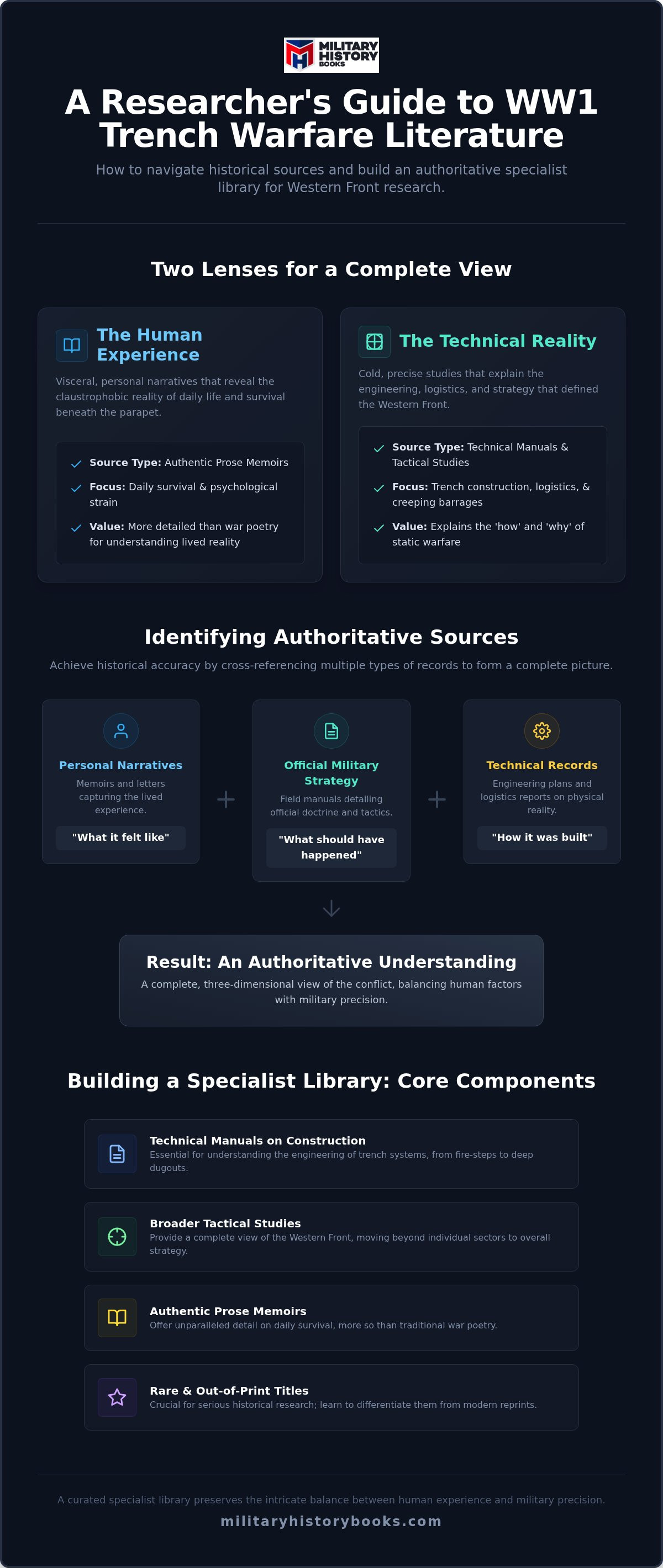
- Learn to distinguish between technical manuals on trench construction and broader tactical studies to gain a complete view of the Western Front.
- Understand why authentic prose memoirs provide a more detailed understanding of daily survival than the traditional focus on war poetry.
- Discover how to identify authoritative WW1 trench warfare books by cross-referencing personal narratives with official military strategy and technical records.
- Gain the knowledge needed to differentiate between modern reprints and the rare, out-of-print titles essential for serious historical research.
- Recognise the value of a curated specialist library in preserving the intricate balance between human experience and military precision.
Understanding the Evolution of Trench Warfare Through Literature
WW1 trench warfare books represent far more than a simple collection of combat stories. This specialised genre bridges the gap between technical military science and the deeply personal, often harrowing, accounts of those who lived within the earth. For the serious researcher, these texts offer a three-dimensional view of the conflict, encompassing everything from the geometry of a traverse to the psychological strain of a bombardment. Understanding this literature is essential for anyone wishing to grasp the British national heritage, as it provides the primary evidence for an era that fundamentally reshaped our society.
The way we read about the Great War has changed significantly over the last century. Early accounts often carried the weight of censorship or a romanticised view of duty, but the late 1920s saw a shift towards the stark, unvarnished realism we recognise today. This evolution is perfectly captured within the broader category of wartime history books UK, where the transition from propaganda to gritty prose reflects a nation finally coming to terms with its trauma. By exploring these varying perspectives, we can piece together a more accurate picture of the Western Front than any single volume could provide.
The Western Front: More Than Just Mud and Wire
General histories often reduce the conflict to a static line of stagnation, yet the literature reveals a far more complex reality. By studying specific sectors like the Salient at Ypres or the chalky ridges of the Somme, readers can move beyond the "lunar mud-scape" cliché. Specialist WW1 trench warfare books provide the necessary detail to visualise how different geological conditions and defensive philosophies shaped the soldier's daily life. This Trench Warfare Overview helps establish the basic framework, but sector-specific titles are what truly bring the tactical landscape to life for the modern enthusiast.
The Transition from 1914 to 1918 in Print
The literature also tracks the incredible technological leap from the war of movement in 1914 to the sophisticated "all-arms" battles of 1918. Contemporary manuals show how trench design evolved from shallow, disconnected scrapes into the formidable deep dugouts of the Hindenburg Line. Whilst many readers focus on the tragedies of 1916, the victory narratives of 1918 are a crucial sub-genre. These books detail the breaking of the stalemate and the refined tactics that finally brought the war to its conclusion, offering a necessary counter-balance to the stories of pure attrition that dominate popular culture.
Tactical and Technical Studies: How the Trenches Really Worked
To truly understand the operational reality of the Western Front, one must look beyond the narrative of tragedy and examine the cold, hard science of the era. Technical WW1 trench warfare books provide a vital framework for understanding how millions of men were sustained, protected, and moved across a devastated landscape. While a memoir might describe the terror of a bombardment, a tactical manual explains the precise timing and coordination required for a creeping barrage to shield advancing infantry. These contemporary field service regulations and training manuals are indispensable for researchers who want to understand the conflict through the eyes of the staff officers and engineers who designed these systems.
The introduction of tanks and armoured vehicles fundamentally altered this static environment, forcing a rapid evolution in defensive architecture and anti-tank doctrine. You can find many of these specific tactical shifts documented in the Library of Congress WWI Primary Sources, which offer a window into the official communications and technical reports of the period. Studying these documents alongside modern tactical analyses helps bridge the gap between the chaotic experience of the front line and the structured logic of military planning.
Engineering the Stalemate: Trench Construction and Logistics
The physical reality of the trench was a triumph of Victorian and Edwardian engineering. Books that focus on "sapping" and mining operations reveal a hidden war fought in total darkness beneath No Man’s Land, where the stakes were measured in tonnes of ammonal. Technical diagrams in these volumes are essential for serious military researchers; they illustrate the complexity of drainage systems, fire-steps, and communication saps that kept the front line operational. This technical literature also highlights the "Total War" economy, showing how domestic production was precisely calibrated to meet the insatiable demand for timber, wire, and corrugated iron. Browsing a carefully curated selection of land warfare titles often reveals these rare technical reprints that general bookshops often overlook.
The Evolution of Infantry Tactics
Tactical literature from 1914 to 1918 records a steep learning curve for the British Army. Early WW1 trench warfare books often reflect the "Big Push" mentality of 1916, but later publications detail the shift towards small-unit infiltration tactics. These manuals explain the decentralisation of power, where the role of the Lewis gun and the standardised use of grenades became central to trench raiding and defensive actions. Modern tactical analysis often re-evaluates these contemporary accounts, providing a clearer view of how the "all-arms" approach eventually broke the German lines in 1918 through a combination of infantry, artillery, and early aerial coordination.
The Human Experience: Essential Memoirs and Personal Accounts
If the tactical manuals discussed previously provide the skeleton of the conflict, it's the personal memoirs that provide the flesh and blood. Whilst many people first encounter the Western Front through the rhythmic verses of the Great War poets, prose memoirs often offer a more sustained and detailed exploration of daily survival. WW1 trench warfare books like Robert Graves' 'Good-bye to All That' or Siegfried Sassoon's 'Memoirs of a Fox-Hunting Man' remain cornerstones of the genre. These works don't just recount battles; they capture the peculiar blend of boredom, terror, and dark humour that defined the soldier’s existence.
It's equally important to seek out the voices of the 'rank and file' rather than relying solely on officer-written histories. Private soldiers often recorded a different war, one focused on the logistics of rations, the struggle against the elements, and the immediate bonds of the section or platoon. Personal diaries, often written in defiance of official regulations, serve as a vital day-to-day timeline. They reveal the mundane routine of trench life that official histories frequently gloss over, from the quality of the tea to the persistent presence of vermin. These accounts are essential for anyone building a truly representative collection of WW1 trench warfare books.
Classic Memoirs vs. Modern Biographies
The late 1920s and early 1930s saw a surge in 'war books' that prioritised raw honesty over patriotic sentiment. These early publications were often controversial because they stripped away the romanticism of the front line. Today, modern historians use these accounts alongside discovered letters to reconstruct the soldier’s experience with forensic detail. The role of military biography books is crucial here, as they help humanise the conflict by tracing a single life from the recruitment hall to the fire-step. This individual focus provides a necessary counterpoint to the broad statistics of attrition.
The Psychology of the Trenches
Beyond the physical dangers, the literature explores the profound mental toll of static warfare. Books detailing shell shock and the psychological strain of constant bombardment provide a sobering look at the limits of human endurance. However, this wasn't a world of total despair. The 'trench humour' found in soldier-produced magazines like 'The Wipers Times' shows a remarkable resilience. These satirical publications, often printed on salvaged presses just miles from the front, are vital for understanding how morale and discipline were maintained amongst men facing unimaginable odds.
Identifying Authoritative Sources for Western Front Research
When building a collection of WW1 trench warfare books, distinguishing between a mass-market reprint and an authoritative first edition is a vital skill for any serious researcher. While modern reprints offer accessibility, they often omit the intricate fold-out maps and detailed appendices found in original publications. These technical supplements are often the very pieces of evidence required to verify a specific tactical movement or trench location. Authenticity isn't just about the age of the paper; it's about the completeness of the data provided to the reader.
Evaluating the visceral claims found in a soldier's memoir requires a methodical approach. You should cross-reference these personal narratives with military strategy books to see if the described events align with established battalion orders and higher-level objectives. This process of triangulation helps separate individual perception from the broader operational reality. To deepen your research, consider these strategies:
- Examine the bibliographies of academic texts to identify primary source sets and forgotten regimental histories.
- Consult publications from the Imperial War Museum or specific Regimental Museums to validate niche details about uniform or equipment.
- Look for titles that cite specific war diaries held at the National Archives.
Official Histories: The Gold Standard for Researchers
The British "Official History of the Great War" series, largely compiled under Brigadier-General Sir James Edmonds, remains the essential foundation for any Western Front library. These volumes were written with access to the full range of official records, providing a level of detail that general campaign summaries simply cannot match. However, a discerning reader must learn to read between the lines. These reports were occasionally edited to protect reputations or maintain military decorum. Comparing divisional histories against these general volumes often reveals the specific local pressures that influenced major command decisions.
Evaluating Modern Military Scholarship
Modern scholarship has undergone a "revisionist" shift, moving away from the "lions led by donkeys" narrative towards a more nuanced understanding of the British Army's learning curve. When selecting contemporary WW1 trench warfare books, look for historians who prioritise archival evidence and photographic analysis over emotive storytelling. The quality of maps is a reliable indicator of a book’s value; a serious study will always provide clear, topographical references for the actions described. If you're looking to expand your archive with verified, high-quality material, you can browse our curated selection of rare and technical titles to find your next essential reference.
Building a Specialist Library with Military History Books
Building a definitive collection of WW1 trench warfare books is a journey of curation that requires a discerning eye and a passion for historical accuracy. Unlike general retailers who often stock only the most recent bestsellers, a specialist bookshop understands that the most valuable insights often lie in older, more technical publications. At Military History Books, our collection is managed by an RAF veteran who brings a level of professional discipline and subject-matter expertise to the selection process. This ensures that whether you're a serious researcher or a casual reader, you're guided towards literature that respects the historical weight of the Great War.
A specialist library serves as a repository for human experiences and tactical evolutions that might otherwise be forgotten. We take pride in acting as a trusted guide, helping enthusiasts navigate an inventory of over 10,000 titles to find the specific works that meet their needs. From rare land warfare studies to modelling magazines that detail the physical reality of the trenches, our archive is designed to support the preservation of history in all its forms. This methodical approach to collecting ensures that your personal library becomes a reliable reference for years to come.
The Value of Rare and Out-of-Print Titles
Some of the most significant research into the Western Front was published in small, limited runs decades ago, often by small presses or regimental associations. These rare and out-of-print titles frequently contain primary data, fold-out maps, and contemporary photographs that are omitted from modern mass-market editions. Finding these gems offers a certain thrill, but it also carries a responsibility for preservation. Significant first-edition memoirs are not only valuable investments; they are direct links to the voices of 1914-1918. Protecting these volumes from damp and direct sunlight ensures that the visceral honesty of the veterans remains accessible for future generations of historians.
Accessing Global Knowledge from the UK
Whilst our roots are firmly in the UK, the community of Great War researchers is truly international. We support this global network through secure international delivery, ensuring that rare British divisional histories can reach collectors across the globe. For those who require immediate access to information, digital titles and downloads are revolutionising how we conduct research. These digital formats, alongside our extensive range of back-issue magazines, provide a wealth of technical detail on trench construction and infantry tactics without the need for additional shelf space. If you're ready to expand your archive, you can browse our extensive collection of land warfare and trench books to find the authoritative sources your research deserves.
Preserving the Legacy of the Western Front
Understanding the Great War requires looking past simple narratives to find the intricate balance between tactical engineering and human endurance. By cross-referencing official records with visceral personal accounts, you'll build a library that truly honours the complexity of the conflict. Finding the right WW1 trench warfare books is the first step in this journey of discovery, whether you're searching for technical diagrams of the Hindenburg Line or the raw honesty of a private soldier's diary.
As a specialist shop managed by an RAF veteran, we're dedicated to helping you find those rare and out-of-print titles that general retailers often overlook. With over 10,000 military titles in stock and secure global shipping for collectors, we're here to support your research at every stage. Explore our curated range of WW1 Land Warfare books today and take your place amongst those dedicated to keeping this vital history alive. Every volume you preserve ensures these stories remain vivid and accurate for the next generation of historians.
Frequently Asked Questions
What are the best books for a beginner to understand WW1 trench warfare?
Beginners should start with accessible titles that balance technical detail with a clear narrative of daily life. John Ellis's 'Eye-Deep in Hell' is a superb entry point because it provides a vivid, illustrated overview of the physical and psychological reality of the trenches. For a narrative approach, Erich Maria Remarque's 'All Quiet on the Western Front' offers a visceral understanding of the soldier's perspective that remains foundational for any new reader.
Where can I find rare first-edition memoirs of the Great War?
Specialist military bookshops and dedicated historical auction houses are the most reliable sources for authentic first-edition memoirs. General online marketplaces often lack the expert verification needed to distinguish between early printings and later, less valuable editions. A specialist curator can provide detailed information on a book's provenance and physical condition, ensuring you acquire a genuine piece of historical literature for your collection.
Are official military histories reliable for personal research?
Official military histories are exceptionally reliable for verifying dates, unit movements, and command structures, though they should be read with an understanding of their original purpose. These volumes were compiled using official war diaries and signals, making them the primary source for factual data. For a truly balanced view, you should cross-reference these records with personal diaries to capture the human experience that official reports often omit.
Which books focus specifically on the technical side of trench construction?
Contemporary field manuals and modern engineering studies provide the most detailed insights into the technical design of the Western Front. Original publications like 'Notes on Field Defences' or the 'Manual of Field Engineering' are essential for understanding the precise geometry of traverses and drainage systems. Modern works, such as Andy Belsey's 'Modelling WW1 Trench Warfare', also offer invaluable technical breakdowns that are perfect for both researchers and modellers.
How do I identify if a military history book is out of print?
You can identify an out-of-print title by checking if the publisher still lists it in their active catalogue or by searching specialised bibliographies. If a book is no longer available for purchase as new from the original publisher, it is considered out of print. Specialist shops often track these titles, as they are frequently the most sought-after WW1 trench warfare books for those conducting serious historical research.
What is the difference between a tactical study and a general history book?
A tactical study focuses on the specific methods of combat and unit coordination, whilst a general history provides a broader overview of the conflict's political and social causes. Tactical books examine the 'how' of the war, detailing the use of specific weaponry like the Lewis gun or the execution of a creeping barrage. General histories offer the wider context, helping you understand the strategic goals that drove those tactical decisions.
Do you offer digital versions of rare WW1 trench warfare books?
We provide a variety of digital titles available for download or on disc, including rare technical manuals and back-issue magazines. These digital formats are an excellent way to access the contents of fragile or expensive out-of-print volumes without the risk of damaging a physical copy. They offer a convenient solution for modern researchers who need to search for specific terms or view high-resolution technical diagrams on their devices.
Why should I buy from a specialist military bookshop rather than a general retailer?
Buying from a specialist shop ensures you receive expert guidance from a team that understands the historical weight and technical nuances of the subject matter. Our shop is managed by an RAF veteran who curates an inventory of over 10,000 military titles, focusing on quality and accuracy. We offer a level of subject-matter expertise and secure global delivery that general retailers simply cannot match for serious collectors of WW1 trench warfare books.


