

Whilst Sun Tzu and Clausewitz provide the philosophical bedrock of conflict, they offer remarkably little guidance when a section commander needs to coordinate fire and movement under pressure. True mastery of the subject requires moving beyond the abstract to the technical manuals that have dictated how soldiers fight and survive for centuries. If you've grown tired of generic reading lists that ignore the practicalities of the front line, you aren't alone. Finding high-quality military strategy books that balance grand theory with tactical reality can be a daunting task for even the most dedicated researcher.
We understand the frustration of seeking out technically accurate infantry literature only to be met with surface-level summaries. This guide is designed to help you bridge that gap, offering a curated look at the essential texts that define land warfare. You'll learn how to distinguish between high-level strategy and field-level tactics whilst discovering how to build a library of truly authoritative works. We will also share specialist insights on identifying rare first editions and sourcing those elusive, out-of-print titles that represent the pinnacle of military scholarship.
Key Takeaways
- Understand the vital distinction between grand strategy, operational art, and the technical manuals that govern small-unit tactics.
- Trace the historical shift from rigid Napoleonic formations to the flexible infiltration tactics born in the trenches of the First World War.
- Learn to categorise your collection effectively by prioritising Field Manuals and authoritative memoirs for a comprehensive view of land warfare.
- Discover a specialist framework for sourcing rare military strategy books, focusing on first-edition identification and the impact of dust jacket condition.
- Gain access to expert guidance from an RAF veteran to help you navigate a curated archive of over 10,000 specialist titles.
What are military strategy books and why are they essential for researchers?
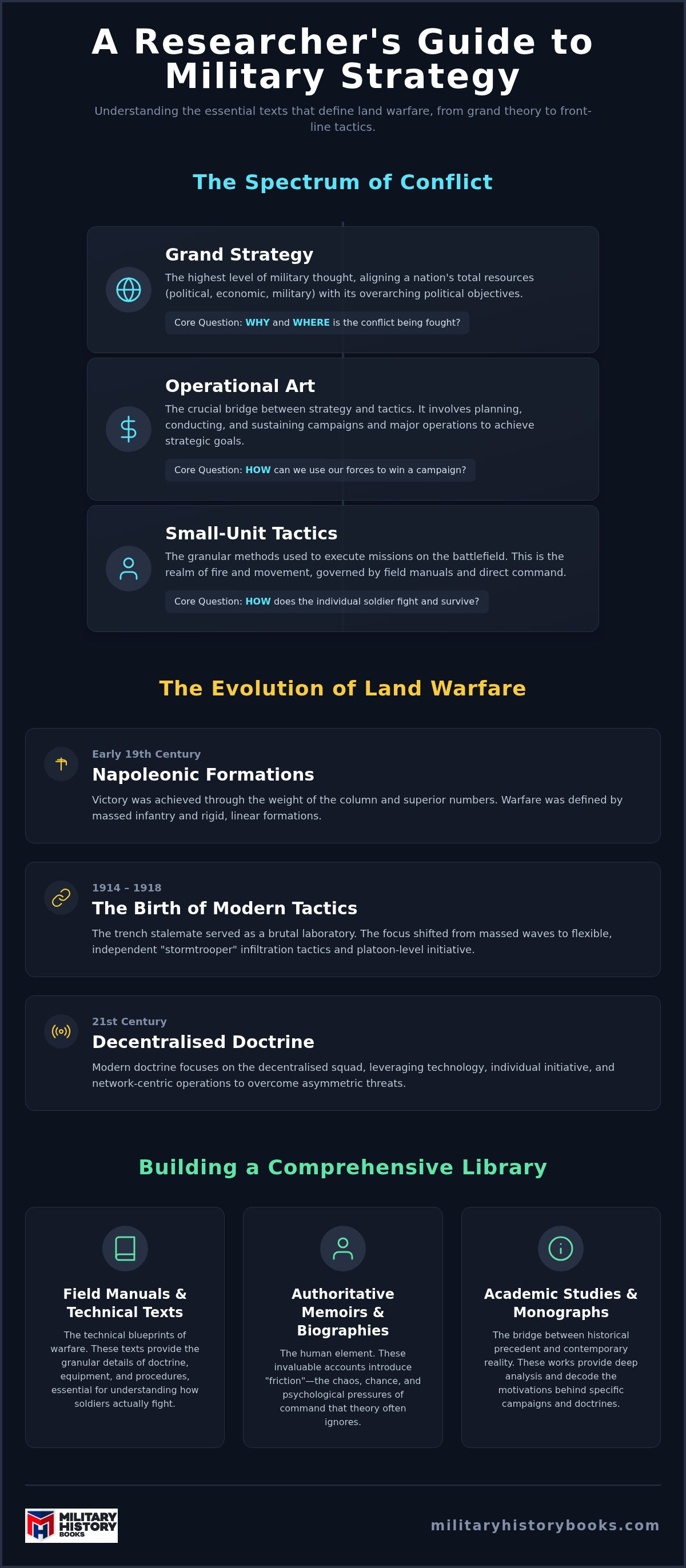
Military strategy is often misunderstood as a purely academic pursuit reserved for high-ranking staff officers. In reality, the genre of military strategy books encompasses a vast spectrum of thought that is essential for anyone seeking a deeper understanding of land warfare. This literature ranges from grand strategy, which aligns a nation's total resources with its political goals, to operational art and the granular details of small-unit tactics. These texts serve as a vital repository for hard-won lessons, ensuring that the technical knowledge and historical experiences of previous generations are preserved for the future. Without this written record, the evolution of combat would be a repetitive cycle of rediscovered mistakes.
For the serious researcher, these volumes are more than just historical narratives; they are technical blueprints. Historians rely on them to decode the motivations behind a specific campaign, whilst modellers use tactical manuals to ensure the period-correct placement of equipment and personnel. Professional soldiers study them to sharpen their professional development and decision-making skills. Whilst the medium has evolved significantly from ancient hand-copied scrolls to modern digital military history books, the core objective remains unchanged. The goal is to understand the disciplined application of force in pursuit of a defined objective.
The distinction between strategy and tactics
It's helpful to view strategy as the "why" and "where" of a conflict. It dictates which battles are fought and for what purpose. Tactics, conversely, represent the "how" on the ground. Infantry warfare books often act as a bridge between these two worlds through operational studies, showing how a commander's intent is translated into fire and movement. A robust library shouldn't focus on one at the expense of the other. A researcher needs to understand the general's map just as clearly as the sergeant's trench to get the full picture of any engagement.
The human element in strategic literature
Theory can only take a student so far. To truly grasp the complexities of command, one must turn to military biography books. These personal accounts introduce the concept of "friction", those unforeseen delays, weather changes, and chaotic variables that theoretical military strategy books often ignore. Memoirs are invaluable because they humanise the cold, technical data found in official manuals. They provide the emotional and psychological context of a decision, allowing the reader to see the weight of leadership through the eyes of those who actually carried it amongst the chaos of the battlefield.
The evolution of land warfare strategy through the ages
Strategic thought has undergone a radical transformation since the days of the Napoleonic line. In the early 19th century, victory was often a matter of massed infantry and superior numbers. By contrast, 21st-century doctrine focuses on the decentralised squad, leveraging technology and individual initiative to overcome asymmetric threats. This shift is meticulously documented in academic monographs and specialist studies, such as those published by the US Army War College Press, which provide a bridge between historical precedent and contemporary reality. Modern military strategy books now reflect this complexity, moving away from simple linear battles to the multidimensional challenges of the current era. Whilst the Napoleonic era relied on the weight of the column, modern warfare demands the precision of the squad.
The birth of modern infantry tactics (1914-1918)
The First World War served as a brutal laboratory for tactical evolution. As the trench stalemate set in, the traditional role of the infantryman was forced to change. By 1917, the development of "stormtrooper" infiltration tactics shifted the focus from the massed wave to small, specialist groups capable of independent action. Authors like Erwin Rommel chronicled this rise of the platoon-level initiative, proving that success on the battlefield often depended on the bravery and quick thinking of junior officers. For those researching this pivotal transition, wartime history books UK offer an essential reference point for understanding how the British Army and its contemporaries adapted to the horrors of industrialised warfare.
Mechanisation and the Blitzkrieg era
The Second World War introduced a revolution in combined arms, where the synergy between infantry, air power, and tanks and armoured vehicles redefined the pace of combat. Amongst the most significant shifts was the integration of the tank as a primary tool for rapid movement and deep penetration. This era's literature explores how German, British, and Soviet forces each developed unique doctrines to manage the chaos of mechanised battle. These studies show that the tactical evolution was swift, moving from the experimental theories of the 1930s to the massive, coordinated operations that defined the mid-1940s.
Asymmetric warfare and urban operations have redefined the landscape once again. Contemporary military strategy books now focus on counter-insurgency and the psychological aspects of conflict, reflecting a world where the front line is often blurred. If you are looking to expand your understanding of these historical shifts, you might enjoy browsing our extensive catalogue of land warfare titles to find the specific era that interests you most.
Categorising your library: Manuals, memoirs, and studies
Building a professional collection of military strategy books requires more than just gathering famous titles; it involves creating a structured archive that reflects the different layers of warfare. A serious researcher should categorise their library based on the source's intent. This typically involves a mix of primary doctrinal sources, secondary analytical studies, and tertiary technical data. By organising your shelves this way, you can cross-reference the "official" way of fighting with the historical reality of how campaigns actually unfolded. This methodical approach is what separates a casual reader from a dedicated student of land warfare.
The foundation of any strategic library is the Field Manual (FM) or its equivalent. These documents represent the official doctrine of an army at a specific point in history. For those looking for modern equivalents, the U.S. Government Bookstore remains a primary source for current strategic thought. Beyond these blueprints, campaign studies are essential for providing the necessary context for tactical actions. Whilst a manual tells you how a squad should move, a campaign study explains why they were moving towards a specific ridge in 1944. For modellers and equipment enthusiasts, technical publications provide the granular detail needed to understand the limitations and capabilities of the hardware used on the ground.
Technical and field manuals: The strategic blueprints
Technical manuals and original Army Council Instructions are amongst the most prized items for serious collectors. These restricted documents were never intended for public consumption, making them rare finds today. They are invaluable for historical re-enactors and technical researchers because they contain the exact drill and frequency of maintenance for period equipment. Sourcing out-of-print technical publications is notoriously difficult, as many were destroyed or lost after their service life ended. Finding a well-preserved copy is often the highlight of a curator's efforts.
The power of personal narratives in strategic research
Whilst official histories provide the "clean" version of events, memoirs offer the "boots-on-the-ground" perspective that reveals the true friction of war. Personal narratives from elite units like the SAS or the Parachute Regiment remain incredibly popular because they detail the individual initiative required when a plan fails. These military strategy books are crucial because they often highlight where official doctrine was ignored or adapted to survive. By comparing a memoir with a field manual from the same era, a researcher can see the fascinating gap between theoretical strategy and the messy reality of the battlefield.
A collector’s guide to sourcing rare military strategy books
Sourcing original copies of military strategy books is a rewarding pursuit that requires a keen eye for detail and a deep respect for historical preservation. For a serious collector, the value of a volume often lies in its physical history as much as its tactical content. A first edition provides a direct link to the strategic thinking of its time, whereas a modern reprint might lack the crispness of original maps or the tactile quality of the period binding. When evaluating a potential acquisition, you must consider the condition of the dust jacket, the presence of any foxing on the pages, and the book's provenance. These factors don't just affect the aesthetic appeal; they are the primary drivers of a book's long-term historical and financial value.
Association copies represent the pinnacle of military book collecting. These are volumes once owned, signed, or annotated by notable military figures, offering a unique window into their personal study of the craft. To maintain the integrity of such a collection, preservation is essential. You should store your volumes in a stable, temperate environment away from direct sunlight to prevent the paper from becoming brittle or the spines from fading. Using acid-free archival covers for dust jackets is a simple yet effective way to ensure these artifacts remain in peak condition for future generations of researchers.
Identifying rare first editions and prints
The copyright page is your primary tool for verification. You should look for the phrase "First Published" followed by the year, without subsequent reprint dates listed. Renowned publishers like Cassell or Pen & Sword have long histories in the military niche, and their early editions are particularly sought after by enthusiasts. Be cautious of modern, unbranded reprints. These often suffer from poor scan quality, especially regarding complex tactical diagrams and folding maps. Research shows that a first edition lacking its original dust jacket can lose over 50% of its market value, so always prioritise copies that remain complete and original.
The benefits of using a specialist military bookshop
Whilst general second-hand marketplaces are abundant, they often lack the specialised knowledge required to authenticate rare technical documents or identify obscure variants. A specialist military bookshop provides a level of security that generalist sellers cannot match. Veteran-led curation is particularly valuable here; an expert who has served understands the significance of a restricted manual or a specific unit history. These specialists are often the only reliable way to locate "lost" or out-of-print technical publications that haven't seen a printing press in decades. If you are ready to expand your archive with authentic historical texts, browse our latest collection of rare and out-of-print titles to find your next essential volume.
Building your strategic library with Military History Books
Military History Books serves as the premier UK destination for those seeking to deepen their understanding of conflict through a carefully curated selection of military strategy books. Managed by an RAF veteran, our business operates with a deep-seated respect for the historical weight of the subjects we cover. We maintain an inventory of over 10,000 specialist titles, ensuring that researchers, modellers, and enthusiasts can find the exact resources they need to complete their archives. Our commitment goes beyond simple retail; we strive to preserve military heritage by providing detailed and accurate descriptions for every volume in our collection, whether it is a rare first edition or a modern digital title.
We understand that building a library is a personal journey that often requires different formats for different purposes. Whilst a digital download offers immediate access for research on the move, a physical, out-of-print technical manual provides a tangible connection to the past that cannot be replicated. Our curation process ensures that every item, from back-issue magazines to primary doctrinal texts, meets the high standards expected by serious students of land warfare. By choosing to source your military strategy books through a specialist, you gain the peace of mind that comes from expert authentication and a shared passion for the subject matter.
Our specialist land warfare and strategy collection
The breadth of our collection is designed to support every level of interest. We stock titles covering everything from the rigid formations of ancient infantry strategy to the fluid, high-stakes environments of modern special forces tactics. For those focused on the technical side of the craft, we offer an extensive range of back-issue modelling magazines that provide essential visual references. We also include a selection of military fiction titles, which are perfect for readers looking to immerse themselves in the historical atmosphere of a specific era without sacrificing technical accuracy.
Expert service and secure global delivery
Acquiring high-value rare titles requires a level of trust that generalist marketplaces often fail to provide. We take extensive security measures for all international shipping, ensuring that your investment is protected from the moment it leaves our shelves until it arrives at your door. If you are struggling to find a specific, "hard-to-find" title that has eluded your search, we invite you to contact our team directly. We take great pride in our ability to source elusive publications and provide the personalised assistance that only a veteran-owned specialist business can offer. Supporting a dedicated niche curator ensures that these vital historical stories and technical lessons continue to be shared amongst the global community of enthusiasts.
Building Your Authoritative Tactical Archive
Mastering the complexities of land warfare requires a diverse library that bridges the gap between grand theory and the technical realities of the front line. By categorising your collection into doctrinal manuals and personal memoirs, you gain a balanced perspective on how strategy is planned and how it's actually executed. For the serious researcher, sourcing high-quality literature is a vital part of preserving this history for future generations whilst ensuring technical accuracy in your own work.
Military History Books is dedicated to supporting your research with a curated inventory of over 10,000 specialist titles. Managed by an RAF veteran, we understand the importance of historical depth and the nuances of tactical evolution. We offer secure global delivery for rare and out-of-print editions, ensuring your next acquisition arrives in the condition it deserves. Whether you're a modeller seeking technical data or a researcher studying operational art, we're here to help you find the elusive titles that will complete your specialist archive.
Browse our extensive collection of military strategy books today and take the next step in building a library that reflects the true depth of military scholarship. We look forward to assisting you in your search for the past's most vital lessons.
Frequently Asked Questions
What are the most essential military strategy books for a beginner?
A beginner should start with Sun Tzu's "The Art of War" for foundational philosophy and Erwin Rommel's "Infantry Attacks" for a practical look at tactical initiative. These two works provide a perfect balance between high-level strategic thought and the realities of small-unit leadership. Once you've grasped these, moving on to modern operational studies will help you understand how these ancient and early 20th-century principles still apply today.
How can I tell if a military history book is a rare first edition?
You should examine the copyright page for the phrase "First Published" followed by a single year, with no mention of subsequent reprints. Collectors of military strategy books also look for a dust jacket that hasn't been price-clipped and a clean spine without sun-fading. If you're unsure, consulting a specialist retailer can provide the authentication needed to verify a volume's rarity and historical provenance.
Where can I find out-of-print British Army field manuals?
Specialist shops like ours are the most reliable source for out-of-print British Army field manuals because they were often restricted or printed in very small quantities. These documents are rarely found in general second-hand bookshops due to their technical nature and specific niche appeal. We maintain a dedicated inventory of these manuals to ensure that researchers can access the original tactical blueprints used by the British Army throughout history.
Are digital military books as useful as physical copies for research?
Digital titles are incredibly useful for quick cross-referencing and keyword searches, but physical copies are often preferred for studying large tactical maps and complex diagrams. A physical book doesn't suffer from resolution issues and remains a permanent part of your archive regardless of technology changes. Many serious researchers use digital formats for initial reading and keep physical copies for their permanent reference library and long-term value.
What is the difference between a campaign study and a tactical manual?
A campaign study focuses on the "why" and "where" of a specific operation, whilst a tactical manual dictates the "how" of combat drills and equipment use. The campaign study provides the historical narrative and strategic context, whereas the manual is a technical guide for the soldier on the ground. Understanding both is essential if you want to see how official doctrine was actually applied during a real-world engagement.
Do you stock books on specific units like the SAS or Parachute Regiment?
Yes, we carry a wide range of unit histories and personal memoirs focused on elite formations like the SAS, the Parachute Regiment, and the Royal Marines. These military strategy books are particularly valuable for researchers interested in unconventional warfare and the development of special operations. They often provide a much more granular look at combat than general histories, focusing on the individual bravery and initiative of specialist troops.
How should I store and preserve my military book collection?
It's best to store your collection in a temperate, dry environment away from direct sunlight to prevent the paper from yellowing or the bindings from cracking. You should use acid-free archival covers for dust jackets to protect them from tears and oils from your hands. Keeping your books upright on a sturdy shelf rather than stacking them will help maintain the structural integrity of the spines over many years.
Can I buy back-issue military magazines for modelling reference?
We stock a variety of back-issue modelling and military magazines that are ideal for technical reference and camouflage research. These magazines often contain detailed scale drawings, equipment photographs, and unit markings that aren't found in standard historical texts. They are an essential resource for modellers who want to ensure their projects are historically accurate and reflect the technical reality of the period.


