

The transition from piston engines to the screaming silence of the stratosphere wasn't just a technological leap; it was a shift in the very soul of flight. For the dedicated enthusiast, finding the right Cold War aviation books often feels like searching for a specific radar signature in a sky full of chaff. You might spend hours sifting through sensationalist accounts that prioritise drama over data, or struggle to track down a technical manual for a defunct interceptor that hasn't seen a printing press since the late sixties.
We understand that your library is more than just a collection of paper; it's a curated archive of human ingenuity and strategic tension. This specialist guide will help you discover the essential literature of the jet age, ranging from gripping pilot memoirs to the rigorous technical references required by serious researchers. We'll examine the difference between narrative accounts and data-driven history, whilst providing expert advice on how to source elusive, out-of-print first editions. By the end of this article, you'll have a clear roadmap for building a collection that respects both the machines and the men who flew them.
Key Takeaways
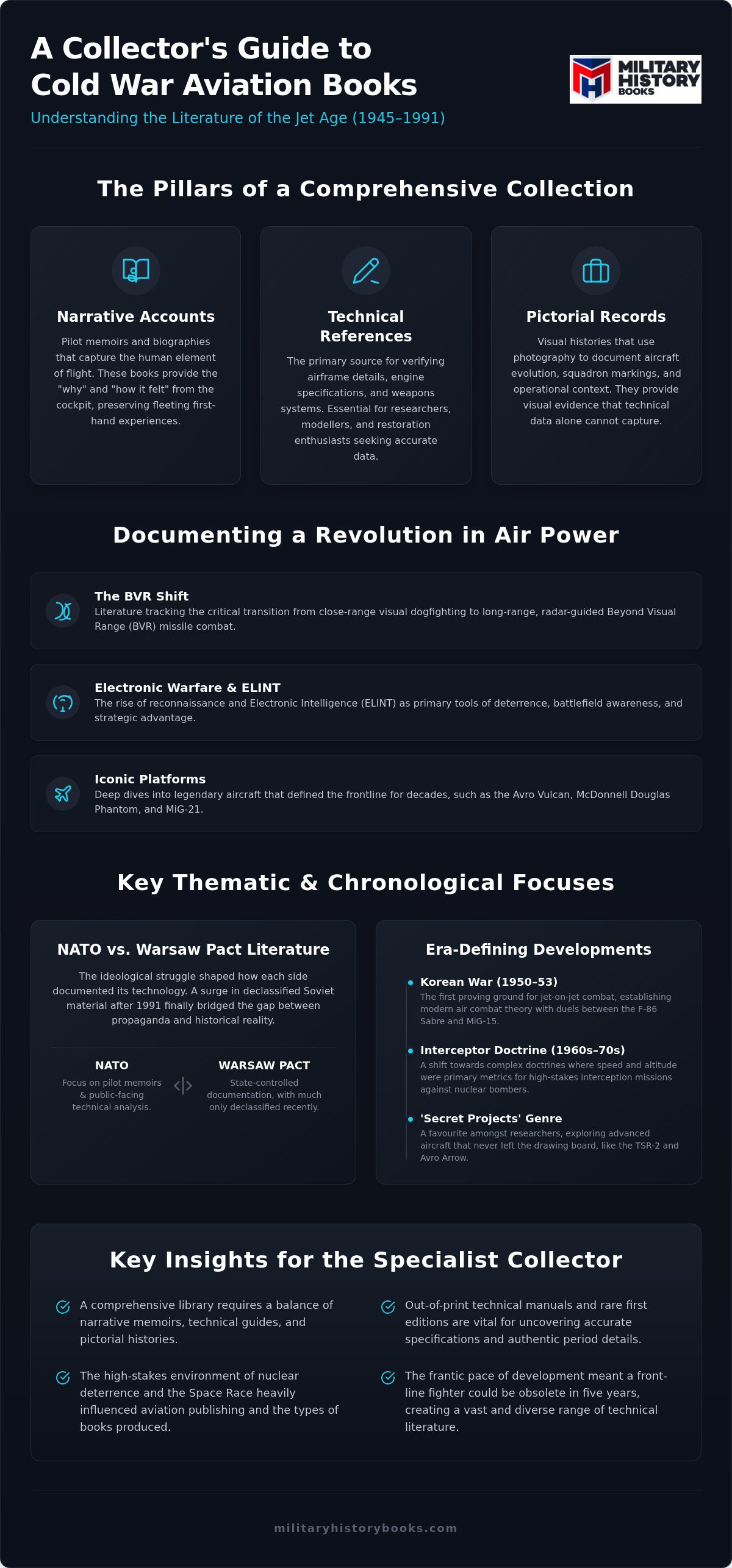
- Learn to distinguish between narrative memoirs, technical reference guides, and pictorial histories to build a comprehensive library of Cold War aviation books.
- Understand why out-of-print technical manuals and rare first editions are vital for uncovering accurate specifications and authentic pilot experiences.
- Explore the thematic differences between NATO and Warsaw Pact literature, focusing on how different nations documented the rapid evolution of jet technology.
- Discover how to source elusive titles and digital archives through a specialist collection of over 10,000 military history works curated by an RAF veteran.
- Identify the impact of the Space Race and nuclear deterrence on aviation publishing and the preservation of jet-age history.
The Golden Age of Jet Power: Why Cold War Aviation Books Endure
The transition from piston engines to jet propulsion marked a definitive literary turning point. Unlike the steady refinement of propeller technology seen in the early 20th century, the jet age was characterised by radical, often dangerous, leaps into the unknown. Early Cold War aviation books capture this frantic era of innovation, where engineers and pilots were effectively writing the rulebook for supersonic flight in real-time. The sheer speed of development meant that a front-line fighter could become obsolete in less than five years, creating a vast and varied landscape of technical documentation.
The ideological struggle between East and West, combined with the looming threat of nuclear deterrence, meant that every technical breakthrough was a matter of national survival. This high-stakes environment gave birth to the "Secret Projects" genre, which remains a favourite amongst researchers for its exploration of the aircraft that never left the drawing board. The 1945–1991 period offers the most diverse range of technical literature because it encompasses everything from the first primitive jets to the dawn of the digital cockpit and stealth technology.
From Korea to the Fall of the Berlin Wall
The Korean War served as the first true proving ground for jet-on-jet combat. Literature from this period often focuses on the legendary duels between the F-86 Sabre and the MiG-15, providing a foundation for modern air combat theory. As the decades progressed, the focus shifted towards the complex interceptor doctrines of the 1960s and 70s, where speed and altitude were the primary metrics of success. Since the end of the conflict, a surge in declassified material has allowed Western readers to explore the history of the Soviet Air Forces with unprecedented clarity, finally bridging the gap between Cold War propaganda and historical reality.
The Technical Revolution in Air Power
This period saw a total revolution in the mechanics of aerial warfare, documented through increasingly sophisticated manuals and research papers that are now highly prized by collectors. The shift was not just about speed; it was about the integration of complex systems that changed the pilot's role forever.
- The BVR Shift: Titles tracking the transition from visual dogfighting with machine guns to Beyond Visual Range (BVR) missile combat.
- Electronic Warfare: The rise of reconnaissance and electronic intelligence (ELINT) as primary tools of deterrence and battlefield awareness.
- V-Force and Beyond: Deep dives into iconic platforms like the Avro Vulcan and the McDonnell Douglas Phantom, aircraft that defined the frontline for decades.
The relentless pace of development during these years ensures that Cold War aviation books remain an essential resource for anyone seeking to understand the technical and human foundations of modern air power.
Navigating the Genres: From Pilot Memoirs to Technical Manuals
Building a library of Cold War aviation books requires a discerning eye for category and intent. A collection usually rests upon three pillars: narrative accounts, technical references, and pictorial records. Each serves a distinct purpose. Narrative works provide the "why" and "how it felt," whilst aviation history books act as essential vessels for preserving the fleeting memories of those who sat in the cockpit. For the scale modeller or the restoration enthusiast, technical manuals are the primary source for verifying airframe details that photographs alone cannot capture.
We've also seen a growing interest in "What If" aviation history. These titles explore the speculative paths of cancelled prototypes like the TSR-2 or the Avro Arrow. While they lean into conjecture, they often base their theories on actual design specifications and political climates of the time. This makes them a fascinating addition to a serious research collection, offering a glimpse into what might've been had budgets or priorities shifted during the height of the arms race.
First-Hand Accounts: The Human Element of Flight
The human perspective is often best captured in military biography books, which offer a deep dive into the unique cockpit culture of the jet age. These memoirs aren't just about the machines. They describe the visceral tension of Quick Reaction Alert (QRA) missions, where pilots waited in darkened hangars for a signal that might mean the start of a global conflict. Authentic accounts are particularly valuable; you can usually tell a genuine pilot's diary from a ghost-written sensationalist piece by the level of technical nuance and the focus on mundane procedures. Historical events like The U-2 Crisis highlight the extreme isolation and psychological pressure of high-altitude reconnaissance, a theme that resonates throughout the best memoirs of the era.
Technical Guides and Aircraft Identification
When precision is the priority for your collection of Cold War aviation books, technical military publications remain the gold standard. These books go beyond general descriptions, providing specific data on engine performance, armament configurations, and avionics. For the historian, reconnaissance and identification guides are indispensable for tracking how airframes evolved under the pressure of the arms race. They are also the best resource for modellers researching authentic camouflage patterns and squadron markings. If you're looking to expand your own archive, you can browse our curated selection of specialist titles to find that missing piece for your research.
Key Themes in Cold War Flight: NATO vs Warsaw Pact
The literary landscape of the Cold War is defined by a fascinating duality between NATO and the Warsaw Pact. Whilst Western Cold War aviation books often benefit from a wealth of declassified pilot accounts and technical data, the literature surrounding Soviet developments was, for decades, shrouded in mystery. This contrast created a unique dynamic in aviation publishing. American titles frequently celebrate the "Century Series" fighters, such as the F-100 Super Sabre and F-104 Starfighter, which represent the pinnacle of early supersonic ambition. You can see the physical legacy of these machines at the National Museum of the USAF's Cold War Gallery, which serves as an excellent visual companion to the technical literature of the era.
In the United Kingdom, the focus often shifts toward the V-Bomber force. The Valiant, Victor, and Vulcan represent a uniquely British approach to nuclear deterrence, and the books documenting their service life provide a somber look at the strategic tensions of the time. Sourcing accurate literature on the Soviet side remains a challenge for many collectors, though the availability of translated works on the MiG and Sukhoi design bureaus has improved significantly since the early 1990s. These translated archives are essential for anyone wishing to move beyond Western-centric perspectives.
Western Air Power: RAF and USAF Chronicles
Western chronicles are dominated by two major technological and tactical shifts. The first is the development of the Harrier, which revolutionised air power through Vertical Take-Off and Landing (VTOL) capabilities. British literature extensively covers the Harrier's evolution from the P.1127 prototype to its frontline service. Simultaneously, USAF operations in Vietnam acted as a catalyst for modern air combat tactics. The lessons learned in the skies over Southeast Asia transformed how pilots were trained and how aircraft like the F-4 Phantom were utilised. For those interested in the European theatre, books detailing the RAF's presence in Germany provide essential context for how NATO planned to defend the "inner German border" during the height of the tension.
Behind the Iron Curtain: Soviet Aviation History
The secretive nature of Soviet aircraft development meant that early Western books were often forced to rely on guesswork and grainy reconnaissance photos. This led to many myths regarding Soviet technical inferiority that post-1991 literature has worked hard to correct. Modern historians now have access to much more reliable data from the Mikoyan and Sukhoi design bureaus. Essential titles now offer deep dives into the development of the MiG-21, perhaps the most iconic jet of the era, and the later MiG-29. These works reveal a design philosophy that prioritised ruggedness and simplicity, providing a vital counterpoint to the high-tech systems developed in the West. Understanding these machines through the eyes of their designers is a key component of any comprehensive collection of Cold War aviation books.
Sourcing Rare and Out-of-Print Cold War Aviation Titles
Finding the right material for a specialist library often requires looking beyond the shelves of mainstream retailers. For the serious researcher, out of print military books are frequently more valuable than modern reprints. These older volumes often contain contemporary observations and unedited technical data that might be omitted in later, condensed versions. Tracking down technical manuals for decommissioned aircraft, such as the English Electric Lightning or the early marks of the Vulcan, presents a particular challenge. These documents weren't intended for public sale, making them rare survivors of a bygone era of operational secrecy.
When you evaluate Cold War aviation books on the secondary market, condition is paramount. Collectors should pay close attention to the state of the dust jacket, as these are usually the first things to perish. Look for signs of foxing, which is the brownish spotting caused by age and humidity, and check for inscriptions that might either detract from or add to the book's history. Whilst some enthusiasts prefer a pristine copy, others find value in a book that's clearly seen service in a squadron library.
The Hunt for Rare First Editions
Collectors typically focus on titles from prestigious publishers like Putnam, Ian Allan, and Jane’s Information Group. These names are synonymous with rigorous research and high production standards. Signed copies by famous Cold War test pilots elevate a standard volume into a historical artefact. Additionally, seemingly insignificant 1950s technical pamphlets are now highly sought-after rarities. They often contain the only surviving diagrams for experimental airframes that never reached mass production.
Identifying Authentic Military Publications
It's vital to distinguish between official MOD or DOD reprints and commercial summaries that may lack technical depth. For those seeking contemporary reporting, back issue military magazines UK offer a unique window into how these aircraft were perceived during their active service life. Verifying the provenance of technical drawings is equally important to ensure you aren't relying on speculative modern reconstructions.
If physical shelf space is at a premium, transitioning to a military history books on disc format can be a practical alternative. This allows for the preservation of high-resolution technical data without the risk of physical degradation. Whether you're seeking a rare first edition or a digital archive, you can search our extensive collection of rare aviation titles to find your next acquisition.
Curating Your Collection with Military History Books
Building a library that truly captures the essence of the jet age requires more than just a random assortment of titles. It demands a methodical approach to selection, ensuring that every volume adds a new layer of understanding to your research. At Military History Books, we don't just act as a shop; we operate as a curated archive for the dedicated enthusiast. Our inventory of over 10,000 titles is meticulously organised to help you find exactly what you need, whether that's a common reference or a rare first edition. For those seeking to surprise a fellow enthusiast, our specialist knowledge is vital when searching for aviation history gifts UK, as we can help you identify works that offer genuine historical value rather than mass-market generalisations.
The Benefit of Veteran-Led Expertise
The primary advantage of our service is that it's managed by an RAF veteran. This background provides a unique perspective on the practical application of air power, allowing us to filter our Cold War aviation books for technical accuracy and historical significance. We understand the nuances of cockpit culture and the logistical realities of airbase operations, which informs how we select everything from squadron histories to operational memoirs. If you're looking for a specific, hard-to-find account of a particular unit or deployment, we offer a personalised service to help you track down the most reliable sources. This commitment to accuracy ensures that your collection remains a trusted resource for years to come.
From Digital Downloads to Rare Hardbacks
We recognise that modern collectors have diverse needs. Some require instant access to data, whilst others value the tactile experience of a vintage hardback. Our collection reflects this, offering a balance between physical preservation and digital convenience.
- Digital Library: We provide digital titles by download and on disc, offering immediate access to technical manuals and reports that are often too fragile or rare to be handled frequently.
- Verified Rare Stock: Every rare and out-of-print title in our inventory undergoes a thorough verification process to ensure its provenance and condition are accurately described.
- Global Reach: We understand that the passion for jet-age history is global. Our secure international delivery ensures that your Cold War aviation books arrive safely, regardless of where your library is located.
By choosing Military History Books, you're joining a community of collectors who value historical integrity. We prioritise the preservation of stories and technical details that might otherwise be lost to time, serving as a bridge between the past and the modern researcher. Whether you're just starting your journey into the jet age or looking to fill a specific gap in a lifelong collection, we're here to guide you through our vast archive of specialist literature.
Preserving the Legacy of the Jet Age
Building a definitive library allows you to witness the rapid evolution of flight from the first primitive jets to the dawn of stealth technology. By balancing visceral pilot memoirs with the rigorous data found in technical manuals, you create a collection that respects both the human experience and the mechanical ingenuity of the era. Recognising the nuances of both NATO and Warsaw Pact developments is essential for any researcher wishing to move beyond simplified historical accounts whilst seeking the truth of the jet age.
Our archive is managed by an RAF veteran who brings a deep-seated passion and professional authority to every title we stock. Whether you're searching for a rare first edition or a digital download of a hard-to-find manual, our inventory of over 10,000 specialist titles is curated to support your research needs. We provide expert international delivery to ensure these historical records reach enthusiasts across the globe safely. Explore our extensive collection of Cold War aviation books today and take the next step in curating your own specialist archive. Every volume you add helps to ensure that these stories remain accessible for future generations.
Frequently Asked Questions
What are the best Cold War aviation books for beginners?
Beginners should start with narrative memoirs that provide a human perspective on the jet age. Titles focusing on the F-4 Phantom or the English Electric Lightning often serve as excellent entry points. These Cold War aviation books offer a balance of technical detail and engaging storytelling without requiring deep prior knowledge. We recommend looking for modern hardbacks or recent reprints of classic accounts before diving into complex technical manuals.
Where can I find rare technical manuals for Cold War aircraft?
Finding rare technical manuals for decommissioned aircraft requires searching through specialist archives and retailers. Unlike general bookshops, we maintain a vast inventory of over 10,000 titles, including elusive flight manuals and maintenance guides. These documents were originally restricted to service personnel, making them rare survivors. We often stock these as physical originals or as digital titles by download and on disc to ensure researchers can access precise specifications.
Are digital military history books as detailed as physical copies?
Digital military history books are just as detailed as their physical counterparts because they are high-resolution scans of original documents. This format is particularly useful for technical manuals where you need to zoom in on intricate diagrams or technical drawings. Choosing a digital download or a title on disc allows you to preserve the information without the risk of physical degradation, making it a practical choice for active research.
Why are out-of-print aviation books so highly valued by collectors?
Out-of-print aviation books are highly valued because they often contain contemporary observations and technical data that were omitted from later, condensed editions. These volumes represent a snapshot in time of military doctrine and technology. For the serious researcher, the unedited technical specifications and first-hand accounts found in these rare titles provide a level of historical accuracy that modern summaries simply cannot replicate, making them essential for any archive.
How do I identify a first edition Cold War pilot memoir?
Identifying a first edition Cold War pilot memoir involves checking the copyright page for a matching publication date and a lack of subsequent printing numbers. Look for reputable publishers like Putnam or Ian Allan. The presence of a pristine dust jacket and the absence of later reprint mentions are key indicators. Signed copies by notable test pilots or squadron commanders also add significant historical weight and value to these first-edition volumes.
What is the best way to research RAF history during the 1960s and 70s?
The most effective way to research RAF history from the 1960s and 70s is to combine official squadron histories with contemporary reporting. Back issue magazines from that era provide a unique perspective on how jet technology was perceived during its active service. We stock an extensive range of these publications, which are invaluable for verifying camouflage patterns, squadron markings, and the day-to-day operational realities of the RAF during the Cold War.
Do you offer international shipping for rare aviation titles?
Yes, we provide secure international delivery for our entire inventory of over 10,000 titles. We understand that aviation collectors and military historians are located all over the world, so we ensure that rare and out-of-print volumes are packaged with the utmost care. Whether you are ordering a delicate technical pamphlet or a heavy hardback memoir, our shipping process is designed to protect your acquisition until it reaches your library.
Can I find Soviet aviation history books in English?
You can certainly find Soviet aviation history books in English, particularly those published after the declassification of archives in the 1990s. Many high-quality translated works now exist that detail the design philosophies of the Mikoyan and Sukhoi bureaus. These Cold War aviation books are essential for gaining a balanced perspective on the era, correcting many of the technical myths that were prevalent in Western literature before the fall of the Berlin Wall.


