
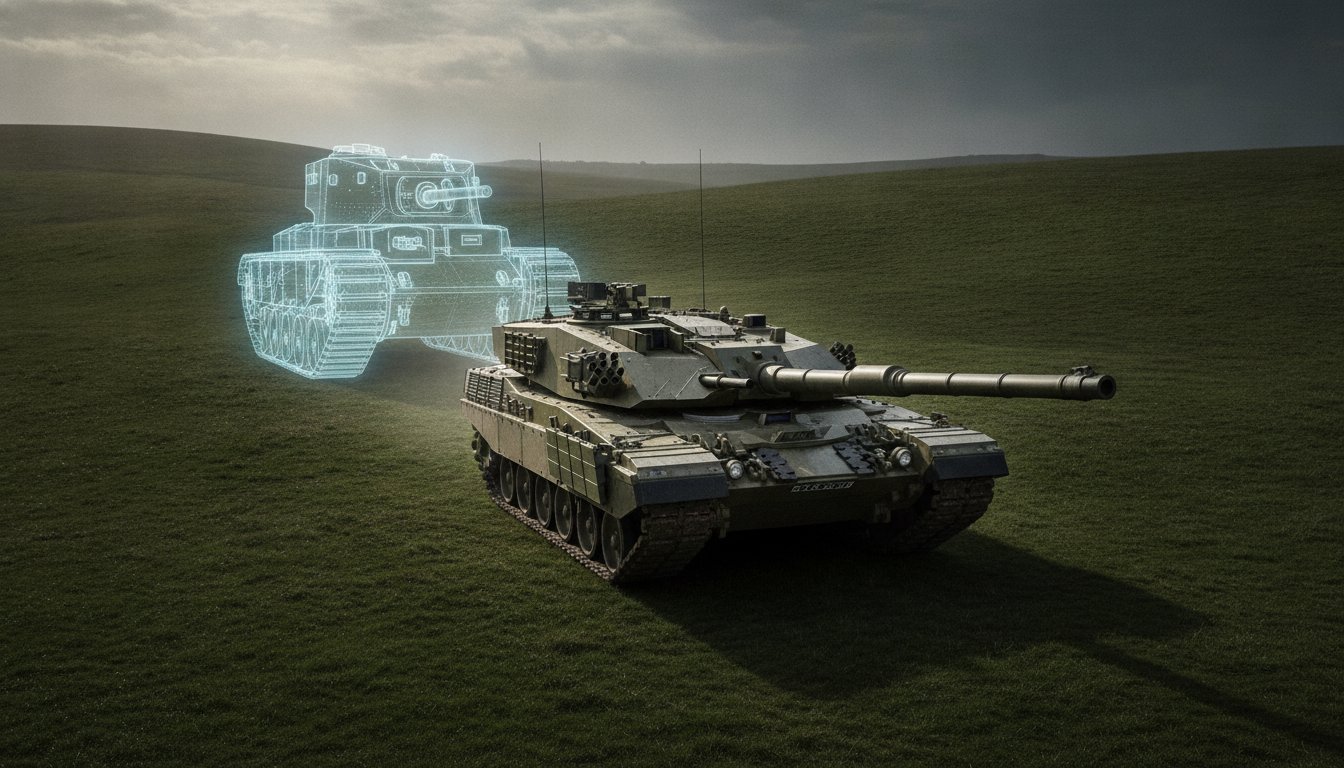
Most general history books treat the tank as a simple iron box on tracks; however, the reality of tanks and armoured vehicles is a complex symphony of engineering, tactical doctrine, and evolving ballistic science. It's often frustrating for serious researchers and modellers when mainstream publications gloss over the vital technical specifications or the nuanced differences between specific variants. Finding a reliable manual for an out-of-print variant can feel like searching for a needle in a haystack, whilst modern AFV classifications only seem to get more confusing with every new procurement cycle.
We understand that a true appreciation of land warfare requires more than just a surface-level overview. This article promises to help you discover the evolution, classification, and essential research literature behind the world's most formidable land warfare machines. We'll explore how design philosophies have shifted from the Great War to the modern era, identify the best reference materials for your specific project, and show you how to locate a trusted source for those elusive, rare titles that define a professional library.
Key Takeaways
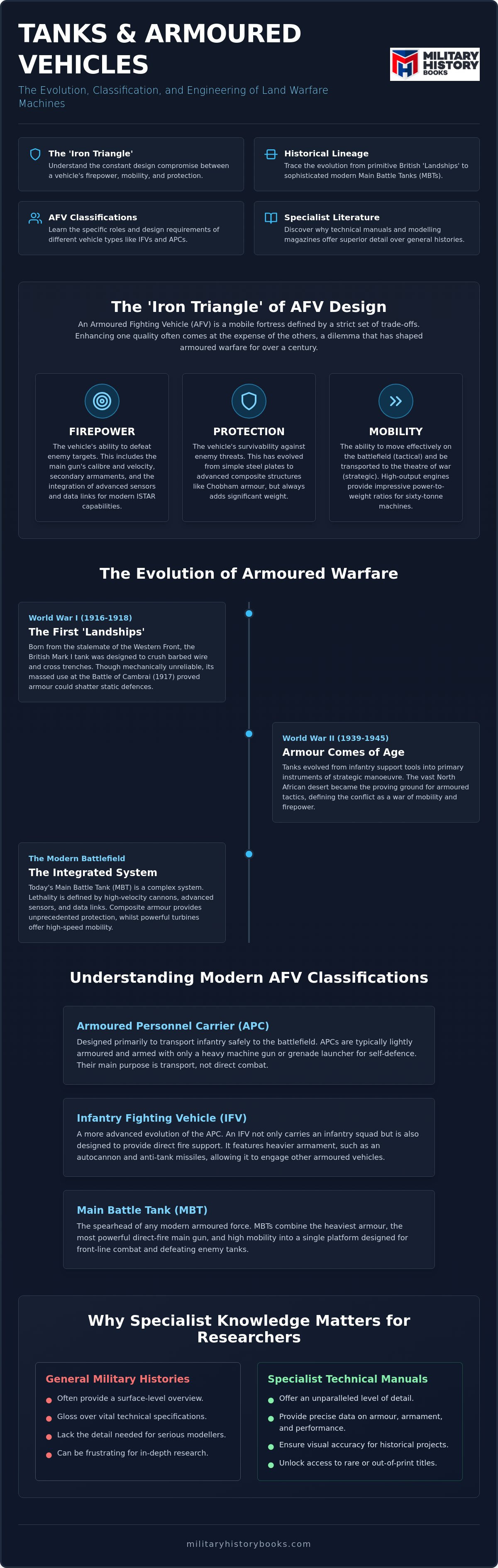
- Understand the 'Iron Triangle' of design, covering firepower, mobility, and protection, to see how every vehicle represents a strategic compromise.
- Trace the historical lineage of tanks and armoured vehicles from the first British Mark I 'Landships' through to the sophisticated Main Battle Tanks used on modern battlefields.
- Learn to distinguish between complex AFV classifications, including the specific roles and design requirements of Infantry Fighting Vehicles and Armoured Personnel Carriers.
- Discover why specialist technical manuals and modelling magazines offer a level of detail and visual accuracy that general military histories often lack.
- Identify how to source rare or out-of-print titles through a curated archive of over 10,000 publications managed by a knowledgeable RAF veteran.
Understanding Tanks and Armoured Vehicles: The Iron Triangle
An Armoured Fighting Vehicle (AFV) is more than just a weapon; it's a mobile fortress designed to survive whilst delivering lethal force. Designers of tanks and armoured vehicles operate within a strict set of constraints known as the 'Iron Triangle'. This framework balances three competing demands: firepower, mobility, and protection. Enhancing one often comes at the expense of the others. For instance, a tank with impenetrable armour becomes too heavy to cross standard bridges, whilst a fast, lightly protected vehicle remains vulnerable to even basic anti-tank weaponry. Understanding these trade-offs requires a deep dive into technical military publications, as general histories often overlook the complex engineering decisions that define a vehicle's success or failure on the battlefield. For those seeking a comprehensive history of the tank, the evolution of this triangle remains the central narrative of 20th-century land warfare.
Firepower: Beyond the Main Gun
Early landships relied on multiple machine guns or small 6-pounder cannons to suppress infantry. Today, the standard is the high-velocity smoothbore cannon, capable of piercing thick composite plating at extreme ranges. Secondary armaments, such as co-axial machine guns and remote weapon stations, provide essential close-in protection against infantry and unmanned aerial threats. In the context of modern ISTAR capabilities, lethality is now defined by the integration of advanced sensors and data links that allow a crew to identify, track, and neutralise threats before the enemy can even register their presence.
Protection and Mobility: The Armourer's Dilemma
The transition from simple riveted steel plates to advanced composite structures like Chobham armour represents a massive leap in survivability. However, this protection adds significant weight, creating a dilemma between tactical mobility (speed on the battlefield) and strategic mobility (the ease of moving vehicles via rail or aircraft). Whilst early 'landships' were restricted to a walking pace, modern engine technology has transformed these platforms into fast, agile cavalry units. High-output diesel engines and gas turbines provide the power-to-weight ratios necessary to move sixty-tonne machines across rugged terrain at speeds that would have been unimaginable to the pioneers of 1916. This constant struggle to balance weight against protection is a primary focus for researchers studying technical manuals and development reports.
The Evolution of Armoured Warfare: A Literary Timeline
The story of the tank begins not in a factory, but in the stagnant, blood-soaked mud of the Western Front. British designers sought a 'landship' capable of crushing barbed wire and traversing trenches, leading to the deployment of the Mark I in 1916. Whilst these early machines were plagued by mechanical failures, they fundamentally altered the trajectory of 20th-century combat. To understand this shift, researchers must look beyond general summaries and consult the primary records of the Tank Corps and contemporary technical reports that detail the transition from naval engineering concepts to mobile land platforms.
World War I and the First Landships
The pioneers of the Great War had no blueprint for victory. At the Battle of Cambrai in 1917, the world witnessed the first massed use of tanks and armoured vehicles, proving that concentrated armour could shatter static defences. This era was defined by rapid trial and error. British engineering led the way, but the shift was global. For instance, the U.S. Army's transition to tanks marked the beginning of the end for traditional horse cavalry, as the internal combustion engine replaced the saddle. Books covering this period often focus on the incredible bravery of crews operating in stifling, petrol-fumed hulls where the risk of carbon monoxide poisoning was as great as the threat of enemy fire.
World War II: The Panzers and the Allies
If the First World War was the birth of armour, the Second was its violent coming of age. The conflict saw tanks and armoured vehicles evolve from infantry support tools into the primary instruments of strategic manoeuvre. The North African desert provided a vast, unobstructed arena for these machines, where the tactical brilliance of commanders like Rommel and Montgomery was recorded in countless memoirs and campaign studies. Technical literature from this period is particularly rich, offering deep dives into the development of the German Tiger and Panther, contrasted against the industrial might behind the Soviet T-34 and the American Sherman.
To grasp the reality of the clash at Kursk or the breakout from Normandy, it's essential to balance technical specifications with the soldier's perspective. Memoirs from this era provide the human context that manuals lack, describing the sensory overload of a tank engagement. If you are looking to expand your research into these pivotal conflicts, you can browse our collection of land warfare titles to find rare and out-of-print accounts that bring these steel giants to life. From the Cold War's development of the Main Battle Tank to the complexities of modern asymmetric warfare, the literature continues to document a restless search for the perfect balance of firepower and protection.
Classifying Armoured Fighting Vehicles (AFVs) for Researchers
Correctly identifying tanks and armoured vehicles requires a grasp of their intended tactical roles, as classification often shifts between different nations and eras. Whilst many people use the word 'tank' as a catch-all term, researchers must distinguish between the various platforms that make up a modern combined-arms force. These range from the heavily protected front-line combatants to the essential support vehicles that keep an army moving. For a deeper look into these technical distinctions, Britannica's history of the tank provides an excellent foundation for understanding how these roles have crystallised over time.
The Role of the Main Battle Tank
The Main Battle Tank (MBT) represents the pinnacle of AFV design, effectively replacing the rigid light, medium, and heavy tank classes of the Second World War. By combining the firepower of a heavy tank with the mobility of a medium, the MBT became the universal standard post-1945 because it offered a single, versatile platform capable of performing almost any battlefield task. British engineering set an early benchmark with the Centurion, whilst the Soviet T-72 and the modern British Challenger 2 illustrate the divergent design philosophies of the Cold War and beyond. These machines are the primary focus of most land warfare literature, but they are only one part of the wider armoured family.
Support and Specialist Armour
Beyond the direct-fire combatants, a vast array of specialist vehicles ensures operational success. Infantry Fighting Vehicles (IFVs) like the British Warrior and Armoured Personnel Carriers (APCs) such as the M113 provide protected transport for troops, allowing them to keep pace with the tanks. Self-propelled artillery and tank destroyers offer long-range support, whilst reconnaissance vehicles prioritise speed and stealth to scout enemy positions. Specialist engineering vehicles, such as bridge-layers and mine-clearers, are often overlooked in general histories despite being critical to tactical mobility. Finding technical manuals for these non-combat support vehicles can be a challenge, yet they are essential for anyone seeking a complete picture of military logistics. Even air defence vehicles, designed to protect the column from aerial threats, occupy a unique niche that reflects the evolving dangers of the modern battlefield. Our collection includes detailed studies on these often-ignored workhorses, ensuring that researchers can find the precise technical data they need for their archives.
Building an Armoured History Library: Practical Guidance
Whilst general history books provide a broad narrative of conflict, they often lack the technical depth required by serious researchers and modellers. Building a library dedicated to tanks and armoured vehicles requires a shift in focus towards primary sources, specialist technical manuals, and contemporary accounts. These publications offer a level of detail that mainstream titles simply cannot match, providing specific data on armour thickness, engine torque, and the logistical challenges of field maintenance. Digital titles have also become indispensable; they provide instant access to high-resolution diagrams and data tables that would otherwise be confined to dusty archives, making them perfect for researchers who need information on the go.
Finding Rare and Out-of-Print Titles
Locating technical manuals for decommissioned armour is a significant challenge for many enthusiasts. These documents were often produced in limited numbers and were never intended for public sale, meaning they rarely appear in high-street bookshops. Specialist booksellers are essential for sourcing these out-of-print military books, as they understand the provenance and historical value of such material. When you are looking for older publications, condition is paramount. Always check for the presence of original fold-out technical diagrams, as these are often the first things to go missing from ex-library or heavily used copies. Verifying the authenticity of first-edition memoirs is equally important; look for specific publisher markings and ensure the spine and binding remain intact, as these factors significantly affect the long-term value of your collection.
Modelling Publications as Research Tools
Scale modelling magazines are frequently overlooked by traditional historians, yet they are amongst the best resources for visual and technical accuracy. These publications specialise in close-up photography of interior layouts, engine bays, and weathered camouflage patterns that general histories ignore. The synergy between historical research and accurate scale representation is vital; a modeller needs to know the exact placement of a rivet or the specific shade of a desert camouflage scheme used in 1942. Finding back-issue magazines that focus on specific vehicle variants allows you to build a comprehensive visual archive. These magazines often feature detailed walk-around articles, which are invaluable for understanding the physical reality of tanks and armoured vehicles beyond the text of a standard history book.
To begin curating your own specialist archive, you can explore our extensive range of land warfare books, which includes everything from technical manuals to rare memoirs. Whether you are conducting academic research or looking for the perfect reference for your next modelling project, our collection is designed to meet the needs of the most dedicated enthusiasts.
Why Specialist Knowledge Matters: The Military History Books Collection
The depth of a historical archive is only as good as the expertise behind its curation. At Military History Books, our collection is managed by an RAF veteran who understands the weight of the history we preserve. With an inventory exceeding 10,000 titles, we don't just sell books; we maintain a curated repository for those who demand technical accuracy and historical truth. This level of specialist knowledge is what separates a dedicated archive from a general retailer. We recognise that for many of our readers, tanks and armoured vehicles aren't just machines; they're the embodiment of engineering evolution and human experience. Having a guide who knows the difference between a mid-production variant and a field modification is essential for serious study. History belongs to those who preserve it.
A Curated Archive for Enthusiasts
Our commitment to the subject extends across land warfare, aviation, and naval history, ensuring a comprehensive resource for any military researcher. We place a particular emphasis on rare and hard-to-find technical military publications that larger outlets often overlook. These documents are vital for understanding the minute details of AFV development, such as the specific hull modifications or internal fire-suppression systems that defined the "Iron Triangle" trade-offs discussed earlier. By focusing on these niche materials, we act as a bridge between the past and the modern enthusiast, connecting researchers with the primary sources they need to complete their work. Whether you are studying the tactical deployment of Panzers or the logistical tail of a modern MBT, our archive provides the necessary depth.
Digital and Physical Formats for Every Reader
We understand that modern research requires flexibility. Whilst many collectors prize the tactile experience of a physical first edition, others require the instant accessibility of digital titles. Our library includes digital formats available via download or on disc, providing high-resolution diagrams and text that you can take anywhere. For those who prefer physical copies, our secure international delivery ensures that your books arrive in the condition described, regardless of where your research takes you. Our selection also extends into military fiction and back-issue modelling magazines, providing a well-rounded view of the service life of tanks and armoured vehicles throughout the decades. Every title in our collection is chosen for its ability to contribute to a deeper understanding of land warfare.
Expertise is the foundation of everything we do. Whether you're looking for a rare technical manual or a contemporary memoir, our veteran-led team is here to help you navigate our vast collection. We invite you to explore our extensive range of land warfare books today and discover the titles that will define your personal archive.
Advancing Your Armoured Research
The journey through the history of armoured warfare reveals a constant pursuit of the perfect balance between firepower, mobility, and protection. By moving beyond general narratives and into the technical specifics of tanks and armoured vehicles, you gain a much deeper appreciation for the engineering and tactical decisions that shaped modern combat. Every manual tells a story. Whether you're identifying a specific variant for a modelling project or researching the strategic shifts of the Cold War, the right literature remains an indispensable tool for any serious enthusiast.
Our archive is designed to support this pursuit of knowledge. With over 10,000 specialist titles in stock, our collection is managed by an RAF veteran with deep historical expertise. We provide worldwide secure delivery for collectors to ensure that researchers everywhere can access these rare and out-of-print records. Take the next step in building your personal library and browse our specialist collection of land warfare books and technical manuals to find the precise details that bring history to life. We look forward to helping you uncover the stories and specifications that define the formidable world of land warfare.
Frequently Asked Questions
What is the difference between an APC and an IFV?
An Armoured Personnel Carrier (APC) is primarily designed to transport infantry to the battlefield whilst protecting them from small arms fire and shrapnel. In contrast, an Infantry Fighting Vehicle (IFV) is built to carry troops into combat and provide direct fire support with its own organic weaponry, such as autocannons or anti-tank missiles. Whilst an APC acts as a "battle taxi", the IFV is a more aggressive platform integrated into the fighting line.
How do I find rare or out-of-print tank history books?
Locating rare or out-of-print titles requires a search through specialist military booksellers rather than general retailers. These experts curate archives of decommissioned technical manuals and limited-run memoirs that are no longer in production. Our inventory of over 10,000 titles is a reliable starting point for researchers looking for specific vehicle variants or historical accounts that have disappeared from mainstream circulation.
Are technical military manuals available for the general public?
Yes, many technical military manuals are available to the general public once they have been declassified or released for historical research. These documents provide exhaustive details on the operation, maintenance, and internal components of tanks and armoured vehicles. Collectors often seek these out to understand the mechanical reality of the machines, as they offer a level of precision that general history books cannot provide.
What are the best books for researching British tank history?
The best research materials for British tank history include technical studies of iconic platforms like the Centurion and Challenger 2, along with unit histories of the Royal Armoured Corps. Authors like David Fletcher provide authoritative accounts of the early landships and interwar developments. We recommend looking for titles that combine engineering diagrams with tactical analysis to get a complete view of the British contribution to armoured warfare.
Can I buy digital versions of military history books?
You can certainly purchase digital versions of military history books, which are often available as downloads or on disc. These formats are particularly useful for researchers who need to carry vast amounts of technical data and high-resolution diagrams whilst travelling. Digital titles allow for easy searching of specific terms and provide a convenient way to preserve fragile information without the wear and tear associated with physical copies.
Why is the Challenger 2 considered one of the best tanks?
The Challenger 2 is renowned for its exceptional protection and combat-proven survivability, largely due to its advanced Dorchester composite armour. Its 120mm rifled main gun provides a high degree of accuracy and the ability to fire unique HESH rounds, which are effective against various battlefield targets. This combination of crew safety and lethal precision has earned it a reputation as one of the most formidable tanks and armoured vehicles currently in service.
Do you provide international shipping for military books?
We provide secure international delivery to ensure that collectors and researchers worldwide can access our curated archive. Every order is carefully packaged to protect the condition of rare or fragile publications during transit. Whether you are ordering a single volume or a large collection of technical manuals, we use reliable courier services to maintain the integrity of our global delivery promise.
What should I look for in a modelling reference book?
A high-quality modelling reference book should feature detailed "walk-around" photography that captures every exterior angle and interior layout of the vehicle. Look for publications that include specific colour call-outs for camouflage patterns and diagrams of stowage equipment. These visual details are essential for achieving historical accuracy in scale representation, providing the technical clarity that general military histories often omit.


