

A library filled with glossy bestsellers often provides a vivid story, but it rarely offers the technical depth required for genuine historical analysis. You've likely felt the frustration of searching for specific armour thickness or an elusive out-of-print unit history, only to be met with generic accounts that skim over the vital details. Sifting through "pop-history" is a common hurdle when your project demands the precision found in specialised military history research books and primary source data.
We understand that building a serious collection requires a more discerning eye. This guide will help you identify and utilise the most authoritative titles to build a professional-grade archive that stands up to scrutiny. We'll explore the essential differences between narrative and analytical history, provide a structured framework for your enquiries, and show you how to locate the rare publications that define a conflict. Whether you're a seasoned researcher or a dedicated enthusiast, you'll discover how to source the technical and tactical materials that bring the past into sharper focus.
Key Takeaways
- Understand the crucial distinction between narrative storytelling and analytical, data-driven accounts to ensure your sources meet professional standards.
- Learn why technical manuals and unit diaries are essential for verifying hardware specifications and maintaining chronological accuracy in your projects.
- Identify the specific types of military history research books required for in-depth study of aviation development, naval operations, and land warfare tactics.
- Discover effective methods for sourcing out-of-print titles and rare memoirs that contain vital historical data often omitted from modern reprints.
- Develop a framework to organise and curate your personal archive using a blend of physical volumes and digital formats for maximum research efficiency.
Defining the Landscape of Military History Research Books
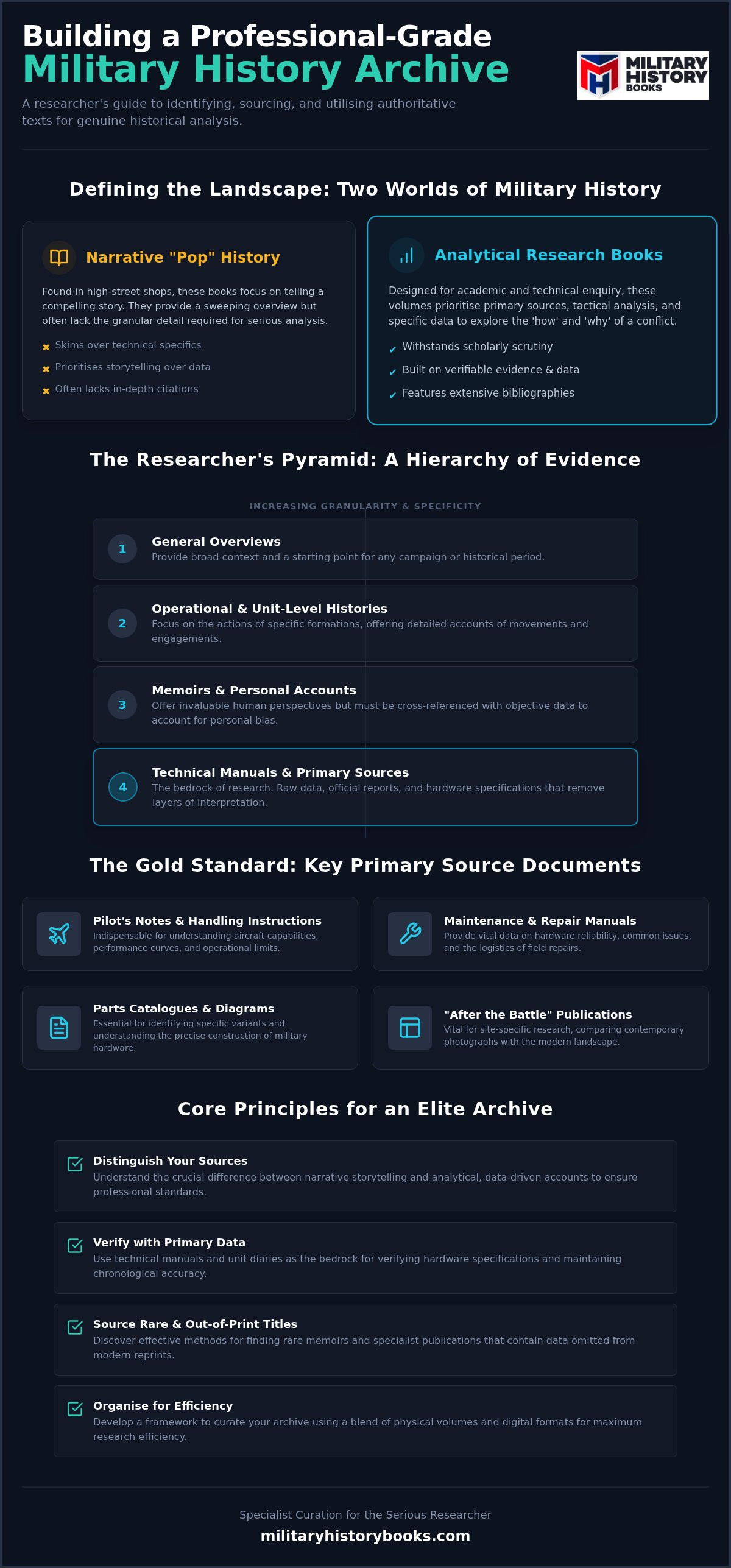
A true research book serves a different purpose than the glossy hardbacks found in a typical high-street shop. Whilst a popular bestseller might provide a sweeping overview of a campaign, military history research books are designed to withstand the rigours of academic or technical enquiry. These volumes prioritise primary source evidence, tactical analysis, and specific data over simple storytelling. They act as the building blocks for a professional-grade archive, allowing you to move beyond the "what" of an event into the complex "how" and "why".
Establishing a hierarchy is essential for any serious project. This progression often begins with general overviews that provide the necessary context for Military history as a discipline. From there, a researcher moves into operational histories, unit-level accounts, and eventually into the granular detail of technical manuals or official after-action reports. This methodical approach ensures that every claim you make is supported by a foundation of verifiable evidence.
Narrative vs. Analytical Military Literature
Identifying the right material requires an understanding of different writing styles. Narrative history focuses on the sequence of events, often using a chronological structure to tell a compelling story. Whilst these are excellent for gaining a broad understanding, they often lack the depth required for technical study. Analytical history, by contrast, examines the underlying factors of a conflict, such as logistics, doctrine, or technological shifts. When you're building a collection of military history books, look for scholarly citations and extensive bibliographies. These are the hallmarks of a work that values factual precision over anecdotal flair.
Memoirs occupy a unique space in this landscape. They offer an invaluable human perspective that official reports cannot capture, yet they must be handled with care. A researcher's task is to balance the personal bias of a veteran's account with the objective facts found in unit diaries. By cross-referencing multiple personal accounts against technical data, you can build a more accurate and nuanced picture of the reality on the ground.
The Importance of Specialist Curation
Generalist booksellers often struggle to provide the technical depth required for serious research. At Military History Books, our collection is curated with the expertise of an RAF veteran who understands the importance of technical specifications and niche unit histories. With an inventory of over 10,000 titles, we offer the breadth needed to cross-reference obscure topics that mainstream retailers simply don't stock. This level of specialist curation ensures that whether you're looking for the armour thickness of a specific tank variant or the operational record of a lost squadron, you have access to the primary and secondary sources that make high-level research possible.
The Value of Technical Publications and Primary Sources
Primary sources are the bedrock of any serious investigation. Whilst narrative accounts provide context, technical manuals and official records offer the raw data needed to verify hardware performance or unit movements. For those building a library of military history research books, these documents are the gold standard. They remove the layers of interpretation often found in later works, providing a direct link to the technical and tactical reality of the era. Accessing these documents is easier when you have a reliable source for specialised military history research books that focus on primary data.
Manuals and Technical Specifications
Technical publications, such as original Spitfire or Hawker Hurricane pilot notes and maintenance manuals, are indispensable for understanding aircraft capabilities. These documents detail every lever, gauge, and performance curve, providing a level of accuracy that standard histories cannot match. Similarly, "After the Battle" style publications are vital for site-specific research, allowing you to compare contemporary photographs with the modern landscape. When selecting these materials, it's vital to distinguish between high-quality reprints and original documents, as some modern editions may omit crucial fold-out diagrams or technical appendices found in the originals.
Key technical sources often include:
- Pilot's Notes and Handling Instructions
- Maintenance and Repair Manuals
- Parts Catalogues and Technical Diagrams
- Official Performance Trials Data
Official Histories and Unit Records
Official histories, often commissioned by national governments after a conflict, provide a comprehensive chronological framework. These series are essential for cross-referencing with National Archives military records to verify specific dates, orders of battle, and strategic decisions. On a more personal level, regimental and unit histories offer a "ground-level" view of how these strategies were executed. These accounts often include detail found nowhere else, such as specific patrol routes or daily casualty lists.
The way we access this data is changing. Whilst physical volumes remain a favourite for many, the transition to digital downloads and discs has made rare technical manuals more accessible than ever. For those seeking visual references, modelling magazines and back issue periodicals provide a wealth of contemporary photographs and camouflage schemes that are often omitted from text-heavy academic volumes. Integrating these visual aids with technical data allows for a multi-dimensional understanding of military hardware. Our collection includes over 10,000 titles, ensuring that researchers can find the specific technical data required for their archives.
Identifying Specialist Books by Branch: Aviation, Naval, and Land
Research requirements shift significantly depending on which branch of service you're investigating. Whilst a study of land warfare might focus on topography and infantry tactics, aviation research often demands a deeper understanding of engineering and aerodynamics. Identifying the right military history research books for each branch ensures that your archive reflects the unique challenges faced by those in the air, at sea, or on the ground. Each service has its own "language" of documentation, and understanding these differences is the first step toward building a comprehensive library.
Aviation and Aircraft History
Aviation research typically falls into three categories: technical development, operational squadron histories, and individual pilot memoirs. Tracking the evolution of the RAF requires a mix of these sources to understand how strategic doctrine kept pace with rapid technological shifts. Aircraft-specific titles, such as those detailing the Lancaster or Spitfire, are essential for researchers looking to verify modifications or specific production batches. You can find a comprehensive range of aviation history books that bridge the gap between raw technical data and the lived experience of flight crews, providing a complete picture of aerial combat.
Naval and Maritime Warfare
Researching the Royal Navy involves a shift in scale, often moving from individual ships to the logistical complexity of entire fleet movements. Essential titles for naval history cover everything from the transition of ironclads to the strategic role of modern carriers in global power projection. For those interested in the "silent service," submarine chronicles provide a specialised look at the unique tactical and psychological pressures of undersea warfare. Building a naval archive requires sources that detail both the engineering of the vessels and the broader maritime command structures. Our curated list of naval history publications offers a steady starting point for exploring these vast maritime archives.
Land Warfare and Armour
Land warfare research is often the most geographically diverse, requiring a focus on tactical studies of tank warfare and infantry memoirs. Tactical books examine how armoured combat evolved from the first deployments in the Great War to the sophisticated combined-arms operations seen today. Infantry accounts provide the necessary human context, detailing the soldier's journey through specific campaign histories across varied terrain. For strategic studies, consulting resources like the U.S. Army Center of Military History publications can provide an international perspective on doctrine and operational planning. Finding specialised wartime history books UK researchers trust is vital for capturing the specific British experience across various global theatres, ensuring that your military history research books cover both the technical and human elements of land combat.
Sourcing Rare and Out of Print Military Books
The hunt for elusive data often leads researchers to volumes that haven't seen a printing press in decades. Whilst modern digital scans are efficient, there's a specific depth found in original military history research books that modern reprints sometimes lack. Appendices, fold-out maps, and technical schematics are frequently the first victims of cost-cutting in contemporary editions. For a serious researcher, these missing elements aren't just decorative; they're the primary evidence needed to verify a tactical movement or a technical specification.
Identifying a true first edition or a rare memoir requires a keen eye for detail. Rare memoirs, particularly those published privately by regimental associations shortly after a conflict, offer a level of granular detail that mainstream publishers often overlook. These books were often written for an audience of veterans who knew the terrain, meaning they don't shy away from the technical or tactical complexities of the campaign. Specialist dealers play a vital role here, acting as curators who understand the historical weight of their inventory. Preserving these books is about more than just collecting; it's about safeguarding the technical history of the service branches for future generations.
The Hunt for Out-of-Print Titles
Finding specific technical publications no longer in print requires a methodical approach. You can't always rely on standard ISBN searches for niche unit histories or wartime manuals. Evaluating the condition is a balancing act. Whilst a pristine copy is a collector's dream, a well-thumbed volume with original marginalia might actually provide more context for a researcher. If the physical rarity is out of reach, digital reprints on disc or via download are a viable alternative. They allow you to access the rare data without the high cost of a collector-grade original. You can browse our collection of rare and out-of-print titles to find the specific volumes your archive is missing.
Collector vs. Researcher Mindset
There's a distinct difference between buying for investment and buying for utility. A researcher might prefer a modern digital download for its portability and ease of cross-referencing, whilst a collector values the physical connection to the past. Building a library that balances these two needs is often the most efficient way to work. You might choose to invest in a rare first edition for a core subject of your study, whilst using back issue magazines or digital files for secondary references. Whatever your preference, ensure your source provides secure international delivery. Rare military history research books are global assets, and they must be handled with the respect their historical value demands. Our veteran-managed team ensures that every title, whether a rare hardback or a digital file, is selected for its research-grade quality.
Curating Your Personal Archive with Military History Books
Organising a collection of military history research books requires a methodical approach to ensure every volume is accessible when needed. Whether you choose to arrange your library by specific conflict, service branch, or a strict chronological timeline, the goal is to create a functional system that supports your enquiries. A well-structured archive allows you to cross-reference technical data across different theatres of war, revealing patterns in doctrine and hardware development that a haphazard shelf might obscure. This systematic organisation transforms a simple book collection into a professional-grade research tool.
Staying updated is equally vital for a modern historian. Using modelling magazines and periodicals allows you to track new historical findings and archaeological discoveries that might not yet have reached mainstream hardbacks. These publications often contain the most recent research on camouflage schemes, minor hardware variants, and recovered unit diaries. By identifying the next gaps in your collection, you can focus your search on the specific technical manuals or rare memoirs required to bring your project to completion.
Digital Integration for Modern Historians
Integrating digital and physical formats is the most efficient way to manage a growing collection without overwhelming your physical space. Digital titles, available by download or on disc, offer the immense benefit of keyword searching, allowing you to locate a specific technical term or unit name amongst hundreds of pages in seconds. This speed is invaluable during the writing or fact-checking process. Choosing digital formats for text-heavy technical manuals also preserves shelf space for rare, large-format volumes or back issue magazines that require physical browsing for their visual detail. Organising your digital files into a mirrored structure of your physical shelves ensures a seamless transition between the two mediums.
The Role of Military Fiction and Biography
Whilst technical manuals provide the raw data, historically accurate military fiction and biographies offer the necessary context of leadership and atmosphere. Biographies serve as a window into the decision-making processes of commanders, providing a narrative thread that connects individual actions to broader strategic outcomes. Similarly, well-researched military fiction can help a researcher understand the daily realities and psychological pressures of a conflict, which is often missing from dry official reports. These titles complement your military history research books by adding a human dimension to the technical facts found in your primary sources.
Building a comprehensive library is a journey of constant refinement and discovery. Whether you are looking for the latest land warfare analysis or an elusive aviation technical manual, our veteran-managed collection is designed to support every level of historical enquiry. We invite you to explore our archive of over 10,000 military titles to find the essential volumes needed to complete your professional-grade research library.
Building Your Definitive Military Archive
Developing a professional-grade library is a continuous process of discovery and refinement. You've seen how moving beyond general narratives into the technical depth of primary sources transforms your understanding of conflict. By prioritising analytical accounts, technical manuals, and rare memoirs, you ensure your research is built on a foundation of verifiable evidence rather than hearsay. Whether you're tracking the development of the RAF or researching land warfare tactics, the right military history research books provide the clarity and precision your work deserves.
Our collection is curated with the expertise of an RAF veteran who understands the specific needs of serious researchers and collectors alike. With over 10,000 specialist titles in stock, we focus on providing the rare and technical publications that high-street retailers often overlook. We invite you to browse our extensive collection of military history research books to find the authoritative sources your archive requires. Every volume you add brings you one step closer to a complete and nuanced picture of the past.
Frequently Asked Questions
How do I start military history research as a beginner?
Beginners should start with reputable campaign overviews to establish a broad chronological framework for their chosen period. Once you've understood the general context, you can narrow your focus to specific branches or units by consulting specialised military history research books that offer more granular detail. It's often helpful to move from general narratives into analytical studies as your knowledge of a particular conflict grows.
What are the best military history research books for technical details?
The best sources for technical precision are original pilot's notes, maintenance manuals, and official performance trial data. These primary documents provide raw specifications and handling instructions that are often simplified in general narrative accounts. You'll find that these technical publications offer the most reliable data for verifying hardware performance or engineering modifications during a conflict.
Are digital military history books as good as physical copies for research?
Digital formats are excellent for research because they allow for instant keyword searching across hundreds of pages. Whilst physical volumes have a tactile and collector value, digital downloads or titles on disc are often more efficient for locating specific technical terms or unit names during the writing process. They also allow you to store a vast technical library without the need for extensive physical shelving.
Where can I find rare or out-of-print military technical manuals?
Rare and out-of-print manuals are best sourced through specialist retailers who curate technical archives rather than generalist bookshops. Our inventory includes over 10,000 titles, many of which are elusive technical publications or privately printed unit histories that aren't found in mainstream outlets. These specialist military history research books are essential for those seeking data that has been lost to modern editions.
Why should I use unit histories for my research?
Unit histories provide a "ground-level" perspective that official national histories might miss during their broader strategic analysis. They offer specific details such as daily patrol routes, casualty lists, and local tactical decisions, making them essential for verifying the movements and experiences of specific regiments or squadrons. These accounts often contain personal anecdotes that bring the technical data of a campaign into sharper focus.
How can I verify the accuracy of a military history book?
Accuracy is best verified by examining the bibliography and citations for primary source evidence. A reliable research book should reference official records, unit diaries, or technical manuals, allowing you to cross-reference claims against established historical data. If a book lacks these scholarly markers, it's likely a narrative account intended for general reading rather than serious academic or technical enquiry.
What is the difference between a first edition and a reprint for research?
First editions are original prints that contain all intended illustrations, fold-out maps, and technical schematics exactly as they were first published. Modern reprints are often more affordable and accessible, but they occasionally omit these complex visual elements to reduce production costs. For technical researchers, checking whether a reprint includes all original appendices is a vital step before purchase.
Do you provide international shipping for rare books?
Yes, we provide secure international delivery for our entire collection, including rare and out-of-print titles. We ensure that every book is packaged with the respect its historical value deserves, allowing researchers worldwide to access our specialised collection. Our veteran-managed team understands the importance of these documents and prioritises their safe arrival at your archive.


