

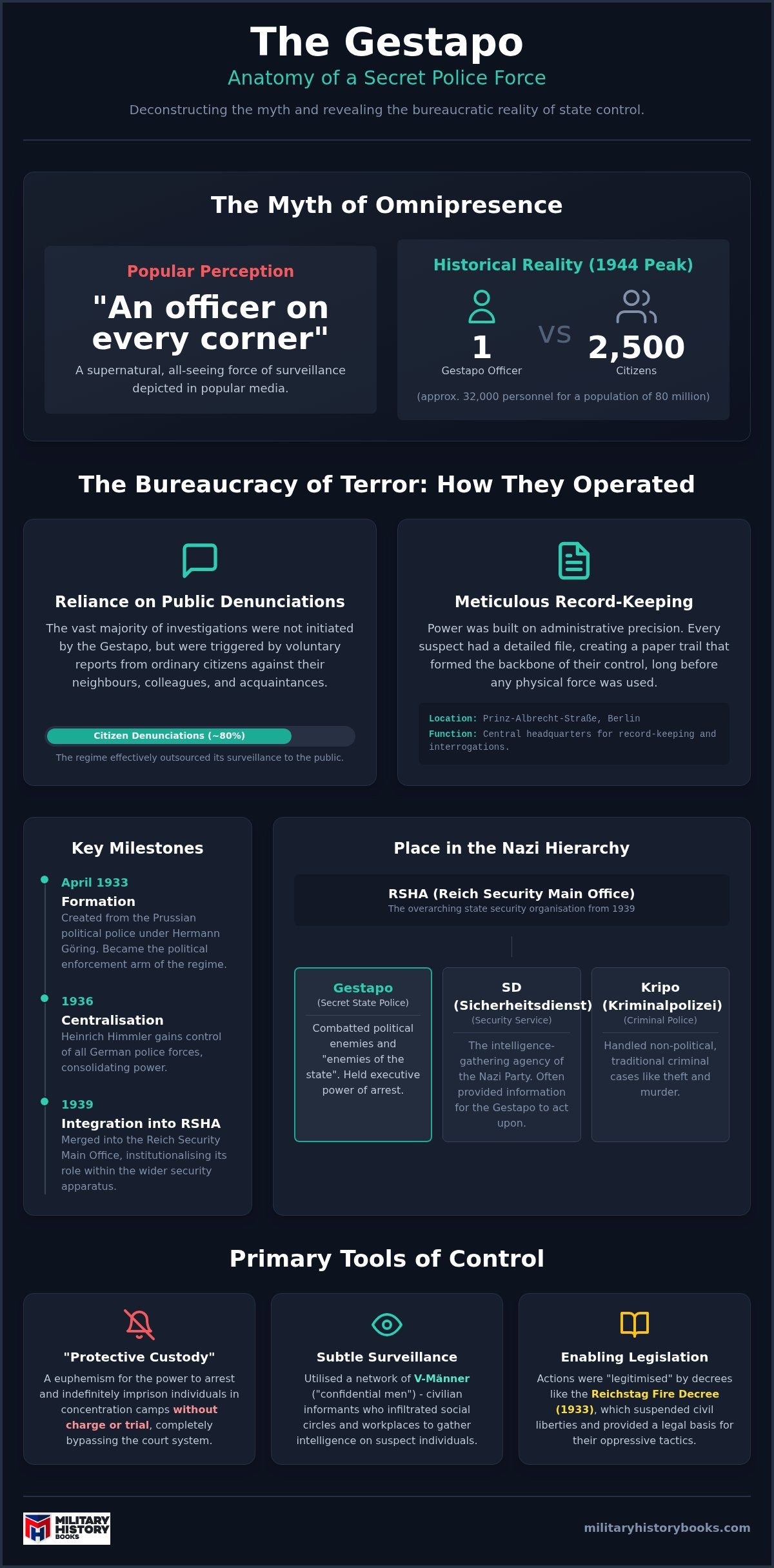
How could a force of just 32,000 personnel maintain an absolute grip over a population of 80 million people at its peak in 1944? You've likely encountered conflicting accounts of the Gestapo in popular media, where they're often depicted as an omnipresent, almost supernatural force. It's often difficult to separate the cinematic myths from the cold, bureaucratic reality of the secret state police, especially when detailed historical sources feel out of reach or contradictory.
We understand that serious researchers require more than just generalisations. This article helps you look past the sensationalism to discover the historical reality of the Gestapo, showing how specialist literature and technical records provide the clearest insights into their operations and legacy. We'll provide a clear historical timeline, examine the internal command structure, and highlight rare books that offer the primary source material essential for any dedicated student of history. By the end, you'll have a much firmer grasp of how this organisation functioned and where to find the most reliable accounts of their activities within the broader landscape of land warfare and political control.
Key Takeaways
- Understand the 1933 origins of the Gestapo and its specific role as the political enforcement arm of the Third Reich.
- Examine the administrative machinery and the network of civilian informants that underpinned the secret police's daily operations.
- Deconstruct the myth of an omnipresent force by reviewing the actual ratio of officers to the general population.
- Learn why technical publications and out-of-print military titles are essential for uncovering complex organisational structures.
- Discover how to access rare land warfare resources through expert curation to elevate the quality of your historical research.
What was the Gestapo? Defining the Secret State Police
The term Gestapo is a syllabic abbreviation of Geheime Staatspolizei, which translates directly to Secret State Police. Formed in April 1933, this organisation became the primary instrument of state-sponsored terror within the borders of the Third Reich. Its core mission involved the identification and elimination of "enemies of the state," a category that expanded rapidly from political rivals to include any group deemed racially or socially undesirable by the regime. Understanding the nuances of this period requires access to detailed scholarship, and wartime history books UK provide the necessary depth for researchers to distinguish between various state and party apparatuses.
The Transition from Weimar to Nazi Control
The birth of the secret police didn't happen in a vacuum; it was a calculated transformation of existing Weimar-era structures. Hermann Göring, acting as the Prussian Minister of the Interior, oversaw the initial "Nazification" of the Prussian political police. He replaced career civil servants with radicalised Nazi loyalists, effectively turning a state investigative body into a party weapon. This shift was legitimised by the Reichstag Fire Decree of February 1933, which stripped citizens of their legal protections. The most significant tool birthed from this era was "protective custody," a euphemism that allowed the state to bypass the court system entirely. It meant individuals could be arrested and held in concentration camps indefinitely without ever being charged with a crime or granted a trial.
The Gestapo’s Place in the Nazi Hierarchy
Navigating the overlapping jurisdictions of the Third Reich is often confusing for many readers. In 1936, Heinrich Himmler took control of all German police forces, eventually merging the Gestapo into the Reichssicherheitshauptamt (RSHA) in 1939. It's vital to separate the state-funded Gestapo from the SS, which was a paramilitary wing of the Nazi Party. Similarly, the Sicherheitsdienst (SD) served as the party’s intelligence service, often gathering information that the Gestapo would then act upon with executive force. Whilst the Kriminalpolizei (Kripo) focused on traditional criminal activity like theft or murder, the Gestapo functioned as a political watchdog with unique powers of arrest. The Gestapo’s jurisdiction was defined by its absolute authority to investigate and combat all activities deemed dangerous to the state throughout the entire German Reich.
The Bureaucracy of Terror: How the Gestapo Operated
The Gestapo didn't just rely on brute force. It was a machine built on meticulous record-keeping and administrative precision. Every suspect had a file, and every file was a testament to the organisation’s obsession with detail. This paper trail was the backbone of their power. Whilst popular culture focuses on the black trench coats, the real terror often sat in the filing cabinets of the Prinz-Albrecht-Straße headquarters. To understand these internal mechanics, many researchers turn to land warfare books which document the evolution of state-sponsored tactical control and internal policing.
Denunciations and Public Cooperation
The most unsettling aspect of the Gestapo's operation was its dependence on the German public. It's a common misconception that the secret police were lurking on every street corner. In reality, a vast majority of investigations were triggered by voluntary denunciations from ordinary citizens. People reported their neighbours for "defeatist" talk, listening to foreign radio, or violating the Nuremberg Laws. These laws didn't just segregate society; they turned every social interaction into a potential crime scene. By encouraging citizens to monitor each other's behaviour, the regime effectively outsourced its surveillance. If you're looking for specific Gestapo facts and tactics, you'll find that this reliance on public cooperation allowed a relatively small force to exert disproportionate control. For those building a personal library on this subject, our collection of rare and out-of-print titles offers deep dives into how these social pressures were engineered.
Surveillance and Interrogation Methods
When the paperwork pointed to a suspect, the Gestapo moved from observation to action. Surveillance was often subtle, involving the V-Männer or "confidential men" who infiltrated social circles and workplaces. However, once an individual was brought to the cells at Prinz-Albrecht-Straße, the veneer of legal procedure vanished. The organisation increasingly utilised Verschärfte Vernehmung, or "enhanced interrogation." This was a systematic approach to breaking a prisoner’s will through physical and psychological pressure. The mere label of the "Secret State Police" carried a weight that often broke suspects before a single question was asked. This reputation was carefully cultivated to ensure that even without physical presence, the threat of the Gestapo remained a constant, chilling reality in the German psyche.
Myth vs. Reality: Was the Gestapo Everywhere?
The image of a secret police officer lurking in every shadow is a potent one, but historical data suggests a far more decentralised reality. Many people imagine the organisation as an omnipresent force that monitored every conversation in Germany. In truth, the perceived power of the state was often a psychological construct fuelled by the public's own anxieties. To understand how individuals navigated this atmosphere of suspicion, military biography books provide essential personal accounts that reveal the gap between the feared legend and the bureaucratic truth.
Personnel and Population Ratios
At its peak in 1944, the Gestapo employed approximately 32,000 personnel. When you consider that they were responsible for a population of roughly 80 million, the ratio was roughly one officer for every 2,500 citizens. This small cadre couldn't possibly have been everywhere at once. Instead, they acted as a high-level investigative body that relied on the Ordnungspolizei (regular police) to handle the groundwork. Much of their most devastating work was carried out by "desk killers"—officials who never saw the front lines but managed the logistics of mass deportations through administrative efficiency. This reliance on a small, professional core meant that their impact was amplified not by their numbers, but by their ability to co-opt existing state structures.
The Limits of Secret Policing
Despite their reputation for efficiency, the secret police faced significant hurdles. They frequently struggled to suppress religious dissent, as seen in the challenges posed by high-ranking clergy who spoke out against state policies. Student opposition groups, such as the White Rose, also managed to operate under the radar for a time because the organisation was often looking for traditional political rivals rather than internal moral resistance. Friction also existed with the Abwehr, the military intelligence wing, which often operated as a rival power centre with its own agendas. The myth of an all-seeing eye was a deliberate propaganda tool designed to ensure that the German public would police themselves out of a fear of the unknown. By cultivating a reputation for omnipotence, the regime ensured that self-censorship did the work that 32,000 officers never could have achieved alone.
Researching the Gestapo: Sourcing Specialist Literature
Serious study of the Gestapo requires moving beyond the surface-level narratives found in general media. Whilst digital summaries offer a broad overview, they often lack the technical precision found in specialist literature. Technical military publications are invaluable for reconstructing complex organisational charts and understanding the exact chain of command that linked Berlin headquarters to regional offices. These resources often detail the rank structures and specific departmental responsibilities that are glossed over in popular accounts. High-quality out of print military books often contain detailed diagrams and personnel lists that modern reprints might omit, providing a clearer picture of the administrative machine.
The Importance of Primary Sources
Primary sources are the lifeblood of historical accuracy. Researchers often seek out contemporary documents, such as internal reports or official gazettes, to understand the mindset of the era. Back issue military magazines from the 1930s and 1940s provide a unique window into the social conditions and propaganda that allowed the secret police to operate. These publications capture the atmosphere of the time in a way that retrospective analysis cannot always replicate. They offer insights into how the state communicated its expectations to the populace. For those managing large research projects, digital titles on disc or via download offer the advantage of being searchable, allowing you to cross-reference names, dates, and locations across thousands of pages of text with ease.
Building a Military History Library
When building a library focused on the Third Reich’s security apparatus, it's essential to distinguish between general histories and specialist monographs. General works provide context, but monographs focus on specific branches like the SD or the RSHA, offering deep dives into their operational methods and personnel. Tracking down these rare titles can be a challenge, but specialist bookshops are often the best starting point for the serious collector. These curators understand the historical significance of their inventory and can help you identify authentic editions that haven't been sanitised by later editorial shifts or ideological filters. If you're looking to expand your collection with verified, historically accurate resources, you can browse our full range of rare and out-of-print military history books to find the specific titles your research requires.
Finding Rare Gestapo and Third Reich History Books
Locating authentic material on the Gestapo requires a source that understands the gravity and technicality of the subject. Generalist retailers often lack the specific focus needed to distinguish between a popular summary and a rigorous historical monograph. At Military History Books, we've curated a specialised collection that serves as a primary resource for researchers, historians, and dedicated enthusiasts alike. Our inventory spans the breadth of land warfare and political history, providing the essential tools for anyone looking to go beyond the surface-level myths discussed in previous sections.
Managed by an RAF veteran, our shop brings a level of subject-matter expertise that ensures every title in our inventory meets a high standard of historical accuracy. This professional background allows us to curate our selection with a keen eye for detail, focusing on the preservation of critical stories and technical records. Whilst this article has focused on the secret police and internal control, understanding the Third Reich’s wider military context is often beneficial for a complete picture. We encourage readers to explore our aviation history books to gain a broader perspective on how different branches of the regime interacted during the war years.
A Curated Selection for Collectors
We're dedicated to the preservation of history through both physical volumes and digital titles. Our inventory includes rare and out-of-print works that are often missing from modern library shelves. For researchers chasing specific technical publications or organisational charts, we provide a proactive service to help you locate those hard-to-find titles. We understand that our community is global, which is why we offer secure international delivery from our UK base. This ensures that rare items reach you in the exact condition described, backed by a service that respects the intelligence and interest of the reader.
Why Choose Specialist Booksellers?
A specialist bookseller acts as a bridge between the past and the modern researcher. With over 10,000 titles in stock across all branches of military service, our collection offers a depth that generalist shops simply can't match. Whether you're looking for land warfare analysis, naval history, or specific accounts of the secret state police, you'll find a steady, informative presence here to support your search. We prioritise the quality of the material and the needs of the individual collector over flashy promotion. Browse our full collection of rare and out-of-print military history books today.
Advancing Your Historical Research
The history of the Gestapo reveals a complex organisation that functioned through administrative precision and the manipulation of public fear rather than through vast numbers alone. Deconstructing the myth of an omnipresent force allows us to appreciate how the Third Reich maintained control through a mixture of legal shifts and social pressure. Access to specialist literature remains the key to distinguishing historical fact from popular myth, providing the technical detail necessary for a truly comprehensive understanding of this era.
Our collection is managed by an RAF veteran who understands the importance of preserving these detailed narratives for future generations. With over 10,000 titles in stock, we specialise in identifying and providing the rare military literature necessary for deep historical inquiry. Explore our extensive range of rare and out-of-print military history books to find the primary sources and specialist monographs that will elevate your research. We look forward to helping you uncover the specific records and stories that will bring your understanding of history into clearer focus.
Frequently Asked Questions
What was the main difference between the Gestapo and the SS?
The primary difference lies in their legal status and origins. The Gestapo was a state-funded police agency within the civil service, whilst the SS was a paramilitary wing of the Nazi Party. Although they eventually merged under Heinrich Himmler's leadership within the RSHA, they maintained separate administrative identities. The SS provided the ideological framework and paramilitary personnel, whereas the secret police focused on executive investigative powers and political enforcement.
Did the Gestapo have a specific uniform for its officers?
No, officers typically didn't wear a specific uniform during their daily investigations because their work required them to remain inconspicuous. Most personnel wore civilian suits or the iconic leather trench coats associated with the era. However, since many high-ranking members also held ranks within the SS, they'd wear the black or grey SS service uniforms for formal state functions or within their own administrative offices.
How did the Gestapo identify their targets within the German population?
Identification relied heavily on a combination of administrative records and intelligence provided by the SD. Whilst public denunciations were a major source of leads, the organisation also maintained extensive card indexes on political opponents, religious dissenters, and minority groups. They utilised census data and professional registries to track individuals. This bureaucratic approach ensured that even without a massive physical presence, their reach into the German population was deep and systematic.
Was the Gestapo active in occupied territories outside of Germany?
Yes, the organisation was highly active across occupied Europe, following the Wehrmacht into conquered nations to establish control. In these regions, they worked alongside the Security Service (SD) to suppress resistance movements and coordinate the deportation of local populations. Their operations in occupied territories were often more overt and brutal than in Germany, as they didn't need to maintain the same veneer of domestic legal procedure.
What happened to the Gestapo leaders after World War II?
The fates of the leadership varied significantly after 1945. Heinrich Himmler committed suicide shortly after his capture, whilst Ernst Kaltenbrunner was tried and executed at Nuremberg. Heinrich Müller, the long-term head of the secret police, disappeared in May 1945 and his ultimate fate remains a subject of historical debate. Many lower-ranking officials initially went into hiding, though some were later integrated into post-war intelligence services or faced trial in later decades.
Can I find primary source documents about the Gestapo in military history books?
Absolutely, many specialist military history books contain reproductions of primary source materials such as internal memos, organisational charts, and interrogation logs. Technical publications and out-of-print titles are particularly valuable for this, as they often include verbatim translations of period documents that aren't available in general histories. Our collection of over 10,000 titles is specifically curated to help researchers find these rare, document-heavy resources for their studies.
How many people actually worked for the Gestapo at its peak?
At its peak in 1944, the Gestapo employed approximately 32,000 personnel to monitor a population of over 80 million. This relatively small number highlights the organisation's reliance on administrative efficiency and public cooperation rather than sheer manpower. It's a striking statistic that challenges the myth of an all-seeing force. Most of these employees were stationed in major urban centres, leaving smaller towns and rural areas to be policed by regular local authorities.
Why was the Gestapo declared a criminal organisation at Nuremberg?
The International Military Tribunal at Nuremberg declared the organisation a criminal body because of its systematic involvement in war crimes and crimes against humanity. The tribunal found that the secret police were essential to the persecution of Jews, the brutal treatment of occupied populations, and the execution of political prisoners. This legal designation meant that membership in the organisation after 1939 could be considered a crime in itself during the post-war denazification process.


