

The most authentic insights into the Second World War air war aren't found in sensationalised modern bestsellers, but in the original technical manuals and internal organisational charts of the era. If you've ever spent hours trying to distinguish between a pilot's biased memoir and objective historical analysis, you'll know how difficult it is to find reliable data. It's frustrating to search for specific engine specifications or structural details only to be met with generalisations that overlook the technical complexity of the Luftwaffe.
We understand that for a serious researcher or dedicated modeller, the details matter most. This comprehensive guide, curated by aviation history specialists, promises to bridge the gap between casual interest and professional-grade scholarship. You'll discover the technical evolution of German air power, the operational realities of the Luftflotten system, and the most effective ways to locate rare, out-of-print technical manuals. We'll examine key aircraft development milestones whilst providing a strategic approach to building a research library that stands up to academic scrutiny.
Key Takeaways
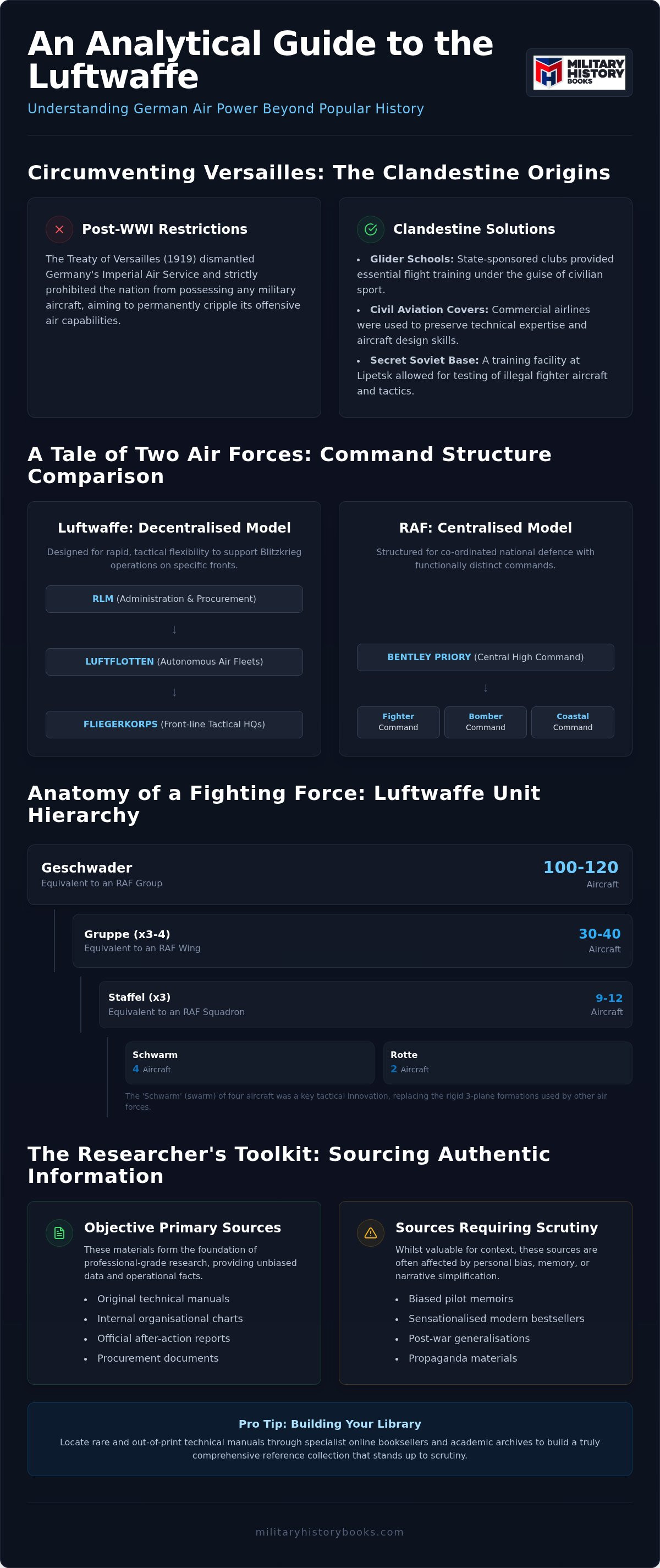
- Understand how clandestine training and civil aviation covers allowed for rapid expansion despite the restrictions of the Treaty of Versailles.
- Decipher the decentralised Luftflotten system to see how its command structure differed fundamentally from the RAF's centralised model.
- Examine the technical evolution of the Luftwaffe, from the minimalist design of the Bf 109 to the strategic failure of the "Zerstörer" heavy fighter concept.
- Learn to distinguish between objective historical analysis and biased memoirs whilst identifying the primary sources essential for professional-grade research.
- Gain practical advice on locating rare and out-of-print technical manuals through specialist booksellers to build a truly comprehensive reference library.
The Secret Origins and Rapid Expansion of the Luftwaffe
The Treaty of Versailles in 1919 was intended to ensure Germany never again possessed an offensive air force. By dismantling the Imperial Air Service, the Allies sought to permanently cripple German military potential. This suppression, however, sparked a period of remarkable ingenuity and clandestine activity. German planners utilised civil aviation covers and "sporting" organisations to keep their pilot pool active and their technical knowledge current. This era of hidden development is a foundational chapter in Luftwaffe history, demonstrating how technical expertise was preserved under the guise of commercial and recreational progress.
Circventing Versailles: The Glider Clubs and Lipetsk
Since powered military flight was strictly prohibited, thousands of young enthusiasts joined state-sponsored glider schools. These clubs provided essential aerodynamic training for future combat pilots whilst remaining within the letter of the law. Beyond domestic borders, a secret agreement with the Soviet Union led to the establishment of a clandestine training facility at Lipetsk in 1925. At this remote base, pilots tested illegal fighter aircraft and refined tactical doctrines far from the eyes of Allied inspectors. The "Black Luftwaffe" is the term used to define this illegal air force precursor that existed in the shadows before its formal re-emergence.
The formal re-establishment of the Luftwaffe in 1935 under Hermann Göring marked the end of this secrecy. Transitioning from a collection of "civilian" pilots into a modern military branch required a massive industrial effort. This expansion wasn't just about numbers; it centred on creating a cohesive command structure that could support the rapid pace of modern warfare.
The Spanish Civil War: A Testing Ground for Blitzkrieg
Real-world operational testing began in 1936 with the deployment of the Condor Legion to the Spanish Civil War. This conflict served as a live laboratory for the Messerschmitt Bf 109 and the Heinkel He 111, allowing engineers to identify technical flaws before the outbreak of a wider European war. It wasn't just machines that were tested; it was the very philosophy of flight.
- Tactical Innovation: Werner Mölders revolutionised aerial combat by developing the "Schwarm" formation. This flexible four-plane unit replaced the rigid V-shaped "Vikte" used by other air forces.
- Psychological Warfare: The 1937 bombing of Guernica demonstrated the devastating psychological power of tactical air support.
- Close Air Support: Early experiments with dive-bombing laid the groundwork for the terrifying reputation of the Ju 87 Stuka.
The lessons learned in Spain shaped the "Blitzkrieg" doctrine that would soon dominate the continent. By 1939, the Luftwaffe had evolved from a hidden collection of glider enthusiasts into the most technologically advanced tactical air force in the world.
Organisation and Command: The Luftflotten System
Unlike the Royal Air Force's centralised command at Bentley Priory, the German air force (Luftwaffe) operated through a notably decentralised structure. This system was designed to provide maximum flexibility during rapid, combined-arms operations. At the pinnacle of this hierarchy sat the Reichsluftfahrtministerium (RLM), which managed administration, technical development, and procurement. However, operational control was delegated to the Luftflotten, or Air Fleets, which functioned as autonomous units within their assigned geographical theatres.
Decentralised Command: The Air Fleet Philosophy
Each Luftflotte was a self-contained, multi-role force. Rather than separating fighters and bombers into distinct national commands, an Air Fleet integrated all necessary elements—fighters, bombers, and reconnaissance—to support a specific front. For example, Luftflotte 2 was primary for the campaigns in the Netherlands and Belgium, whilst Luftflotte 5 operated from bases in Norway and Denmark. This structure was essential for the "Blitzkrieg" doctrine, as it allowed local commanders to react to battlefield changes without waiting for orders from Berlin. The Fliegerkorps served as the tactical headquarters within these fleets, acting as the direct link between the high command and the front-line combat units.
Unit Hierarchy: From Geschwader to Rotte
To understand the Luftwaffe on a technical level, one must grasp the internal hierarchy that governed its daily operations. The primary operational unit was the Geschwader, roughly equivalent to an RAF Group, which usually contained between 100 and 120 aircraft. These were further categorised by their specific combat roles, such as Jagdgeschwader (JG) for single-engine fighters and Kampfgeschwader (KG) for medium bombers. Within these large formations sat the following essential building blocks:
- Gruppe: The basic mobile unit, typically consisting of 30 to 40 aircraft and commanded by a Major or Hauptmann.
- Staffel: The smallest administrative unit, usually comprising 9 to 12 aircraft.
- Rotte and Schwarm: The essential tactical pairs and four-plane formations that defined aerial combat behaviour.
Specialised units, such as the Aufklärungsgruppe, provided vital reconnaissance data that informed the entire command chain. These groups often operated independently, flying high-altitude missions in modified aircraft to gather intelligence. For researchers looking to identify specific unit markings or detailed combat histories, our collection of aviation history books offers an extensive range of records covering these complex organisational structures.
Technological Evolution: From Propellers to Jet Propulsion
The Luftwaffe was a pioneer in aeronautical engineering, often prioritising aggressive performance over pilot comfort or structural longevity. This design philosophy is best seen in the Messerschmitt Bf 109. It was built as a minimalist airframe wrapped around the most powerful engine available at the time. Whilst this made it a formidable fighter, the narrow undercarriage and cramped cockpit were persistent technical challenges that pilots had to manage throughout the war. This focus on raw power over ease of use defined much of Germany's aerial development.
The Mainstays: Messerschmitt, Focke-Wulf, and Junkers
The Bf 109 underwent constant evolution, with variants ranging from the Emil (E) used during the early blitzkriegs to the high-performance Kurfürst (K) of 1945. It didn't fight alone, however. The Focke-Wulf Fw 190, often called the "Butcher Bird," introduced a radial-engine revolution to the fighter force. Its rugged design and wide-track landing gear provided a much-needed alternative to the more delicate Messerschmitt. In the ground-attack role, the Junkers Ju 87 Stuka became a symbol of terror, though the technical reality was a slow aircraft that relied entirely on air superiority to survive. Not all ambitious projects succeeded; the Bf 110 "Zerstörer" (Destroyer) failed as a long-range escort because it was too sluggish to compete with nimble single-engine fighters.
Wunderwaffen: The Pursuit of Revolutionary Technology
As the conflict progressed, engineers turned to "Wunderwaffen" or miracle weapons to offset the growing numerical advantage of the Allies. The Messerschmitt Me 262 heralded the dawn of the jet age, yet it faced severe challenges with engine reliability. The Jumo 004 turbojets had an incredibly short operational life, often requiring a complete overhaul after just 10 to 25 hours of flight. Even more radical was the Me 163 Komet, a rocket-powered interceptor capable of reaching 30,000 feet in under three minutes. Its volatile fuel mixture of T-Stoff and C-Stoff was highly corrosive and prone to spontaneous explosion, making every sortie a life-threatening gamble for the pilot.
For enthusiasts and modellers, achieving true historical accuracy requires more than a cursory glance at general history. Accessing specialist technical specifications and authentic blueprints is vital for any professional-grade project. Our collection of modelling magazines and back-issue publications provides the granular detail needed to recreate these aircraft, covering everything from precise camouflage patterns to internal cockpit layouts that general retailers often overlook.
Navigating Luftwaffe Historiography and Specialist Literature
Researching the Luftwaffe requires more than just an interest in aircraft; it demands a critical eye for historiography. For decades, the narrative was dominated by post-war memoirs that, whilst engaging, often lacked the objective distance required for accurate history. Enthusiasts must learn to navigate the sea of information by identifying which sources provide verifiable data and which offer personal, sometimes biased, perspectives. Objective analysis is the only way to dismantle the "Clean Luftwaffe" myth, which is the historical misconception that the air force operated in a political vacuum, entirely disconnected from the wider actions of the state.
Memoirs vs. Objective History: Reading Between the Lines
The influence of high-profile memoirs, such as those by Adolf Galland or Hans-Ulrich Rudel, cannot be overstated. These accounts shaped Western perceptions of the air war for a generation. However, modern historians now use extensive archival records to correct wartime exaggerations and provide a more balanced view of operational success. Reading these memoirs alongside modern peer-reviewed studies is essential for anyone seeking the truth behind the propaganda. For those looking to deepen their understanding of these sources, our guide on Wartime History Books UK provides a comprehensive reference for researchers and collectors alike.
Building a Researcher’s Library: Essential Categories
To move beyond general history, you need to focus on specific categories of literature that offer granular detail. A professional-grade library isn't built on bestsellers, but on specialised publications that offer primary-source evidence. Consider the following essential categories:
- Unit Histories (Chronik): These are considered the gold standard for tracking specific pilots and individual aircraft movements. They offer a day-by-day account of operations that general histories simply can't match.
- Technical Manuals: Reprints of original Flughandbuch (flight manuals) are indispensable for modellers and restorers who need to understand the precise internal workings of a machine.
- Back-Issue Magazines: Specialist military magazines often contain unit-level research and rare photographs that haven't been published in major hardback titles.
Investing in these specialist formats allows you to verify facts rather than relying on secondary interpretations. You can find more detail on these specific genres in our Aviation History Books: The Ultimate Collector’s Guide. Finding these titles can be difficult as many are out of print or were produced in limited runs by small publishers. If you're struggling to locate a specific unit history or technical guide, browse our extensive collection of rare aviation titles to find the missing piece for your research.
Sourcing Rare and Out-of-Print Luftwaffe Titles
Finding definitive information on the Luftwaffe requires moving beyond the curated shelves of general bookstores. Whilst large retailers provide a useful entry point for casual readers, they often lack the depth required for serious academic study or high-fidelity modelling projects. Generalists rarely stock the technical data or unit-level histories that have long been out of print. Specialist bookshops serve as essential hubs for the global research community, offering access to the primary sources that allow for objective historical analysis.
The Value of Specialist Sourcing
Veteran-managed shops offer a level of expertise that generalists cannot replicate. Understanding the difference between a first-edition technical manual and a later, less accurate reprint is vital for maintaining research integrity. We maintain a stock of over 10,000 titles, ensuring that rare and out-of-print aviation publications remain accessible to those who need them most. For collectors and historians located abroad, secure international delivery is a standard requirement to protect these fragile historical records during transit. If you're beginning a hunt for a specific volume, our Out of Print Military Books: A Specialist Guide offers practical advice on navigating the complexities of the secondary market.
Digital and Magazine Resources
Sometimes the most elusive information isn't found in a hardback book, but in the pages of a specialist periodical. Back-issue modelling and military magazines are invaluable for identifying rare camouflage schemes or obscure field modifications. These publications often feature contemporary photographs and veteran interviews that have never been digitised or reprinted in modern volumes. They provide a level of granular detail that's essential for anyone building a professional-grade research library.
- Modelling Magazines: These are essential for verifying precise unit markings and technical alterations that occurred during the war.
- Digital Titles: Available via download or on disc, these provide a portable way to cross-reference multiple sources whilst working in the workshop. They're particularly useful for researchers who require technical depth without the physical footprint of a sprawling archive.
- Rare Technical Publications: Original engine manuals and airframe blueprints provide the final word on design specifications for restoration and modelling.
By providing a bridge between past records and modern enthusiasts, we help preserve the technical history of the Luftwaffe and its contemporaries. Whether you're looking for a specific squadron history or a digital archive of technical drawings, our collection of Military History Magazines Back Issues UK is a vital resource for any researcher's library. We take pride in supporting your passion for history with a methodical and reliable service that respects the intelligence of our community.
Advancing Your Research into German Aviation History
To truly grasp the history of the Luftwaffe, one must look past popular myths and focus on the technical and organisational realities that defined the era. We've explored how clandestine origins led to a decentralised command structure that was as innovative as it was complex. By prioritising objective archival data over post-war memoirs, you can build a research library that offers genuine historical insight. This is far more rewarding than relying on surface-level summaries.
Finding these specialised records requires a trusted partner who understands the nuance of the subject matter. Managed by an RAF veteran, our store offers a curated selection of over 10,000 specialist titles, including rare, out-of-print, and digital publications. We provide secure international shipping to ensure that collectors and researchers worldwide can access the high-quality material they need for their projects. Browse our extensive collection of Aviation History Books today and take the next step in your historical journey. We look forward to helping you find the perfect addition to your archive.
Frequently Asked Questions
What were the main types of aircraft used by the Luftwaffe in World War 2?
The force utilised a variety of specialised airframes, most notably the Messerschmitt Bf 109 and Focke-Wulf Fw 190 for fighter roles. For bombing and tactical support, the Heinkel He 111 and Junkers Ju 88 were primary assets. Later in the war, revolutionary designs like the Me 262 jet fighter were introduced. These aircraft represented a mix of proven technology and experimental propulsion, so they're a favourite subject for technical researchers and modellers alike.
How did the Luftwaffe command structure differ from the RAF?
The German system was decentralised into several Luftflotten (Air Fleets), whilst the RAF used a more centralised command model. Each Luftflotte operated as a self-contained unit with its own fighters and bombers assigned to specific geographical regions. This allowed for greater tactical flexibility on the ground during rapid campaigns. In contrast, the RAF’s structure focused on functional commands managed from a central headquarters, which didn't always allow for the same level of local autonomy.
Where can I find rare technical manuals for Luftwaffe aircraft?
Specialist military booksellers are the most reliable source for original or reprinted technical manuals, such as the Flughandbuch series. These documents are often hard to find at general retailers because they weren't produced for public consumption. We maintain an inventory of rare and out-of-print titles that include these detailed specifications. These manuals are essential for restorers and modellers who require precise data on airframe construction that you won't find in general history books.
What are the best books for researching Luftwaffe unit histories?
The most effective resources for unit-level research are Chronik (Chronicle) volumes, which provide day-by-day operational records. These specialised histories often include casualty lists and pilot names that broader historical overviews omit. Look for titles published by specialist aviation houses that focus on individual Geschwader records. These books are vital for verifying combat claims, so they're the gold standard for anyone who's serious about tracking the operational movements of specific units.
Was the Luftwaffe a separate branch of the German military?
Yes, the Luftwaffe was established as an independent third branch of the German armed forces in March 1935. It held equal status alongside the Army (Heer) and the Navy (Kriegsmarine). This independence allowed for the development of a distinct military culture, though it often led to complex bureaucratic rivalries. Under the leadership of Hermann Göring, it grew rapidly from its clandestine origins into a massive, modern air force that didn't just support ground operations but conducted strategic missions.
How reliable are the memoirs of famous Luftwaffe pilots?
Pilot memoirs should be treated with caution, as they're personal narratives often written long after the events took place. Whilst they offer invaluable insights into the daily life of aircrew, they're prone to exaggeration or selective memory regarding combat successes. Professional researchers always cross-reference these accounts with official archival data and unit records. Balancing subjective experiences with objective historical analysis is the key to forming an accurate picture of the air war.
Can I buy digital versions of out-of-print aviation history books?
Digital titles are increasingly available for many out-of-print aviation publications, providing a convenient way to access rare information. We offer a selection of digital titles by download and on disc, which don't take up the same space as a physical library. These formats are particularly useful for modellers who need to cross-reference data whilst working. They preserve the content of rare books that might otherwise be prohibitively expensive or difficult to source in their original printed form.
What does the term "Jagdgeschwader" mean in the Luftwaffe?
The term Jagdgeschwader refers to a fighter wing within the Luftwaffe organisation. These wings were the primary units for single-engine fighter operations and typically consisted of three or four Gruppen, totalling around 120 aircraft. Each Jagdgeschwader had its own identification number and often a distinctive unit emblem. They were the fundamental combat formations responsible for maintaining air superiority and escorting bomber groups, so they're essential for any researcher tracking specific aerial campaigns.


