

That heavy, leather-bound volume on your shelf is a masterpiece of preservation, yet it's often the most frustrating tool when you're hunting for a specific serial number or wing specification. We all value the tactile nature of a physical archive, but the reality of modern research involves navigating hundreds of pages whilst managing limited shelf space. High shipping costs for weighty military tomes can also make expanding a physical collection a costly endeavour. You've likely felt the frustration of knowing a specific technical detail exists but being unable to find it without an exhaustive page-by-page search.
Integrating digital aviation history books into your library doesn't mean abandoning your printed volumes. Instead, these formats offer a way to enhance your research through superior searchability and instant portability. You'll discover how a digital archive can provide immediate access to rare technical manuals and save significant space in your home or office. This article compares the practical benefits of direct downloads, physical discs, and traditional print, helping you decide which format best serves your passion for aviation history and your need for a more functional research library.
Key Takeaways
- Understand how digital formats are transforming military research by providing instant access to rare technical manuals and high-resolution archival scans.
- Learn how to choose between direct downloads and discs when building your collection of digital aviation history books to balance convenience with long-term preservation.
- Discover the practical benefits of space-saving digital libraries that allow you to search through thousands of pages of technical data in seconds.
- Identify why specialist-curated publications, overseen by those with genuine service expertise, offer superior accuracy compared to generic document scans.
- Gain insights into the best practices for organising and viewing your digital archive to ensure technical diagrams remain clear and accessible.
The Rise of Digital Aviation History Books for Modern Researchers
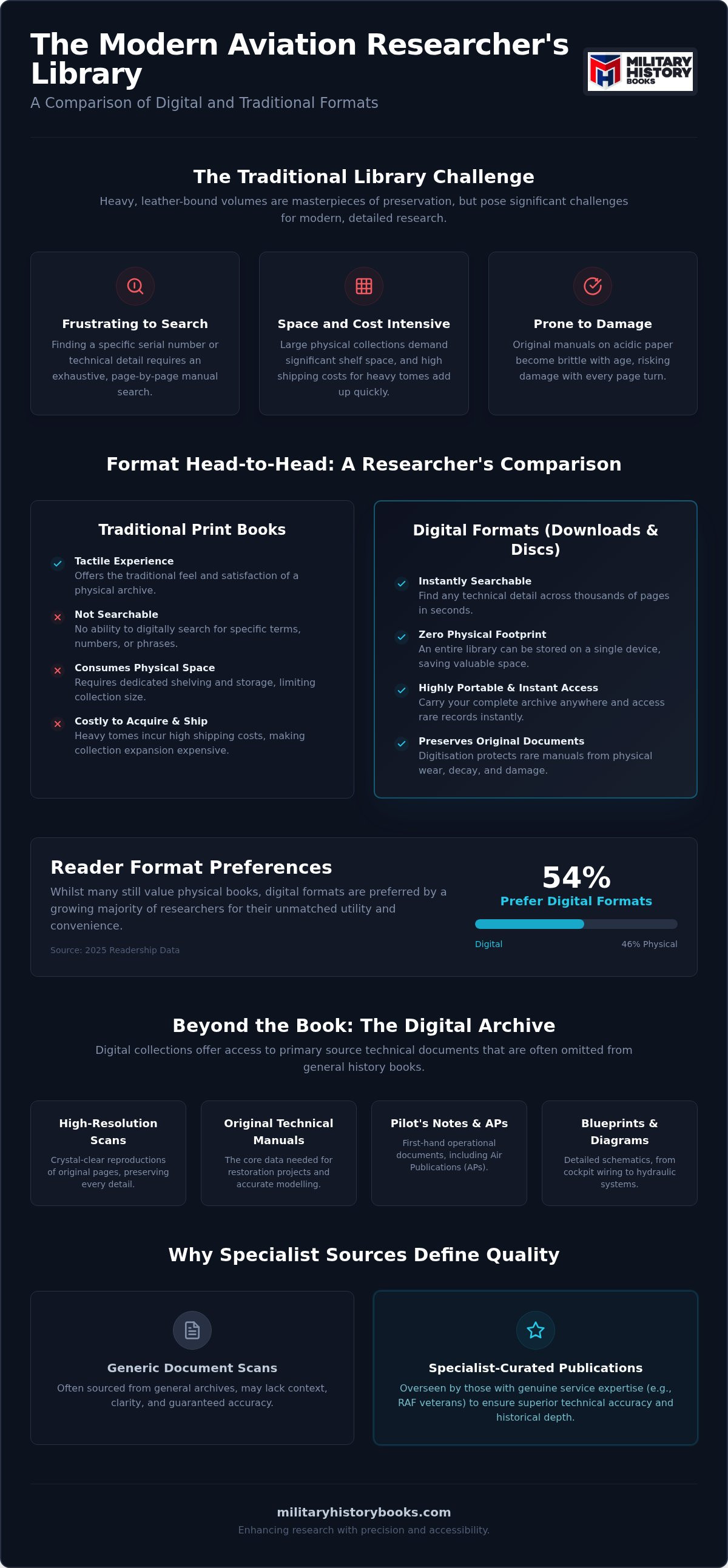
The landscape of historical research has evolved significantly since the early history of the e-book, particularly for those dedicated to digital aviation history books. What once required a physical visit to a dusty archive or the expensive purchase of a heavy, out-of-print tome can now be accessed in seconds. This shift is amongst the most significant changes for military historians, as it transforms static information into a dynamic, searchable resource. Whilst 46% of readers still prefer physical books according to 2025 readership data, the growing percentage of researchers using digital formats find they offer a level of utility that print simply cannot match.
Digital aviation history books aren't just text on a screen; they often consist of high-resolution scans of original technical manuals, pilot notes, and blueprints. This format bridges the gap between owning a beautiful physical collection and maintaining a functional database of technical facts. For the serious enthusiast, these digital titles complement a traditional library of military history books by providing a portable, high-speed alternative for day-to-day research. Under the guidance of an RAF veteran, our collection focuses on the technical accuracy and historical depth that serious researchers require.
The transition hasn't been about replacing the smell of old paper or the weight of a hardback. It's about utility. If you're looking for a specific serial number or a fuel consumption rate for a Cold War interceptor, searching a digital file is infinitely faster than flipping through a thousand pages. These digital titles allow you to carry an entire archive in your pocket, ensuring that rare records remain accessible regardless of your physical location.
The Evolution of Military Aviation Literature
Military literature has moved far beyond heavy paper archives. We've seen a steady progression from physical volumes to portable digital downloads, which has democratised access to primary source technical documents. Researchers now favour digital access because it allows for rapid cross-referencing between different aircraft types or historical periods. When you're comparing the specifications of various RAF variants, having multiple digital windows open is far more efficient than balancing five heavy books on a desk. This evolution ensures that the technical details of our aviation heritage are always within reach.
Preserving History Through Digital Formats
Preservation is at the heart of our mission. Original technical manuals are often printed on acidic paper that becomes brittle with age; every time a page is turned, there's a risk of damage. Digital formats protect these rare records from physical wear and tear whilst ensuring their longevity through multiple backups. This accessibility means that a researcher in the UK can study a rare manual that might otherwise be tucked away in a distant museum archive. By digitising these records, we ensure that the stories and technical achievements of the past aren't lost to time or physical decay.
Formats and Technical Manuals: Exploring the Digital Inventory
The inventory of digital aviation history books extends far beyond standard narrative histories. For the serious researcher, the true value lies in the technical military publications that were once restricted to government archives or private collections. These documents, including Air Publications (APs) and Pilot's Notes, provide a level of detail that general history books often omit. Accessing these rare aircraft manuals is essential for those who need to understand the exact wiring of a Lancaster's cockpit or the hydraulic pressures of a Spitfire's undercarriage. Our collection, curated with the expertise of an RAF veteran, ensures these technical details are preserved with the highest fidelity.
Historical records, such as the Federal Aviation Administration records, show how extensively technical documentation has been used to regulate and record aviation progress over the decades. In our collection, we prioritise high-resolution scans that preserve every minute detail of these original documents. This precision is vital for aircraft restoration projects and for modellers who strive for absolute historical accuracy in their work. Whether you're researching the structural integrity of a vintage airframe or the specific camouflage patterns of a particular squadron, these digital resources provide the clarity you need.
Technical Aviation Manuals and Blueprints
Large-scale technical drawings and blueprints are notoriously difficult to handle in physical form. They require large tables and careful folding to prevent tears. Digital formats solve this by allowing you to zoom into specific aircraft components without any risk to the original document. Searchable PDFs are particularly useful; they allow you to find a part number or a specific maintenance procedure amongst hundreds of pages of technical data in seconds. For scale modellers, these digital files provide a reference that can be viewed on a tablet right at the workbench, making it easier to ensure every rivet and panel line is correctly placed.
Digital Titles on Disc vs. Instant Downloads
When you choose digital aviation history books, you often have to decide between a physical disc or an instant download. Discs are excellent for long-term archival stability; they provide a physical backup that doesn't rely on cloud storage or internet access. They feel like a permanent part of your library. Conversely, instant military books downloads offer the convenience of immediate research. If you're in the middle of a project and need a specific technical manual right now, a download is the fastest solution. Modern devices usually support both, though you might need an external drive for discs on newer laptops. If you're looking to expand your technical archive, you can browse our extensive range of aviation history books to find the format that suits your research style.
Digital Downloads vs. Physical Books: A Researcher’s Comparison
For the dedicated historian, the choice between a physical spine and a digital file isn't merely about preference; it's about purpose. Physical archives are undeniably beautiful, yet they present significant challenges when your collection grows. A library of 1,000 titles, which would require several heavy bookcases and a dedicated room, can now fit comfortably inside a pocket on a single tablet or laptop. This space-saving reality is a primary driver for those building extensive collections of digital aviation history books, as it allows for a vast archive without the need for physical renovations or high shipping costs for heavy military tomes.
Cost efficiency also plays a vital role for information-seekers. Digital formats often provide better value because they bypass the overheads of printing and international postage. This allows researchers to acquire rare technical manuals and out-of-print titles that might otherwise be prohibitively expensive in their original paper form. Institutions like the UT Dallas History of Aviation Archives demonstrate the immense scale of aviation records that exist; for the individual researcher, digital formats are the only practical way to manage and carry such vast amounts of information into the field or a museum for on-site comparison.
Searchability and Cross-Referencing
The true power of digital aviation history books lies in the "Ctrl+F" function. This simple tool allows you to locate obscure pilot names, specific unit details, or part numbers in seconds. Digital searchability reduces research time by hours when cross-referencing multiple technical specifications across different volumes. Instead of manually checking indices in ten separate books, you can search your entire digital library simultaneously. This speed makes digital sources indispensable for academic referencing and ensures that no detail, however small, remains hidden in a sea of text.
Tactile Value vs. Information Density
There is still a place for the printed word. Many enthusiasts choose to buy physical copies for their favourite aircraft legends, where the photography and layout can be appreciated in a traditional format. However, when it comes to the "heavy lifting" of data extraction and technical study, digital copies are superior. Finding the right balance for your personal military history source books often involves keeping a curated shelf of high-quality hardbacks whilst using a digital archive for technical manuals and rare records. This hybrid approach ensures you have the aesthetic pleasure of a library alongside the raw utility of a modern research tool.
Organising and Preserving Your Digital Aviation Library
Building a collection is only the first step; the true value of digital aviation history books is realised through effective organisation. Unlike a physical shelf where you can see the spines, a digital folder can quickly become a chaotic list of "Scan_001" and "Document_A" if not managed with care. A well-structured archive ensures that when you need to verify a specific technical detail or find a rare pilot's account, the information is only a few clicks away. Proper management also protects your investment from technology shifts and hardware failures, ensuring your research remains accessible for decades.
Preservation in the digital age relies on the "Rule of Three." This strategy involves keeping your primary research files on your main computer, a second copy on a local physical backup like an external drive or disc, and a third copy in a secure cloud storage service. This redundancy protects your archive against everything from accidental deletions to hardware malfunctions. Whilst modern solid-state drives are reliable, having a physical backup on a disc remains a favourite method for many serious collectors who value the permanence of a tangible record alongside their digital files.
File Management for Historians
Success in digital archiving starts with a standardised naming convention. Instead of cryptic file names, use a structure such as "Year_Aircraft_DocumentType" to make your files instantly recognisable. You might categorise your digital military history research books by conflict, such as the Second World War or the Cold War, or by specific branches like the RAF or Fleet Air Arm. Adding metadata or tags to your PDFs can further enhance your private search database, allowing you to filter documents by specific keywords or technical components without opening every file.
Hardware and Software Recommendations
Viewing high-resolution technical scans requires the right tools. Large-screen tablets are excellent for technical aviation diagrams because they allow you to pinch and zoom into intricate blueprints whilst maintaining clarity. For reading narrative histories, e-readers with e-ink displays are easier on the eyes during long research sessions. We recommend using PDF software that supports annotation and highlighting; this allows you to mark important passages and add your own research notes directly onto the digital page. This interactive element turns a static document into a living part of your historical study. To start building your own organised archive, you can browse our digital titles on download and disc to find rare technical manuals and out-of-print records.
Why Specialist Sources Define the Quality of Military Books Downloads
The quality of a digital file depends entirely on the care taken during its creation. Generic retailers often provide e-books with poor formatting or low-resolution scans that obscure vital technical data; this makes them nearly useless for serious research. In contrast, specialist publications are curated with an eye for detail that only a subject-matter expert can provide. When you invest in digital aviation history books from a specialist, you're receiving a document that has been checked for completeness and clarity, ensuring that every technical plate and footnote is legible.
Managed by an RAF veteran, our inventory reflects a deep-seated passion for this niche. This background ensures that every technical manual or historical account meets a high standard of accuracy. We understand that a missing page in a pilot's notes or a blurry diagram in an Air Publication can stall a research project for weeks. By prioritising the preservation of these stories and technical details, we act as a bridge between the vast archives of the past and the modern enthusiast, offering a level of reliability that generalist platforms cannot match.
Our collection features over 10,000 titles, ranging from land warfare and naval history to rare aviation records. Whilst our digital titles offer instant access, we also provide secure international delivery for our physical books and back-issue magazines. This allows you to supplement your digital archive with rare and out-of-print titles that deserve a place on your physical bookshelf, providing a comprehensive solution for your research needs.
Expert Curation in Aviation History
Trust is built through expertise. Knowledgeable curators are essential for selecting the best technical editions and sourcing rarities that have long been out of print. A general retailer might list thousands of books, but they lack the insight to distinguish between a common reprint and a definitive technical source. Our RAF veteran-led oversight means that the inventory is not just a list of products, but a carefully managed archive. This level of service ensures that researchers receive the most reliable material available for their specific field of study, amongst a community that respects the historical weight of the subject matter.
Taking the Next Step in Your Research
Beginning your journey into digital research is as simple as choosing a military books download that aligns with your current project. You can combine the speed and searchability of digital files with the prestige of a physical collection, creating a library that is both functional and evocative. Whether you're a casual reader or a serious academic, the right tools will transform your understanding of aviation history. To find your next essential reference, explore our extensive collection of digital and physical aviation history books and discover the depth of our specialist archive.
Advancing Your Aviation Research
The evolution of historical study has made it clear that a modern archive benefits immensely from the integration of digital resources. By adopting digital aviation history books, you gain the ability to navigate thousands of technical pages in seconds whilst preserving your physical volumes from the wear of constant use. This hybrid approach ensures that rare blueprints and pilot notes are always accessible, whether you're at your workbench or conducting research in the field.
Quality remains paramount, and choosing a specialist source managed by an RAF veteran ensures that your digital library is as accurate as your physical one. With over 10,000 specialist titles in stock and secure international delivery for all orders, building a comprehensive archive has never been more achievable. We're here to help you bridge the gap between the legendary aircraft of the past and the modern tools of the present.
Browse our specialist collection of digital aviation history books and downloads to find the technical manuals and rare records you need to complete your research.
Frequently Asked Questions
What are the main advantages of digital aviation history books for researchers?
The primary benefits include instant text searchability and significant space-saving for your home library. Researchers can find obscure technical details or specific serial numbers without flipping through hundreds of paper pages. Digital aviation history books allow you to carry an entire archive on a single device, making it much easier to cross-reference data whilst working at a desk or visiting a museum.
Can I download military history books directly to my tablet or smartphone?
Yes, you can download military history titles directly to most modern portable devices. Our digital files are typically provided in standard formats like PDF, which are compatible with almost all tablets and smartphones. This allows you to reference technical drawings or historical accounts whilst away from your main computer, providing excellent flexibility for your on-site research or hobbyist projects.
What is the difference between a digital download and a book on disc?
A digital download provides immediate access to your material, whereas a book on disc offers a physical backup for your permanent collection. Downloads are ideal for those who need information right away for a pressing project. Discs remain a favourite for collectors who prefer a tangible record that doesn't rely on cloud storage or internet connectivity for long-term archival stability.
Are digital technical manuals high enough resolution for scale modelling?
High-resolution digital scans are often superior for scale modelling because they allow you to zoom into intricate details without losing clarity. You can examine rivet patterns, cockpit instrumentation, and camouflage lines at a much larger scale than a traditional printed page allows. This precision ensures that your models remain historically accurate to the original technical specifications found in the manuals.
How do I ensure my digital aviation library is backed up safely?
You should follow the "Rule of Three" to protect your digital library effectively. Keep your primary files on your computer, a second copy on a local physical backup like an external drive or disc, and a third copy in a secure cloud service. This redundancy ensures that your digital aviation history books remain safe from hardware failures or accidental deletion over the years.
Do digital aviation books include the same illustrations as physical editions?
Digital editions usually contain the exact same illustrations, diagrams, and photographs found in the physical books. Because many of our digital titles are high-quality scans of original technical manuals and out-of-print records, every page is preserved in its original layout. You won't miss out on any of the visual data that makes these historical records so valuable for your study.
Is it possible to find rare or out-of-print aviation titles in digital format?
It is often easier to find rare or out-of-print titles in digital formats than in physical ones. Many technical publications are no longer in print, but digital preservation allows us to offer these scarce resources to a wider audience of researchers. Our inventory specialises in sourcing these hard-to-find records, ensuring that vital aviation history isn't lost to time or physical decay.
Why should I buy digital military books from a specialist rather than a general store?
Specialists provide curated content that general retailers often overlook due to a lack of subject-matter expertise. Buying from an RAF veteran-managed shop ensures that the technical data is accurate and the scans are of a high enough quality for professional research. General stores often use automated processes that can result in missing pages or poor resolution, which can significantly hinder your historical study.


