

The true history of aerial combat isn't always found in the sweeping narratives of general histories; it's often locked within the precise, technical data of a pilot's manual or a manufacturer's blueprint. For those dedicated to understanding the evolution of fighters, bombers, air forces, and missiles, the transition from casual reading to serious research can feel like hitting a wall of impenetrable jargon. You've likely spent hours searching for an elusive out-of-print technical manual, only to find yourself overwhelmed by the sheer volume of official documents that seem written for engineers rather than historians.
We understand that frustration, as we've spent decades curating a collection that bridges the gap between broad historical accounts and the granular engineering reality of flight. This guide will show you how to identify reliable primary sources and decipher the complex language used in military literature to deepen your understanding of weapons technology. We'll explore how to build a credible reference library that stands up to academic scrutiny whilst satisfying your passion for the technical details of the sky.
Key Takeaways
- Learn to distinguish between general narrative histories and official technical manuals to identify credible primary sources for your research.
- Trace the technical evolution of air power through the engineering transition from piston-engine aircraft to modern Fighters, Bombers, air forces, missiles.
- Understand how guided weaponry and strategic missile systems fundamentally altered the operational doctrines of global air forces.
- Discover effective methods for sourcing rare out-of-print technical literature and the advantages of utilising digital titles on disc for archival study.
- Build a more authoritative reference library by leveraging specialist curation and the subject-matter expertise of veteran-managed collections.
Understanding Technical Military Publications and Their Value
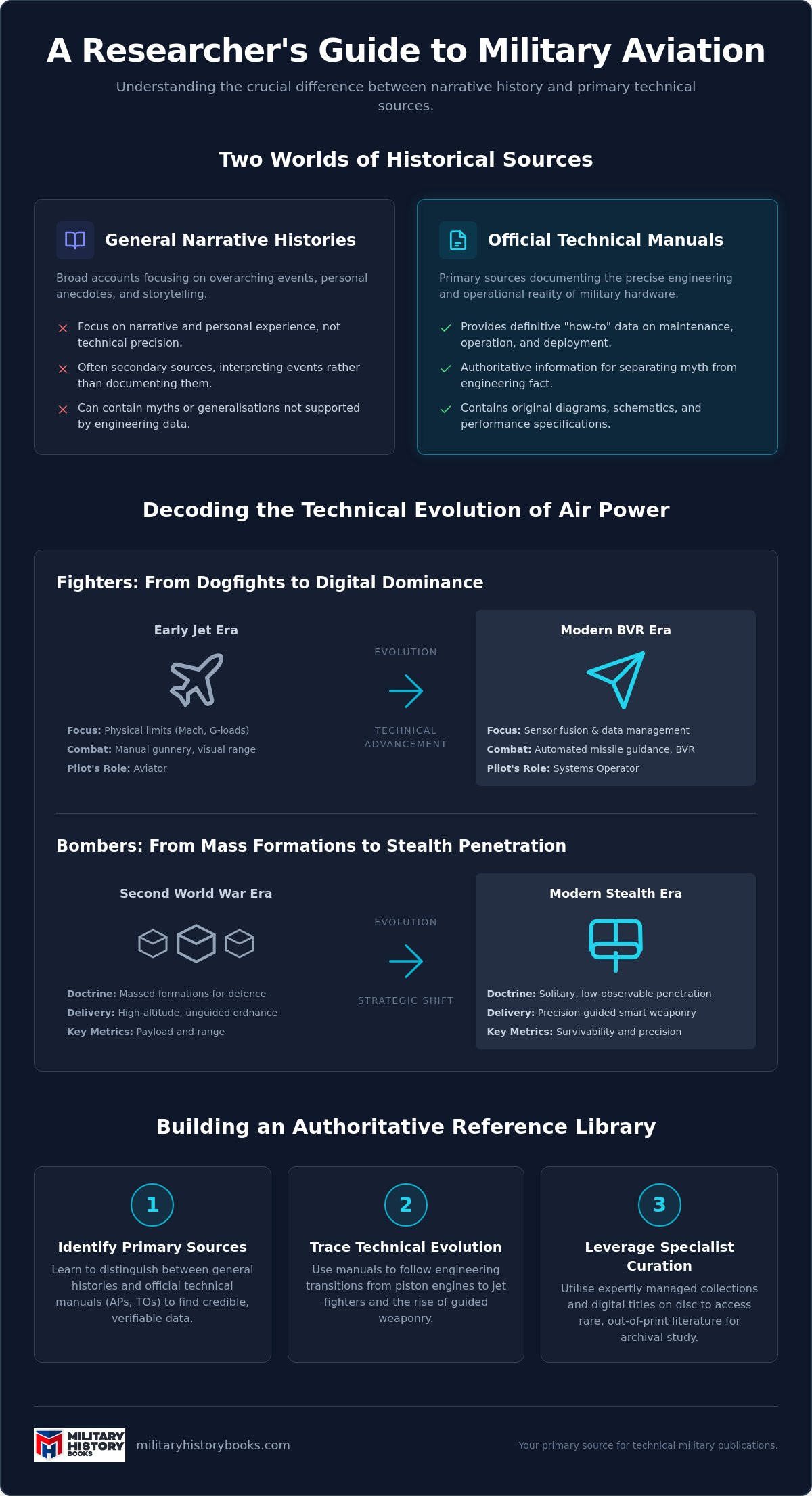
Technical military publications serve as the bedrock of accurate historical research, acting as primary sources that document the precise operational reality of global air forces. Unlike general history books, which often focus on broad narrative accounts and personal anecdotes, official technical manuals were created to ensure the safe and effective operation of complex machinery. These documents provide the definitive "how-to" for everything from engine maintenance to the deployment of ordnance. For anyone studying the evolution of Fighters, Bombers, air forces, missiles, these publications are indispensable for separating myth from engineering fact.
Researchers and scale modellers prioritise these technical orders because they offer a level of detail that general publications simply cannot match. Whether it's the exact placement of a cockpit instrument or the specific wiring for a radar system, the information found in these manuals is authoritative. By preserving these documents, we aren't just archiving paper; we're safeguarding the technical heritage of the personnel who operated and maintained these machines under the most demanding conditions.
Categorising Air Publications (APs) and Technical Orders (TOs)
The organisation of technical data follows strict, logical hierarchies designed for rapid reference. In the United Kingdom, the Royal Air Force utilises the Air Publication (AP) system. This structured framework categorises information into specific volumes, covering topics such as pilot's notes, general orders, and detailed maintenance schedules. Similarly, the United States Air Force employs the Technical Order (TO) system. These systems don't just list facts; they organise the daily life of an air force, detailing how ground crews must maintain airframes and how aircrews should operate sophisticated weaponry whilst in flight. Understanding these hierarchies is the first step in finding the specific data needed for a research project or a detailed scale model.
The Importance of Primary Sources in Military History
Relying on primary sources is essential for anyone seeking to understand the true History of aerial warfare. Technical manuals allow researchers to verify historical performance claims, such as a specific jet's maximum climb rate or a missile's effective engagement envelope, using the same data available to the personnel at the time. For scale modellers, these documents are a treasure trove of original diagrams and schematics, providing the exact dimensions and stencil placements needed for a faithful reproduction. Beyond the hardware, these manuals offer a unique window into pilot behaviour and training, revealing the rigid protocols and tactical thinking that defined different eras of flight. They provide a clear, unsentimental view of how technology dictated the terms of combat.
Decoding the Technical Evolution of Fighters and Bombers
The transition from the high-performance piston engines of the 1940s to the integrated digital cockpits of the modern era represents a seismic shift in aerospace engineering. This journey is meticulously recorded in the technical revisions of the period, where we see the rigid boundaries of early air power begin to dissolve. The emergence of the fighter-bomber is perhaps the best example of this trend, as global air forces sought more versatile platforms capable of performing multiple roles within a single sortie. For researchers, these technical mission profiles are the only way to understand how Fighters, Bombers, air forces, missiles were developed as a unified response to the evolving threats of the 20th and 21st centuries.
Fighters: From Dogfighting to Beyond Visual Range (BVR)
Early manuals for jet aircraft focused primarily on the physical limits of the airframe, such as Mach numbers and G-loadings. However, as the tactical focus shifted toward Beyond Visual Range combat, technical documentation began to prioritise the management of radar and sensor fusion. This evolution turned the pilot into a systems operator, a change clearly visible in the cockpit schematics and wiring diagrams found in our collection of Aviation History Books. These manuals detail the integration of early head-up displays and the transition from manual gunnery to automated missile guidance, providing a granular view of how aerial combat was digitised.
Bombers: Payload, Range, and the Advent of Stealth
Strategic bombing evolved from the massed formations of the Second World War to the solitary, low-observable missions of the modern age. Whilst the B-52 Stratofortress relied on its immense payload and fuel capacity, later designs focused on reducing the radar cross-section through radical geometry and composite materials. Technical publications archived by the Air Force Historical Research Agency provide a fascinating look at the maintenance requirements for these stealth platforms. They reveal the staggering complexity involved in keeping a low-observable fleet operational in contested environments.
For instance, the B-21 Raider programme carries an estimated total lifetime cost of approximately £156 billion over 30 years of operations. The documentation for such a programme covers not just the aircraft itself, but the vast logistical tail and specialised environmental housing required to maintain stealth coatings. This technical reality defines how modern air forces plan for long-range global strikes, moving away from the brute force of heavy bombers toward the precision of stealth technology. Understanding these shifts requires a deep dive into the manuals that governed their development and daily use.
The Strategic Shift: Air Forces, Missiles, and Guided Weaponry
The introduction of guided weaponry represents a fundamental pivot in the history of aerial combat. While earlier eras prioritised the kinetic performance of the airframe, the advent of the missile age shifted the focus toward sensor integration and electronic interfaces. This evolution is meticulously documented in technical launch manuals that detail the transition from unguided "dumb" bombs to precision-guided munitions (PGMs). For modern air forces, the ability to engage targets from standoff distances has redefined the roles of Fighters, Bombers, air forces, missiles. These publications provide the granular data needed to understand how a pilot transitions from a visual dogfighter to a systems manager operating in a digitised battlespace.
Technical documentation also covers the strategic literature surrounding Intercontinental Ballistic Missiles (ICBMs). Although these operate beyond the traditional flight envelope, their command, control, and maintenance protocols are deeply rooted in air force technical doctrine. Understanding these systems requires a deep dive into the manuals that govern launch sequences and silo maintenance. This technical reality is essential for any researcher looking to move beyond general history and into the engineering specifics of global deterrence.
Missile Technology and Guidance Systems
Technical literature provides the only accurate way to understand the complex behaviour of different guidance systems. Heat-seeking missiles, which home in on infra-red signatures, require vastly different maintenance protocols compared to active or semi-active radar-guided systems. These distinctions are clearly outlined in standard technical orders, which also cover the storage and handling of volatile propellants. As guidance technology matured, the documentation expanded to include the software logic required for mid-course corrections. This ensured that ground crews and pilots understood the exact engagement envelope of their ordnance, a process detailed in The Evolution of Modern Aircraft and subsequent weapon system manuals.
The Interplay Between Aircraft and Ordnance
A critical aspect of technical military publications is the management of compatibility between the airframe and its weapons. It isn't enough for a missile to fit on a pylon; it must communicate with the aircraft's mission computer. Technical manuals detail these digital handshakes and the impact of electronic warfare (EW) on missile effectiveness. They describe how countermeasures like chaff and flares are documented to defeat incoming threats. This technical interplay defines the modern "kill chain"-the sequence of find, fix, track, target, engage, and assess.
Analysing this sequence through technical military literature reveals the sheer complexity of modern operations. It involves the seamless integration of airborne radar, data links, and missile seekers. By studying these primary sources, researchers can see how the aircraft and its weapon function as a single, integrated system. This level of detail is rarely found in general histories, making technical publications the primary tool for anyone seeking a credible understanding of modern aerial warfare.
How to Source and Utilise Rare Technical Literature for Research
Finding specific technical literature requires a methodical approach that differs significantly from browsing a general bookshop. When you're tracking down data on Fighters, Bombers, air forces, missiles, the most effective starting point is the official publication number. For British researchers, this means identifying the relevant Air Publication (AP) code, whilst those focusing on American equipment will need the Technical Order (TO) reference. These numbers act as a fingerprint, ensuring you're looking at the correct revision for a specific airframe or weapon system. Identifying authentic editions is crucial, as later reprints or low-quality digital scans can sometimes omit vital fold-out schematics or colour-coded diagrams found in the original pressings.
Searching for Rare and Out-of-Print Titles
Locating Rare and Out of Print Titles often requires looking beyond global marketplaces. General retailers rarely understand the nuances of military provenance, often mislabeling technical manuals as general histories. Specialist aviation bookshops, particularly those managed by experts with service backgrounds like our own RAF veteran owner, provide a higher level of accuracy in their listings. They can verify if a manual is a complete set of "Pilot's Notes" or just a fragmentary maintenance sheet. When searching for rare military memoirs or technical diaries, check for contemporary annotations or squadron stamps. These small details add significant historical weight and confirm the document's journey through the service, providing a tangible link to the past that general marketplaces simply cannot offer.
Leveraging Digital and Magazine Archives
Whilst physical books are often prized for their tactile value and presence on a shelf, Digital Titles by Download & on Disc offer unparalleled convenience for active research. They allow you to search for specific keywords across hundreds of pages instantly, which is invaluable when you're cross-referencing maintenance protocols whilst building a scale model or writing a research paper. You can supplement these technical sources with Back Issue Magazines and Modelling Magazines. These publications often contain unique walk-around photos, internal cockpit shots, and colour profiles that official manuals might lack. They provide the visual context that helps bring the technical data to life.
Organising your personal archive is the final step in becoming a credible researcher. We recommend grouping your collection by branch of service or historical era, and keeping a digital index of your publication numbers to avoid duplicate purchases. This methodical approach ensures that your library remains a functional tool rather than just a collection. If you're ready to expand your collection with verified, specialist material, you can explore our inventory of over 10,000 military titles to find your next primary source.
Building Your Archive with Specialist Military History Books
The transition from a casual interest to a dedicated research archive requires a shift in how you acquire material. It's about finding the specific documents that define the operational history of Fighters, Bombers, air forces, missiles. Specialist curation is vital because military literature is vast and often fragmented. General booksellers may miss the significance of a specific technical revision, but a specialist collection ensures that every title has been selected for its historical or technical merit. With an inventory of over 10,000 specialist titles, we aim to provide a bridge between the past and the modern enthusiast, offering resources that general retailers simply don't carry.
The Specialist Advantage for Historians
Expert knowledge is the most valuable tool for any historian. Managed by an RAF veteran with deep subject-matter expertise, our shop offers a level of insight that general marketplaces cannot replicate. We understand the nuances of technical editions and can help you identify exactly which manual or history book will fill the gaps in your research. This expertise ensures that you receive the correct document for your specific area of study, whether you're researching the Cold War or modern stealth technology. We also prioritise secure international delivery, ensuring that rare aviation books reach researchers across the globe in pristine condition. This creates a reliable environment for those who value the preservation of military heritage and the accuracy of their reference library.
Next Steps for Your Military Research
Starting your own collection doesn't have to be daunting. We recommend beginning with a few "must-have" titles that cover the core development of fighters and bombers within your chosen era. Once you've established this foundation, you can expand into more niche areas like missile guidance systems or specific air force squadron histories. To stay informed about new arrivals and rare acquisitions, it's best to check our listings regularly, as out-of-print technical manuals often sell quickly once they're catalogued. We invite you to explore the vast archive at Military History Books to find the primary sources that will bring your research to life. Whether you're a serious academic or a dedicated modeller, our curated collection is here to support your journey into the technical reality of aerial warfare.
Mastering the Technical History of Flight
Developing a profound understanding of aerial warfare requires moving beyond general narratives to embrace the specific data found in primary technical sources. By focusing on official manuals and verified publication numbers, you gain access to the engineering reality that dictated the development of Fighters, Bombers, air forces, missiles. This methodical approach ensures your research is grounded in fact, allowing you to trace the evolution of technology from the first jet engines to the sophisticated guided weaponry of the modern age.
Building an authoritative reference library is a journey of preservation and discovery. As a specialist shop managed by an RAF veteran, we're dedicated to helping you find those elusive, out-of-print titles that define military history. With an inventory of over 10,000 specialist titles and secure worldwide delivery for collectors, we provide the resources you need to deepen your expertise. Explore our collection of over 10,000 military history titles to find the rare manuals and technical publications that will complete your archive. We look forward to helping you uncover the technical stories that shaped the history of the skies.
Frequently Asked Questions
What is the difference between an Air Publication and a Technical Order?
An Air Publication (AP) is the structured classification system used by the British Royal Air Force, whilst a Technical Order (TO) is the equivalent hierarchy used by the United States Air Force. Both systems serve the same purpose: providing a logical framework for maintenance, flight operations, and equipment handling. Whilst the nomenclature differs, the internal logic remains similar, categorising information into specific volumes that cover individual airframes, engines, or weapon systems.
Where can I find out-of-print technical manuals for vintage fighters?
You can find out-of-print technical manuals for vintage Fighters, Bombers, air forces, missiles through specialist military retailers. General marketplaces often lack the subject-matter expertise to correctly identify specific technical revisions or publication numbers. A specialist shop, particularly one managed by veterans, can verify the provenance and completeness of rare manuals. Our collection includes over 10,000 titles, focusing on these hard-to-find primary sources that are essential for accurate historical research.
Are digital military books as accurate as original print editions?
Digital military books are highly accurate when they are high-resolution scans of the original physical documents. These digital titles, often available on disc or via download, preserve the exact text, diagrams, and schematics of the original technical orders. Whilst some collectors prefer the tactile nature of paper, digital formats offer the advantage of keyword searchability. This makes them a practical tool for researchers who need to find specific technical details across hundreds of pages quickly.
How do I identify a rare first-edition military history book?
Identifying a rare first-edition requires checking the copyright page for specific publisher markings, such as a "1" in the number line or the absence of later printing dates. You should also examine the binding quality and dust jacket details, which often change in subsequent editions. In technical military literature, original squadron stamps or contemporary pilot annotations can also signal an early, authentic pressing that was actually used during the period of service, adding significant historical value.
Can I buy technical publications for modern aircraft like the F-35?
You can often find unclassified pilot flight manuals or basic technical descriptions for modern aircraft like the F-35, but detailed maintenance and weapon system data remain restricted. Air forces typically release general performance specifications whilst keeping sensitive engineering details classified. For researchers, focusing on the publicly available documentation for the F-35 program, which has a total projected lifetime cost exceeding £1.5 trillion, provides significant insight into its strategic role and operational requirements.
What are the best magazines for technical military aircraft reference?
Modelling magazines and specialist back-issue journals are excellent resources for technical aircraft reference. Publications like these often feature detailed walk-around photography and internal cockpit diagrams that supplement official technical manuals. They provide visual context that isn't always present in text-heavy air force documents. By utilising back-issue magazines, researchers can find specific airframe details and colour profiles that help in creating accurate historical reconstructions or highly detailed scale models.
Why should I use technical publications instead of general history books?
Technical publications offer primary source data that general history books often omit. Whilst a narrative history might describe a battle, a technical manual explains the engineering limits of the aircraft and the precise engagement envelopes of its missiles. Using these documents allows you to verify historical performance claims with the same data used by the pilots and ground crews at the time. This technical depth is essential for building a credible reference library that stands up to academic scrutiny.
How do air forces organise their technical documentation today?
Modern air forces now organise their technical documentation through integrated digital management systems that provide real-time updates to maintenance crews and pilots. These systems have largely replaced the bulky paper manuals used in previous decades, although the underlying logical structure remains rooted in the traditional AP and TO hierarchies. Today, technical data is often unified across entire fleets, ensuring that personnel have instant access to the latest revisions for airframes and sophisticated on-board electronics.


